

Across Punjab's Flood-Affected Villages, Mounds of Silt Bury Farmlands


Dera Baba Nanak (Punjab): Standing amidst scattered heaps of sand in the hot and humid weather, Dilpreet Singh, a farmer from flood-affected Thetharke village of Gurdaspur district was waiting to receive a cavalcade of tractors to clear sand and silt from his fields.
Dilpreet’s village Thetharke is one among many others in Punjab’s Majha region which was devastated by the overflowing Ravi river during the floods in the last week of August.
“All these 4.5 acres were my fields, but now they are buried under four to five feet of sand. By now, I would have started harvesting my cauliflower crop. Instead, here I am, staring at losses of around Rs 10 lakh,” he said.
The Wire visited Dera Baba Nanak, Pakhoke Tahli Sahib, and Thetharke in Gurdaspur district, and Ghonewal and Machiwala villages in Amritsar, all of which were ravaged by the floods. The picture is similar in farmlands.
Pointing at an under-construction embankment, Dilpreet said that on the night between August 27 and 28, their village was submerged under 15 to 16 feet of water.
“The water broke the Khasa-Thetharke Dhussi Bandh (embankment) and created a 150-foot gap in it. The river also swept away logs, particularly the tall eucalyptus trees, causing massive loss to life, land, and houses,” he added.
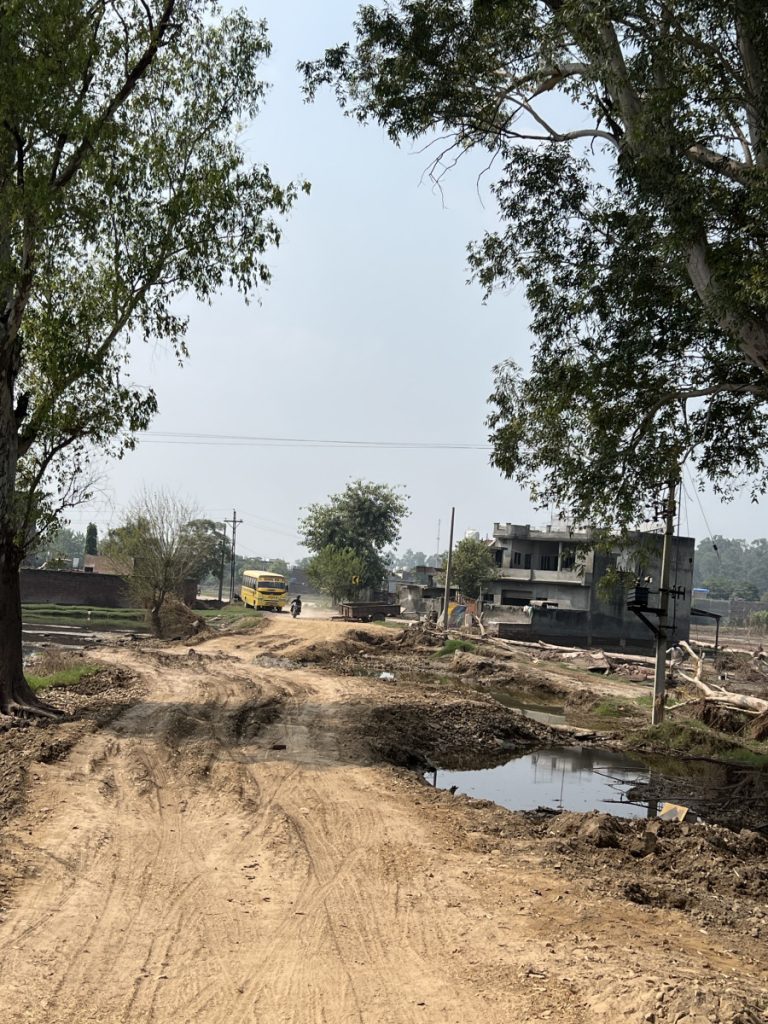
A washed away road and dust all around in Machiwala village, Amritsar. Photo: Kusum Arora.
Dilpreet is being helped by the Hoshiarpur-based organisation Pagdi Sambhal Jatta, which is assisting him in clearing his fields. In this group was Jatinder Singh Jhaur, a farmer from Bhaini Milwan village, also from Gurdaspur district, who despite having lost his 10 acres of paddy and sugarcane crop had reached Thetharke to help clear sand in the fields of other farmers.
“Everybody is in crisis and needs help. There are hundreds of people like me, who are on the ground despite their own losses. I have been volunteering right from first day of the floods,” he said.
Earlier, Baljinder Singh, the president of Pagdi Sambhal Jatta, had said that he had come with more than 50 youths on 25 tractors from Hoshiarpur to work in the fields.
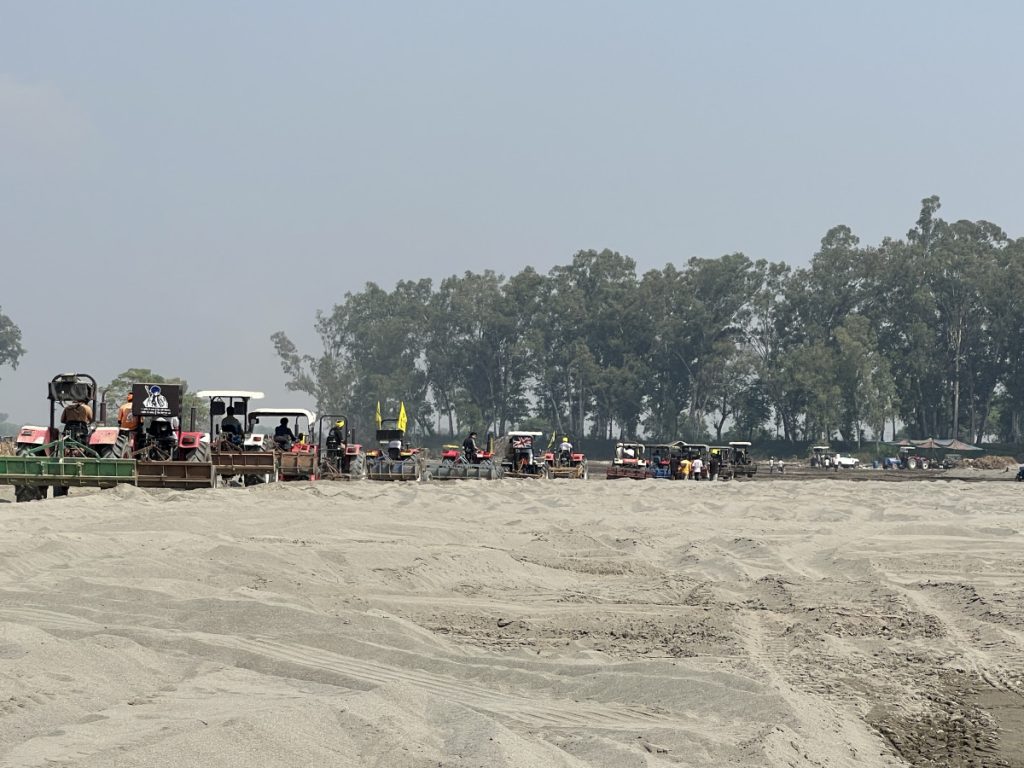
A cavalcade of tractors led by Pagdi Sambhal Jatta organisation from Hoshiarpur at Thetharke village in Gurdaspur district. Photo: Kusum Arora.
Massive damage at Indo-Pak border’s last village in Kartarpur Corridor
The Wire also visited the last village on the Indo-Pak border – Pakhoke Tahli Sahib at the Dera Baba Nanak town of Gurdaspur – where the aftermath of floods was massive. The famous Kartarpur Sahib corridor is situated just around three kilometres away from Pakhoke Tahli Sahib.
A major portion of the Indo-Pak border dividing Gurdaspur from Pakistan was washed away in the floods. The jawans of the last Border Security Forces post on Kartarpur Sahib corridor had to take refuge in Gurdwara Darbar Sahib in Dera Baba Nanak during floods. Around 30 kilometres of the physical Indo-Pak border has been washed away in the floods, affecting BSF check posts in the border districts of Gurdaspur, Amritsar and Ferozepur sectors.
The floods also ravaged Pakistan, leading to several deaths.
The border point at Pakhoke Tahli Sahib was inundated when this reporter visited. It had a 70-foot-deep and 482-foot-wide gap in it.
The extent of damage was such that Pakistan’s marooned fields were clearly visible from the village embankments. While farmer groups and social organisations tried to clear sand from their fields, BSF jawans could be seen keeping vigil on the exposed border point.
Councillor Gurnam Singh of Pakhoke Tahli Sahib village lost 15 acres of cauliflower crop. The region is famous for its all-weather cauliflower which is supplied to parts of Punjab and Jammu and Kashmir. Gurnam said his fields, like that of many others', were also covered by sand and silt. He was facing losses of around Rs 45 lakh.
Extracting sand from the fields was also a major expense in terms of diesel consumption, he shared.
“The work to clear sand from the fields started in our village on September 15. Within a fortnight, people have spent Rs 25 lakh on diesel alone. We are deeply thankful to Sikh organisations, volunteers from Dera Radha Soami Satsang Beas, people from Haryana, Rajasthan, and Uttar Pradesh, who stood shoulder to shoulder with us,” he said.

An embankment being laid at the worst-affected Machhiwala village in Amritsar district. Photo: Kusum Arora.
The Punjab government has launched a one-time ‘Jehda Khet, Ohdi ret’ scheme, under which farmers can extract and sell the sand accumulated in their fields. “We are clearing sand from the fields but there is no clarity as to when it will be lifted. We also have no idea that how the farmers would get compensation for the same," Gurnam added.
Another farmer, Naseeb Singh, from the same village, said that his nine acres of agricultural land was buried under sand. “Once the sand is cleared, we will have to spend at least Rs 3 lakh per acre to prepare the fields to make it cultivable,” he shared.
Houses washed away, terraces and walls have cracks
If it is a race against time for farmers, it was even more difficult for labourers and those from the financially weaker sections to restart life with few resources.
At the worst-affected Ghonewal, Machhiwala and Ramdaas villages of Amritsar, the situation was grim. Almost every second house was either broken or has developed cracks in walls, terrace, and floors.
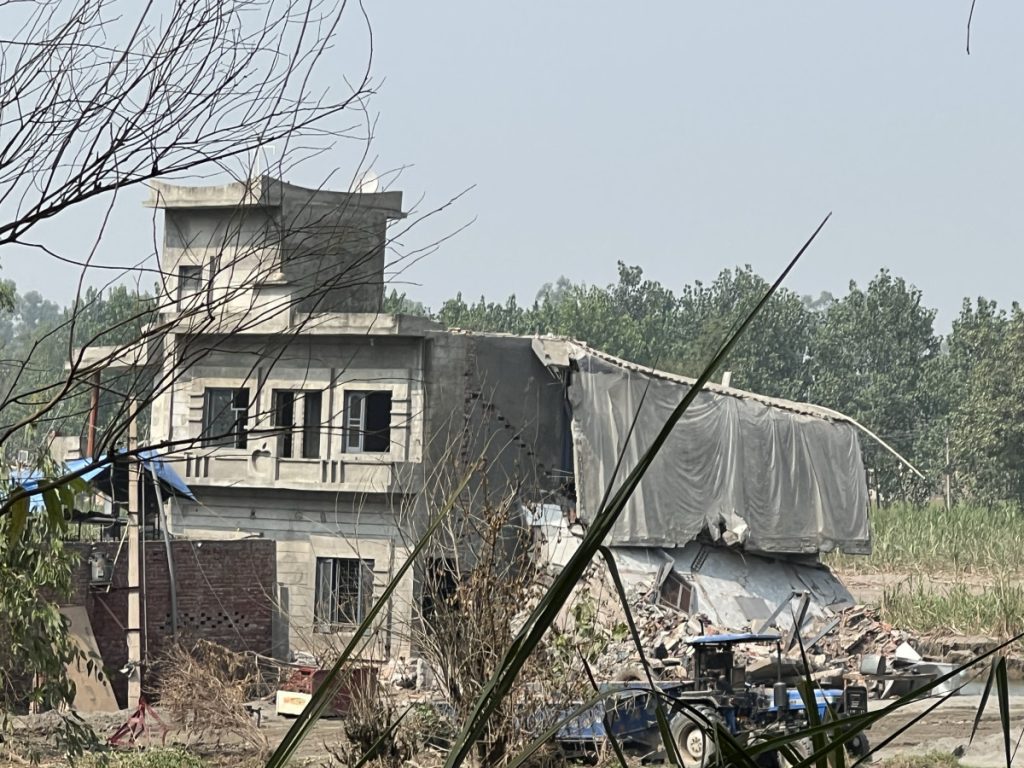
A badly damaged house in Ghonewal village. Photo: Kusum Arora.
Road connectivity is badly hit too. Most of the roads have been washed away while lanes are chocked with dust as work to lay embankments is going on at full speed. The cattle sheds have been washed away in the floods, leaving villagers with no option but to tie their cattle in the open.
Sulakhan Masih, a farm labourer from Ghonewal village told The Wire that he was dependent on rations and essentials donated by various organisations.
“The walls and the terrace of my house were lying broken and the rooms were filled with silt. My cow was also swept away in the floods,” he said, adding that he used to earn a living by spraying pesticides in the fields but that source of livelihood is gone now.
Sulakhan said that as his house was situated in the middle of the village, he and his family were stuck on the terrace of his house for the first three days. “I also lost a cart, which I had made just a few days before the floods. Now, I spend my day standing at the intersection of Ghonewal and Machhiwala villages in search of some work,” he said.
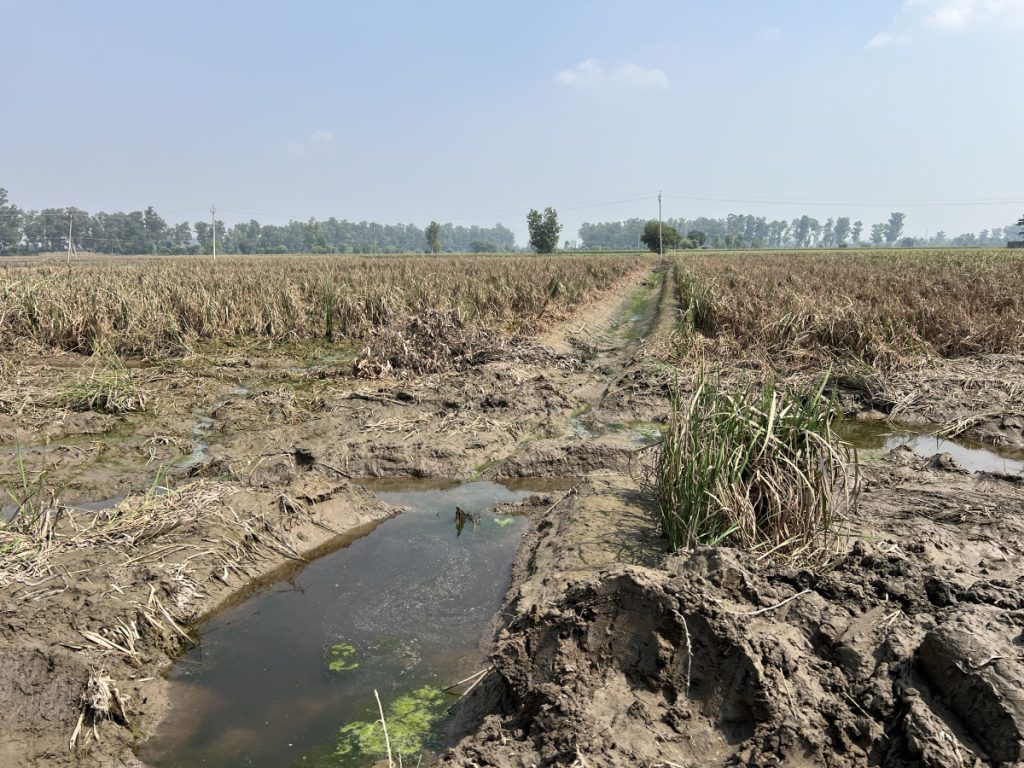
Damaged paddy crop at the severely hit Ghonewal village in Amritsar district. Photo: Kusum Arora.
Malkit Singh, a farmer from Machhiwala spoke of how the tiles of his floor caved in at his newly constructed house. “The boundary wall of my house also got washed away,” he said.
While Malkit rushed his wife and kids to his in-law’s house in Amritsar, he could not get to his buffaloes. “I left my house in a car and came back on a boat. For three days, my eight buffaloes were in stuck in flood water and survived without any fodder. I am thankful to the almighty that my cattle survived in the floods,” he said.
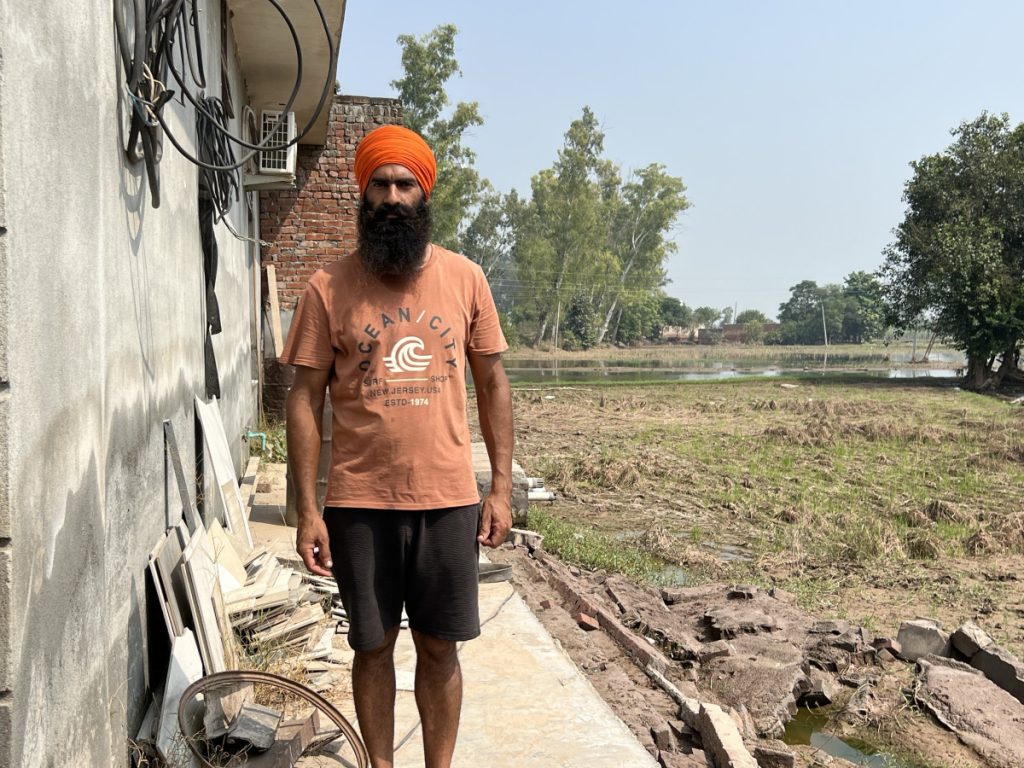
Malkit Singh standing in the backyard of his house, shows how the boundary wall was washed away in the floods at Machiwala village in Amritsar. Photo: Kusum Arora.
At Pakhoke Tahli Sahib village, most labourer families have been living in filthy conditions. Nearly, all the houses have a thick layer of silt in them. Residents have been keeping their belongings in tarpaulin sheds.
Showing a dumping site where most villagers had thrown away their damaged furniture, electronics, blankets, utensils and clothing, Nazir Masih and his wife Madhu said, “We are limping towards normalcy. It is like beginning life from the scratch.”
The couple thanked the Global Sikhs NGO headed by Amarpreet Singh and his team for giving them a brand-new refrigerator, washing machine, bed, and mattress.
Sabi Masih, another labourer, showed how a horizontal black line across all houses reflected where the water stood – 12 feet high. “We could not collect anything, no documents, no cash, or essentials. Everything was washed away and damaged within minutes,” he said.
Sabi said also got a bed, fridge, and mattress from Global Sikh team, but his house was completely damaged and he had to keep those at a relative's house, he said.
Raj, another flood victim from the same village, showed how the floods damaged her newly constructed house. “I constructed my house five months ago. Now, it has developed cracks while the silt has led to dampness in the rooms,” she said.
Showing the aftermath of floods, Gurnam Singh told The Wire that though no flood water entered his house but still the walls of his house and the floor had developed major cracks.
He said that following the floods, the water level has increased and that in turn has led to dampness in the soil. “Receding water level and sunlight exposure will further increase these cracks in flood affected areas,” he added.
From broken houses to dusty lanes, from fallen trees to damaged electricity poles, from marooned fields to disease infested livestock, life was seemingly on a pause for most in these villages.
The Global Sikhs NGO has been helping villagers in laying embankments, levelling fields, constructing houses, providing household essentials, and supplying medicines, rations and drinking water.
Union versus Punjab governments
Terming the Rs 1600-crore package announced by the Union government as minuscule in the wake of the massive loss, chief minister Bhagwant Mann on September 30 met Union Home Minister Amit Shah and demanded a special relief package for Punjab.
Mann said that 60 people lost their lives while more than 20 lakh people across 2,614 villages were affected. Around 6.87 lakh people were displaced because of floods, according to state government records. The devastating floods destroyed more than 4.8 lakh acres of crops and more than 17,000 houses were damaged.
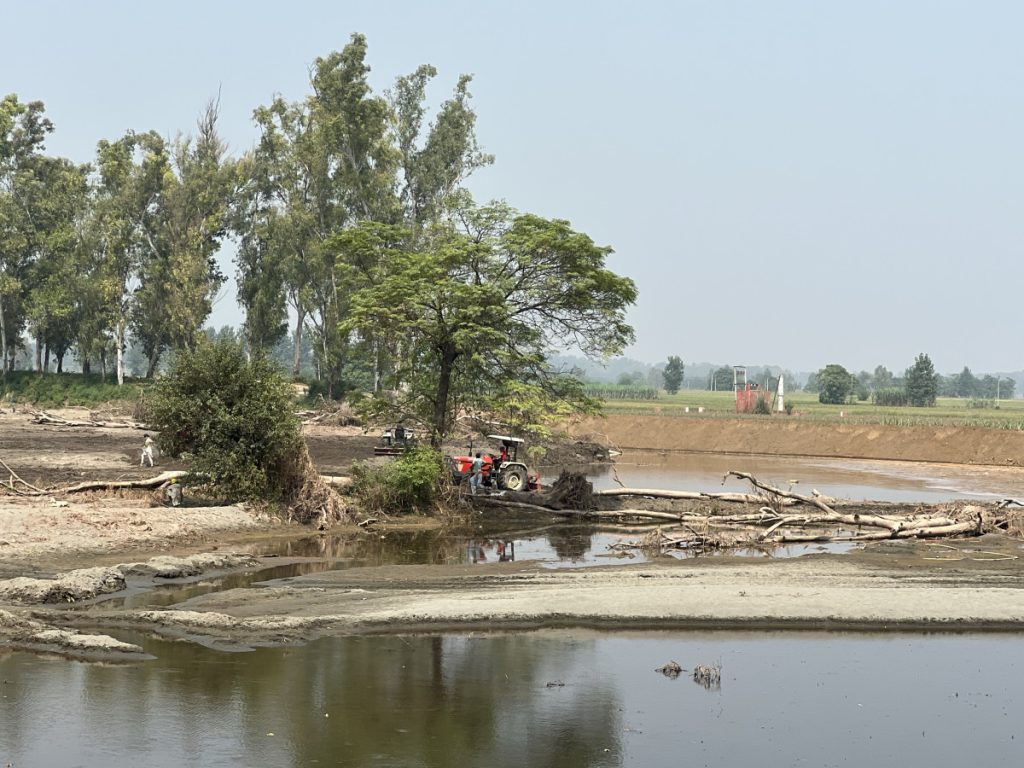
Standing flood water and broken trees in the badly affected Ghonewal village in Amritsar district. Photo: Kusum Arora.
He said that the floods affected over 2.5 lakh livestock while 4,675 kilometres of rural roads, 485 bridges, 1,417 culverts and 190 grain markets were damaged too.
The chief minister stated that the preliminary estimate of losses stands at Rs 13,800 crore and this amount was likely to increase more in the coming days. He also raised the issue of the Union government's pending share of Rs 11, 297 crore of Rural Development Fund and market fee.
However, a press statement issued by the Press Information Bureau (PIB) reveals that Union home minister Amit Shah told CM Bhagwant Mann that the State Disaster Response Fund (SDRF) has sufficient funds to the tune of Rs 12, 589 crores, which could be utilised for the relief and rehabilitation of affected people.
The press statement mentioned that out of the financial assistance of Rs 1,600 crore announced by Prime Minister Narendra Modi, Rs 805 crore has already been released to the state government intended beneficiaries under various schemes.
It also said that an Inter-Ministerial Central Team (IMCT) was constituted on September 1, 2025 without waiting for the receipt of memorandum from Punjab.
Further, Shah stated that the Union government team visited the affected areas for an on-the-spot assessment of damages in the state from September 3 to 6, 2025.
“However, the state government was yet to submit a detailed memorandum. After the receipt of the memorandum, the same will be considered by the central government as per the Government of India approved norms,” the PIB statement read.
This article went live on October third, two thousand twenty five, at sixteen minutes past six in the evening.The Wire is now on WhatsApp. Follow our channel for sharp analysis and opinions on the latest developments.


