

Interview: Joginder Ugrahan on the Importance of Popular Struggle and the Issues in Punjab


As village after village was visited by the political elite of the state of Punjab to make promises and appease the voters for February 20 (when their fate gets decided by the population of the state), the members of BKU (Ekta) Ugrahan – the largest Kisan union in Punjab – was busy preparing for its rally on February 17. The rally, held at dana mandi (grain market) Barnala, was a call to people to remind them the importance of struggle.
Ever since they returned from the Delhi protests, the organisation has been careful to time and again to warn the voters, especially those who participated in Delhi morcha, to not compromise on the ideals of struggle and weaken the unity which they had achieved during the year-long struggle at Delhi borders. During the past two months, whether it was to oppose Prime Minister Narendra Modi’s visit to Punjab on January 5, when thousands of farmers and labourers marched the streets of Sangrur, or on January 31 – to mark the day of betrayal announced by the Samyukt Kisan Morcha (SKM) – when the effigies of the Union government and Modi were burnt outside the district collector's office Sangrur, the kisan union has been standing true to its belief that no real change lies in electoral politics.
In a press conference on January 12 held at Press Club, Chandigarh, a few days after 22 factions which were a part of SKM decided to contest parliamentary elections in Punjab under a political front Sanyukt Samaj Morcha, the top leadership of BKU Ugrahan took the opportunity to explain to the people pf Punjab at large why they do not support the idea of farmers' unions contesting elections and why they themselves will not do it. In an hour-long press conference, Jhanda Singh Jethuka, Sukhdev Singh Kokhri Kalan and Joginder Singh Ugrahan lay out in detail the reasons for them to not contest elections and further explain how the political system is too vast and deep in itself to be changed by few good intentioned individuals.
“Electoral politics is divisive. During elections families get polarised, there is fighting on the ground over who will win and as the politicians try to woo voters whom they have not seen for the past five years,” Joginder Ugrahan said. While addressing the crowd at the lifting of the morcha at the Reliance Petrol Pump in village Kheri, Sangrur district, he narrated an anecdote, “When I was young there was campaigning in the village during elections. I asked my father who he will vote for. He said candidate Paramjit. I asked him his reasons for choosing this particular candidate over others. He said he will vote for Paramjit because he touched my feet. I was surprised.” The crowd began laughing.
Every election season in the state has been witness to different popular announcements, and buying votes with money or bottles of alcohol. But the contours of politics in the state are changing, and a reflection of it can be witnessed on the ground when many politicians who are holding smaller rallies are being questioned by the villagers over their agendas and how can they solve their real problems relating to agriculture, health, employment, education and overall governance.
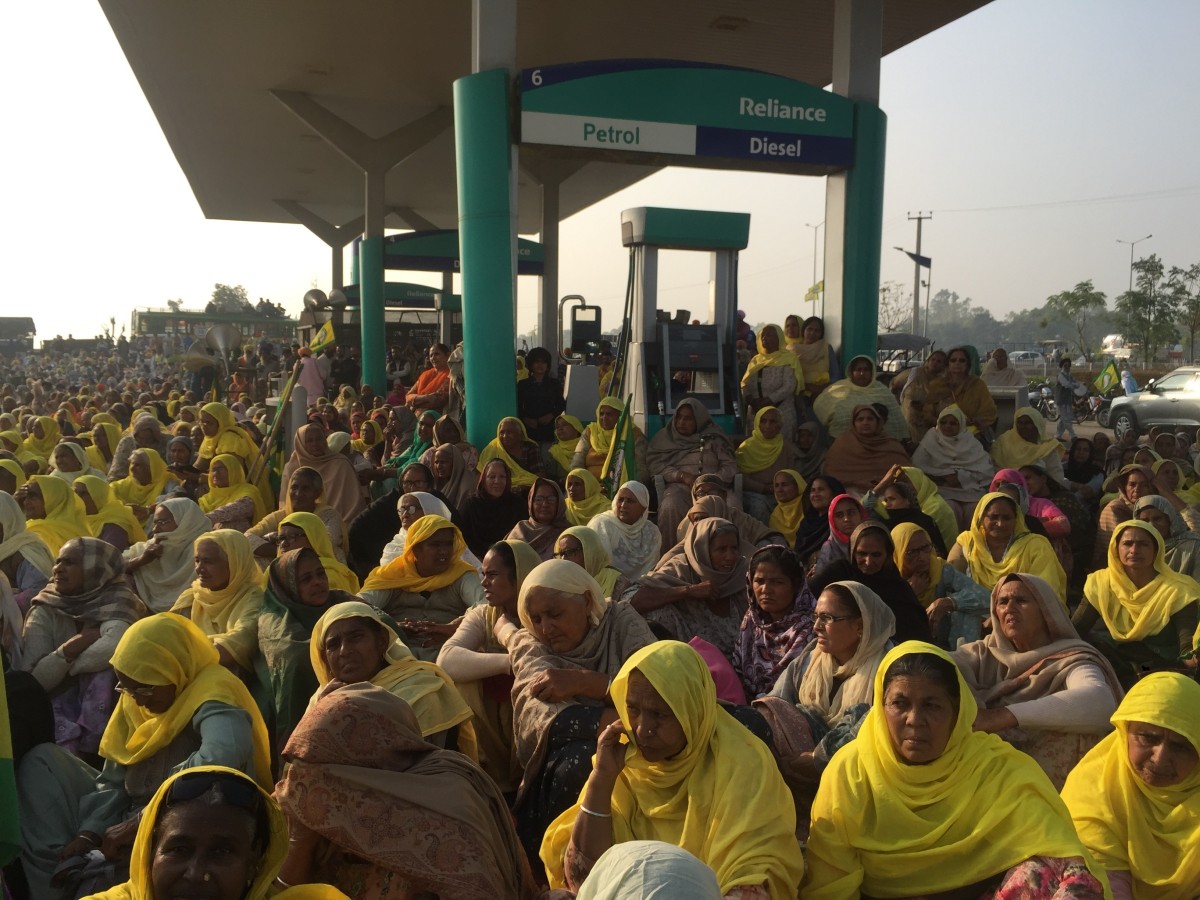
Crowds listen to Joginder Singh Ugrahan's speech at the Reliance Petrol Pump in village Kheri, Sangrur, the day of the morcha ending. The local morchas in Punjab at Reliance pumps, Adani units and toll plazas were mostly lifted on December 15, 2021. Photo: Novita Singh
The main issue still remains the drug menace and employment as many youth migrate abroad in the hope of securing a better future. This has been a cashing point for parties and even the chief minister of Delhi, Arvind Kejriwal, has been heard saying that the Aam Aadmi Party will send the youth abroad and bear the costs. But people do not want populist policies. They want jobs.
The role of organisations like the BKU (Ekta) Ugrahan has been massive in educating the rural population and bringing about a sense of awareness in them about the real issues that are the cause of their suffering. The new slogan coined by the group, ‘Votan di jhaak chhaddo, sangarshan de jhande gaddo (Stop looking for change in electoral politics, remain focused on the struggle)', urges people to remain true to their struggle.
Even organisations like the Lok Morcha Punjab and Krantikari Kisan Union led by Darshan Pal Singh have been holding rallies across the state to reiterate these very issues and say that if people want change, they should be prepared to struggle, because once the election season goes away so will most of these politicians, no matter how honest they sound right now. The believe the problem does lie not in this party or that, but with the system at large.
To understand and speak on this more, I visited Ugrahan village to have a conversation with Joginder Singh Ugrahan and understand what he thinks about the Sanyukt Samaj Morcha and their view that they can bring about a real change from top down by penetrating the system.
Edited excerpts from the interview:
The election season is on and there is lot of noise everywhere. The basic idea is of change and how to bring about change. There are two thoughts on this now – one believes that system can change by being in it and the other thought which is your organisations that to bring about any systematic change struggle is the only answer. What do you have to say?
There is a lot of noise and conversation over this – how can we change the system. These two ideas are there – one of struggle and the other of being in the system to change it. Also there is a third which says which political party to vote for and which will bring about change.
There is lot of conversation on social media and new channels over this – which party is more beneficial for the state. But none of the political parties are having any real conversations on any real issues. They are not saying how can they deal with this problem better than the other. They are just trying to put the other party down. What I see is just clamouring for power.
Their outlook is limited to pleasing voters and get them to vote for their party on election day. There is no talk about how they can bring about fundamental change in the lives of people. As for the voters, they are confused about who to vote for, whether to vote or not to vote. They want change but are unable to find a way forward. And therefore they find themselves in a trap and are feeling trapped within this limited thought. This is the conundrum of politics in Punjab at this time.
And we (as an organisation) look at this is as an opportunity to make people aware, to educate them and guide them and therefore try and remove people from this trap. To let them know that the system cannot change so soon. If we can know what our destination is, if we can know who our friends are, who our enemies are, who is the one in control of our destiny, who is looting our hard work, how will we get a better life, which are the organisations responsible for giving us a better life and who controls those organisations. Right now people are not aware about all these things. In the current scenario, votes are sold for money, alcohol and people run after these things. And people are often disillusioned.
Given the current way electoral politics functions and until our voters get to that level of awareness, I don’t think it is good for an organisation leading a people’s movement to get involved in electoral politics. We are not upset with them (SSM) that they are contesting elections, or why they are contesting elections or that it’s wrong for them to do it. When we started with the morcha, we were very conscious that if we want to make this mass movement strong, it has to stay away from active politics. And we succeeded in that. And this is our only complaint with SSM.
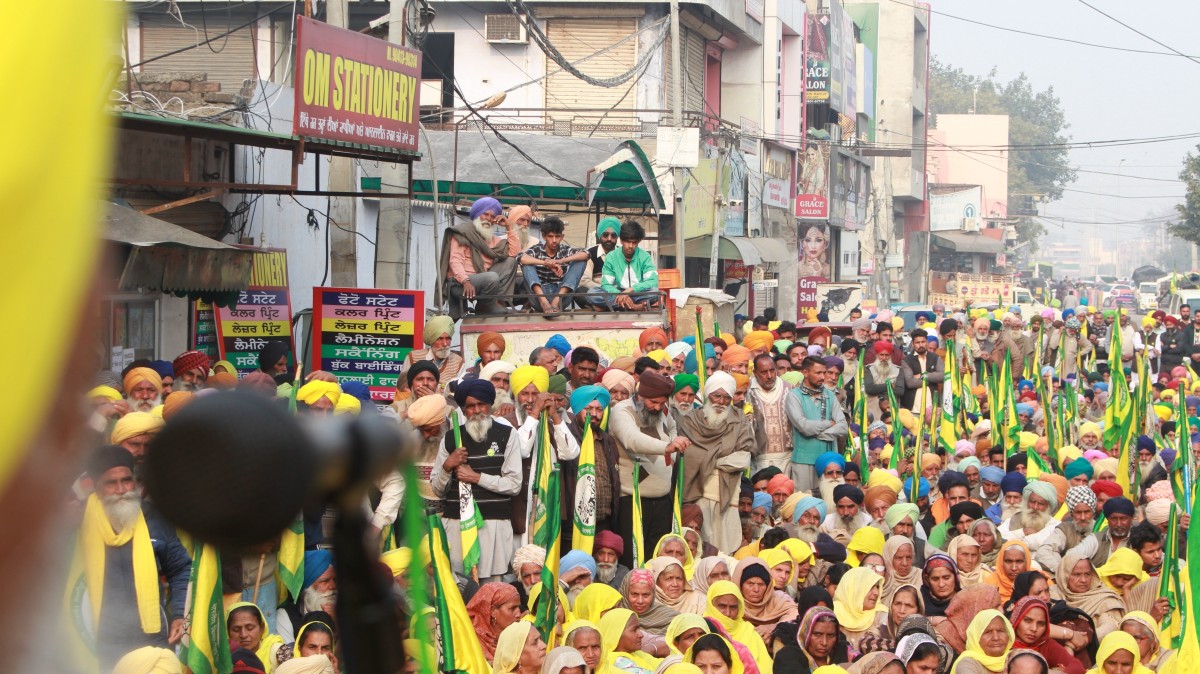
Farmers gather outside the DC's office Sangrur to mark the Day of Betrayal (as announced by SKM) on 31st January 2022. Photo: Novita Singh
But now unions have returned to Punjab after a big victory and people are very happy that they have succeeded in repealing the laws and are capable of bringing about a change. After all this, to go in the direction of electoral politics you think is correct? If they hadn’t won the morcha, it would have been different.
Firstly, let us understand that the morcha is not an absolute victory. We have won, there is no doubt in that, but we cannot say that it's an absolute victory. The morcha is not over. It is just suspended. And we all (other kisan organisations) understand this. We came back knowing that right now we have not been given a guarantee on MSP, that those responsible for the Lakhimpur Kheri massacre still remain unpunished, that the cases on the farmers in Delhi and other states are still not revoked. Even the compensation to the families of those who lost their lives has not been done. So we cannot say we have won the morcha completely.
Secondly, victory is not something we should be gloating over or be overjoyed with. These things come and go with time. The fact that people have become aware after the morcha, have started questioning political parties over their issues, have gained strength in themselves, is a start in the right direction. But we still need to work towards strengthening this aspect. What is a vote, how to use your vote, what kind of questions to ask the political parties and that their questions should reflect their reality. Until now did we ever hear people discussing WTO normally in villages? Did they ever discuss corporates or public sectors in daily conversations? The fact that they (the government) are selling off public sectors is a matter of conversation with people right now. They know that there is unjust distribution of resources, land and jobs.
Why is there unemployment, why is there financial stress, why are farmers committing suicides – people are now thinking about these things. It’s important to raise the level of discourse. This is the first struggle (Delhi morcha) which has made people aware. If our counterparts (SSM) wouldn’t have taken this step (to contest elections), then this morcha would have been a symbol of politics in India. The entire politics would have revolved around this morcha. This would have been a political power in itself and worked from the side as a massive pressure group on the government. It’s unfortunate that we couldn’t achieve this. But to think that it won’t be done or cannot be done in the future, that is also not true. This is like a hindrance and small hindrances often do come.
Why is this election of 2022 different from past elections? Why is it seeming different? The answer to this connects with the Delhi morcha. If these 22 kisan organisations had not formed SSM, the impact of (SKM) would have been different on the current election scenario. It would have also been different on the 2024 elections…This is what we think. It’s their democratic right to contest elections and we do not have an issue with that. It’s their right. Even if they want to make their entire organisation (kisan union) political, they can. But they should have made a separate political wing. To bring kisan unions into electoral politics, that we feel is wrong.
Novita Singh is an independent filmmaker and has been documenting the Kisan Andolan since November 2020 and now its political impact on state elections.
This article went live on February twentieth, two thousand twenty two, at zero minutes past four in the afternoon.The Wire is now on WhatsApp. Follow our channel for sharp analysis and opinions on the latest developments.


