

Mineral Imbalances, Metre-High Deposits: How Punjab's Deluge Has Altered Its Prized Soil


Jalandhar: The recent devastating floods have altered the foundation of Punjab's agriculture – its fertile soil known for enabling the bulk production of crops – by causing nutrient imbalances, the formation of a water-resistant layer and the deposition of red silt from the Himalayan foothills that has threatened productivity.
A study conducted by the Department of Soil Science at the Punjab Agricultural University (PAU) in Ludhiana of flood-affected soils across Punjab reveals that the deluge has reshaped the state's farmlands in complex ways.
The university conducted soil tests in flood-affected villages in Amritsar, Gurdaspur, Ferozepur, Kapurthala and Patiala districts.
PAU vice chancellor Satbir Singh Gosal said that Punjab's soil is one of the best in the world in terms of its fertility and yield.
“Soil is composed of major and minor minerals. While the major minerals include nitrogen, potassium and phosphorus, the minor ones include zinc, iron and magnesium,” he said.
“In case of the recent floods, though the incoming mountain soil from Himachal Pradesh was carrying minor minerals beneficial for crops, it has disturbed Punjab's native soil profile,” the VC said.
“The challenge now is to restore the soil's balance,” Gosal added.
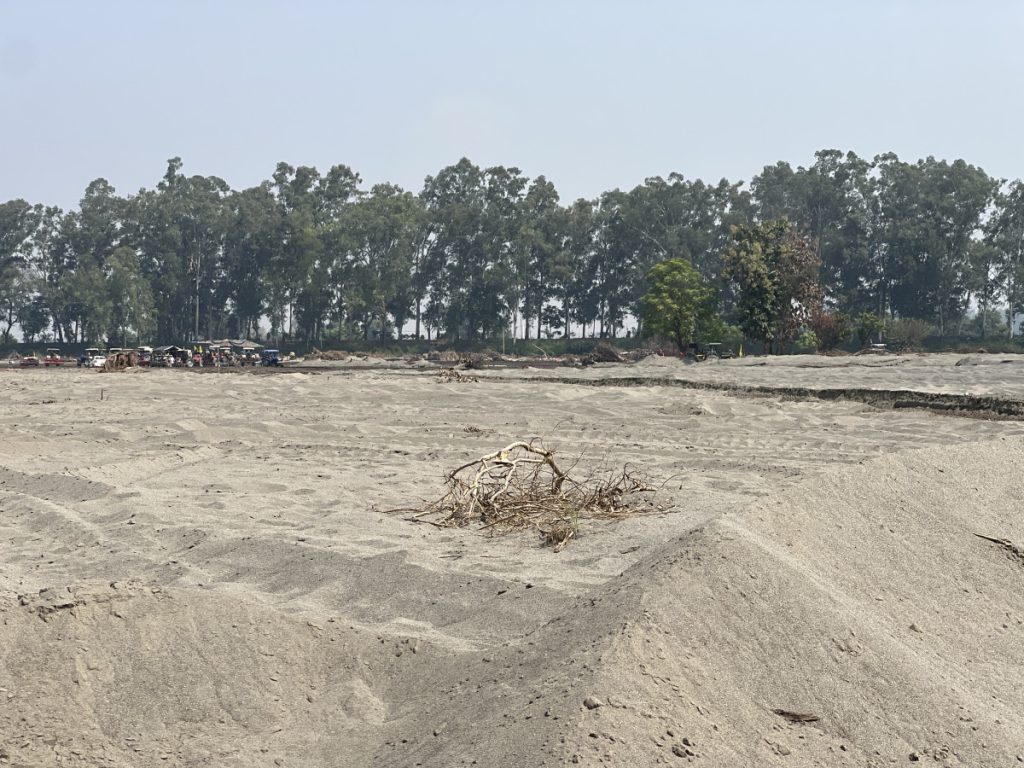
Sand, rising five to six feet high, has buried farmers' agricultural land in the flood affected Thetharke village in Gurdaspur district. Photo: Kusum Arora.
Further, the PAU study results showed large variations in soil sediment depth, texture and composition. While some fields were buried under sand and silt deposits exceeding one metre in depth, others had thinner layers deposited on them.
Soil texture ranged from sandy to fine and loamy, and pH values were found to be alkaline. Electrical conductivity was low in general, indicating no major threat of salinity, per PAU.
The Wire had visited villages in Gurdaspur and Amritsar districts that were ravaged by an overflowing Ravi River and found heaps of silt and sand lying on farms.
Nearly every village in these districts was buried under four to five feet of deposits, while an overflowing Ravi River had broken embankments and created pits as deep as 100 feet in the ground.
“We have been clearing sand from our fields for the past fortnight and the extent of loss is massive. Even if the sand is removed, we will have to either add earth or leave our fields for some time after spraying fertilisers to help the soil regain its nutrients,” said a group of farmers at Thetharke village in Gurdaspur district.
Many social organisations and independent groups from Punjab, Haryana, Rajasthan and Uttar Pradesh volunteered to clear sand from the farmers' fields and make them cultivable.
“We are deeply thankful to the volunteers and social groups for standing shoulder-to-shoulder with us. Had we been dependent on government aid, we would have been ruined by now,” Dilpreet Singh, a farmer, had told The Wire at Thetharke village.
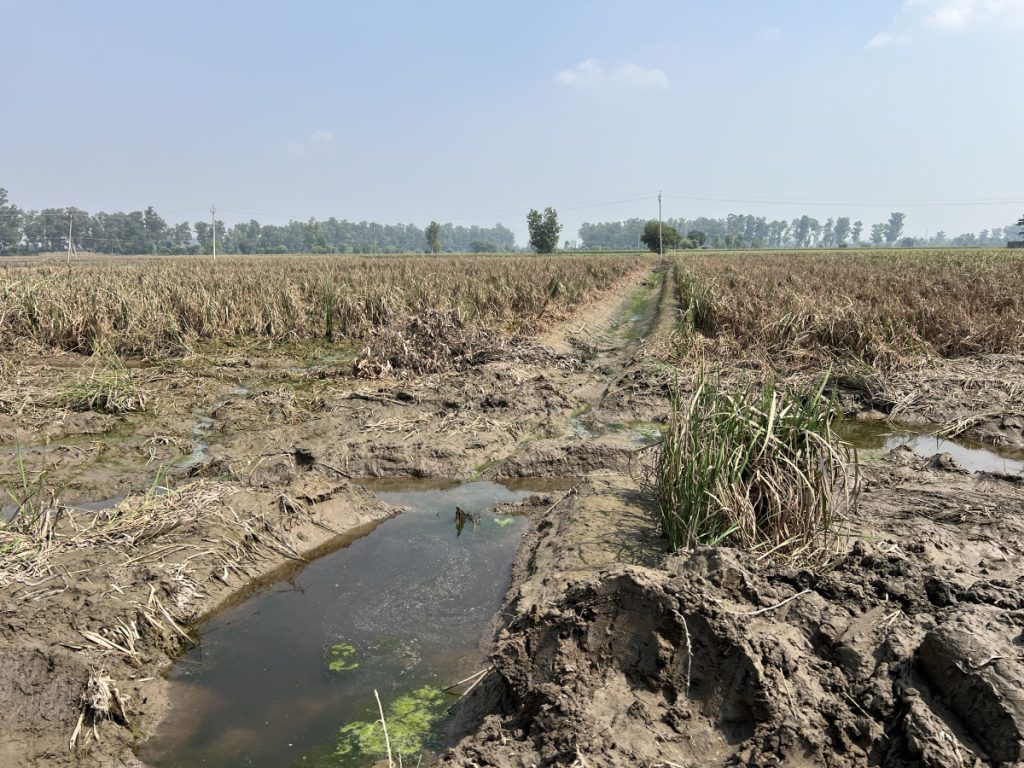
1. Damaged paddy crop at the severely hit Ghonewal village in Amritsar district
Similar was the condition of Kapurthala, Ferozepur and Fazilka districts, where mounds of silt had covered farms, leaving farmers in distress.
Around five lakh acres of agricultural land has been affected because of the floods in Punjab.
Principal soil chemist Rajeev Sikka from the PAU's Department of Soil Science said that five teams took samples from 50 metre, 100 metre, 500 metre, one kilometre and five kilometre-radiuses of flood-affected areas.
“We have issued an advisory for soil health and handed over the same to the deputy commissioners concerned. Farmers should get their soil tests done free of cost at PAU, at the local krishi vigyan kendras of the university in the state or through Markfed [Marketing Federation] laboratories to improve the quality of soil,” he said.
According to Sikka, the organic carbon content of the soil they tested was high, averaging above 0.75% as compared to the 0.5% usually seen in Punjab.
In some samples, it was more than 1%. “However, areas with heavier sand deposition recorded lower carbon content. Phosphorus and potassium levels varied, while micronutrients like iron and manganese were found in much higher concentrations than normal,” he said.
He noted that the elevated iron levels could be from iron-coated sand particles brought to the plains by floodwaters.
“We are also suggesting farmers to stick to organic manure apart from fertilisers to increase the nutrient content of the soil. Organic manure accelerates the growth of earthworms, which in turn will help create channels in the soil, thereby allowing water infiltration and retention,” he added.

An aerial view of an area partially submerged in Patiala district on September 4, 2025. Photo: PTI.
Another suggestion, he noted, was that farmers should bury stubble within their fields, which he said is a time-tested formula for improving soil fertility.
Sikka said that PAU has also submitted a report to the State Disaster Relief Fund seeking a Rs 5-10 crore grant for further studying the deeper impact of the floods.
“The PAU along with Thapar University, Patiala, and the Punjab Remote Sensing Centre would jointly work on this study, as floods are becoming a recurring event in Punjab. Earlier, Punjab witnessed floods in 2023 but the scale of loss at that time was less. However, these floods have been the worst since 1988. It is important to study the factors [behind] and the impact of floods,” he said.
Supporting PAU's demand, Sarwan Singh Pandher, a farmer union leader of the Kisan Mazdoor Sangharsh Committee, Amritsar who has been on the ground for flood relief work, said that the Punjab government should raise this matter with the Union government.
“After all, the PAU's study would help farmers and improve the state's agriculture. The Punjab government should ensure that PAU receives the grant at the earliest”, he said.
PAU research director Ajmer Singh Dhatt disclosed that surface and subsurface ‘hardpans’ – which are layers of soil that can obstruct water infiltration and root growth – had developed in a number of places due to sediment compaction.
As a remedy he advised the deep tillage of heavy soils with a chisel plough in order to restore their porosity, while for lighter soils he said deposited silt and clay should be mixed thoroughly to prevent layering.
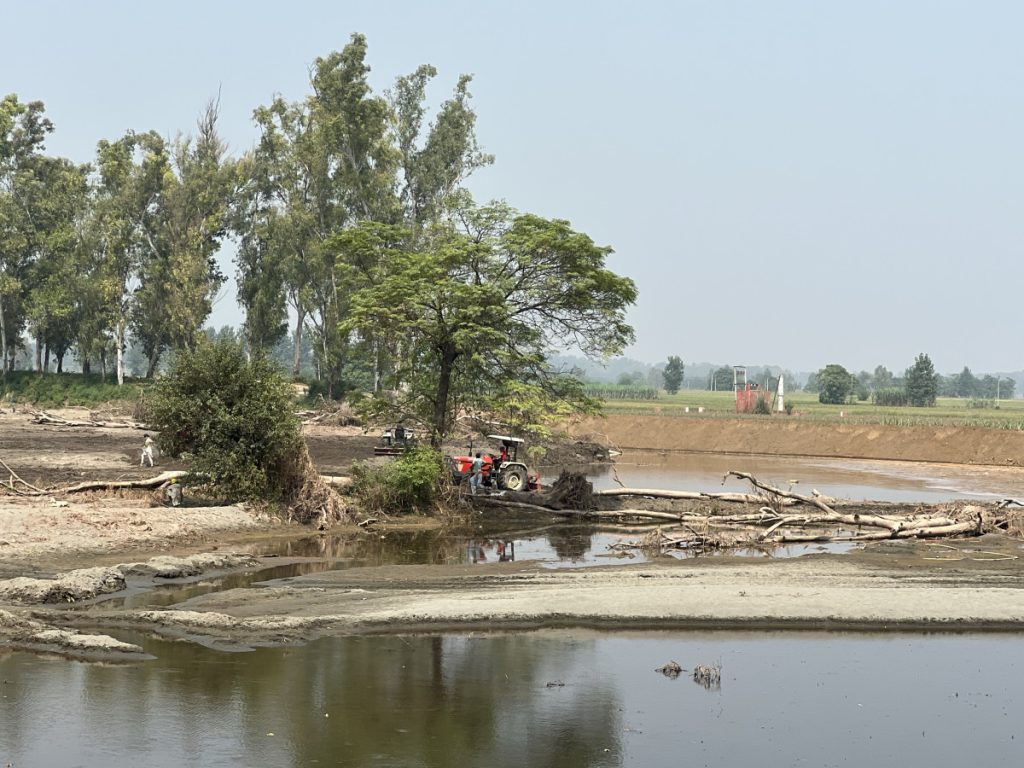
Standing flood water and broken trees in the badly affected Ghonewal village in Amritsar district. Photo: Kusum Arora.
Makhan Singh Bhullar, director of extension education at PAU also urged farmers to integrate organic matter into the soil. “Farmyard manure, poultry manure and green manure can help rebuild soil structure, stimulate microbial activity and support healthy root systems,” he said.
Further, for the rabi season, PAU has advised farmers to follow the university's recommended fertiliser doses and apply a 2% urea spray (which is prepared by dissolving four kilos of urea in 200 litres of water) for about 40 to 50 days after sowing to enhance growth.
“In wheat and berseem crops, manganese deficiency should be watched for; if symptoms appear, a 0.5% foliar spray of manganese sulphate (0.5% solution of manganese sulphate in 100 litres of water per acre) is recommended and [should be] repeated after a week,” the university shared.
Gosal remarked that the floods may have disrupted current and upcoming cropping cycles but that “timely soil management can turn the setback into an opportunity”.
“With coordinated testing, targeted nutrient management and community-level extension support, PAU aims to help farmers rebuild the fertility and resilience of Punjab's farmlands,” he said.
This article went live on October tenth, two thousand twenty five, at thirty-six minutes past eleven at night.The Wire is now on WhatsApp. Follow our channel for sharp analysis and opinions on the latest developments.


