

'Have You Seen This?': When M.S. Swaminathan Appeared on TIME Magazine


The following is an excerpt from M.S. Swaminathan: The Man Who Fed India, by Priyambada Jayakumar.
‘Sir, have you seen this?!’ A flustered staffer at the M.S. Swaminathan Research Foundation, burst into Swaminathan’s light-filled and airy office at the institute, now in its eleventh year, breathlessly waving a magazine copy in the air.
‘Seen what?’ asked the soft-spoken Swaminathan, buried deep within a pile of papers on his enormous desk.
‘This ... sir ... please … look,’ replied the staffer barely able to speak, both out of breathlessness and out of genuine excitement. ‘Please sit, catch your breath and have some water first. I can barely hear you.’
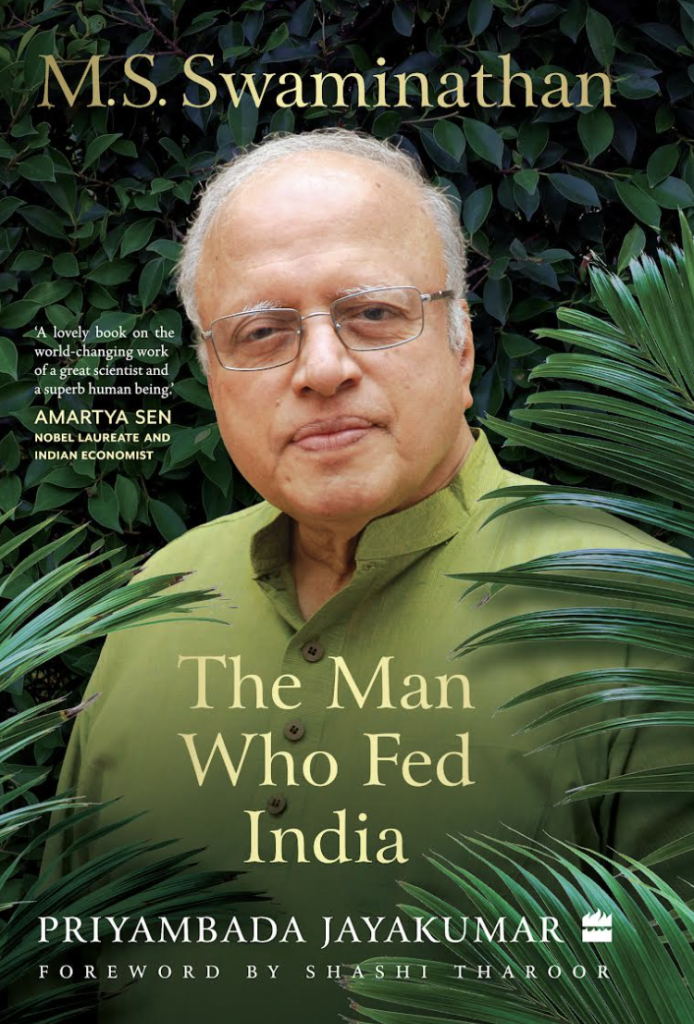
MS Swaminathan: The Man Who Fed India, Priyambada Jayakumar, HarperCollins India, 2025.
‘You … sir,’ the flustered young staffer was still a bit breathless, ‘are one of only three Indians … to be featured in this prestigious list of the Most Influential Asians of the 20th century!’ The pride and emotion in the young man’s voice was unmistakable.
‘Really! Who are the other two and what’s the magazine again?’ a clearly unflustered Swaminathan asked, looking bemused at the fuss his young colleague was making.
‘Mahatma Gandhi and Rabindranath Tagore are the only other Indians on that list apart from you, sir, and this is TIME magazine … a special double edition,’ said the young man.
‘Mahatma Gandhi and Rabindranath Tagore?’ a clearly startled Swaminathan enquired.
‘Yes, sir. Please see for yourself.’
For once, the usually quick-witted Swaminathan was clearly lost for words. He had grown up idolising both Gandhi and Tagore. He stared at the cover thoughtfully for a few seconds, the modest black-and-white photograph of Mahatma Gandhi that always stood on the table behind him adding a quiet poignancy to the entire conversation.
TIME magazine wrote gushingly about Swaminathan:
‘The seeds planted today by farmers from Punjab to Pusan are nothing like those used by their ancestors. If they were, the entire continent would either be starving or enslaved to the outside world for food or financing. That turn of history, one of the truly astonishing transformations of the century, is now known as the Green Revolution. It relied heavily on the work of a diminutive Indian geneticist named Monkombu Sambasivan Swaminathan. As godfather of the Green Revolution, Swaminathan, 74, is modest about his own achievements but forthright about his work’s impact on his native land and the planet Earth. Our history, he says, changed from that time. Swaminathan, together with colleagues in India and around the world, managed in a few short years to demolish the dire Malthusian worldview that was so prevalent, and pertinent, four decades ago. Asia’s populations were growing uncontrollably. None of the largest countries was self-sufficient in food. China lost as many as 30 million people to famine from 1958 to ’62 during and after the Great Leap Forward, and postwar India lived a ship-to-mouth existence, subsisting on foodgrains imported from the U.S. Too many mouths, ever more pregnancies, the same farmers growing the same crops– something had to give. Instead of tragedy, though, a miracle was born in the mid-’60s at Swaminathan’s laboratory in New Delhi – and, a few years later, at the International Rice Research Institute in the Philippines which he later headed. Swaminathan brought into India seeds developed in Mexico by U.S. agricultural guru Norman Borlaug and, after cross-breeding them with local species, created a wheat plant that yielded much more grain than traditional types. Scientists at IRRI accomplished the same miracle for rice. Imminent tragedy turned to a new era of hope for Asia, paving the way for the Asian economic miracle of the 1980s and ’90s. As with all great revolutions, though, the seed was but the starting point. Swaminathan combined all the great components of a revolutionary: vision, dedication, energy and follow-through’.
Still clearly taken aback, Swaminathan handed the magazine back to his young staffer, ‘Thank you for sharing this with me,’ he replied softly.
‘But this calls for a celebration, sir,’ the young man protested. ‘Us continuing with our work is celebration enough.’
Swaminathan smiled gently, seeing his enthusiastic colleague off at the door.
It was all in a day’s work for Swaminathan who is likely the most decorated Indian internationally by any standards in modern-day India. And the write-up in TIME magazine was but part of a mile-long list of national and international acclaims, awards, policy positions and honorary doctorates that had steadily been bestowed upon this modest, shy and unassuming scientist throughout his stellar career.
Never one to be swayed either by excessive praise or cowered by trenchant criticism, his work always spoke loudest for him and was undoubtedly his first priority. His greatest achievement, if you ever stopped to ask him, was always the same—a genuine acknowledgement that the farmers of India and indeed, Asia, considered him as one of their own. That, to him, was his biggest reward and his greatest decoration of all time.
Swaminathan’s achievements, list of awards, honorary doctorates and honorary and nominated positions held on various national and international committees, councils and organisations would likely require a separate chapter in itself! The data is simply overwhelming and is an ode to a long life lived well, lived righteously and purposefully.
Priyambada Jayakumar has studied history at St. Stephen’s College, social and political sciences at Cambridge University and has attended Harvard University for a further period of study. She has lived variously between Delhi, London and Boston.
This article went live on August seventh, two thousand twenty five, at zero minutes past eight in the morning.The Wire is now on WhatsApp. Follow our channel for sharp analysis and opinions on the latest developments.


