

Despite RBI Move, Some Indian Banks Risk Skipping Coupon Payments


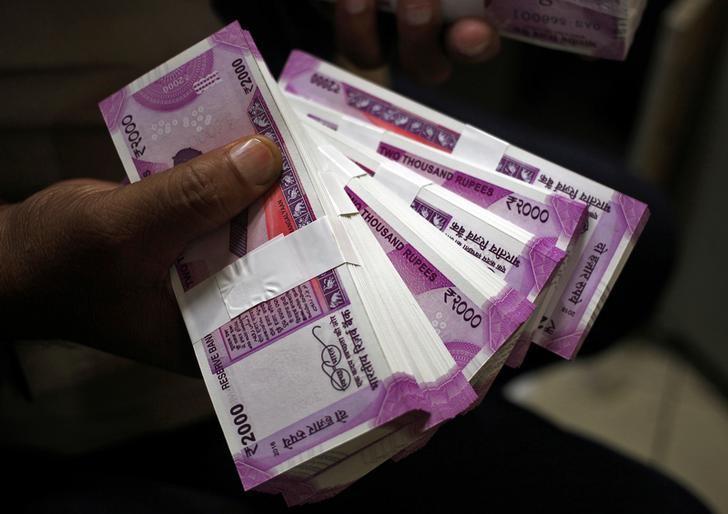
A cashier displays the new Rs 2000 banknotes inside a bank in Jammu, November 15, 2016. Credit:Mukesh Gupta/Reuters/File photo
Some Indian banks are at risk of skipping coupon payments on their capital instruments despite recent easing of rules by the central bank and capital injection by the government into state-run lenders, Fitch Ratings said on Thursday.
Mid-sized banks are the most at risk of breaching capital triggers, the agency said. A Fitch analysis showed total capital adequacy ratio of 12 banks was at or below the minimum 11.5% required by the year to March 2019 to enable coupon payments on both legacy and Basel III additional tier 1 (AT1) capital instruments.
There are 11 banks with common equity tier 1 (CET1) ratios at or below the minimum 8% that will be needed by March 2019 to make coupon payments on the AT1 instruments, Fitch said.
India's banks have been burdened by a surge in bad loans and falling profit, increasing their capital needs. About two dozen state-run lenders, which dominate the country's banking sector, account for bulk of the bad loans and their capital position is weaker than their private-sector rivals.
Fitch previously estimated that the sector would need about $90 billion new capital by March 2019 to meet the global Basel III rules.
(Reuters)
The Wire is now on WhatsApp. Follow our channel for sharp analysis and opinions on the latest developments.


