

The Song That Encapsulates the 'Afsana' of 1947


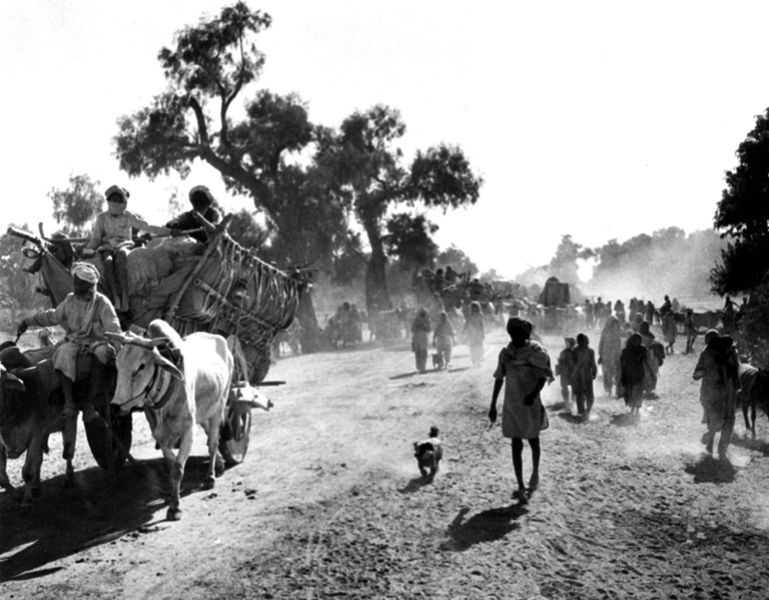
1947: Afsana Likh Rahee Hoon
Afsana likh rahee hoon
Dil e beqaraar ka
Aankhon mein rang bhar ke
Tere intezaar ka
Lyricist: Shakeel Badayuni
Music: Naushad
Singer: Uma Devi
Film: Dard
Time froze, in the meltdown that was 1947. The British packed their bags and rolled out, back to Blighty. And a dawn of unbelievable possibilities broke out in India.
A luminous morning that promised the bright light of freedom did not come without its shadows. The clouds hovering above may have been darker than what India's founding fathers had hoped for. They carried in them the agony of Partition, the pain of separation as the country was divided into two nations: India and Pakistan. But the phrase 'the empire on which the sun never sets' got a fitting burial, well after dark on that day in August.
Yes, 15 August 1947 did spell Freedom in several languages: Swatantrata, Azaadi, Sudandiram, Swadhinata. It was no Russian Revolution and India's transformation would be stuck with the label of being a social democratic one. But there was little to be sanguine about that day.
It was a new day and a new way.
'Afsana likh rahee hoon' is arguably the most memorable melody of 1947, it is hummed – with a familiar ring to it – even today. It is anything but easy to pick a song that tells or encapsulates the 1947 story. Events headier and more surprising than a Bombay blockbuster were unfolding in real time in the subcontinent. The afsana (story) of India itself would begin to unfold this year. And what a start it got too. In August, Mahatma Gandhi and Khan Abdul Ghaffar Khan were in Calcutta trying to stop the communal mayhem and Jawaharlal Nehru was in Delhi. Each hoping to cement the idea of a modern India amidst all the turmoil – both together, yet apart.
So – midwifed in both agony and hope – did India's afsana get under way.
Uma Devi (better known as Tun Tun, perhaps the first comedienne of Hindi cinema) sang the words of Shakeel Badayuni to the music of Naushad in the film Dard. She wanted to be an actress. Having lost her parents early, she ran away from home, landed at Naushad's door and insisted he secure her a break. He said he could not make it work for her as an actress, but sensing that she could carry a tune, he suggested playback.
Shakeel Badayuni, who was to become known as one of Bombay's finest lyricists, had just arrived in the city in 1946. Naushad was also new at the trade and scoffed at in early reviews. But Dard went on to become a huge hit.
Coming from the stable of Kardar Studios, directed by the well-established A.R. Kardar, Dard was what you might call a 'Muslim social' with two women in love with a doctor and one woman (played by the beauteous Suraiya) eventually, dying. A.R. Kardar, apart from being a phenomenon himself in film terms, would be spoken of in many conversations later: the first cricket Test captain of neighbouring Pakistan was his brother, and another brother, whom he cast as the star in Dard, migrated to Pakistan too. In many ways, the Kardar story itself is the story of twinned yet partitioned brothers.
Seema Chishti, Sushant K. Singh and Ankur Bhardwaj
Note By Note: The India Story 1947-2017
HarperCollins, 2018
Despite the turmoil, it is a wonder that so many Hindi films were made and Hindi film songs continued to be popular. The year was about both hope with the shaking off of the imperial yoke as well as bloodshed and mayhem that the division of the land brought about.
This was the year when the music colossus K.L. Saigal died, marking the end of an era. His last film Parwana was released in that year. Mohammed Rafi started his climb, with his first hit in Jugnu with Noor Jehan – 'Badla wafa ka'. Soon after recording her songs for Jugnu, Noor Jehan left for Pakistan – marking another big milestone. Geeta Dutt started her rapid ascent to stardom with her songs for Do Bhai.
India, in 1947, was buzzing at an unbelievable pace; in the middle of a 'tryst' and a churn that was to shake its core.
The previous year had seen relations between the Congress and the Muslim League break down almost completely. The interim government with Jawaharlal Nehru as prime minister and Liaquat Ali Khan as finance minister was not working. The British Cabinet Mission continued discussions, and in February 1947, the British prime minister Clement Attlee announced that British rule would end by June 1948.
It was the appointment of Lord Louis Mountbatten – the cousin of the King Emperor – as viceroy with more autonomy than his predecessor Lord Wavell, that further (and alarmingly) speeded up things. In June 1947, Lord Mountbatten announced the agreement of a formula whereby the date for the transfer of power to two successor states was brought forward to 15 August 1947. 'Ten weeks would suffice for the constitutional, social, military and infrastructural vivisection of a subcontinent' as historian John Keay put it sardonically.
The Indian Independence Act, 1947, passed by the British Parliament on 4 July 1947, reads: 'As from the fifteenth day of August, nineteen hundred and forty-seven, two independent Dominions shall be set up in India, to be known respectively as India and Pakistan.'
Lord Mountbatten's picking of an early date, 15 August, historians point out, was prompted by his own personal history. Mountbatten later claimed, as quoted in Freedom at Midnight: 'The date I chose came out of the blue. I chose it in reply to a question. I was determined to show I was master of the whole event. When they asked had we set a date, I knew it had to be soon. I hadn't worked it out exactly then – I thought it had to be about August or September and I then went out to the 15th August. Why? Because it was the second anniversary of Japan's surrender.'
The separation of India and Pakistan had a human cost of catastrophic dimensions, being the largest exodus in human history involving ten million people. At least one million died. Much is made of the 'unfinished business' of Kashmir, but little attention is paid to how much else was botched up as the British packed their bags.
International boundaries were not made available by Sir Cyril Radcliffe's Boundary Commission till 17 August, two days after 15 August. The hurry with which the British decided to depart from India is clear in how Radcliffe came to India only on 8 July 1947, with just five weeks to make sure that two commissions, one for Punjab and the other for Bengal, drew their lines. But boundaries in hearts and heads were firmly etched by then and people fled in fear, whether they wanted to or not.
A ceremony in Karachi was overseen by Muhammad Ali Jinnah, the Quaid-i-Azam (supreme leader) of the new country on 14 August. Lord Mountbatten attended, flying back for the Indian event on the night. Interestingly, Pakistan, officially for a few years, was okay with acknowledging that 15 August was when it too got its freedom – postage stamps issued as late as July 1948 bear witness to that. But later, anxious to be seen seceding from British India and not independent India, it advanced its Yaum-e-Azadi to 14 August. In India, its first prime minister gave his most memorable 'tryst with destiny' speech 'at the stroke of the midnight hour' and heralded the dawn of freedom. His calm articulation of the idea of India and the importance of the moment in world history was to be among the first steps that he took to situate India boldly on the world stage.
While the entire country was on fire, Punjab and Bengal, being actually partitioned, bore the brunt of the violence. Art, fiction and cinema were to echo the pain for generations. Whether in Sadaat Hasan Manto's stories, Bhishm and Balraj Sahni's recollections or in Ritwik Ghatak's memorable scenes from Meghe Dhaka Tara or Khushwant Singh's Train to Pakistan, the sense of loss was felt and expressedly so, as the full import of 1947 dawned on both India and its new neighbour.
Film-musically speaking, two other notable events took place this year. In the grimness that 1947 represented, 'fun and frolic (too) were legitimised', as author Ganesh Anantharaman puts it, when C. Ramachandra composed 'Aana meri jaan Sunday ke Sunday' for Shehnai. And Lata Mangeshkar, the voice that would go on to sing for four generations at least, went on to find her feet in Bombay, with her debut for Hindi films in Aap Ki Sewa Mein.
The Wire is now on WhatsApp. Follow our channel for sharp analysis and opinions on the latest developments.


