

A Requiem to Democracy or a Beacon to Save It?


Electoral democracy may not be overthrown with a bang – it can be dismantled methodically from within, using the very institutions meant to uphold it. A century ago, Fascism in Europe demonstrated how democratic systems can be subverted under the guise of legality and national renewal.
In Italy, Benito Mussolini rose to power through a parliamentary route in 1922, invited to form a government despite his Blackshirts’ violence in the streets. Once in office, Mussolini gradually stripped the parliament of power, passed emergency laws, crushed opposition media, and outlawed political dissent – all the while maintaining the appearance of constitutional legitimacy.
 Similarly, Adolf Hitler was appointed Chancellor of Germany in 1933 through lawful democratic means. He quickly exploited the Reichstag Fire to push through the Enabling Act, which gave him dictatorial powers, dissolved democratic institutions, and established a one-party totalitarian regime. In both cases, fascist leaders used the electoral mandate not to serve democracy but to extinguish it.
These historical precedents remain deeply instructive. They show how democracies can fall – not by rejecting elections, but by rendering them meaningless through concentrated power, propaganda, legal manipulation, and manufactured consent. Contemporary regimes that deploy mass surveillance, criminalise dissent, and delegitimise opposition while holding periodic elections bear the spectral echo of that earlier descent into authoritarianism. We see this process unfolding in India over many years but very clearly since 2014.
The book under review – The Dismantling of India's Democracy 1947 to 2025 , (Speaking Tiger, June 2025) – written by Prem Shankar Jha, one of the most celebrated commentators on Indian politics, explicates this process, tracing its roots to the beginning of the post-colonial state in 1947 [p.33] to the present times.
The foundational flaw
One of book's diagnostic arguments about the erosion of India’s democracy starts with the failure of successive governments to deliver the three basic pillars of good governance: economic security, rule of law, and accessible justice. This chronic failure, worsening over decades, created fertile ground for the rise of an alternative vision of nationhood – one that rejected pluralism and sought to recast India as a ‘hard’ Hindu nation-state in the image of Europe’s unitary states, rooted in the glory of ancient dynasties. [p. 33]
A central failing of what is often called ‘Nehruvian democracy’ was its inability to ensure secure employment, particularly for the youth. Today, over 83% of those between ages 15 and 30 in the labour force remain unemployed. Justice remains elusive; law and order are crumbling, especially in rural India. The legal system is in collapse: with over 50 million pending cases, it could take 120 years to clear the backlog. Even industrial disputes, which move faster, suffer delays.
In Chapter 4, titled Where Did India Take the Wrong Road?, its answer is unequivocal: “At its very birth.” The Constitution, drafted in 1948–49, assumed that India already had a functioning democracy that merely required universal franchise. This assumption led to two critical omissions that now haunt the Republic.
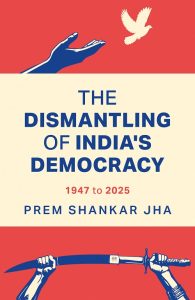
The Dismantling of India's Democracy 1947 to 2025, written by Prem Shankar Jha, (Speaking Tiger, June 2025). Photo: https://speakingtigerbooks.com/
First, the Constitution made no provision to finance the political system, distinguishing it from administrative functioning. Second, it created no mechanism to hold the bureaucracy accountable – an oversight inherited from colonial indemnity clauses in the Government of India Act, 1935, which shielded officials from civilian action. Here, curiously Jha excludes the political leaders that are fountainhead of the bureaucratic discontent. [p. 46]
While the book identifies two foundational flaws in the Constitution – the absence of state financing of elections and the lack of administrative accountability to the people – it does not go far enough. The deeper problem lies in the ruling elite’s intent to preserve the colonial state structure within the new Constitution. The real culprit, then, is not just how elections are financed, but the very choice of the electoral system itself.
The Constituent Assembly adopted the first-past-the-post (FPTP) system inherited from the British, whose only virtue is its simplicity. Conceptually, democracy should ensure representation of all citizens in decision-making. FPTP fails to do so. Even in a two-candidate contest, the losing side – often nearly half the voters – gets simply excluded. Worse, electoral outcomes can be strategically manipulated, enabling a candidate to win with a small minority of total votes.
Even state-financed elections would not have resolved this flaw. FPTP incentivises tactical victories and does not eliminate money power. A real alternative lay in the Proportional Representation (PR) system, which the book briefly mentions but does not foreground. PR is adaptable and more democratic. In systems like the Party List model, that it refers to, voters cast ballots for parties, which then allocate seats in proportion to their vote share – ensuring every vote translates into representation.[p. 48]
To illustrate, BJP’s vote shares in the 2014, 2019, and 2024 general elections were 31.0%, 37.4%, and 36.6%, yet its seat shares were 51.9%, 55.8%, and 44.2% respectively. This distortion allows a party to rule with a parliamentary majority despite lacking popular support – an outcome impossible under PR. In a PR system, opposition parties would gain seats proportional to their vote share, preventing the kind of unchallenged autocracy that now we see today.
Many members in the Constituent Assembly proposed PR, but it was rejected. Economist D.R. Gadgil had revealed that the Congress opposed it because it wanted a single-party strong government at the centre. This self-interest is not unique. The British themselves ignored the Royal Commission’s 1910 recommendation for PR for similar reasons. When ruling parties decide the electoral rules, they tend to favour systems that preserve their own power.
PR, combined with state-financed elections, could democratise representation, reduce manipulation, and limit the corrosive role of money in politics – outcomes FPTP cannot achieve.
The absence of any provision to prosecute civil servants is indeed a foundational flaw – one that has not only remained unaddressed but has been worsened by a spate of draconian laws and the creeping fascisation of the state. The police already exercise sweeping powers under the Code of Criminal Procedure, 1973 – now further intensified by the new Sanhitas BJP brought in.
Why did the framers of the Constitution allow such a gap? The answer lies in the intent of the postcolonial elite: while they upheld the appearance of democracy, they were unwilling to devolve actual power to the people. This aversion ossified over time into a stable alliance between politicians and the police – mirroring the fusion of the Executive and Legislature – a structural flaw that was inherent in politicians heading the administration as ministers.
In 1967, when Indira Gandhi banned corporate donations to political parties – ostensibly to curb corporate influence, but more plausibly to starve opposition parties of funds, the book contends, the power shifted to regional leaders, who turned to mobilising funds from a wide base of small traders, contractors, and informal enterprises.
Over time, these networks devolved into alliances with criminals and gamblers [p. 61]. While earlier Congress-era policies – such as land reforms and the Green Revolution – had already fostered a petty bourgeoisie with growing agricultural surplus, it would be reductive to blame the degeneration of democratic politics solely on these dispersed sources of funding, the “anonymous moneybags”. The real structural driver was the logic of the same FPTP system, which incentivised patronage and rent-seeking.
These financiers inevitably demanded returns on their investments, morphing popular democracy into a clientelist regime. A related outcome was the entrenchment of political dynasties, as regional elites consolidated ties with moneyed interests. The book thus charts a trajectory of political decay –characterised by the criminalisation of politics and the consolidation of a predatory state that feeds off the very poor it claimed to serve.
Advent of fascism in India
Chapter 8 explores the economic roots of fascism in India. Between 1970 and 1973, Indira Gandhi’s government broke its last ties with big business, entrenching a protectionist economy dominated by a handful of favoured cronies and political intermediaries. By 1984, India’s industrial landscape resembled pre-fascist Germany and Iran under the Shah – marked by xenophobia toward foreign capital and a stifled, dependent intermediate class. At this stage, however, a key fascist element was absent: the alignment of this class with a militant nationalist force. [p. 144]
Ironically, Rajiv Gandhi’s partial liberalisation in 1985 along with a series of political blunders – overt emphasis on KHAM (Kshatriya, Harijan, Adivasi, Muslims)-like caste blocks, reversal of Shah Bano judgement with constitutional amendment, opening of the locks of Ram Lalla temple at Babri mosque, leaning towards Hindu majority – triggered that shift. Without adequate transition time, India’s small and medium manufacturers – the ‘Mittelstand’ – faced decline, much like Germany’s during the 1930s. In search of new protectors, they turned toward the RSS and its Swadeshi Jagran Manch, which then postured as a resistor to economic liberalisation. [p. 144]
By the 2000s, nearly all preconditions for Hindutva’s fascist transformation were in place, except for one: a mass of disaffected foot soldiers with no stake in the status quo. This cadre emerged from the social churn caused by industrialisation, urbanisation, and globalisation. The arrival of colour television played a significant catalytic role in breaking the cultural isolation of rural India. TV beamed glamourized mythologies like Ramayana and Mahabharat to reignite pride in the Hindu past and also urban lifestyles, sex and violence – recasting identity and grievance into potent ideological material. [p. 147]
Yet, the BJP remained electorally marginal until it aggressively embraced the Ram Mandir issue in the wake of Mandal Commission reservations. Its fortunes surged with Advani’s Rath Yatra, and its Lok Sabha tally jumped from just 2 seats in 1984 to 85 in 1989. Meanwhile, the RSS was steadily expanding its grassroots presence, particularly among the sections of marginalised communities overlooked by mainstream parties.
Its silent yet strategic focus on education resulted in a vast network of Vidya Bharati schools – over 16,000 by 2003. Through these schools, the book estimates, around 400,000 ideologically influenced youth were entering the electorate annually for nearly two decades. Many of these students became the foot soldiers of the Sangh Parivar. Particularly notable are RSS-run military schools, such as the Bhonsala Military School in Nashik, which has been linked to several violent attacks by Hindu extremists. [p. 148]
The Narendra Modi factor
Chapters 9–14 traced how Gujarat became the laboratory of the Hindu Rashtra, where Indian fascism took concrete shape under Narendra Modi. Modi, trained in the RSS ideology from early childhood and groomed later as its pracharak, developed himself into a flamboyant and ambitious personality. Worming his way up the BJP’s hierarchy, he got himself chief minister’s post in politically beleaguered Gujarat in October 2001, dislodging senior leader like Keshubhai Patel.
He would not have passed through the next elections in 2003 to confirm his post. The burning of the Sabarmati Express’s S-6 coach on 27 February 2002 at Godhra – killing 59 passengers, projected as kar sevaks – altered the course of his as well India’s history. The ensuing anti-Muslim pogrom, with clear state complicity, transformed Modi into a Hindu hero. There was no looking back since then.
Consolidating power, Modi established himself as a populist autocrat. Whenever his popularity flagged, police killed alleged Muslim terrorists in staged encounters – 21 such killings occurred between 2003 and 2006 [p. 216]. He perfected propaganda during his Gujarat tenure, projecting the state as a ‘development model’ – a claim as fabricated as the encounters themselves. His biennial Vibrant Gujarat summits wooed Indian and global capital with promises of deep concessions, winning big business to his side.
Modi was hugely helped by the internal problems of the Congress that headed a coalition – United Progressive Alliance (UPA) – government at the centre, since 2004. It did splendidly well in its first term. While the economy, averaged 8.3% growth between 2003–04 and 2011–12, it faltered during UPA II, likely due to the shifting of the power centre to Rahul Gandhi, a political novice. Despite a decade-long average of 8% GDP growth, employment began stagnating post-2011 due to droughts and a high-interest-rate policy.
The resulting massive joblessness – 30 million educated youth never entering the labour market, and another 40–50 million giving up looking for work – created a vast pool of disillusioned youth, forming a reservoir of frustration from which the Sangh Parivar began drawing its fascist storm troopers. This disorientation of the Congress party provided a platter of opportunity to Modi as it continues to do for his current sustenance in power.
The RSS exploited the vulnerabilities that emerged during the UPA II government, conjuring and amplifying corruption cases through its extensive network within the state. The business backing to Modi catapulted him to be the BJP’s prime ministerial candidate in 2014. Modi in his characteristic style personalised the campaign foregrounding his Gujarat model and projecting himself as a developmental leader with slogans like sabka saath, sabka vikas, carefully keeping his communalism under cover. But once in power he began centralising control and unleashing his storm troopers to deepen communal polarisation for further consolidation.
He took complete control of the state apparatus, strengthening the PMO (Prime Minister’s Office) with his loyal bureaucrats mostly drawn from Gujarat. The cabinet was reduced to his echo chamber, just implementing the orders received from the PMO. He installed his men at the helm of all institutions and tamed their hierarchies into submission. Modi turned to silencing civil society dissent, creating a terror wave by arresting journalists, intellectuals, and rights activists across India and incarcerating them using draconian laws like the UAPA.
Political opponents were hounded through the PMLA and made to either join the BJP or rot in jail. He created a paradigm where none could question him and operated like an emperor, spending unprecedented amounts on publicity. A 2018 study noted that under Prime Minister Atal Bihari Vajpayee, the central government spent just Rs. 9.3 crore annually on self-promotion. In contrast, during its first three full years (2015–2018), the Modi government spent Rs. 3,807 crore – a more than twentyfold increase even after accounting for inflation [p. 279].
Alongside, he launched a slew of populist schemes accompanied by high-decibel propaganda, which endeared him to the masses. Ruthlessly focused on power, he adopted unscrupulous electoral strategies – buying opposition legislators, engineering defections, and splintering rival parties. Exploiting a disoriented and divided opposition, he steadily expanded his dominance in successive elections. He discarded every constitutional constraint with disdain and transformed the parliament as a quasi-military extension of his political will.
By the 2019 general election, Modi had firmly established himself as an unassailable populist strongman. The successive elections reinforced his convictions that the masses could be swayed by well-oiled propaganda, even based on pure lies.
His aggressiveness knew no bounds. His narcissistic ambition sought to erase historical legacies and inscribe his own imprint everywhere as though nothing existed before he came to power. The Central Vista project is standing testimony for his profligacy and megalomania. Whatever he did, masses appeared to uphold and applaud him.
Yet, in the 2024 elections, he had a brush with defeat. Just an indicative coming together of the opposition into a INDIA block, rattled the well-oiled election machine Modi built over the decade. Shaken but not out, he managed to retain power by buying off support from regional parties with massive central allocations.
Simultaneously, he moved to entrench his position by manipulating electoral processes. The Election Commission, now handpicked under a revised law by him, was allegedly complicit in altering voter rolls and skewing electoral outcomes. The post-2024 assembly elections in Maharashtra were marred by allegations of such manipulation, and Bihar is now witnessing unrest over the controversial Special Intensive Revision (SIR) of voter lists ahead of its state elections. It is going to fortify his rule unless the judiciary thwarts his moves and the opposition gets its acts together.
A wakeup call to people to save democracy
The book reads like a requiem to democracy in parts and also a wakeup call to people to save democracy. It is well structured to trace the degeneration of Indian democracy right from its constitutional foundations and rich in data surrounding key events and analytical insights, though may not be agreeable to all.
Most importantly, amid the pervasive atmosphere of fear and repression, it presents the author’s perspective with boldness and intellectual integrity. A compelling read for those who wish to understand what has happened – and continues to happen – to their country.
Anand Teltumbde is former CEO of PIL, professor, IIT Kharagpur, and GIM, Goa. He is also a writer and civil rights activist.
The Wire is now on WhatsApp. Follow our channel for sharp analysis and opinions on the latest developments.


