

A Selection of Rabindranath Tagore’s Wide Variety of Work, All Collected in a Single Volume


Rabindranath Tagore was a many-sided genius, who dominated the cultural landscape of Bengal during the late 19th and early 20th centuries. His output was prolific, flowing through poetry, song, novels, short stories, plays, essays and paintings. A century later, his work still stirs the hearts and minds of Bengali-speaking people across the world. However, Rabindranath was much more than a Bengali poet. He belonged to India. His writings embody a deep knowledge of Indian history, civilisation, culture, philosophy, and traditions. As a public intellectual, he addressed major social and political issues of his time. As an educationist, he established rural schools and also the Visva Bharati University as an “international centre of humanistic values”.
Tagore wrote mainly in Bengali, and his work spanned many genres and thousands of pages. Though translations exist, the wide range of his work has not been accessible in a compact form to non-Bengali readers. A new book, The Best of Tagore edited and introduced by Rudrangshu Mukherjee, presents a diverse selection of Tagore’s work, in English, collected in an elegant volume of about 800 pages. The book contains selected short stories, a novel, plays, essays, poems written for children, songs, and poetry. A few of the pieces were originally written in English by Tagore or were translated by him. But the majority is translations by other authors that have been published earlier.
The introduction by Rudrangshu Mukherjee provides a short biography of Rabindranath Tagore (1861–1941). A well-researched table details the main personal events in each year of Tagore’s life. It also lists the major literary publications by other authors and the major historical events that occurred in that year. This provides a valuable backdrop for understanding the man and the context of his work.
In his early twenties, Rabindranath travelled extensively in East Bengal (now Bangladesh), managing his family estates. This exposure profoundly influenced his creativity and social conscience. Tagore was moved by the beauty of nature. He also observed the difficult lives of ordinary people. These themes found expression in many of his famous short stories and poems.
By 1905, Rabindranath became politically active. He opposed Curzon’s plan to communally divide Bengal. Tagore supported the ‘swadeshi’ movement but rejected the use of coercion to enforce the boycott of foreign goods. Nationalism became a recurrent theme in his writing. By 1906, he advocated initiatives for improving the welfare of the villagers. In his own family estates, he established free health centres, primary schools, adult education classes at night, and also a rural bank to fight moneylenders.
The depth and variety of the writings included in this book provide a comprehensive exposure to Tagore’s creative endeavours from different phases of his life. However, one may ask: Why read Tagore today? Is he relevant to our life and times? From this perspective, Rabindranath’s writings can be broadly classified as follows: (a) Those that do not belong to any era; (b) Those that reflect a particular historical period and society; and (c) Those that address grand themes like civilisation, nationalism and philosophy.
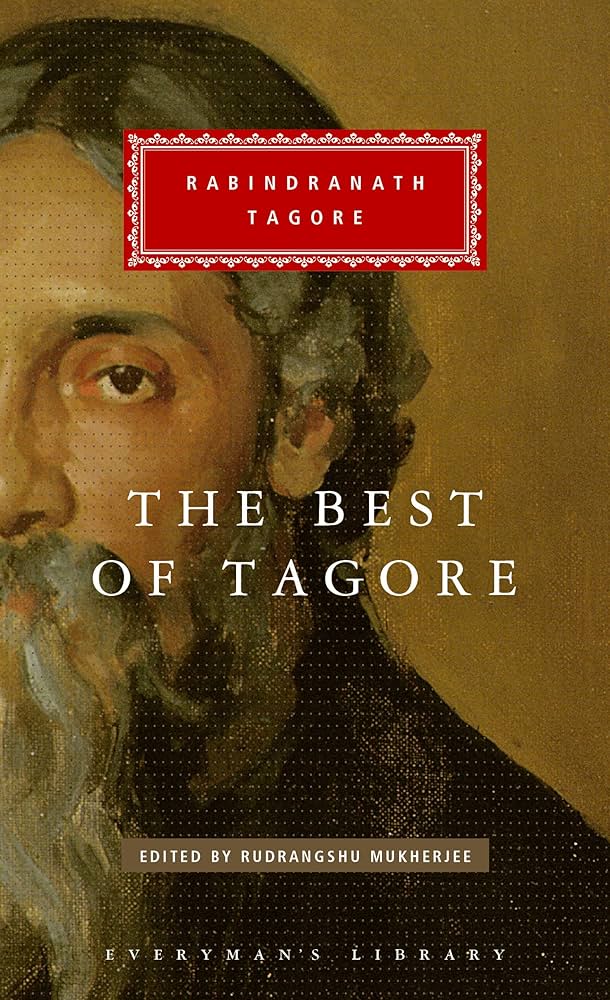
The Best of Tagore
Edited by Rudrangshu Mukherjee
Everyman's Library, 2023
The songs and poems belong to the first category. Tagore’s songs are of exquisite lyrical beauty and their themes (love, nature’s beauty, the changing seasons, prayer, sorrow and hope) transcend time and place. Tagore composed over 2200 songs. He said that many of them arose in him spontaneously. The book contains the translations of 30 of his best-known songs. Of all his writings, however, the songs are the most difficult to translate. In the original, the words and music blend magically. Their beauty transports the listener to another plane of awareness. It is extremely difficult to convey the subtle nuances and emotive content of these songs in English. Hence, it may be a good idea to provide web links to the original songs that are available online. Readers of the translated lyrics would appreciate them more fully by hearing them sung.
There are 46 poems in the book. They are powerful and beautiful. Their themes vary. I will comment on a few to convey their flavour. ‘The Spring Wakes from Its Dream’ is famous. It records the poet’s actual spiritual experience in his teens, which awakened the fountain of his creativity. ‘I Won’t Let You Go’ is a poignant poem about a little daughter’s reluctance to let her father leave. The poet sees in the little girl’s cry a reflection of the eternal contest between love and inevitable farewell that resonates through all creation. Some poems are patriotic. ‘Now Turn Me Back’ highlights the poet’s role in a time of political struggle. The poet must sacrifice for the cause. He “must walk life’s thorny path silent, alone, patient through joy and grief.” In the iconic poem ‘Where the Mind Is Without Fear’, Tagore articulates his vision for independent India—free and fearless, independent yet open to the world, grounded in truth and justice, and shunning petty divisions. In ‘Pilgrimage to India’, Tagore sees India’s grand civilisational role as a great unifier of humanity. On India’s sacred shore, the poet says, down the ages successive waves of different races have arrived. India has absorbed them all and unified them. Her inclusive mission, to forge a common humanity, still continues. ‘The Flying Geese’ (Balaka) is profound. Beside the Jhelum River, in the hushed twilight—the immense silence is suddenly broken. A flock of geese streaks across the evening sky. The sound of their fluttering wings transports the poet spiritually. He perceives the universal longing in all creation to merge with the infinite. There are many more poems here to delight the reader.
In the second category are his short stories, plays and novels. This volume contains seventeen short stories. A few, like Kabuliwallah, The Post Master, and The Hungry Stones have inspired award-winning movies. These stories reflect the social conditions of Bengal in that period. Tagore’s keen power of observation, his sympathy for ordinary folk coping with life’s difficulties, his depiction of the social relations between master and servant, of the rigidity of social customs paint a vivid picture of rural life in late 19th century Bengal. In many of the stories, the central characters are girls and women who confront social obstacles. ‘The Ghat’s Story’ is about a sweet young girl, Kusum. She is married off as a child, is widowed early and returns to her village. But after the disgrace of widowhood, as she grows to be a beautiful woman, there are no options for her to experience normal emotions. ‘The Post-Master’ is about a young, orphaned girl. She works as a domestic servant for an urban young man who is appointed a postmaster in her village. He is lonely and a misfit in rural society. The two form a sweet, innocent, almost brother-sisterly friendship. He starts teaching her. She takes care of him when he is ill. However, when he leaves the village, the power of the social barrier between them becomes apparent. The simple girl’s human feelings are real, but his attitude remains fundamentally transactional. ‘The Living and the Dead’ is a strange tale about a young widow, who lives with her relatives. She loses consciousness and is mistakenly presumed dead. Her cremation is delayed inadvertently. She wakes up alone and escapes unnoticed from the unlit pyre. However, when she finally returns to her relatives, she finds it impossible to convince them that she is actually alive. The story reveals that identity and status are socially conferred.
‘The Little Master’s Return’, portrays the feudal relationship. Raicharan is a devoted servant in a wealthy household. He has served the young son of the family since latter’s childhood. The young man eventually becomes the head of the family, marries and has a son. Raicharan is asked to look after the zamindar’s little son. He does so with love and zeal. Unfortunately, the child drowns accidentally while in his care. Raicharan departs for his village. Soon, he has a son of his own, but loses his wife. He brings the child up like a ‘little master’. Having exhausted his resources, Raicharan finally takes the boy to the zamindar’s home and claims that he had abducted the zamindar’s child. His story is believed. The young boy is accepted by the zamindar, but Raicharan is kicked out.
Some stories cast a critical eye on the behaviour of the urban wealthy class. ‘The Patriot’ exposes the hypocrisy of a ‘patriot’ who boycotts Western cloth and wears khaddar but refuses to help a sweeper who is being thrashed for accidentally touching an upper caste individual. ‘The Laboratory’, published in 1940, is a critique of urban, wealthy Bengal society. The characters push against traditional boundaries and customs. Tagore is candid in his description of sexuality, seduction, inter-caste, inter-community and extra-marital relationships. The society is amoral, decadent, and commercially driven, in which the characters are cunning, manipulative and dishonest. Tagore criticises the contemporary Bengali male through the personalities of key characters--a scientist who is studious but unworldly and weak, an engineer who is brilliant but corrupt, and a professor who gets sexually manipulated.
In the third major category of work are his essays. In these works, the author addresses major issues of his time. During the 1920s and 1930s, he travelled extensively and lectured in Asia, America and Europe, where he spoke against blind nationalism, war and violence. He articulated his views in essays on nationalism, colonialism, and the crisis of civilisation, several of which are included in this volume.
Though these essays were written a century ago, they remain surprisingly relevant. Tagore’s message of universal humanism and cultural understanding is inspiring and thought provoking. A core argument running through them is that man is primarily a moral creature. Morality is grounded in affinity with nature, community, social bonds and cooperation. India, he says, should abandon the social customs of the caste system “that generated a want of self-respect” and also the “lazy habit of relying upon the authority of traditions”.
However, when societies are mobilised into machines for material aggrandisement and organised aggression, a “dense, poisonous atmosphere of world-wide suspicion and greed and panic” is created. Colonized countries are exploited. But the rich also suffer by “bartering the higher aspirations of life for profit and power” leading to the “wreckage of your soul”…In these conditions “the moral man remains behind”. Our task, according to Tagore, is to reclaim our full humanity. For people of different races to thrive together, we must acknowledge real differences where they exist, and yet seek a basis for unity. For this, Tagore recommends the message of great saints like Nanak, Kabir, and Chaitanya. Human beings will have to exert all their moral power of love and clarity of vision to comprehend, what Tagore terms, the “whole world of men”.
There is much more in this volume and commend Rudrangshu Mukherjee for this excellent book. English readers will benefit from reading it and I recommend it wholeheartedly to them.
Chiranjib Sen is distinguished Pprofessor in the School of Liberal Studies at the BML Munjal University.
This article went live on January first, two thousand twenty four, at thirty minutes past two in the afternoon.The Wire is now on WhatsApp. Follow our channel for sharp analysis and opinions on the latest developments.


