

An Uneasy Night: 'Railsong' Excerpt


Excerpted with permission from Railsong by Rahul Bhattacharya, published by Bloomsbury.
The station was silent. The still stands and stalls were shuttered. The human figures were covered in light fog. It felt like a place in a novel where a crime had been committed or was about to be committed, and when she went to the stationmaster he looked as though he had seen a ghost not meant to be in the book.
‘I am welfare inspector Charulata Chitol from Bombay,’ she introduced herself and explained her purpose. ‘How can you come here like this?’ the stationmaster responded in agitation. ‘Why did they send ladies? What do you think, this is Bombay? This is not Bombay, madamji, this is Kamalpur.’
‘Calm down, Varmaji,’ she was compelled to say. ‘I tried to call but the number was engaged.’
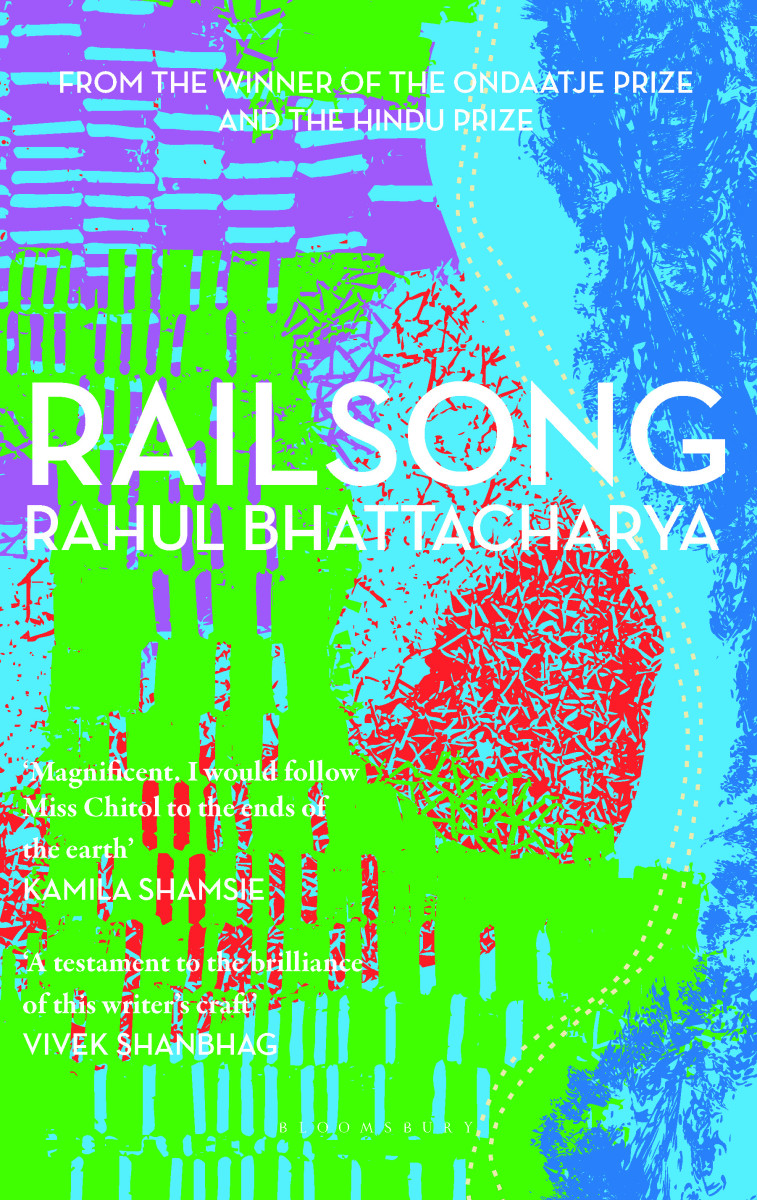
Rahul Bhattacharya
Railsong
Bloomsbury India, 2025
‘Why should it not be engaged? The lines have been down for three days.’ He glared at her as though she were responsible. ‘Only I know how I have managed.’
‘I too have a job to do, Varmaji,’ she stressed. ‘I need a place to stay.’
‘That is the trouble,’ he replied. ‘You have put me in a fix. Where am I to put you? You are now my responsibility. But where shall I put you? You tell me where. The two things famous in Kamalpur are mangoes and crime. The mango season has gone.’
‘Varmaji, I am nobody’s responsibility but my own. Are there no retiring rooms here?’
The stationmaster chuckled.
‘There are two. For the last month an engineer from works and his family have taken them over. Their quarters are getting renovated.’
‘Is there a subordinate rest house?’
‘There is. But that place is in a bad way. I don’t think it will be good for you. There may be men. They may be drinking. I cannot guarantee your safety.’
He turned agitated again.
‘And actually, since you are a ladies, you will need clearance from the a.e.n to stay there. But look at the time. How can I disturb him at this hour for a matter like this? I just do not understand how –’
‘Let it be, Varmaji,’ she cut in. ‘I will make my own arrangements. Just tell me how I can get to Godlan tomorrow.’
He appeared relieved.
‘The buses leave from right outside the station, starting seven o’clock.’
She got up to leave.
‘Wait, where are you going?’ he said. ‘I will send a pointsman with you. He will take you to the right place.’
The pointsman’s name was Jawahar. She followed him out of the station. The streets were narrow and dirty. The dogs were thin and restless. Here and there men were huddled on their haunches, rubbing their hands together. Someone sang ‘Oye Oye’ at her, others laughed and said something she did not understand. Jawahar told her to ignore them – as if she didn’t know.
In ten minutes they were at Adarsh Hindu Hotel – far from ideal. Nothing about the place gave her a good feeling: not the quarter-bottles of liquor in the rubbish strewn near the entrance, not the dim lighting in the reception, not the man sitting there she could see looking out towards them. Jawahar told her it was the only decent hotel in the area. The lilt in his Hindi, his vocabulary, reminded her just a little of the Bhombalpuriya style, and this familiarity was one reason she retained her confidence.
Once inside the room, that began to leak out. Everything was designed to raise doubt. The hollow-sounding door with the flimsy four-inch latch, the space at the bottom through which she could hear men and watch their shadows stride past, the blanket so heavy with dust it triggered sneezes that called attention to oneself, the rat tail swishing off behind the rat-bitten curtains hanging over a trail of rat or lizard shit, perhaps both.
She considered leaving the light on for the night but decided that would only attract more attention.
She washed and lay in the dark dread, listening to the rat’s activities.
Khoos-khoos, chik-chik.
All night tiny rats overran her thoughts, scampering over her with their sharp feet and probing snouts, prising open her lids, flattening themselves against her eyes.
In the morning she saw it had bitten through her bag and nibbled its way into the biscuits.
But the night was finished. No harm came to her. It was dense and greenish grey outside, like phlegm. Yet it was indisputably morning. When she went downstairs, she found Jawahar waiting. He had not said he would come. She was touched.
They conversed enthusiastically on the way to the station. On learning that her visit was to do with school and caste certificates the conversation turned, naturally, to the new reservations. He belonged to a boatman community, and he hoped the court would uphold the prime minister’s decision. After all, the Dalits and Adivasis had their quotas, while the Thakurs, Banias and Brahmins ruled the country no matter how few they were. Where did that leave the rest? The census was coming, so why only Scheduled Castes and Scheduled Tribes, count Other Backward Classes if you have the guts, then everyone will know how many we are and how little we have – count every caste, in fact, then everyone will know what is what, and she saw his point. The upper-caste students ought to think about this instead of going about setting themselves on fire, he continued, this entire rath yatra was a ploy to create division between Hindus and Muslims and divert from real issues like this one.
It was busy at the station. Men were chewing on neem sticks, drinking tea, bombing the ground indolently with spit, urinating over small heaps of garbage as if dousing little fires. Women lent dignity through abstinence. Jawahar pointed her to the kachori man’s stall, showed her the bus she was to take, only then could she persuade him to carry on. Once the vendors hawking vials for potency and venereal disease were gone, and they were packed to double capacity, and there arrived among them a young goat, the bus grunted off.
The sun was up but its glow was diffuse, as though struggling to penetrate X-ray film. It was not beautiful. Clusters of unplastered brick structures, dusty in colour, in between them bare fields, some covered with low potato crop. The dry brown air stuck in the throat. A fly browsed her nape. She loosened her bun over it. She drifted in and out of sleep – she had barely slept the past few nights – and was shocked when she heard the conductor thump the side of the bus announcing her stop.
Nothing had quite prepared her for the sight of the tehsil office in Godlan. All that remained of the gates were the hinges. The weeds in the compound were so unseemly even the grazing cow chose to forage in the garbage heap instead. The only people around were a bunch of men at a tea stall and a typist stall across the office. She felt their eyes on her as she took the thin path through the weeds towards the building. The windowpanes were shards; a few windows had been pilfered whole, frames and all. Where the ceiling plaster had not come off, the paint gently flaked down, like dandruff.
A bicycle on the veranda was the single sign of habitation. Climbing the two steps up towards it Smt Chitol heard unusual sounds emanate from a room. She peeped inside to find a shirt and a gamchha draped over registers on the desk; further in, a balding man in trousers, vest and sacred thread sitting cross-legged on the floor before a smoking claypot, staring at her. She had spoken barely two words before he interjected, in a very pure Hindi: ‘This is extremely necessary. Wait outside, let what has commenced complete’ – as though it were she who was asking to perform a ritual in a government office in the middle of a working day.
Waiting, she could feel once more the eyes of the men at the stalls. She walked over to another side of the veranda. Across the road stood a buffalo stable.
Now a boy, seven or eight years old, entered the compound. She watched in surprise as he bounded over the weeds, right up to her.
‘I have brought a message for you,’ he said, a little impudently.
‘For me? From who?’
‘Somebody is calling you to their house about the certificate. I will take you.’
She felt a shudder of unease.
‘Who is this person?’
‘Come with me,’ he said.
‘But who –’
The boy turned round and skipped away just as quickly as he had come.
He worried her.
Perhaps, she told herself, he was playing a prank, a naughty village boy. What must people come here for but certificates? Or maybe he worked for a tout. She was sweating.
Available for pre-order on Amazon https://amzn.in/d/6YzpQvd
This article went live on November third, two thousand twenty five, at seventeen minutes past three in the afternoon.The Wire is now on WhatsApp. Follow our channel for sharp analysis and opinions on the latest developments.


