

Bettina Bäumer’s Inclusive Philosophy Is What We Need in Such Times


One of the most memorable moments of the year was speaking on a panel for the launch of Bettina Bäumer’s autobiography, The Light in-between: A Journey of Recognition. Held on October 31 under the energetic personal supervision of Austrian Ambassador, Katharina Wieser – whose husband (a former professor of Tibetology) had been one of Bettina Bäumer’s students at the University of Vienna – the event opened with a meditative rendering of Rāga Kedar on the Indian cello by Saskia Rao-de Haas, evocative of the conversation between Śaṅkara and the Devī in Vijñāna Bhairava.
This autobiography is a rare account of a woman’s journey in the deepest sense from Europe to India; from Christianity, both Protestant and Catholic, to the Philosophy of Recognition (Pratyabhijñā), popularly called Kashmir Śaivism.
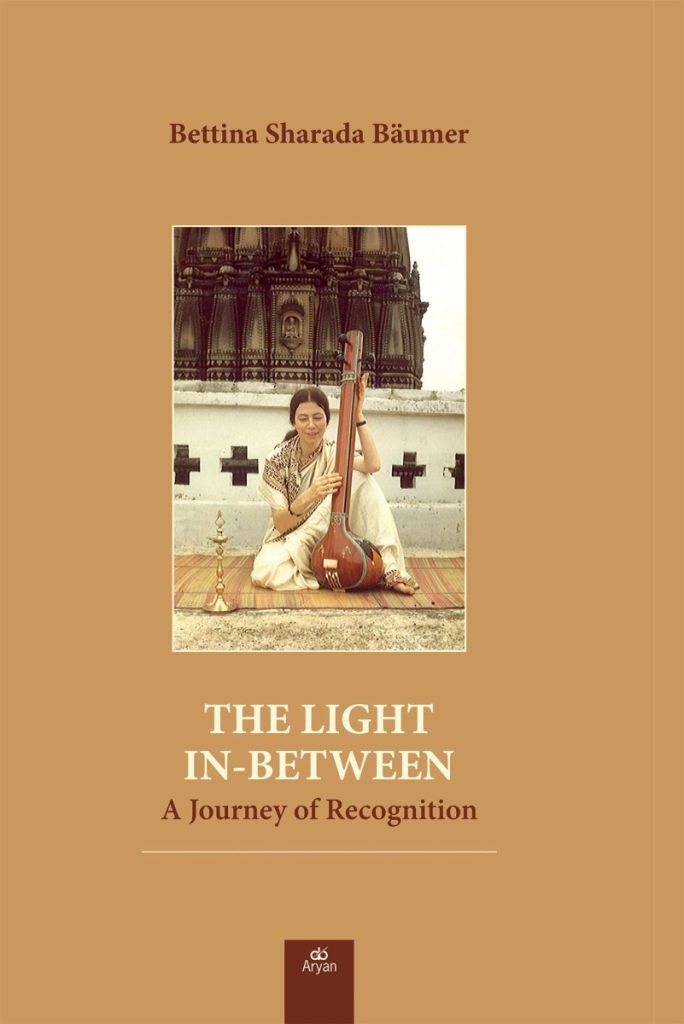
THE LIGHT IN-BETWEEN: A journey of Recognition, Bettina Sharada Bäumer, Aryan Books International, 2025.
It belongs to the genre of women’s spiritual biography shaped by cultural encounter. Others in this lineage include Peter Heehs’ The Mother: A Life, on Sri Aurobindo’s spiritual collaborator, Mira Alfassa; Jacqueline Chambron’s, Lilian Silburn, A Mystical Life; Jetsunma Tenzin Palmo, the Tibetan Buddhist nun’s, Cave in the Snow; and the Diaries of Alice Boner.
The autobiography intimates many journeys:
1) Childhood and survival under a Nazi regime
One of the most moving parts of her story is the account of being a half Jewish child under Nazism. Her father, Eduard, was Protestant (later became Catholic) and her mother, Valerie, was of Jewish origin, but registered herself as “Protestant Christian.” Foreseeing danger – Eduard had read Mein Kampf early – they moved from Frankfurt to Salzburg in 1933. Austria’s annexation in 1938 closed off escape routes.
The Bäumers were artistes, but their elder daughter, Angelica was called a “bastard” at school. Her description of being dragged out of class by two Gestapo men as children shouted “bastard, bloody Jew,” while the teacher stood paralysed, chillingly illustrates the everyday complicity that enables fascist violence.
In 1943 her mother left three-year-old Bettina in the village of Grossarl, in the care of a Catholic priest, Father Linsinger and his cook, Kaisermama for nearly six months. Beautiful photographs in the book document this improbable refuge.
Valerie returned to Salzburg but visited Bettina periodically. When their family doctor warned her that she and her children were on a list to be deported to Auschwitz, Valerie fled with her two older children. After an arduous refugee-train journey and a 16-km mountain walk carrying a few bundles they reached Grossarl, where Valerie worked on a farm until the end of the war. In 1985 Bettina visited Father Linsinger, reconnecting, as she writes, “from soul to soul.” He thanked her for allowing him to serve them.
2) Journeys between Christianity and Hinduism
A young Bettina studied at the Universities of Vienna and Rome. Two Christian scholar-theologians shaped her spiritual path and also the Christian world: Raimon Panikkar (1918-2010) and Swami Abhishiktānanda (Henri Le Saux, 1910-1973). Conferences on both, organised by Bäumer, remain among my special intellectual experiences. These figures were leading lights in the Church’s turn toward religious pluralism signalled by Vatican II and its landmark declaration Nostra Aetate (1969), which, for the first time, acknowledged multiple truths across religions.
Panikkar, son a Hindu father from Kerala and a Catalan Catholic mother, joined Opus Dei in 1940. It was an authoritarian organisation which later expelled him for disobedience. Incorporated in 1946 in the Diocese of Varanasi, he studied Sanskrit and Indian philosophy at BHU and Mysore, taught in Varanasi, lived simply, dressed in dhoti and sandals. Rebellious in temperament, he even married at 73, defying clerical celibacy.
Panikkar famously said: "I left Europe (for India) as a Christian, I discovered I was a Hindu and returned as a Buddhist without ever having ceased to be a Christian.” He refused notions of mixed identity: “I am not half Spanish and half Indian…but fully Western and fully Eastern.” In Santa Barbara his Easter service involved blessing the five elements – earth, air, water, fire, and space – along with all forms of life before celebrating the Eucharist. He celebrated a Cosmotheandric vision viewing cosmos (world), theos (God), anthropos (human) as interconnected.
Bäumer travelled to Rome via Assisi, where she studied with him. Panikkar taught her meditation and “converted” her, urging her to surrender her “little self” to the Divine. Their collaboration later produced The Vedic Experience: Mantramañjarī, which Panikkar metaphorically called an immersion in the “Ganga of the Veda.”
As Come Carpentier de Gordon observed, Panikkar moved beyond a conception of western ecumenism as a dialogue restricted to the three Abrahamic religions. He refused to deny the Vedic gods and asked, “Why should we decide whether they are gods?” He emphasised cross-fertilisation of cultures and enrichment through the other.
Inspired by the Bhakti tradition of the Marathi saint-poets, Tukaram, Jñaneśvar, Namdev and Eknath, Panikkar and Bäumer made a pilgrimage to Alandi, Jñāneśvar’s samādhi.
In Rome, Panikkar had given her The Hermits of Saccidānanda, by Abhishiktananda and Jules Monchanin. After reading it she travelled to India in 1963 to meet Swami Abhishiktānanda at Shantivanam. A late encounter with Ramana Maharshi had transformed him; the Upaniṣads, he wrote, revealed Christianity’s deepest truths. After Abhishiktānanda attained mahāsamādhi in 1973, his disciple Marc Chaduc (Ajātānanda) entered ten years of silence. Bäumer wrote movingly of him as her guru-bhāi, describing his aspiration toward the sahasrāra and the self-luminous Puruṣa (svaprakāśa) recorded in his diary.
Both Panikkar and Abhishiktānanda insisted she complete her academic studies before returning to India again.
3) Journey from Veda to Tantra, 1965 onwards
The book offers a vivid portrait of Banaras – and of another India. Two women profoundly shaped Bäumer’s path: Alice Boner and Lilian Silburn.
Swiss artist and art historian Alice Boner (1889–1981) lived in Banaras from 1936. She collaborated with Bäumer on texts of Vāstuśāstra, Śilpaśāstra, and the temples of Odisha. Boner wrote of her Indian adventures in Indian dance; Indian sacred sculpture; and Indian temple architecture. Alice Boner’s mystical experience at Ellora’s Kailāsanātha temple left an indelible mark.
Shortly before her death she placed a shawl on Bäumer’s shoulders saying, “You are my daughter.”
Bäumer lived in Boner’s stone house on Assi Ghat for twenty years. It became the venue for early workshops on Kashmir Śaivism—including on her translation of two chapters of the Netra Tantra—the site of my first workshop with her in 2013.
Lilian Silburn, French Indologist and mystic, studied with Swami Lakshman Joo (as did André Padoux). She wrote what Bäumer considers the finest commentary on the Vijñāna Bhairava. She referred to the intuitive search for the source of yantra and mantra and of a secret doctrine passed from master to disciple known by persons such as Swami Lakshman (Joo) of Srinagar.
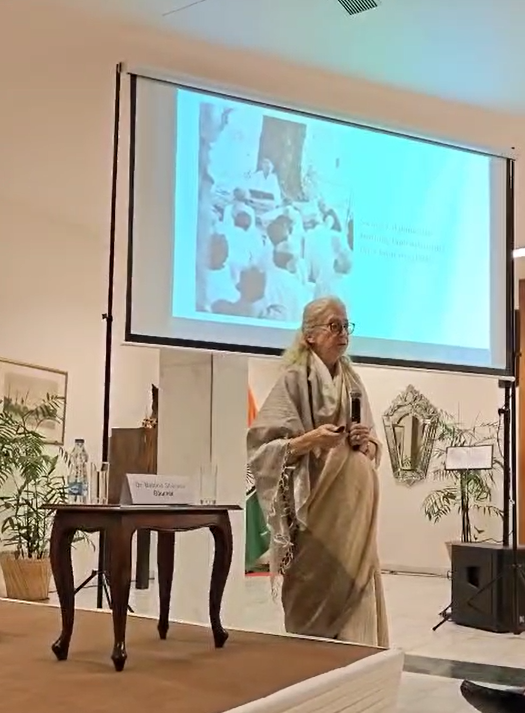
Baumer with a slide of Swami Lakshman Joo in the background, at the Austrian Embassy, October 2025. Photo: By arrangement.
Banaras was also home to Gopinath Kaviraj, whose scholarship revived tantra studies. He told Bäumer that Kashmir Śaivism is the culmination of Indian thought. Among his students were Pandit H. N. Chakravarty, who took Bäumer to meet Swami Lakshman Joo in 1986, and Jaideva Singh, renowned scholar of the philosophy of Kashmir Śaivism and translator of major texts of the tradition.
Both Lilian and Jaideva Singh had Sufi connections. A Sufi is said to have visited Jaideva Singh shortly before his death; he reportedly experienced the nāda (cosmic sound) rising to the sahasrāra (crown chakra). Lilian Silburn became a follower of a Hindu Kayastha Naqshbandi Sufi teacher, Śrī Rādhā Mohan Lāl Adhauliyā (1900-1966), whom she called sadguru.
4) Journey of awakening the self and teaching the tradition of Pratyabhijna (the school of recognition)
After experiencing self-realisation Bäumer received dīkṣā from Swami Lakshman Joo in 1986. Perhaps because of her early exposure to violence she found eventual satisfaction in a philosophy that contributed the idea of Śānta Rasa, a ninth rasa regarded by Abhinavagupta as containing the essence of all the other rasas, which enables the Rasika to savour all the eight others and experience aesthetic delight.
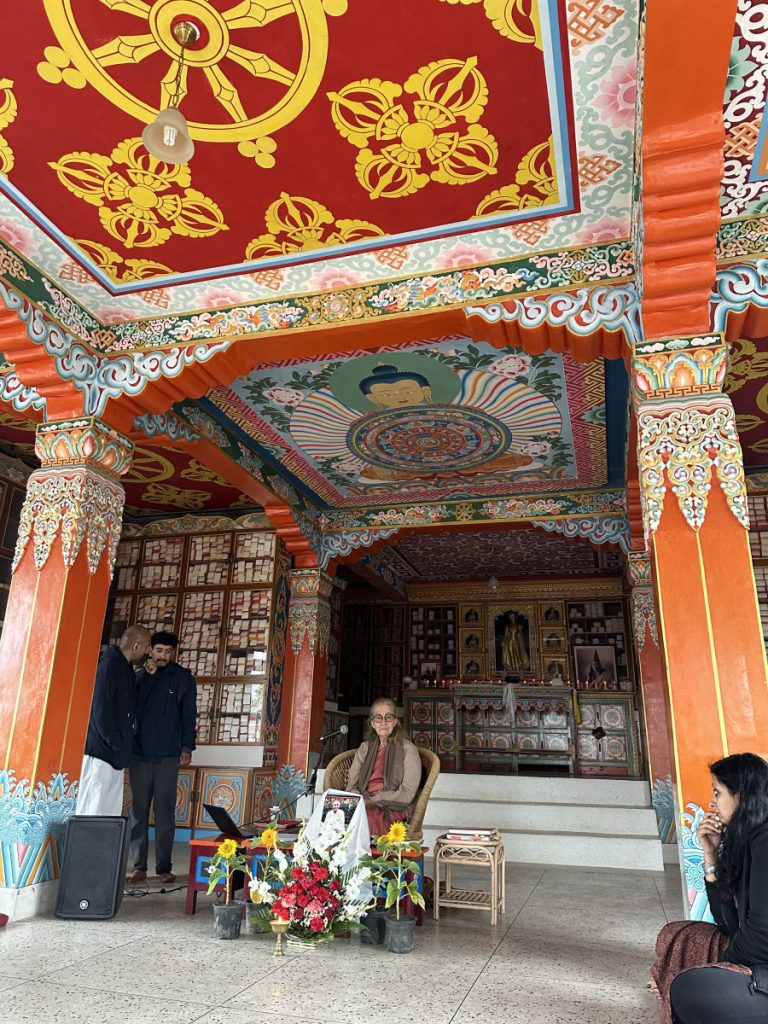
Baumer with a photograph of Swami Lakshman Joo, at a workshop, Deer Park Institute, Bir, August 2022. Photo: By arrangement.
Pratyabhijñā offers an extraordinarily rich conceptual vocabulary connecting the aesthetic and the metaphysical. Non-dualism (a-duality in Panikkar’s preference) does not preclude multiplicity or beauty; divinity is both male and female. The cit (caitanya, saṁvit or consciousness) of Kashmir Śaivism is neither the Vedāntic ātman nor the Buddhist anātman. Instead it shares aspects of prakāśa (illumination) and vimarśa (reflexive awareness) with Param Śiva, who presides over and pervades a hierarchy of tattvas (elements of the universe and human nature including water, earth, fire, air and ether).
For nearly two decades Bäumer has conducted many workshops in India and Europe. She devised a seminar-retreat structure integrating Text, Meditation, and Nature, with meals taken in silence – following Lakshman Joo’s instruction that silence preserves the energy generated in meditation.
A brilliant talk by philosopher Arindam Chakrabati on the Vijñāna Bhairava invites us to reinhabit Kashmir Śaivism as social philosophy. Verse 106 emphasises sambandha, the relational, which takes us beyond the narcissism we inhabit.
ग्राह्यग्राहकसंवित्तिः सामान्या सर्वदेहिनाम्।
योगिनां तु विशेषोऽस्ति सम्बन्धे सावधानता॥ १०६॥
grāhyagrāhakasaṁvittiḥ sāmānyā sarvadehinām |
yogināṁ tu viśeṣo'sti sambandhe sāvadhānatā || 106 ||
The experience of object and subject (grāhya-grāhaka) is common to all embodied beings; yogins differ in their attentiveness to the relation between them. Focusing on the madhya (also the suṣumnā nādi), the centre between object and subject enables the self to transcend, what philosopher Daya Krishna called, the “prison-house of I-centricity.”
Śaṅkara tells the Devī that this is the very secret of the secret doctrine. The great question she asks already has all the seeds of an explanation; doubt is pregnant with insight – as Lakshman Joo beautifully renders it.
This inclusive philosophy enables us to fight then the totalitarian ideologies of our times that are egocentric and ecologically destructive.
Shail Mayaram is the author of the book The Secret Life of Another Indian Nationalism: Transitions from the Pax Britannica to the Pax Americana, published by Cambridge University Press. She is an honorary fellow at the Centre for the Study of Developing Societies in Delhi. She is chairperson of the Academic Advisory Board at the Käte Hamburger Centre for the Study of Apocalyptic and Postapocalyptic Studies at the University of Heidelberg.
This article went live on December eighth, two thousand twenty five, at fifty-three minutes past two in the afternoon.The Wire is now on WhatsApp. Follow our channel for sharp analysis and opinions on the latest developments.


