

An Introduction to Saint Gorakhnath and His Inclusive Legacy


Saint Gorakhnath lived in the eleventh century, say most historians, littérateurs and scholars in folklore, though there is no unanimity among them on his exact lifespan. He was the founder of the Nath monastic order. His followers are known as Yogis, Gorakhnathis, Darshanis or Kanphattas.
Gorakhnath has left behind an inclusive legacy. He lived in a time when the liberal Sufi and Bhakti traditions were taking root in India. He had a following among both Hindus and Muslims. Bihar and eastern Uttar Pradesh still have many villages inhabited by Hindu as well as Muslim Yogis.
Gorakhnath’s first disciple was said to be Yogi Vardhanath. Gorakhnath had himself initiated Vardhanath into his order. It is believed that Gorakhnath, a wanderer, accompanied by Vardhanath, visited the place where the Gorakhnath Temple came up and it came to be known as Gorakhpur later.
The credit for the temple’s present form goes to Mahanta Buddhanath (1708–23). There was a small temple in the area where Baba Buddhanath lived as its mahant, or priest. Historical accounts suggest that Asaf-ud-Daulah, the Nawab of Awadh, donated over 52 acres of land to Baba Roshan Ali, a fakir and devotee of Gorakhnath, in the eighteenth century, which helped rejuvenate the temple and enhance its glory and grandeur. The tomb of Roshan Ali, which stands opposite the temple, constitutes the identity of Gorakhpur.
Gorakhpur is the cultural capital of Devaria, Kushinagar and Maharajganj districts in Uttar Pradesh, Gopalganj and Siwan districts in Bihar and those parts of Nepal that border these areas in India. The Gorkha community of Nepal is said to have its origins in the sect of Gorakhnath.
The temple was an iconic centre of composite culture till Digvijaynath took over its management in the 1930s. Digvijaynath became the Gorakhpur chief of the Hindu Mahasabha when V.D. Savarkar became its president in 1937. Savarkar was arrested in connection with the Mahatma Gandhi assassination case. He was the first mahant who entered electoral politics and won the Gorakhpur Lok Sabha seat on the Mahasabha’s ticket in 1967. He died in 1969.
Digvijaynath’s successors, Avaidyanath and Adityanath, emerged as symbols of militant Hindutva in the Gorakhpur region. Avaidyanath represented Gorakhpur in the Lucknow Assembly and the Lok Sabha several times. Adityanath, who also represented Gorakhpur in the Lok Sabha five times (1998–2014), is the present mahant and chief minister of Uttar Pradesh.
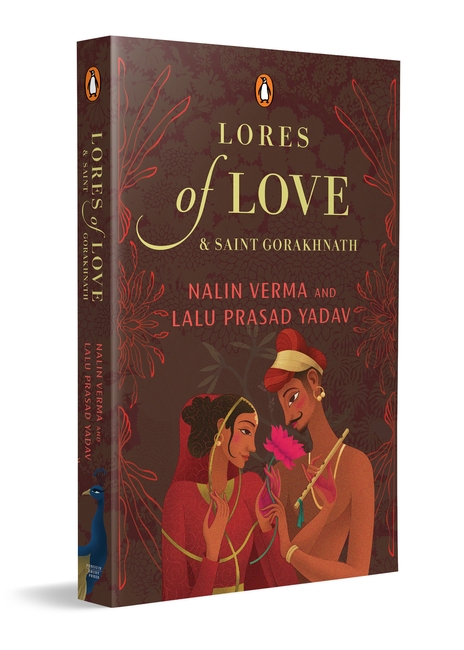
'Lores of Love and Saint Gorakhnath,' Nalin Verma and Lalu Prasad Yadav, Penguin Random House India, 2025.
This book does not aim to profile the politics of the mahants. Instead, its purpose is to preserve and retell the stories of love, lust and renunciation from an era shaped by the guidance and influence of Saint Gorakhnath.
The tale of Heer–Ranjha exemplifies this. Ranjha, the protagonist, endured immense suffering in his pursuit of Heer, who shared his unwavering passion. Their tragic love story inspired poignant verses by the nineteenth-century poet Mirza Ghalib, which are still celebrated in mushairas across the Indian subcontinent. Rooted in the folklore of Punjab in India and in Pakistan, this tale also captivated Bollywood, with Chetan Anand and Ketan Anand producing the 1970 film Heer Ranjha, starring Raaj Kumar as Ranjha and Priya Rajvansh as Heer.
Another narrative, Sorthi-Brijbhar, follows Brijbhar, whose maternal uncle Khekharmal cruelly demanded Sorthi—Brijbhar’s beloved—as a bride for himself. Heartbroken but determined, Brijbhar embarked on a treacherous journey under the guidance of Saint Gorakhnath, who ultimately helped him reunite with Sorthi.
Saint Gorakhnath also influenced King Bhartrihari who, disillusioned by the infidelity of his wife Pingla, renounced worldly attachments to become an ascetic. Similarly, the ballad of Saranga and Sadabrij, deeply ingrained in the folklore of the Bhojpuri-speaking regions of north India, bears Gorakhnath’s imprint. This dramatic tale, filled with magical elements, tells of Sadabrij donning a hermit’s robes to win over Saranga.
Noted Hindi writer Hazari Prasad Dwivedi, in his seminal work Nath Sampradaya, says that the followers of Gorakhnath or the Nath sect exist across the country. They belong to the weavers’, shepherds’ and agricultural communities among Hindus and Muslims.
In Punjab, the Yogis are called Rawals. In Bengal, they are known as jugis or jogis. The Awadh and Varanasi regions of Uttar Pradesh and Bhojpur and Magadh regions of Bihar have several villages of Yogis. They sing the ballads of Sorthi-Brijbhar, Bhartrihari-Pingla, Heer-Ranjha and Gopichand and also the bhajans of Kabir, Nanak, Raidas, Dadu and Meera. They sing the folk songs of Lord Rama and Shiva-Parvati. They sing to the accompaniment of the sarangi and extol the virtuousness of Gorakhnath and his guru Matsyendranath.
They seek alms, perform magic tricks, suggest herbal cures, read palms and tell fortunes to earn their livelihood. Like they are called Rawals in Punjab, the Gorakhnathis are known as Darwes in Hyderabad and Gosawis in the Konkan. They are found in Gujarat, Maharashtra and Karnataka too.
The Nath sect doesn’t accept the supremacy of the Brahmins. The followers of the sect choose their gurus from among the communities of weavers, dyers, shepherds and agriculturists. The gurus and disciples wander for alms together. Dwivedi says that the people of the lower strata of society in both the communities—Hindu and Muslim—who were looked down upon by the priestly class became Yogis in the north as well as south of the Vindhyas.
Growing up in Phulwaria village in Gopalganj district on the Bihar–Uttar Pradesh border in the 1950s and 1960s, I loved these Yogis playing sarangis and singing the ballads of Sorthi-Brijbhar, Bhartrihari-Pingla and Saranga-Sadabrij. Over the years, these ballads became a source of sustenance for folklorists and folk theatre artists, who performed at wedding parties and religious events.
I am very passionate about these stories. I got the folklorists to perform when I became the chief minister of Bihar in 1990. I still invite them to perform when I find time. I shared these stories with Nalin Verma, who has carried out extensive research to present these stories here. I am greatly thankful to him for writing these stories, which have been a part of our culture and our heritage.
In his book Gorakhnath and the Kanphata Yogis, George Weston Briggs put the number of Yogis in India at 2,14,546 with reference to the 1891 Census. In the Agra and Awadh provinces, there were 5319 Oghars, 28,816 Gorakhnathis and 78,387 Yogis. He also put as many as 83,137 Muslim Yogis in Punjab at that time.
According to the census held in 1921, there were 6,29,978 Hindu Yogis, 31,158 Muslim Yogis and 1,41,132 Fakirs in both the communities.
Manoj Singh, a researcher in folklore and convenor of the Jan Sanskriti Manch, a sociocultural forum, travelled across many villages inhabited by the Muslim Yogis in eastern UP between 2007 and 2017. He wrote a research paper on his findings that was published in The Wire on 27 March 2017.
Manoj’s work suggests that Gorakhnath had rebelled against the orthodoxy of his time and inducted the people looked down upon by the powerful priestly class into his order.
But Digvijaynath, Avaidyanath and now Adityanath have defiled Gorakhnath’s inclusive legacy.
Gorakhnath cast a strong influence on the saints Kabir, Dadu, Mulla Daud and Malik Mohammed Jaisi. Acharya Rajnish, known as Osho, delivered several discourses on Gorakhvani, which are available as books and audio recordings.
Osho recounts that once, the noted Hindi poet Sumitranandan Pant asked him to pick twelve major religious figures of India. Osho named Krishna, Patanjali, Buddha, Mahavir, Nagarjun, Shankar, Gorakhnath, Kabir, Nanak, Mira, Krishnamurti and Ramakrishna Paramahansa. Pant then asked him to cut the list down to seven, then to five and then to four. Osho picked the names of Krishna, Patanjali, Buddha and Gorakhnath. When Pant asked him to further shorten the list and pick only three, Osho refused. Why could he not leave out Gorakhnath, Pant asked. ‘I cannot leave him out,’ Osho replied, ‘because Gorakhnath opened up a new avenue and gave birth to a new religion.
Without him, there would be no Kabir or Nanak. There would be neither Dadu nor Wajid, Farid or Mira. The entire Sufi tradition of India is indebted to Gorakhnath. Nobody equals him in his teachings, which led to the discovery of the inner soul.’
Nalin Verma is a journalist, author and media educator.
Lalu Prasad Yadav was chief minister of Bihar from 1990 to 1997 with a brief interruption in 1995 and the union minister for Railways from 2004 to 2009.
This article went live on August fourth, two thousand twenty five, at thirty minutes past four in the afternoon.The Wire is now on WhatsApp. Follow our channel for sharp analysis and opinions on the latest developments.


