

India's Democracy Is Under Pressure, But Is Not Without Hope


Democracy Derailed: The Way Forward for India @75, edited by P.I. Jose and P.J. Antony (Media House, Delhi, 2025), is a timely addition to the discourse on democratic backsliding in India. It offers a comparative and reformist analysis of institutional erosion, compromised secularism and participatory renewal, grounded in India’s contemporary socio-political context, providing insight into how political power is exercised in a way that exposes the fragility of democratic institutions.
With India now in its 75th year of independence, Democracy Derailed arrives as both a diagnosis and a call to action. The book interrogates the structural and normative decline of democratic institutions in India. The authors blend political analysis with sociological insight, offering a textured account of how institutions meant to safeguard pluralism, accountability and rights are being hollowed out from within.
The book’s central thesis is encapsulated in the foreword by K.P. Fabian, who observes that democracy can be subverted even by those who come to power through democratic means and that it is possible to violate the constitution without amending it. This insight resonates with contemporary theories of democratic backsliding, a process by which the erosion of democracy occurs not through coups or revolutions but through the slow, legalistic dismantling of institutional checks and balances.
One of the book’s most compelling themes is the erosion of secularism in India. Antony’s observation that there is a growing perception that the quality of our secularism is getting seriously compromised merits attention. This is not merely a normative lament but a sociological observation about the transformation of the Indian state’s relationship with religious pluralism.
The authors argue that secularism has shifted from a constitutional principle to a rhetorical device, selectively invoked and strategically ignored. Institutions such as the National Minorities Commission, once envisioned as guardians of pluralism, are now portrayed as symbolic and ineffective, sidelined in both policy and public discourse.
Jose and Antony’s contribution lies in portraying how this erosion is not accidental but structurally enabled through executive dominance, media complicity and civic disengagement.
Also read: BBC Documentary on Gujarat 2002 Reminds Us That We Are Not Interested in Truth
The book has a detailed chapter listing the major events and initiatives – social, political, economic, legislative and judicial – that have contributed towards both the building as well as the incremental dismantling of institutions over the years.
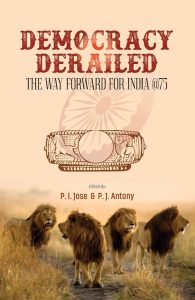
Democracy Derailed: The Way Forward for India @75, edited by P.I. Jose & P.J. Antony. Media House, Delhi 2025.
The Election Commission of India, once a globally respected body, is critiqued for its perceived partiality and hesitancy to act against ruling party figures, especially in matters of campaign finance and electoral law violations. The media, once hailed as the fourth pillar of democracy, is portrayed as a vehicle for state propaganda, with investigative journalism described as “an endangered species” today.
Rather than treating these failures as isolated events, the authors locate them within a broader socio-political framework. They highlight how legal and constitutional safeguards in the constitution, meant to protect and promote minority rights, are selectively undermined by the commissions and omissions of responsible entities, and how laws like the Foreign Contribution Regulation Act are weaponised to deny resources to organisations addressing rural poverty and seeking to empower the socially marginalised. They argue that majoritarianism weakens institutions meant to protect pluralism, while executive overreach centralises appointments and funding, eroding democratic checks, and that public apathy contributes to institutional decay through fostering civic disengagement and fear.
The authors claim that many within our country and outside it feel that the rules of the game of what is called “democratic governance” have changed in our country of late. People are now compelled to unlearn their own understanding of concepts like constitutionalism, democracy, justice, equality, fraternity, secularism – and even jurisprudence. They also write that some observers see liberal, democratic India transforming itself into a “Deep State”. According to them:
“The language and content of our mainstream political communication today, noticed for their majoritarian undertones, with their allusions to particular religious symbolism, resonate with those some theocratic and authoritarian regimes experimented with in Europe in the first half of the previous century, but were forced to discard, for very convincing reasons, within a short span of time.”
Democratic erosion, according to them, often occurs incrementally – through legal reforms, institutional restructuring and rhetorical delegitimisation – rather than through overt authoritarianism.
Despite its cautioning diagnosis, Democracy Derailed is not a pessimistic book. Jose and Antony advocate for a reinvigoration of participatory governance, emphasising decentralisation, transparency and youth engagement. Their call for civic renewal aligns with the notions of communicative action and deliberative democracy. The book’s emphasis on local accountability and institutional reform reflects a principled commitment to pluralism and democratic resilience.
This reformist optimism distinguishes the book from more fatalistic accounts of democratic decline. Providing prescriptions for the ills, these chapters invite readers not only to critique but to act – to reclaim democratic spaces through civic engagement, institutional vigilance and public discourse.
While the book is not empirical in the conventional sense, it draws on policy analysis and media discourse. The authors’ interdisciplinary lens, blending sociology, political science and advocacy, offers a textured account of democratic decline and the prescriptions for renewal. Their writing is accessible yet analytically rigorous, making the volume suitable for both academic and policy audiences.
Democracy Derailed is both a mirror and a map. It reflects the current state of India’s democratic institutions with unflinching clarity, while also offering a roadmap for renewal. Its social sensitivity, comparative breadth and reformist spirit make it a valuable contribution to the literature on democracy, governance and institutional change.
As India – indeed, the world – grapples with democratic backsliding, this book deserves close attention from sociologists, political theorists and engaged citizens alike.
Dr Joseph Viruthiyel is honorary director at the Institute for Development Initiatives.
This article went live on November twenty-sixth, two thousand twenty five, at forty-eight minutes past five in the evening.The Wire is now on WhatsApp. Follow our channel for sharp analysis and opinions on the latest developments.


