

Bridging Philosophy and Science: From Aporias of Sensory Perception to Extra Bodily Sensibility


It is either the case that we as a species have mostly figured out the laws of nature and their applications in everyday life, and all that is left is mostly the ironing out of a few wrinkles – the problem of the unification of quantum theory and gravity being one of the more irksome ones – or that in our blasé complacence we are unknowingly at the cusp of a revolution in our understanding of nature, one that will completely upend our systems of science.
The first seems to be the general opinion not just amongst laymen but also scientists and specialists, and if there are some holdouts who believe in the second, this is mostly a residue of hope left over from earlier revolutions like that of non-Euclidean geometries in the 19th century or Einsteinian relativity and quantum theory in the 20th and not on the basis of any actual scientific work currently underway.
What is common to both these scenarios is that it is the world of science that has the responsibility of telling us whether we are at the end of history or whether there are revolutions to come. Philosophy, that ancient motherlode, from which all sciences have descended, stopped being an important influence in our understanding of nature many centuries ago. That is why the retreat of philosophers to language and culture has been so well remarked; they have carved out a niche where they can continue their earth-shaking discoveries without, fortunately or unfortunately, those discoveries having any impact on the world of science and technology which now more than ever has insinuated itself even into the very fabric of our brains.
Cover of 'The Embodiment of Senses: Exploring the Spatiotemporal Structure and Extension of Sensory Perception' by Babu Thaliath.
Babu Thaliath’s book The Embodiment of Senses: Exploring the Spatiotemporal Structure and Extension of Sensory Perception seeks to put a small but perhaps shattering cog within this humongous and indifferent machinery. Translated by the author himself from his book first written in German – titled Die Verkörperung der Sinnlichkeit – The Embodiment of Senses challenges a basic dogma that the natural sciences and physiology have inherited from philosophy: the centrality of the subject in sense perception.
The fact that all our sensory perceptions – vision, touch, smell, taste and hearing – are constructed neuronally by our nervous system from sensory input is a widely accepted dogma in the sciences. Thaliath, however, shows how this dogma is one that is inherited from a philosophical revolution in the 17th century, which turned away from reference to objects in the world to the impressions of the subject which is no longer in the world but in the mind.
This revolution, begun by René Descartes and completed by the German philosopher Immanuel Kant, cemented the subject as the sole originator of the sensory world we inhabit, with even space and time becoming categories constructed by the subject. The physiological sciences then built upon this revolution and deepened it, postulating that every bit of the world we sense has been constructed by our neuronal apparatus via the intermediaries of the passive senses.
The senses are then receptive and passive; the neuronal apparatus is spontaneous and constructive. This is a complete reversal from ancient understandings of sensory perception, which believed in the extramission or emission theory of vision – that there were visual rays that went from the eye to the object, instead of the intromission theory we believe in now.
How can we dispute this today? It is quite obvious to even schoolchildren that the extramission theory is wholly mistaken and the intromission theory functions perfectly, not just theoretically but also practically. But are there cases where this certitude can be called into question?
In his book, Thaliath, a professor of German studies and philosophy at Jawaharlal Nehru University and formerly a post-doctoral researcher at Cambridge, argues that there are multiple aporias that call into question our wholesale acceptance of the intromission theory of vision.
Of the few dozen aporias that Thaliath catalogues, three stood out to me: the aporia of visual position, that of the inverted retinal image, the aporia of visual size perception and the moon illusion. In the first case, we know that the retinal image as it forms in our eye is both upside down and laterally reversed. The argument is that if we see visual phenomena upright as they are, this must be because the inverted retinal image is corrected at the neuronal level.
However, Thaliath cites an experiment performed by a British scientist, Stratton, who in 1896 constructed an optical device that inverted the light rays before they reached the retina. Stratton observed that he was able to adapt to the uninverted image in his day-to-day life. But if it was a simple case of adaptation, Thaliath argues that this does not occur in the case of short or long-sightedness, which require geometric aids like lenses to be corrected. The solution to the aporia, according to Thaliath, simply requires a step back from the subjective theory of perception and opening one’s mind to the possibility that “the eye, when visually adapting to the correct perception of position, does not use the retinal image but the position of the directly seen real object itself as a reference” (57).
This would mean that it is not the image on the retina which is the reference point for vision but the referenced object itself – which is as we can make out, another aporia. How else can the object be directly seen without the necessity of postulating that we project our visual field onto the object to see it, like a fisherman casting a net to catch fish? But this would directly contradict the intromission theory and demand a return to the discarded extramission theory of visual rays.
The second aporia is that of object size constancy, which is drawn from the size of the retinal image. The size of an observed object in close proximity to the eye should vary dramatically as it moves slightly closer or slightly farther away, but in fact it doesn’t. Citing a French philosopher of the 17th century, Condillac, Thaliath argues that if a man four feet away moved eight feet away, the image of him on the retina would be halved in size. And thus the man should appear half as short as he did – but he does not.
This deviation from the geometrical-optical principles makes Thaliath wonder whether we see the retinal image at all. Or do we see the real objects in the visual field? If we do, how is it possible? Neuronal causality can provide one way out of this predicament but it is not clear how it could override the geometrical-optical basis of vision. For Thaliath, this aporia requires a move away from the retinal image and towards a more tactile perspective on vision, in which the objects of visual perception are our actual points of reference.
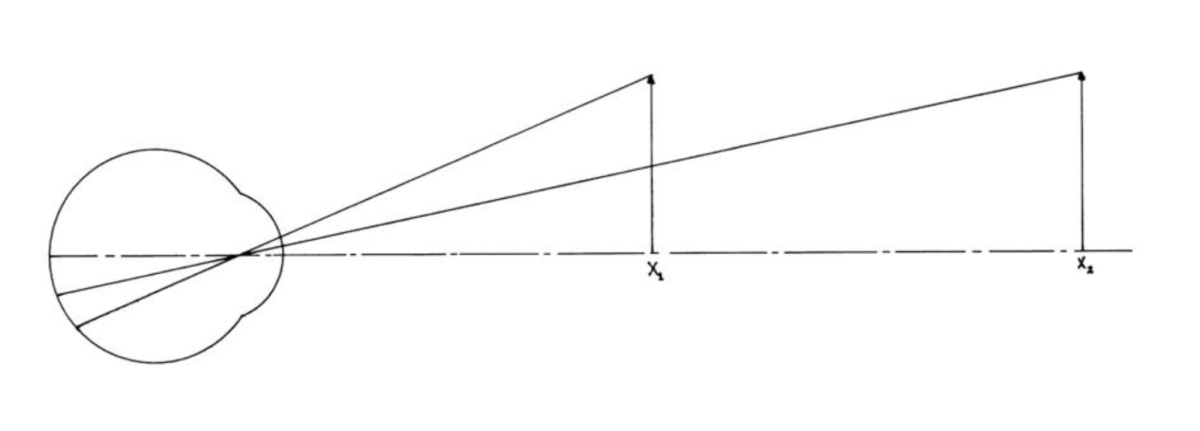
The object size constancy in the visual size perception
The third aporia, that of the moon illusion, gets a much longer discussion in the book. This illusion is that a celestial body like the moon seems larger when it is on the horizon than when it is in the zenith of the sky, though photographs taken of it have shown that its diameter remains the same throughout, and the angle that it makes is also the same. This illusion is one that has been discussed by philosophers and natural scientists for millennia, at least since the ancient Chinese and Greeks, and the solutions to the problem are multiple, but none of them seem to address the real issue at hand. Thaliath seems to agree with the Arab philosopher and inventor of the science of optics, Al-Haytham, in his claim that the visual space of the sky is not spheroidal but that of a flattened dome.
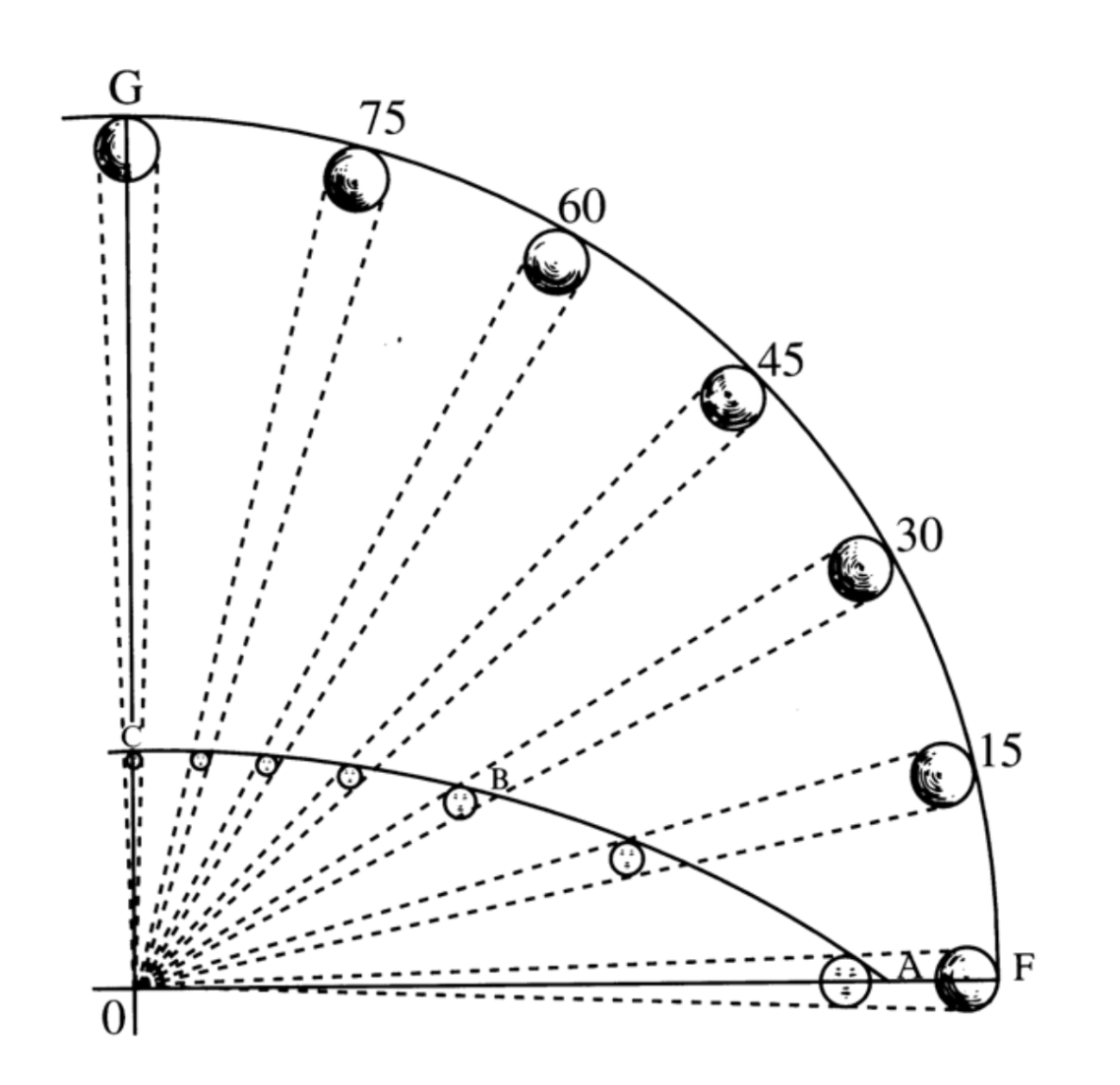
Moon illusion in a flattened dome-shaped sky
According to Thaliath, this shape signifies that what Ptolemy called visual rays do not reach as far looking up as they do when we are looking straight ahead. While Ptolemy thought that visual rays have more difficulty going up than straight, Thaliath believes this has more to do with our visual apparatus, which has evolved to look straight, horizontal-frontal vision: “the long habituation to horizontal and frontal vision on earth prompts the human eye to construct a special form of its visual space or visual boundary level, in which horizontal depth perception develops greatly in comparison to mere vertical and intermediate oblique depth perceptions” (85).
These and many other aporias, Thaliath finds, can be resolved if we posit visual rays that create a sort of visual field within which real objects exist, are seen, touched and referenced, and reject the theory of the retinal image as the only source of our vision. But this would mean a return to the much derided extramission theory of vision, which is another aporia. What would these visual rays be?
Thaliath speculates that they could be electromagnetic waves or even brain waves, but he admits that this is just speculation and that there is not yet an experimental proof for this. But the aporias, even if we do not accept Thaliath’s solutions, do seem to challenge the retinal image theory in ways that it cannot entirely wish away.
This book, which is Thaliath’s seventh, and the first in English, is part of his larger project of uncovering aporias. He believes that the task of philosophy is to revive aporias that have been buried by science. Philosophy itself cannot resolve these aporias, it can only display them and show that they have not been addressed. Redress, however, would require a complete overhaul of the dogmas and certitudes of science, which is quite unlikely today.
The questions in Thaliath’s book demand serious discussion, even if they are threatening to the status quo. They challenge the subjective understanding of sensory perception, one which even philosophical movements sceptical of modern science like phenomenology had gingerly sidestepped, focusing more on the discursive and logical moments of cognition rather than the fundamental aesthetic moment.
In my opinion, Thaliath’s book leaves us with a lot to think over, and a lot more rethinking to do. Phenomenology, the subfield of philosophy I specialised in, has for long argued against the perspective of cognitive consciousness as minds in a box, arguing that we project ourselves into the world. It made that argument in the context of higher level functions like discourse and cognition, but Thaliath’s work makes us uneasy by finding these same problems at the level of aesthetic sensibility as well.
Perhaps we need to think of this projection as active even at the basic level of sensory perception as well, which would necessitate a complete rethinking of natural science. Like the works of Henri Bergson and Alfred North Whitehead, Thaliath’s book then seeks to instigate not just a revolution in our science but also in our philosophy of perception.
Huzaifa Omair Siddiqi is assistant professor, Department of English, Ashoka University.
The Wire is now on WhatsApp. Follow our channel for sharp analysis and opinions on the latest developments.


