

Asked to Investigate UPA Govt's Use of 'Fake Notes' That Never Were: Ex-Finance Secretary Subhash Garg


New Delhi: About a year ahead of the 2019 Lok Sabha elections, Narendra Modi-led Bharatiya Janata Party (BJP) government then eying a second term, asked then union finance secretary, Subhash Chandra Garg, to investigate fake currency notes that had been allegedly used by the previous Congress-led United Progressive Alliance government to use for political funding. While Garg informed the Prime Minister's Office that he did not find anything suspicious after undertaking the exercise for a couple of months, the PMO was still not satisfied and appointed an expert committee headed by an external professional.
In his new book No, Minister: Navigating Power, Politics and Bureaucracy with a Steely Resolve, Garg writes that while he communicated that “under no circumstances” would he “find it acceptable that an outside professional be allowed to go into the highly sensitive and confidential currency printing presses.” Despite his misgivings, an expert committee headed by former chairman to the PM’s Economic Advisory Council Bibek Debroy was formed, close to the 2019 Lok Sabha elections.
Garg who took voluntary retirement in 2019 writes in his book that in April-May 2018 he received a confidential demi-official (DO)-from then principal secretary to the prime minister, Nripendra Misra, to audit “all the paper purchased and used for printing currency notes over the last ten years.”
“There was no explicit purpose mentioned for undertaking this massive exercise. When I spoke to him to find out, he was not very forthcoming. It appeared that there was some suspicion in the mind of the PMO that the previous government had used the currency note printing presses to print notes over and above what were officially accounted for to use the same for political funding,” writes Garg in the book.
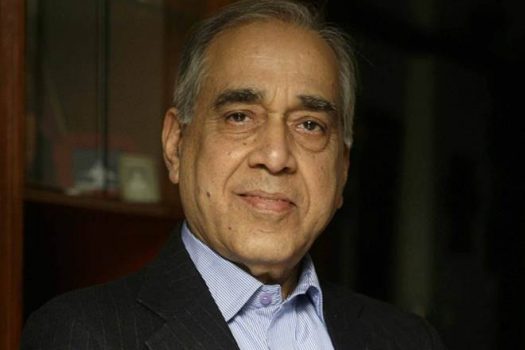
PM Narendra Modi’s former principal secretary Nripendra Misra. Photo: Wikimedia Commons
Garg writes that since it was an order “and indeed a sensitive matter” he undertook a detailed audit, which he described as a “Herculean exercise” that took a couple of months.
“In consultation with government’s note printing company, the Security Printing and Minting Corporation of India Ltd (SPMCIL), I designed a broad worksheet to capture all the currency printing paper purchased over the past 10 years in square metres, all the currency notes printed during this period, the paper consumption which these printed notes accounted for by taking their dimensions into consideration and all the resultant and accounted for wastages,” he writes.
“I gathered the international norms of wastages to benchmark wastages accounted for by note printing presses. It was a Herculean exercise and took a couple of months.”
Garg said that at the end of the exercise which was undertaken by the SPMCIL officers, it was found that there was slightly higher wastage which was “not alarming” than international norms and that he found nothing suspicious.
“There was slightly higher wastage (though nothing alarming) than the international norms, but it was quite close to the Indian experience and the long-term trend. I went through all these calculations and got the SPMCIL management to send the report along with all the details officially concluding that there was no unexplained wastage. I thereafter forwarded it to the PMO with my covering note that I did not find anything particularly suspicious in the printing of notes over that period of 10 years,” he writes.
According to Garg, the PMO was not satisfied and he was sent another DO from Misra in which he was informed that an expert committee headed by an external professional would be formed. Garg said that he found it unacceptable that an outside professional would be “allowed to go into the highly sensitive and confidential currency printing presses.”
“I found it uncalled for and decided to meet him to persuade him not to embark on that wild goose chase. He was insistent. I said that the government might appoint an expert committee but under no circumstances would I find it acceptable that an outside professional be allowed to go into the highly sensitive and confidential currency printing presses,” Garg writes in the book.
“He agreed to this. The PMO decided to appoint Bibek Debroy as head of the committee, a decision that was taken just prior to the Lok Sabha elections of 2019,” he writes.

Bibek Debroy. Photo: PTI/Files
Debroy had been the chairman of the PM’s Economic Advisory Council since 2017. Garg writes that the Debroy committee however did not start work till his voluntary retirement in July 2019.
“Nothing has been placed by the government in public domain about the work done and conclusions reached by the Debroy Committee,” he writes.
In July 2019, Garg who was moved to the power ministry applied for voluntary retirement, preferring to resign over a year before his scheduled ‘superannuation’ date. Although Garg’s new position in the power ministry came with the same salary and perks, it was widely seen as a demotion.
The decision to shift Garg to the power ministry was seen as being abrupt, primarily because the finance ministry bureaucrat was closely and personally involved with several government initiatives including leading the government’s fight in trying to secure a greater portion of the RBI’s reserves,
This article went live on July twenty-sixth, two thousand twenty five, at twenty minutes past twelve at noon.The Wire is now on WhatsApp. Follow our channel for sharp analysis and opinions on the latest developments.


