

Meet The ‘Sorted’ Indian Who Says, ‘There’s Nothing Anyone Can Teach Us’


Many people ask me how I have come to be so clear-sighted, with a personality so wondrously simple and straightforward.
The thing is, many years ago I asked myself some pretty direct questions. At the time I had a clean conscience – as clean as a mirror prior to a vigorous shave. There are some who even in old age boast a conscience that has stayed unaltered from the time of their birth: wallowing in their fathers’ means in their growing years without any qualms, they spend a lifetime seeing the world in the image of their fathers, sponging off it with no scruples whatsoever.
So, years ago, my pristine soul gave direct answers to my direct questions the way a fan starts rotating at the mere touch of a button. By avoiding questions that can inflict pain it is possible for humans to lead a happy existence, and I have always strived for such happiness. To that end I never asked any questions other than the ones I put to myself, nor did I ever change my answers. That is the secret of my clear-sighted approach, my sense of self-confidence and my happiness.
To show others the way to happiness I have put down those questions and the answers:
What is your nationality?
Indian.
Which country in the world has the most ancient culture?
India.
Which race do you belong to?
Aryan.
Which is the most ancient race in the world?
Aryan.
The most superior race?
Aryan.
Have you had your blood tested?
Yes, it consists of 100% Aryan cells.
What does one pray for before the gods?
To ensure our birth in the sacred land – punyabhumi – that is Bharat.
What are the other lands like?
They are paapbhumi, or lands of sin
Do the gods take birth in other lands?
Never! They inform me before taking birth.
Do the gods possess a political map?
Yes, they have the ‘Oxford World Atlas’ with them.
Are they aware of Pakistan’s creation?
They know everything. They accept the lines drawn by the Boundary Commission.
Who possesses all knowledge?
Only the Aryans.
You, that is?
No, our Aryan ancestors possessed that knowledge.
Is knowledge to be found anywhere else?
No.
In thousands of years, has the human race achieved anything?
Nothing whatsoever. All the breakthroughs had already been accomplished in our land.
Do we need to learn anything now?
Certainly not! Remember, our ancestors were world leaders – vishwa guru.
Who is the greatest in the world?
We, we, we, we, we…!
Also read | Harishankar Parsai: The Satirist Who Gave Us a New Understanding of the Nation
I was in raptures. A gush of tears followed. I closed my eyes and the words started coming out of my mouth: Aha! What happiness!
An acquaintance who had just dropped by, asked: “Sore eyes, is it? Have you put any medicine?”
I replied: “It’s kohl, applied not in the eyes without but in the eyes within. I have been blessed with a new vision. Such contentment! Everything has become so simple and clear now. History has revealed itself. The secret essence of life has become apparent. No question raises its head in my mind anymore, no doubt either. Anything that was worth knowing is already known. There is nothing left to know or do now.”
Then I shared those questions and answers with my acquaintance.
He said: “Okay, now I understand – self-confidence flows from wealth, knowledge and strength, but the biggest source of self-confidence is foolishness.”
I took his remark as high praise for me, which further strengthened my beliefs. So, I started expressing my ideas openly and people found them interesting. In fact, they became restless to hear me speak, and I found myself being invited to speak by various groups ranging from engineers to philosophers.
One day, at a doctors’ gathering I said: “The West is proud that its discovery of penicillin, during the Second World War, has increased humanity’s lifespan. They haven’t the foggiest that the antibiotic was actually discovered in our land during the time of the Mahabharata war.
“Friends! Imagine the scene – Bhishma pitamaha, the upright, eternal brahmachari, Bhishma, is lying on a bed of arrows, his entire body lacerated. He is observing the pace of the sun’s movement – as soon as it begins its northward moment – uttarayan – he will leave his earthly existence.
“He stayed alive for a full 51 days and even then, he did not die of his wounds; he chose the moment of his death.
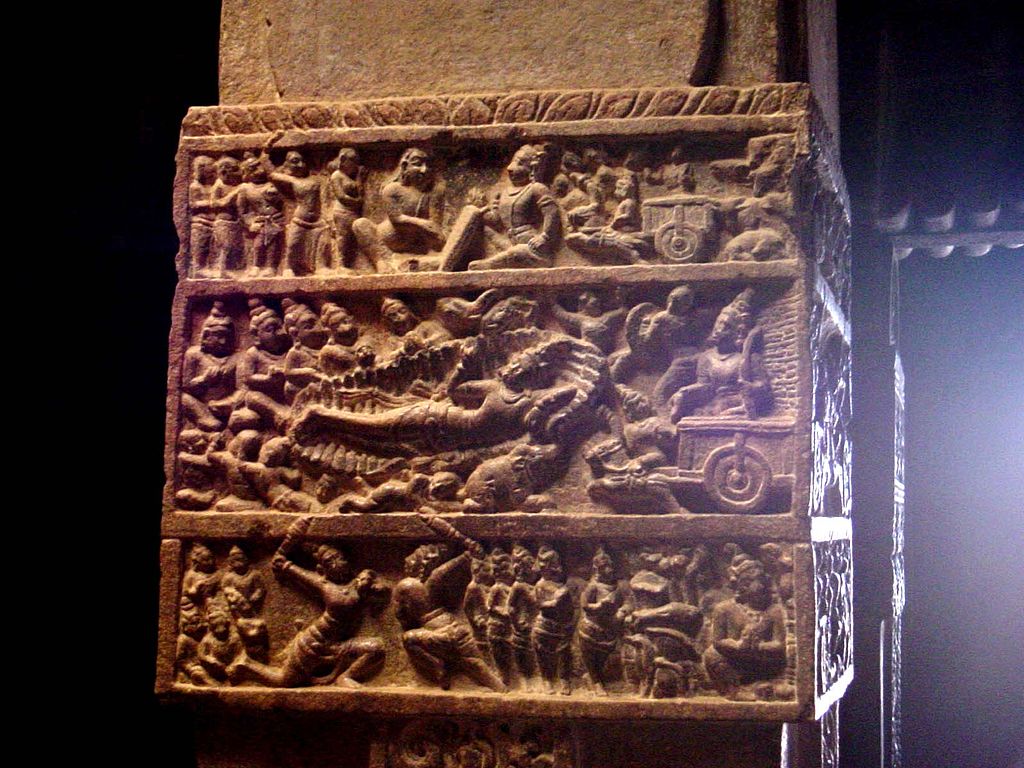
A narrative frieze in relief on a column in the Virupaksha Temple in Pattadakal (Karnataka), depicting scenes from the Mahabharata, with the central band showing Bhishma lying on a bed of arrows. Photo: G41rn8 (CC BY-SA)
“The question I want to ask Western scientists is – how come his wounds did not turn septic? Due to the existence of penicillin, that’s why! He had been administered penicillin. The penicillin which Bharat gave to the world 10,000 years ago is now being returned to us with such fanfare by the West as if they had discovered it! Friends, don’t forget that Bharat is the world leader. We are know-alls; there’s nothing anyone can teach us.”
There was a burst of applause at this statement and everybody agreed, there’s nothing anyone can teach us.
During the recent Indo-Pak conflict (1965) there was much talk about an anti-tank gun. I would listen and smile to myself. Finally, one day I could restrain myself no longer, and at one gathering I said what I had to say: “Those who shower praises on the anti-tank gun forget that these guns were being manufactured in our land during the treta yuga.
“Brothers, picture the scene – Rama is telling Sugriva, ‘I am going to kill Bali’. Expressing some doubt Sugriva says, ‘Bali is a mahabalshali. I am not absolutely sure that you will be able to kill him.’
“Then Maryada purushottama lifts his bow, takes aim at a row of palm trees and releases his arrow. The arrow pierces one tree after another, emerging clear from the hole in the seventh tree. Sugriva is dumbstruck. All the creatures of the forest – animals and birds, creepers and blossoms – are dumbstruck. Gentlemen, one who pierces seven palm trees in one go – wouldn’t he have guns to riddle the strongest of tanks with holes? Don’t forget, we have been world leaders, know-alls; there’s nothing anyone can teach us. "
There was wild applause, and everybody agreed, there’s nothing anyone can teach us.
Also read | The Son Who Rises Against the Patriarch
Once a discussion was organised on the subject of psychology and professors were giving serpentine speeches. When I couldn’t bear it any longer, I stood up to make my point.
I said: “Psychology, huh! People say psychology is a modern science. I ask you, did ancient India not know of psychology? Most certainly it did. Ah! picture the scene -- the forest is quiet, and on a spanking clean rock are seated a rishi (sage) and his wife. The jungle is bathed in moonlight, enveloped in a mild fragrant breeze. What kind of emotions must be throbbing in the hearts of the rishi and his wife? That’s it, that’s psychology for you. India was familiar with psychology thousands of years ago and they have the nerve to say it is a modern science. They forget, there’s nothing anyone can teach us.
People clapped thunderously and agreed, there’s nothing anyone can teach us.
Once, a botanist came visiting from abroad. He was scheduled to give a talk at a particular venue. I was told that he was an expert on fossils, that is, the remains or traces of prehistoric plant and animal life embedded in rock. As I heard his lecture, I became increasingly agitated. He kept taking the names of scientists solely from the West, and the only fossils he showed were from foreign countries.
After his talk ended, I stood up to speak: “Today we heard a great talk by a ‘botany’ (later it was told to me that the term I should have used was botanist). He explained to us how fossils are formed. I ask you, were there no ‘botanies’ in ancient India? Most certainly there were. It’s just that we are increasingly forgetting them.
“Bhagwan Ramchandra was a great ‘botany’ and Ahalya was a ‘fossil’. It was Ramachandra the great ‘botany’ who discovered the fossil of Ahalya. He was far superior to all the ‘botanies’ of our time put together. Today’s ‘botanies’ only go as far as discovering fossils and studying them. The great ‘botany’ that Ram was, he transformed the fossil Ahalya into a living woman. Such are the miraculous ‘botanies’ we have had in our land. We have been world leaders, know-alls; there’s nothing anyone can teach us."
Once again there was resounding applause. What’s more, even the foreign experts agreed that there’s nothing anyone can teach us.
One day I reached a venue where two beefy men looking like wrestlers were scheduled to give a talk. We were informed that they had just returned from a foreign training stint in bodybuilding and were going to explain how the body could be strengthened.
I heard them out. Finally, I spoke: “It was our ancestors who really knew how to build their bodies. We have neither the bodies nor the ability to build them. I ask you, of all the pictures of Bhagwan Rama and Krishna that you have seen, has there been any picture in which they were shown fully clad? In no calendar will you find a picture in which they are clothed waist up. They kept this part uncovered. Why? Simply because they had built their bodies to perfection and wanted to display them.

Krishna lifting Govardhan Mountain; bas relief in Mahabalipuram. Photo: Ilya Mauter (CC BY-SA)
“All of you, however, are clad in trouser and coat. Granted, you have nothing much to show. Can these Western educated gentlemen teach you what Lord Rama and Krishna communicated through just one picture?”
People clapped enthusiastically and everybody agreed that there’s nothing anyone can teach us now.
My vision has become so clear that my ideas are beyond all reasoning and argument. They are based on belief; one has to believe in them. I just have to speak at a place once for the audience to unequivocally agree that there’s nothing anyone can teach us.
I know for a fact that after listening to my ideas, many people have put an end to their learning process. They have stopped learning.
Harishankar Parsai (1924-1995) was a noted Hindi writer and satirist.
Translated from the Hindi original by Chitra Padmanabhan.
This article went live on January twenty-seventh, two thousand twenty, at fifty-six minutes past nine in the morning.The Wire is now on WhatsApp. Follow our channel for sharp analysis and opinions on the latest developments.


