

How a Book of Poetry Navigates the Vocabulary of Silence


Ludwig Wittgenstein, in Philosophical Investigations, asks us to imagine someone pointing to his cheek with an expression of pain and saying, “Abracadabra”! We ask “What do you mean?”. And he answers, “I meant toothache.”
Wittgenstein suggests that there are things we should understand with silence – yet words impel us to ask the obvious. It has been theorised that for communication, words are often superfluous. Yet with their usage, we feel the pleasure of speaking and carrying out a conversation.
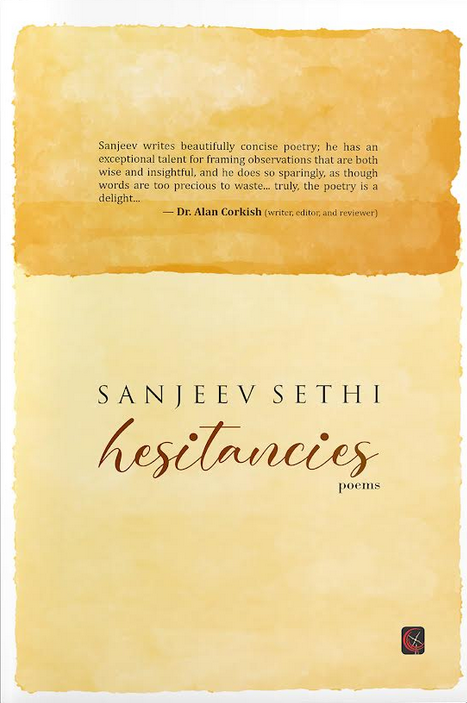
'Hesitancies: Poems', Sanjeev Sethi, Classix, 2021.
Sanjeev Sethi’s poems in Hesitancies (Classix, 2021) are about that pleasure. In his poems, unknown, arcane words appear in the familiar, as in the poem Coition:
Hesitancies coerced us
to surrender our shields. We lost the link
to smiles and stuff. Sitzkrieg emerged as
our channel to continuity. Between thighs
are carte blanche and incarceration.
Here even before the word Sitzkrieg appears, we have been led by the poet to its meaning – of lull. But more than that, it feels as though the poet has pulled the word out of a Thesaurus and offered it to readers.
The poet, here, is a familiariser of words – uncommon, unheard.
In Postil, the poet says:
Urge for intercalation is an off-shoot of elation.
Intercalation is more commonly known to a chemist than to ordinary folk, but on reading the verse, one feels how comfortably the word sits within the context, as if truly ‘intercalated’.
Sethi’s poems in Hesitancies courageously liberate the words from their specialised domains and offer them to the plebeian.
Also read: The Quiet Days
We often look up to our poets as people who possess a healing touch for words, as people who renew, refresh the everyday frayed words, infusing them with meanings. The poems in Hesitancies turn that perception on its head. The poet brings in unfamiliar words and offers them to the readers to relish.
For example in Barrack Backgrounder, one reads tenebrosity and feels the mouthfulness associated with succulent and fluffy chole bhatoore, a well-known North Indian breakfast dish, mentioned in the next line:
In tenebrosity, she offered
bhatooras but no chole. We grokked aunty
had gone wrong, in a whiz stillness gagged us.
Poetry is an act of intimacy. What is personal, deeply felt, a poet attempts to transform into language, as an irreducible art. Many of the poems in the collection echo the privateness of the poet, emphasising what Alberto Caeiro (one of the heteronyms of Portuguese poet Fernando Pessoa) once wrote about writing poems as his way of being alone.
...When my poems
globe-trot, a part of my longstanding love affair
with myself, travels with them. They carry my
flavors, my failures.
Writing poetry, therefore, is a conviction that a poet’s experiences are not hers or his alone, but in a way a metaphor for all. However, the poems in Hesitancies, while attempting to act as such, also emphasise the limitation or the impossibility of sharing one’s core.
…Now, when intimacy
encourages us to undress,
we cover our feelings.
The we in the poem could very well be the poems themselves. This failure of sharing is not necessarily the hesitancies of the poet, but of the language itself. The poet suggests:
Words embroider; they can’t alter.
Grief in any text is grief.
It feels that the poet has wandered into the desert of his language, where no vegetation exists; he is staring at its periphery where the foliage of his vocabulary is barely visible. He has spoken but something still remains within him, lingers. The grief therefore, may not be the grief of his experiences but of the language itself.
Words are first indicators of inadequacy.
The poet in Xeriscaping has situated his poem in this very arid landscape.
In aridity, I have planted grass and greenery.
Thicket and some trees. It lunges my spin.
Also read: Chandeliers in Our Sky
Here the poet is hopeful and enthused with the task of creating pastures of language in his desert. However, a sense of Sisyphean punishment pervades as one reaches the end of the poem, as if the only reward for such a task is the labour itself.
When faced with the palpable, eyes ripen
to moist repositories. There is proof as in
perdition. I stew myself in a sheaf of papers.
Writing about family, relationships is a way of knowing about oneself; the exploration is often difficult. However, in Hesitancies, one discovers that the poetic voice navigates the sweet with the bitter most eloquently here. The collection opens with an homage to Mother as a seeder of dreams in her child’s fibrous mind:
On the strand of my mind
you set up kiosks
vending items
enabling cheerful voyages.
The poem also alludes to Father perhaps, when it asks:
We mustn’t disremember
ministrations of another mentor,
you edified me.
Interestingly, the poet writes disremember instead of forget, cautioning not against a loss of memory but remembering perhaps in a ‘wrong’ way. In On Father’s 69th Birthday, we see a father as a maker of civilisation for his kids.
Everyone has a father –
but only some fathers
sow the seed
for their sons
to break into song.
The poem here juxtaposes the image of a father with that of a civilisation, finding in their decline a similar gradient.
Historians chronicle
the cave-in of civilizations.
I can see your decline –
see it with precision and pain.
More than physical, father is a psychological construct, even perhaps a spiritual one. The poem ends with suggesting that the construct is coming apart. The poem asks us to consider that if a father makes a civilisation for his kids, aren’t they – the kids – in turn chroniclers of that civilisation, and effectively of their fathers? This role-reversal between father and child is perhaps captured in the anguish expressed as a question in the last stanza.
Father, you want to hold
the space you held.
But, is it my fault,
that your hands
now need me?
In Loose Canons, loneliness in a relationship is captured. On reading it, one feels the loss of something precious, may be of a freedom that leads to the atomisation of being, and how worthless it is.
Seeing you tonight brings back
what we leveraged
of our freedoms.
Even when expressing loss, the poem focuses on the utility of language as a tool to recover something of value from the waste of a relationship, as though believing that if one can express the loss, all is not lost.
By being earless
you helped me
with my hesitancies.
However, there are poems that bow to silence, as an ultimate language for all our inadequacies:
Less questioning,
quiet of their itches.
Closing this conversation is ethical.
Inditing is livelihood,
lown, and liturgy.
The whirlpools in her eyes draw me deeper and deeper
into connections. Not known for a heart set in
stone, I acquiesce, wishing their togetherness
the lasting tint of amaranthine grains.
Also read: A Fine Balance
In these verses, silent moments trigger a dialogue within. At such instances, a loneliness permeates the poet’s being. He is among his people, but he is somewhere within, watching his outer world. There is an interiorisation, as if no one else will share his feelings until put on paper, as poems. Is it a fear or a hope? Perhaps a hope:
…On upbeat days cheer you
generate morphs my grim hours, generosity with
which you share links to the grammar of existence.
As the poems navigate the terrain of relationships, one inevitably encounters loss in the form of death. Dealing with the loss of dear ones is varied, since the mystery around death is diverse and is often rooted in spiritual, cultural and even individual discourse. Writing, though it cannot make up for the loss, can be a way of working through it, an act of catharsis in words. In Allover, we witness death as an activity:
Smoke billows
from the crematorium
inscribing the last lines
on the sky’s surface
of another loved one
who lies curdled as a cadaver.
The handler’s of the high-ups
spiral alternate spiels in media outlets.
Death happens even after one is dead, it continues beyond that moment, in the rituals, in the official bureaucratic processes, in the relationships; the living ones make things anew to their respective advantage:
Does empathy clamp winning positions?
In Death of a Friend, the bereaved is unsure of how to respond to a dear friend’s death
Fall of day you secure flight to the empyrean
a capsule of my childhood erases. Pliancy of
switch makes me inquire: should I be mournful
or mollified?
The poem then turns into a stoic meditation on the act of suffering, by considering death as a request to remember the dead for the cheerful times spent together:
Amphibolies permeate your passage as you turn
motif urging us in our prouder moments to be happy
for our happiness.
In Hesitancies, words are cryptic like riddles and invite the reader to decipher them. The minimalist nature of the poems also suggests that the poet trusts the readers with exploration, since the economy of words relies on a faith, that one will be understood, not only with what is expressed but with what is left unsaid. In that sense, the poems create a vocabulary that can be said to belong to silence – the unexpressed part of our language.
The style also gently overlays language above the meanings the expressions appear to possess, trying to make it (the language) an independent individual, worthy of its own existence, echoing Andres Fava from Diary of Andres Fava by Julio Cortazar that if you really have to suffer let it not be for what you write but how.
Cortazar discusses this aspect of disconnect between language and thoughts which every form of communication struggles to negotiate, and claims it is only among poets that this gap is bridged, for to them words and thoughts are one and the same. One finds this unity in the poems of Sanjeev Sethi.
Tabish Nawaz teaches Environmental Science and Engineering at IIT Bombay.
This article went live on September eleventh, two thousand twenty two, at forty-five minutes past two in the afternoon.The Wire is now on WhatsApp. Follow our channel for sharp analysis and opinions on the latest developments.


