

Kashmir as Font of 'Sanskritic Civilisation' Comes From Colonial Indology


A big controversy erupted last week in Jammu and Kashmir after the lieutenant governor received representations from a private NGO seeking introduction of Sanskrit in Classes 6 to 10 in schools across the union territory.
Jammu and Kashmir, as we know, is a Muslim majority region where Urdu was the sole official language from the year 1889 until 2020 when it was stripped of this distinction. Urdu is now one of five official languages.
After erasing Jammu and Kashmir’s special status under Article 370, which had embodied the titular autonomy granted at the time of accession, and splitting the state into two union territories, the Centre trained its sights on other markers of Kashmir’s distinct identity.
Since 2019, the Union government's relations with Jammu and Kashmir have been defined by an aggressive push towards political, cultural and constitutional homogenisation.
Although the supporters of the latest proposal, which is still being debated, insist that the encouragement for Sanskrit learning is enshrined in the National Education Policy (NEP) 2020, the move is still contentious.
The anxieties over imposition of Sanskrit come on the heels of a decision by a Jammu tribunal to waive the requirement for proficiency in Urdu in tests for the selection of naib tehsildar (deputy revenue officer) in Jammu and Kashmir. The decision is counter-intuitive given that a large percentage of official records in the union territory are in Urdu.
Nevertheless, an interesting pattern has emerged in the arguments in defence of teaching Sanskrit in Jammu and Kashmir’s schools, as exemplified by many of the responses to Kashmiri politician Iltija Mufti’s post on X in which she had criticised the move. This narrative hinges on the trope about Kashmir being ‘sacred Hindu land’ to which Sanskrit’s ties are, by definition, primordial.
As proof, these tweets cite the examples of great Sanskrit poets, philosophers and theologians of Kashmir, such as Kalhana, Abhinavagupta and Vasugupta. The language was being used in Kashmir before Islam came to the region and so it is not Sanskrit, they argue, but Urdu that should be regarded as “alien” to the Kashmiri ethos.
However, this argument borrows deeply from the colonial-era historiography that the European Orientalists popularised through their extensive works written over a century before India gained Independence. And given the processes that helped shape colonial Indology, it does not make for an ideal case for promoting Sanskrit.
Kashmir’s role in the articulation of Hindu-ness of Dogras
The colonial state’s interest in exploring Indian antiquity was fundamentally classificatory in nature, partitioning history into the competing categories of ‘Hindu’ and ‘Muslim’.
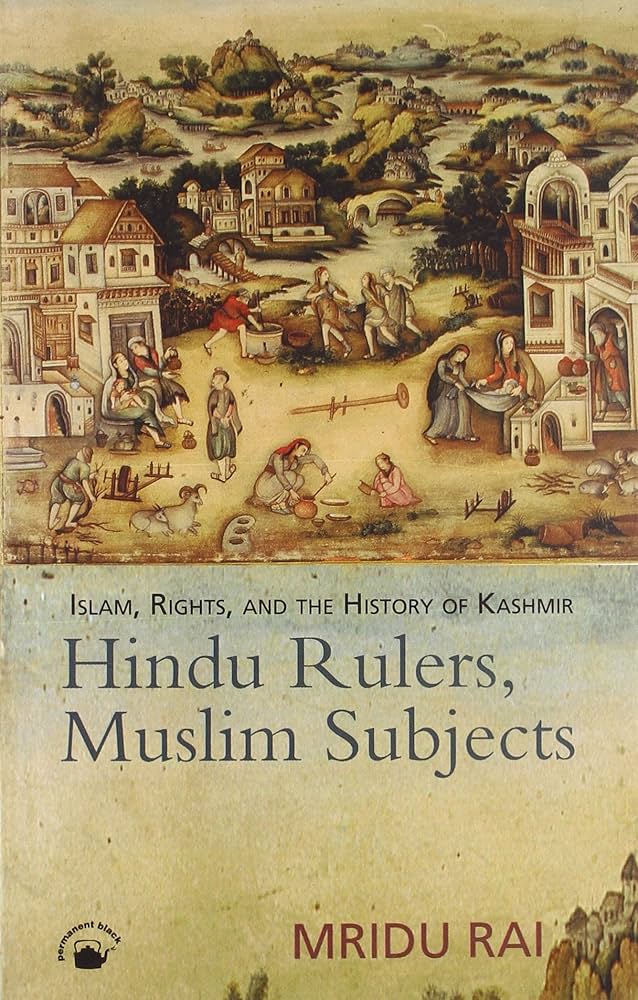
'Hindu Rulers, Muslim Subjects', Mridu Rai, 2007.
As H.H. Cole, the superintendent of ASI, writes, rather wryly, in 1870, the enterprise was important to “those who wish to know who the people of this great country are and what state they existed in before the Mahomedan invasion.”
Whereas these colonial undertakings had secular pretensions elsewhere in India, they took on a different character in Jammu and Kashmir, where the newly instituted Dogra rulers had sought to refashion themselves as “patrons of Hindu learning.”
The Dogras split up the archaeology and research departments, with the latter given entirely into the management of Brahmin scholars and officials who, writes Mridu Rai in Hindu Rulers, Muslim Subjects, focused on “collecting, translating, and publishing Sanskrit texts.”
Kashmir emerged as a site of intersection for these twin undertakings, feeding into the Orientalist endeavours to monumentalise India’s “venerable ancientness.”
Thus, the Dogra state played host to an entire deputation of European explorers -- Aurel Stein, George Abraham Grierson, James Hinton Knowles, Walter Lawrence and others -- that swarmed the Valley from 1870 onwards to explore its historical ruins and material artefacts.
This project was particularly geared towards “refashioning a standard Indological practice,” to quote scholar Ananya Jahanara Kabir, “into a new collaboration that anticipates the utility of Kashmir for a vision of Hindu India.”
The coupling of two strands of Hinduism
With the establishment of Srinagar’s Shri Pratap Singh (SPS) Museum in 1898, and the Archaeological and Research Department in 1904, these colonial vocations became systematised and were later embodied in endeavours such as the Kashmir Series of Texts and Studies, published by the department under the directorship of Jagdish Chandra Chatterji, a Bengali Brahmin.
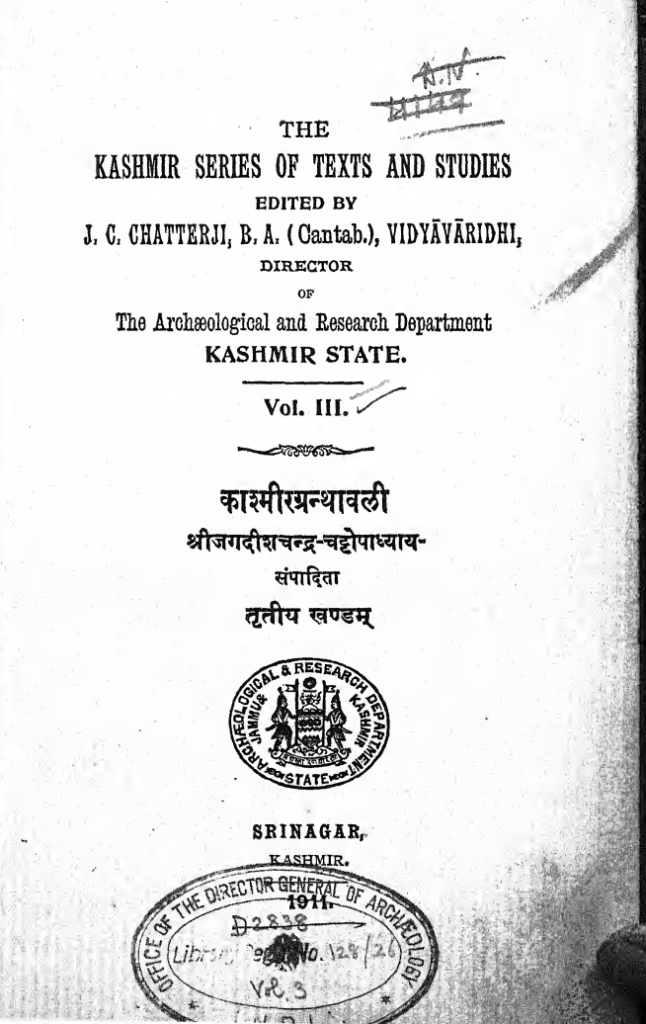
The second page of a volume of the 'Kashmir Series of Texts and Studies', published by the department under the directorship of Jagdish Chandra Chatterji.
The meticulously curated corpus of Kashmir Series set in motion a grand academic reinvention of Kashmir on a scale not attempted before.
The bedrock for this enterprise was the notion that only the vast stockpile of Sanskrit manuscripts – either in private possession or in the custody of the Dogra durbar – formed the authentic registers from where the building blocks for reconstructing Kashmir’s ancient past could be harvested.
Thus, the first volume of Kashmir Series would publish critical commentaries on Shaivism by Vasugupta and Kshemaraja, the two Kashmiri exegetes from the early medieval period. Between 1911 and 1947, the research department boasted having published 76 volumes, a majority of them on Trika Shastra.
The Dogras, who were devout practitioners of Vaishnavite Hinduism, presided over a subsumption of the Tantric Shaivism of Kashmiri Pandits into their patterns of legitimacy, evidenced by the production of the Kashmir Series and by the rewriting of the mahatmya of the Khir Bhawani temple in Kashmir, which described the Goddess as the “one who grants Rama Rajya.”
Only in modern academic scholarship have we realised to what extent this project of reimagining Kashmir was hobbled by critical limitations.
Historian Dean Accardi has revealed that the publication of Lalla Vakyani (1920), an English translation of poems by the 14th century saint-poetess Lal Ded, was predicated on the wholesale suppression of Persian sources on the saint who is revered by both Pandits and Muslims. Authors Abraham Grierson and Lionel Barnett represented Lal Ded exclusively as a Shaivite ascetic, shorn of any influences from mystical Islam, although Persian hagiographies depicting Lal Ded precede the first Sanskrit manuscripts of her poetry by more than six decades.
The appropriation of Sanskrit texts of Kashmir
The colonial knowledge-production and its scramble for Sanskrit texts climaxed with the quest for the manuscripts of Rajatarangini, a 12th century history of the ancient kings of Kashmir.
The project also became a vehicle through which the colonial tropes were smuggled into academic scholarship. Horace Wilson, the British Orientalist who initiated the first significant engagement with the text, did so with the intention of trying to embed Kashmir within the larger framework of the ‘Hindu history of India.’
This approach is also reflected in the efforts of Georg Bühler, a German Indologist, who assembled numerous manuscripts from Kashmir. His practices reveal to us the resilience of colonial instincts, for Bühler gave precedence to Sanskrit texts -- 800 of them -- over Persian, of which he collected only eight.
Although the eventual two-volume translation of Rajatarangini by Aurel Stein is considered as seminal, the project elevated the symbolism around the 12th century text to the extent that it became a prism through which the entire corpus of Kashmir’s narrative space was understood, setting the stage for Kashmir’s Persian texts to be sidelined as “imitations and interpolations,” even as the Sanskrit chronicles were upheld as “legitimate sources of history.”
Intent on projecting the ‘Hindu’ and ‘Muslim’ periods as perpetually feuding categories, the Orientalist scholarship ignored the fact that Kashmir’s Persian writing tradition remained in conversation, and affirmed continuity, with its older Sanskrit texts, as scholar Chitralekha Zutshi has observed in her celebrated work Kashmir’s Contested Pasts.
Rather than see it as a source located in the historical specificities of Kashmir, the Orientalist scholars – along with Indian translators of the text such as R.S. Pandit and J.C. Dutt – transformed Rajatarangini into an artefact that was supposed to instantiate Kashmir’s seminal ties to the “Sanskritic civilisation.”
In the words of Zutshi, the “naturalisation of Kashmir as a historical space embodied by a text such as Rajatarangini facilitated its appropriation into the larger narrative of Indian history.”
Kashmir as melting pot of cultures
It was this appropriation and politicisation of the Kashmiri Sanskrit texts - rooted in the colonial methods of legitimisation - that paved the way for Kashmir’s identification as a wellspring of Sanskritic culture - a trope that continues to be reproduced profusely to this date.
Implicit in this narrative was the suggestion that Kashmir’s emplacement within this "Sanskrit cosmopolis” was undermined by the corrupting influence of Islam in the 14th century.
But as more modern research informs us, Kashmir does not have to be representative of any particular culture, whether Islamic or Sanskritic.
Instead, it is more appropriate to see Kashmir’s past as defined by historical eclecticism, which situates the region at the confluence of multiple streams of cultural inflow: Indic, Persianate, Graecian, Chinese and more.
So, while it is welcome that Kashmiri students will get an opportunity to reconnect with their ancient history by getting familiarised with Sanskrit, the framework of learning in which this familiarisation takes place doesn’t have to be hegemonic.
Shakir Mir is a journalist and book critic based in Srinagar. His work delves at the intersection of conflict, politics, history, and memory. He is working on his first book.
This article went live on July thirtieth, two thousand twenty five, at eight minutes past eleven in the morning.The Wire is now on WhatsApp. Follow our channel for sharp analysis and opinions on the latest developments.


