

Why Manto's Pain of the Partitioned Mind Resonates Even More Today


‘Don’t kill my daughter in front of my eyes.’
‘All right, all right. Peel off her clothes and shoo her aside!’
– Saadat Hasan Manto
Saadat Hasan Manto was born on May 11, 1912. Today on his birth anniversary, as I think of him and read his stories, essays and notes, I pass through a strange experience. I feel happy with a realisation that the sub-continent gave birth to such a gifted writer who with his hard realism and extraordinary sensitivity to human suffering made us aware of the consequences of the partitioned mind—its implicit brutality, sexual violence and dehumanisation. However, I feel deep pain when I see that despite the passage of time, things remain the same. With our divided selves, we keep brutalising our polity, culture and society, and repeating the same mistakes of history.. With the normalisation and celebration of communal violence in our times, we seem to be losing our sensitivity. In Manto’s narrative, I begin to see the sociology of everyday violence, or the history of human degradation that seems to be more real than the mere archival documents. At times, it appears that in 2018, I am seeing what this passionately engaged/gifted Urdu writer saw in his times:
At six in the morning, the man who used to sell ice from a pushcart next to the service station was stabbed to death. His body lay on the road, while water kept falling on it in steady driblets from the melting ice. At a quarter past seven, the police took him away. The ice and blood stayed on the road. A mother and child rode past the spot in a tonga. The child noticed the coagulated blood on the road, tugged at his mother’s sleeve and said, ‘Look, mummy, jelly.’
Yes, in these troubled times that paralyse human sensitivity everything looks absurd: violence is peace, war is patriotism, noise is truth, death is statistics, rape is politics, and Rama is a macho hero. No wonder, despite Kathua, cow vigilantism, lynching, and everyday aggression, the country, we are told, is progressing. It is not surprising. Imagine how the disciples of (Veer) Savarkar celebrated the ‘sweet moment’ in those turbulent days of 1948. To refer to Manto again:
XXX…XXX…Reports are coming in of sweets having been distributed in the Indian cities of Amritsar, Gwalior and Bombay to celebrate the death of Mahatma Gandhi…XXX…XXX
Before I come back to Manto and see the divided sub-continent through his eyes, let me try to make sense of the seeds of this violence in the political doctrine of both Savarkar and Jinnah.
Savarkar is Jinnah, Jinnah is Savarkar
‘Hey, you there, speak at once, who are you?’
‘I…I…!’
‘You offshoot of the devil, at once…are you Indoo or Musalmeen?’
‘Musalmeen.’
‘Who is your Prophet?’
‘Mohammad Khan.’
‘OK, let him go.’
– Manto
Well, as the meticulously designed social engineering of the Aligarh Muslim University episode suggests, Jinnah is projected once again as the notorious villain responsible for the partition. I am no admirer of Jinnah; but then, I know that the self-proclaimed ‘nationalists’ who want Jinnah’s photograph to be removed from AMU are not essentially different from him. What unites them is their belief that Hindus and Muslims constitute two different nations, and they cannot live together. A close look at history indicates that Jinnah and Savarkar thought alike, particularly the way they normalised the divisive politics emanating from the antagonistic binaries—Hindus vs. Muslims.
Look at the speech delivered by Jinnah in 1940 in Lahore at the Muslim League meeting. "It is a dream", he said, "Hindus and Muslims can ever evolve a national community." For him, their ‘irreconcilable differences’ cannot be denied; and it has to be accepted that ‘"they have different epics, different heroes, different episodes, and very often the hero of one is the foe of the other, and likewise their victories and defeats overlap." No wonder, he could think that "the only force open to all of us is to allow the major nations separate homeland by dividing India into autonomous national states." Is it different from Savarkar’s Presidential Address at the Hindu Mahasabha in 1937? In fact, we see a similar argument in favour of the Hindu-Muslim dichotomy. He spoke of the "monumental war between indigenous Hindus and Muslim invaders and tyrants." Not solely that. "A Muslim", he alleged, "cherishes an extra-territorial allegiance; their faces are ever turned to Mecca and Madina."
In a way, both contributed significantly to the intensity of the cleavage between the two communities. In a toxic environment that eventually caused Partition with its divided/fragmented identities, Gandhi’s body became the site of ultimate revenge. While ‘atheist’ Jinnah preferred the division of India on the basis of religious identities, and betrayed ‘religious’ Gandhi’s plea for inclusive/secular nationalism, Nathuram Godse—Savarkar’s disciple—trusted his pistol to taste the blood of the ‘pro-Muslim/effeminate’ Mahatma. The trauma keeps haunting us, and with the rise of hyper-masculine militant nationalists, we see the recurrence of the bloody stories of Partition.
The Earthquake of Manto’s Harsh Realism
It was in the sea of blood that I plunged myself to come up with a pearls of regret at what human beings had done to human beings, at the labour expended by brothers to draw the last drop of blood from their brothers’ veins. I gathered the tears which some men had shed because they had been unable to kill their humanity entirely.
– Manto
Under these circumstances when I revisit Manto, I feel that I am seeing the flashback of a realistic film uniting the past and the present. The gendered politics of communalism, Manto knew, brutalises men, and reduces women into objects of violence or conquest. In that eight-year old girl—a victim of gang-rape at Kathua, I see Manto’s Sakina; I feel the pain of her father Siraj’s tormented self. I begin to see a succession of events:
Attack…fire…escape…railway station…night…Sakina. He rose abruptly and began searching through the milling crowd in the refugee camp. He spent hours looking, all the time shouting his daughter’s name…Sakina, Sakina…but she was nowhere to be found.
The popularisation of this sort of mass politics of hatred is bound to create what Manto saw in his yet another character—Ishwar Singh. Think of that terrible night and his conversation with his wife Kalwant Kaur:
‘Who was she?’ she screamed.
Ishwar Singh’s voice was failing. ‘What a motherfucking creature man is!’
‘Ishr Sian, answer my question,’ Kalwant Kaur said.
‘Kalwant, jani, you can have no idea what happened to me. When they began to loot Muslim shops and houses in the city, I joined one of the gangs. All the cash and ornaments that fell to my share, I brought back to you. There was only one thing I hid from you.’
‘There was this house I broke into…there were seven people in there, six of them men whom I killed with my kirpan one by one…and there was one girl…she was so beautiful…I didn’t kill her…I took her away. I said to myself…Ishwar Sian, you gorge yourself on Kalwant Kaur every day…how about a mouthful of this luscious fruit!’A refugee camp during partition and one in Muzaffarnagar, UP, after the riots in 2013.
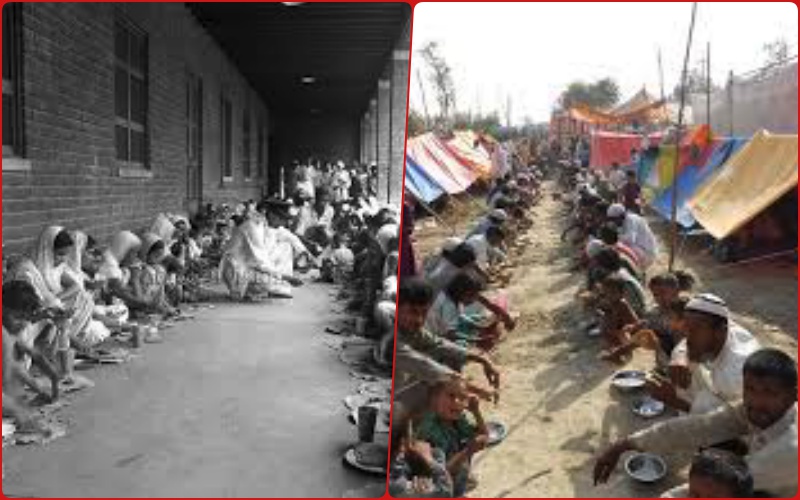
It is sad that we refuse to learn; instead, we seem to be intoxicated with the same violence—the same partitioned mind that makes it impossible to transcend the boundaries of territories and fractured consciousness. The ‘rationality’ implicit in this ‘pragmatic nationalism’, to use Michel Foucault’s language, excludes all sorts of ‘madness’. However, in that ‘madness’, I tend to believe, exists the domain of true sanity—the urge to overcome the divisive politics. Is it the reason that Manto could create a character like Bishen Singh in his classic story, Toba Tek Singh? This ‘lunatic’ mind fails to understand the logic of the politics of the nation-states, and their tight boundaries. Can Toba Tek Singh—the place where he used to have his home— be classified through the logic of the partitioned mind? Friends, feel the sanity in Bishen Singh’s madness:
When Bishen Singh was brought out and asked to give his name so that it could be recorded in a register, he asked the official behind the desk, ‘Where is Toba Tek Singh? In India or Pakistan?’
‘Pakistan’, he answered with a vulgar laugh.
Bishen Singh tried to run, but was overpowered by the Pakistani guards who tried to push him across the dividing line towards India. However, he would not move. ‘This is Toba Tek Singh,’ he announced. ‘Uper the gur gur the annexe the bay dhayana mung the dal of Toba Tek Singh and Pakistan’.
As officials from the two sides rushed towards him, he collapsed to the ground.
There, behind the barbed wire, on one side, lay India and behind more barbed wire, on the other side, lay Pakistan. In between, on a bit of earth, which had no name, lay Toba Tek Singh.
(Avijit Pathak is a Professor of Sociology at JNU)
This article went live on May eleventh, two thousand eighteen, at thirty minutes past seven in the morning.The Wire is now on WhatsApp. Follow our channel for sharp analysis and opinions on the latest developments.


