

Omar Abdullah Sets the Record Straight on Baisaran, ‘Normalcy’ in the Valley


The following is an excerpt from Harinder Baweja's memoir They Will Shoot You, Madam: My life through conflict, published by ROLI.
On 22 April, Omar was on his way to Jammu from Srinagar, when reports of the terror strike at Pahalgam first started trickling in. ‘I was told one had died and several had been injured but by the time I reached Jammu, I was told 26 had been killed,’ Omar told me when I spoke to him, in May 2025. He had by then received a call from Union Home Minister Amit Shah, and he soon returned to Srinagar to meet Shah.
When the Modi government responded with Operation Sindoor and used the Air Force to fire missiles that hit the headquarters of the LeT and the JeM, it was Omar once again, who was left staring at the debris of conflict. The pendulum swings without notice in Kashmir. It swung on 22 April at the Baisaran meadow and as Omar said, ‘A very dark cloud hovered over Kashmir.’ The terrorists, who asked tourists to recite the kalma, had also aimed their guns to provoke a communal conflagration and deepen the Hindu-Muslim fault line. The Kashmiris who have never taken to the streets to protest terror attacks – or even the migration of the Kashmiri Pandits – spoke up against the blood of their ‘guests’ being spilled on their soil.
Harinder Baweja,
They Will Shoot You, Madam: My life through conflict,
ROLI (2025)
The Kashmiri response was not debated in television studios. It was not, as the Mirwaiz Umar Farooq told me, ‘even acknowledged in Prime Minister Modi’s Mann ki Baat.’ Far from acknowledging the solidarity shown by the Kashmiri street, several hardline voices forced Kashmiri students and professionals to return to the Valley. Himanshi Narwal, who lost her husband, was viciously attacked after she pointedly said, ‘Don’t attack Kashmiris and Muslims.’ Jammu and Kashmir signalled for peace and stability and despite Omar’s categorical statement that not all Kashmiris are terrorists, New Delhi has paid scant attention to the one-in-a-lifetime opportunity to reach out to the alienated population. That has been Kashmir’s greatest tragedy. The windows of opportunity have always been frittered away. Everyone talks about Kashmir but nobody talks TO (emphasis mine) Kashmir.
All through the India-Pakistan military exchanges between 7 and 10 May, the border areas of Poonch, Kupwara, and Uri bore the brunt. As the country went into a hyper-nationalist mode, few spoke about the lives and livelihoods lost in the border areas. The leaders adopted a belligerent tone and television anchors conveniently played war games. Their microphones sounded like missiles. Some even aimed their ‘missiles’ at Omar, lending credence to the whisper campaign that tourist guides had accessed the Baisaran meadow without permission.
In an exclusive – and revelatory – interview with me for this book, Omar set the record straight. He’d perused all the files and said, ‘Let me set the record straight. Only last year [2024], the current lieutenant governor’s [Manoj Sinha] government issued a tender for Baisaran for three years and made it a ticket destination. The contract was given to a local businessman from South Kashmir, who in turn paid the LG’s government one crore rupee per year for ticketing rights. You don’t offer one crore a year for some place that’s only open for a month. It was open for eight to nine months in the year. The only time it closed was after heavy snowfall and during the Amarnath Yatra. There was an effort to feed sections in the media with the line that the tour operators opened it without permission.’
I asked him the question again, saying, ‘Let me clarify this once again, no permission was needed to open Baisaran?’ His reply was unequivocal. ‘I asked for all the papers, all the records. There is not a single piece of paper to suggest that written permission or any sort of permission was ever sought. And again, I make the point, Baisaran was bid and sold as a ticketed destination. I mean, my numbers are correct. More than 40,000 or 50,000 people had already visited Baisaran by 22 April. The number could be higher. Now, if it had been opened without permission, was the administration sleeping? Couldn’t they see 50,000 people trooping up the mountain on ponies? Show me a piece of paper where the police have said that Baisaran should have been closed or why it was open without permission... those demanding my government’s head in the studios are just ill-informed. They don’t know any better. They’re also cowards because it’s much easier to demand my head than to seek actual accountability.’
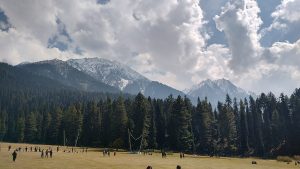
Baisaran valley in Kashmir. Photo: Wikimedia commons CC BY SA 4.0
Conflict is a great teacher. The din of the television studios drowned the voices seeking accountability. Nations and governments are free to respond to terror strikes but if another attack is to be prevented, hard questions must be asked. Why was there not a single man in uniform anywhere near the Baisaran meadow? Kashmir is still a conflict zone. Why was the popular destination left unguarded? Why was there scant intelligence about the attack? Had the administration fallen victim to its own narrative of ‘everything is now normal in Kashmir’? Complacency is dangerous.
The erstwhile state’s future lies buried, not just under the weight of its past, but also in the uncertainty of its tomorrow. Pahalgam served as a reminder that Jammu and Kashmir remains a fault line that cannot be papered over. The levels of violence may have been down; its streets bereft of protests and stone pelters, but that cannot be mistaken for normalcy. The number of tourists visiting the Valley each year cannot be the yardstick to measure levels of normalcy. The absence of violence does not signal the advent of peace. The alienation is still crying out for a political initiative. There are indices, before and after Pahalgam that hold a mirror to the ground reality: the arrest of human rights defenders, the killings of Kashmiri Pandits and migrant labour, the liberal use of the PSA, and the weaponizing of dissent. There is a difference between dissenters and those who wield weapons.
Kashmir has always responded to outreaches by prime ministers, be they Jawaharlal Nehru, I. K. Gujral, P. V. Narasimha Rao, Atal Bihari Vajpayee, or Manmohan Singh. It is Modi’s turn to make one.
In the separate ruling, delivered by the Supreme Court upholding the scrapping of Article 370, Justice Sanjay Kishan Kaul called for an impartial investigation into human rights abuses in Jammu and Kashmir since the 1980s, when militancy took root in the beleaguered state. ‘I recommend the setting up of an impartial Truth and Reconciliation Committee to investigate and report on the violations of human rights both by the state and non-state actors perpetrated in J&K at least since the 1980s and recommend measures for reconciliation,’ Justice Kaul said.
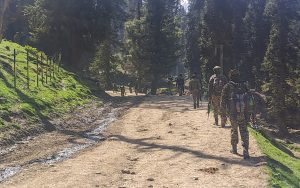
Security personnel during a search operation at Baisaran area of Pahalgam to nab attackers of the Pahalgam terror attack, in Anantnag district, Jammu and Kashmir, Wednesday, April 23, 2025. Photo: PTI.
‘To move forward, wounds require healing. Inter-generational trauma is felt by people. The first step towards healing the wounds is the acknowledgment of the acts of violations done by the state and its actors,’ he added. Jammu and Kashmir stands at an emotional crossroad, begging for attention. Several experts have recommended the way forward. Former R&AW chief, A. S. Dulat, author of several books, proposed – in an interview with me for The Times of India in 2023 – that Narendra Modi should go to Srinagar, drive around its streets and announce the restoration of statehood. ‘I can tell you, that if Modi does that, he will never feel the need to be protected by security guards after that,’ he said.
Lieutenant General Dua, the corps commander, who got a good taste of Kashmir when it exploded in anger after the killing of Burhan Wani, is also of the view that the alienation needs political redressal. In his book, A General Reminisces: A life under fire in Kashmir, Dua sticks his neck out and recommends what he calls a ‘bold suggestion’. He articulates an exit strategy for the army in Jammu and Kashmir and explains what he means thus: While recommending that the army continue be deployed on the LoC, he proposes that it be withdrawn from the hinterland. ‘The army can remain in a hand-holding role and continue to underwrite peace by remaining in their hubs and bases in case the situation turns ugly.... This transition cannot happen in a hurry, but merely by articulating it, we will create more stakeholders in the peace process. Today, sadly, every aspect of the situation in Kashmir seems to be outsourced to the army.... The political process must start as soon as possible, giving expression to the political aspirations of the populace....’
Soldiers seldom speak of political processes or political aspirations, but there are several ways forward if New Delhi is seriously committed to making the territory of Jammu and Kashmir into the Union of India. For the present, the task lies at Modi’s door. Lieutenant General D. S. Hooda, who headed the Northern Command and has studied Kashmir closely, also recommends a political outreach and warns against the use of force to settle what is essentially a problem that requires New Delhi to gain the trust of people. ‘It cannot be viewed just as a piece of real estate,’ he cautions.
Will Modi make a bold move or has Pahalgam shut the door to that initiative? When I read about External Affairs Minister S. Jaishankar having spoken to his counterpart in Afghanistan, I couldn’t help wonder why the government was willing to speak to the Taliban, a force once guilty of shielding Osama bin Laden, but not to its own citizens in Kashmir.
It is difficult to write the last word on the destiny of Jammu and Kashmir that has continuously swung between hope and hopelessness. The surgical strikes after Uri (2016) and Pulwama (2019) did not deter the terrorists or their masters. Will Operation Sindoor put an end to terrorism? Omar is of the firm belief that ‘Jammu and Kashmir is not normal and you can’t just wish normalcy. Normalcy has to be created, and the fact is that you can’t also normalize Jammu and Kashmir without taking the people along with you.’
The people made their voices count. The anti-Pakistan sentiment was crystal clear after Pahalgam. An anguished Farooq Abdullah, in an interview with me, said, ‘Pakistan will not get Kashmir. They can keep trying for a thousand years.’ The last word on Jammu and Kashmir lies in the distant future. It, in fact, may not be written in my lifetime.
This article went live on September thirtieth, two thousand twenty five, at thirty-seven minutes past four in the afternoon.The Wire is now on WhatsApp. Follow our channel for sharp analysis and opinions on the latest developments.


