

Premchand's 'Oldest Hindi Manuscript' Found in the Archives of Nagari Pracharini Sabha


The practice of maintaining and preserving archives is nearly missing from scholarship on Hindi literature. The papers of its eminent writers are either forgotten, or remain largely inaccessible to researchers. Under the leadership of Vyomesh Shukla, an extraordinary poet and prose writer of his generation, the Nagari Pracharini Sabha of Kashi has recently initiated a significant venture to upgrade its archives. He recounts this momentous finding of rare manuscripts of Premchand that enrich the Hindi language and society. Today, July 31, is Premchand's birth anniversary.
One
The great Hindi novelist Premchand has had a profound bond with the oldest institution of Hindi language-literature and the Nagari script, the Nagari Pracharini Sabha. A lesser-known chapter of this illustrious relationship has recently come to light, which is surprising not only for the residents of Kashi but also for Hindi scholars. During the process of gathering the neglected and decaying records located within the Sabha premises, we discovered several documents penned in Premchand’s own handwriting.
It did not take us long to examine and ascertain that these are manuscripts of his stories, which he had submitted to Acharya Mahavir Prasad Dwivedi, the legendary editor of the Hindi magazine Saraswati, during the first two decades of the 20th century. The first set of documents has four pages of his short story ‘Panch Parmeshwar’; while the second is a complete 41-page manuscript of his short fiction ‘Ishwariya Nyaya’.
Both these works are among his earliest contributions to Hindi literature. Since the restoration efforts are still on, it is possible that we may uncover his letters and manuscripts of other stories and letters in the repository of the Sabha. We are hopeful.
The aesthetic and historical significance of ‘Panch Parmeshwar’ can’t be overestimated. Prior to this, only a few of Premchand’s stories were published in Hindi. One such story appeared in the Vijayadashmi edition of Pratap (1914), which is referenced in a letter, dated 4 September 1914, written by Premchand to Munshi Dayanarayan Nigam, the editor of the Urdu journal Zamana. In this correspondence, he writes: ‘I have been compelled by Pratap’s insistence to compose a brief story in Hindi for its Vijayadashmi issue. I don’t know how to write in Hindi but I put pen to paper anyhow.'
However, there is no mention of any story published in Pratap in the appendix of 'Kalam Ka Sipahi’, Premchand’s authoritative biography by his son Amrit Rai.
Before 'Panch Parmeshwar' (June 1916), 'Saut' (December 1915) and 'Sajjanata Ka Dand' (March 1916) had been published in Saraswati. Dwivedi had entrusted the files of all published and unpublished works of Saraswati to the Nagari Pracharini Sabha for preservation. However, over time, the Sabha’s authorities couldn’t adequately care for these papers, resulting in the destruction or misplacement of many documents. We remain hopeful that some of these papers still exist, and the manuscripts of 'Saut' and 'Sajjanta Ka Dand' would also be unearthed.
It, however, can be safely stated that as of now, the manuscript of 'Panch Parmeshwar' is likely the oldest existing handwriting document of Premchand in Hindi. The Sabha is proud to have restored its original version in its archives.
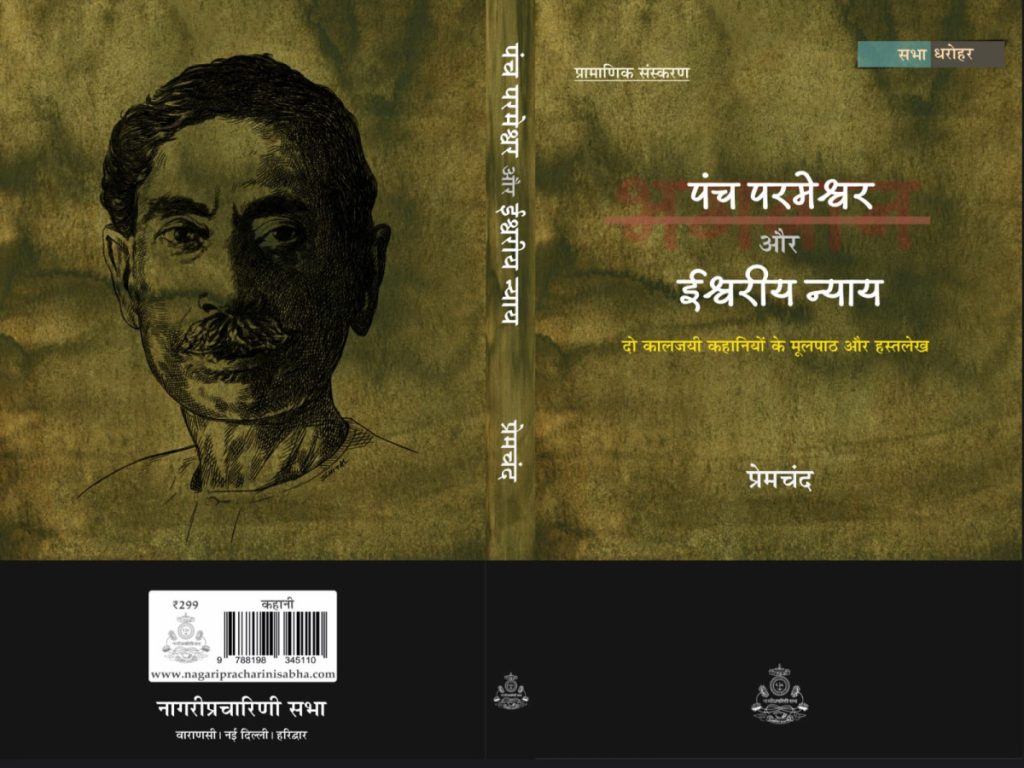
The Sabha has recently published a book, Panch Parmeshwar Aur Ishwariya Nyay. What was once rare and unavailable is now accessible and in the public domain.
Two
Before we continue with the manuscripts, let us reflect on the journey of Premchand and the Sabha to understand the path his manuscripts had taken to arrive at the Sabha’s premises from the desk of the novelist.
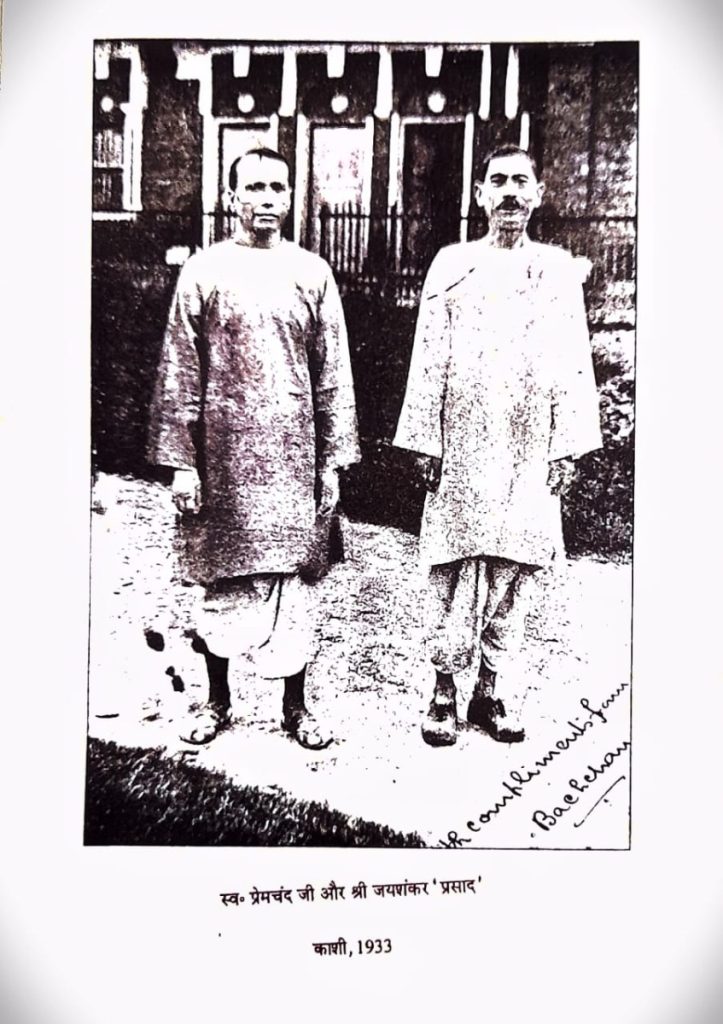
Once upon a time, Premchand's printing press was situated near the Sabha premises in Visheshwarganj, Varanasi. He would visit the Sabha regularly during his lunch break from the press. The renowned art museum – Bharat Kala Bhavan – had not yet relocated to Banaras Hindu University and was housed within the premises of the Sabha. The founder and guardian of that museum, Rai Krishnadas, would also be around. The two eminent personalities would meet regularly. Occasionally, Jaishankar Prasad, another giant writer of that era, would arrive from Nariyal Bazaar and join the group too. Pravasilal Verma served as the press manager for Premchand. A prolonged court litigation came to be recorded between Pravasilal Verma and Rai Krishnadas. Back then in Banaras, litigation was as addictive as kite flying and gahrebaazi (a local traditional horse cart race). The animosity stemming from legal disputes was confined to the courtroom and did not permeate personal relationships. Such gatherings would typically take place almost every evening at Rai Krishnadas's residence at Ramghat, where bhaang was the prime delicacy for consumption. Notable Hindi critics Acharya Ramchandra Shukla and Acharya Keshavprasad Mishra were regular attendees of those meetings for many years.
Subsequently, the Sabha established a new relationship with Premchand. Almost two decades after his death, his younger sibling Mehtab Rai assumed the role of the Sabha’s 'press manager' in the 1950s. Many old publications bear the inscription - 'Printer: Mehtab Rai, Nagari Mudran, Varanasi'. In due course, Mehtab Rai generously donated the ancestral land located in front of Premchand's birthplace in Lamahi to the Sabha. The donation letter is kept in the Sabha’s archives.
The donation letter was officially registered in the Banaras court on July 8, 1958, bearing the signatures of Mehtab Rai's sons – Shri Ramkumar, Krishnakumar, Vinaykumar, Nandkumar, and Kaushalkumar. Significantly, the 1470 square feet plot was not sold by Premchand's brother; it was gifted to the Sabha free of cost. However, shortly thereafter, some distant relatives of Premchand's family – Shri Shyamlal and Sanjeevan Rai – sold an adjacent 4,580 square feet of land to the Sabha for Rs 1,500. As a result, the Sabha acquired a total of 6,050 square feet of land for his memorial. This was all made possible through the generosity of Shri Mehtab Rai and the dedicated efforts of the then Prime Minister of the Sabha, Rajbali Pandey. On October 9, 1959, the then president Rajendra Prasad laid the foundation stone of the memorial. Tarashankar Bandyopadhyay, a renowned Bengali storyteller, presided over the event.
Following the laying of the foundation stone, the Sabha continued to host seminars and cultural events on the land annually on 31st July and 8th October. However, due to a dearth of resources, the Sabha couldn’t develop the premises in accordance with their plans. Nevertheless, a bust of Premchand was erected on the platform. The very next year – in 1960 – the memorial was inaugurated by Babu Sampurnanand, a prominent figure from Banaras, who was then the Governor of Rajasthan and a patron of the Sabha.
After a significant interval, in 2006, the Uttar Pradesh government created a blueprint for the comprehensive cultural development of Lamahi and requested the land from the Nagari Prachirini Sabha. The Sabha willingly offered the land to the government free of charge.
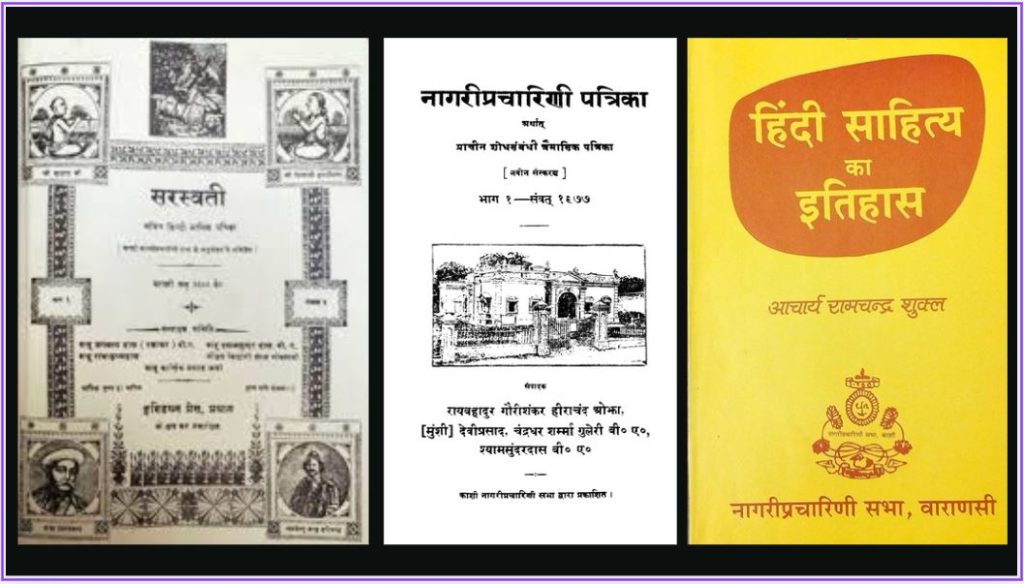
Some ublications of Nagari Pracharini Sabha.
Three
The Sabha shares another connection with Premchand that begins from the desk of Acharya Mahavir Prasad Dwivedi. Until now, this pathway has not been fully explored. In the early months of 1916 Premchand first turned his focus towards Hindi. Till then, he had been writing and publishing in Urdu. But the income from Urdu writings had dwindled. He had been observing the declining state of Urdu, which fuelled his growing interest in Hindi.
He, thus, began writing stories in Hindi. Between 1903 and 1920, Mahavir Prasad Dwivedi served as the editor of Saraswati. Under his editorship, seven of Premchand's stories were published in the journal: 'Saut' (December 1914), 'Sajjanata Ka Dand' (March 1916), 'Panch Parmeshwar' (June 1916), 'Ishwariya Nyay' (July 1917), 'Durga Ka Mandir' (December 1917), 'Balidan' (May 1918), and 'Putra Prem' (June 1920). He continued to publish his short stories in Saraswati even after Dwivedi had retired from his position as the editor.
I have previously stated that Dwivedi donated a collection of manuscripts comprising articles, translations, stories, and poems intended for publication in Saraswati to the papers of the Sabha. The collection represented an invaluable asset of literary history. However, between 1970 and 2023, due to the negligence of the Sabha's administrators, a significant portion of these documents was either destroyed or misplaced.
Fortunately, during a thorough cleaning of the Sabha premises a few months ago, we stumbled upon the manuscripts of Premchand's two classic stories—'Panch Parmeshwar' and 'Ishwariya Nyay.' The cleaning required both risk and caution, as some rooms had remained closed for 90 years. The dilapidated rooms had become habitats for snakes and scorpions, with one of our staff even suffering a snake bite.
Inside one building, banyan and peepal trees had taken root. Rooms had piles of papers covered in dust accumulated over at least seventy years, with few willing to enter the premises. However, the young staff of the Sabha carried out the task with enthusiasm and meticulous care. Every item was scrutinised, separating the valuable from the waste. Although many precious items had succumbed to the ravages of time, numerous artefacts were preserved.
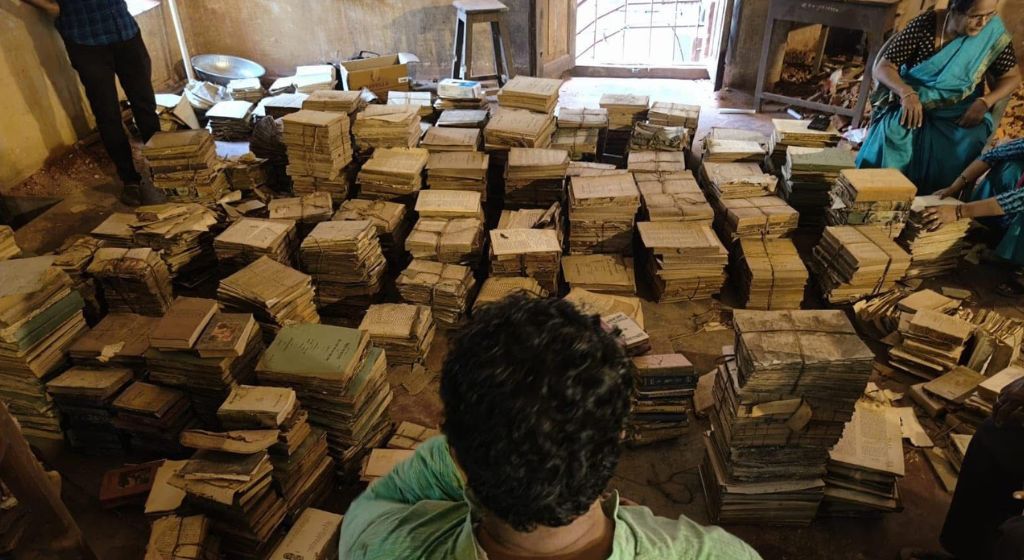
Pile of documents in the assembly hall. Photo: Shashwat
Discovered by our young team, the manuscripts of the two short stories are a remarkable gift. It is quite a coincidence that 132 years ago, three teenagers—Babu Shyamsundar Das, Ramnarayan Mishra, and Shivkumar Singh—established the Sabha; and today another group of teenagers was instrumental in this revival.
The manuscript of 'Panch Parmeshwar,' written nearly 110 years ago, is incomplete, whereas the manuscript of 'Ishwariya Nyay' is comlpete. 'Panch Parmeshwar' was later published in Premchand's collection of seven stories titled 'Saptsaroj' (First Edition, 1927, Publisher: Hindi Book Agency, 203, Harrison Road, Calcutta). 'Ishwariya Nyay' appeared in another collection of seven stories called 'Saptasuman' (Second Edition, 1931, Publisher: Nandkishore and Brothers, Booksellers and Publishers; Banaras City). It comprised simple, comprehensible and moral tales suitable for inclusion in the high school curriculum. In its preface, Premchand states:
Fiction occupies a significant position in contemporary world literature, a status it has attained only in the past decade. Almost all literature examinations include some collection of stories. One of my collections is part of the Intermediate and B.A. examinations. However, there was no collection appropriate for high schools. This collection has been published to address that deficiency.
In every era, certain forms of literature capture the public's attention. There was a period when Samasya-purti (verse-completion) was at the forefront. For an extended time, dramas held a prominent place in literature. Then emerged the age of novels. Currently, we are in the age of fiction writing. In magazines that do not have the stamp of any particular sect, fiction prevails. Both the youth and the connoisseurs of literature utilise stories as a medium to convey their messages and experiences. In today's world, there is no prominent literary figure who has not demonstrated their skill through storytelling. I hope that by engaging with these narratives, the youth will cultivate refined tastes and appreciate the works of the world's esteemed fiction writers.
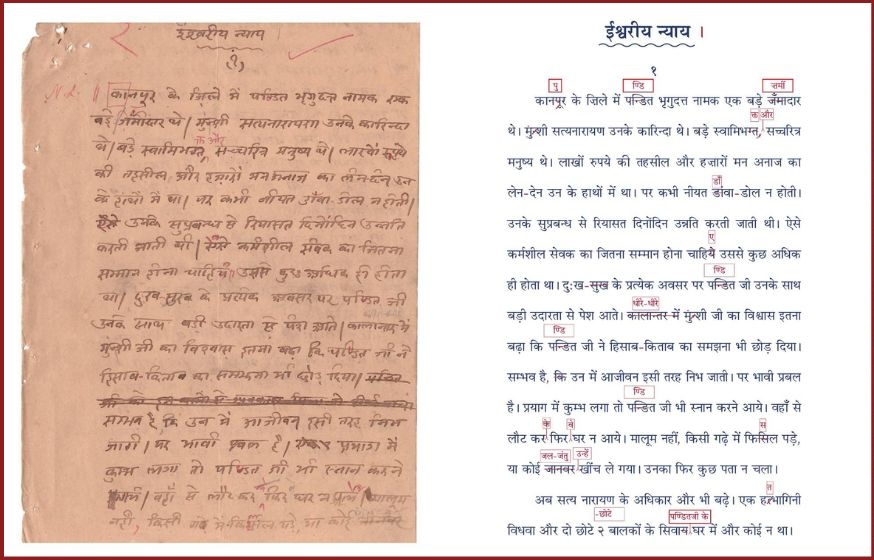
The narrative of these stories is, in Premchand's own words, 'appropriate for high schools', easily understandable, and serves as a source of moral inspiration for adolescents. This aspiration for clarity and simplicity in language was a goal shared by Premchand and his contemporaries.
The ideal can be seen through the revisions made to his stories by his editor, Mahavir Prasad Dwivedi. Dwivedi altered Premchand's 'kaalantar(कालांतर)' to 'dheere-dheere (धीरे-धीरे)', 'swamibhagt (स्वामिभग्त)' to 'swamibhakt (स्वामिभक्त)', 'dharam (धर्म)' to 'imaan (ईमान)', 'vichaar (विचार)' to 'khayal (ख़याल)', 'sashastra (सशस्त्र)' to 'shastrasajjit (शस्त्रसज्जित)', 'kewaad (केवाड़)' to 'kiwaad (किवाड़)', 'birla (बिर्ला )' to 'birala (बिरला)', 'algu (अल्गू)' to 'alagu (अलगू)', 'sakta (सक्ता)' to 'sakata (सकता)', 'huwa (हुवा)' to 'hua (हुआ)', and 'banne (बन्ने)' to 'banane (बनने)'. Numerous such amendments have been made, each accompanied by valuable insights. Even the title of the story 'Panch Parmeshwar' was given by Dwivedi, as the manuscript originally bore the title 'Panch Bhagwan'. Dwivedi replaced ‘Bhagwan’ with 'Parameshwar'.
The Sabha has published the two manuscripts in a recent book titled Panch Parmeshwar Aur Ishwari Nyay.
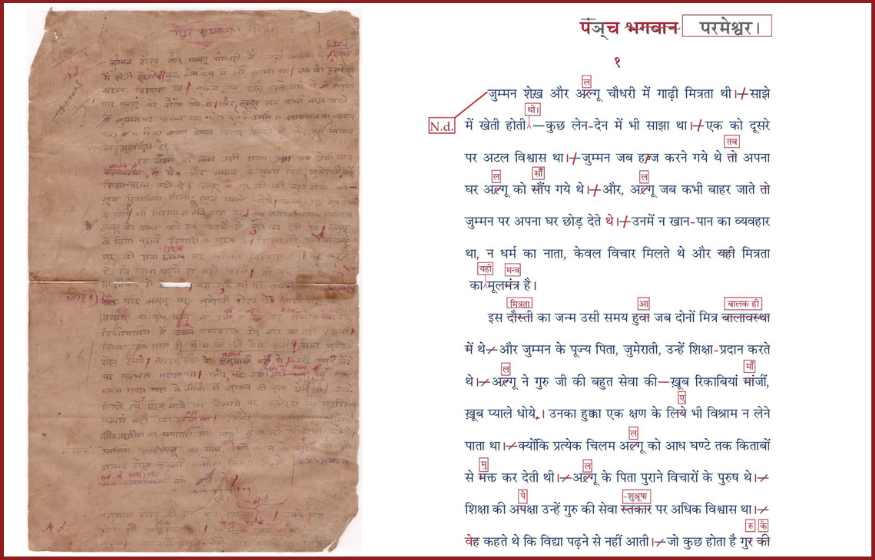
In this publication, alongside both stories, are also included the drafts submitted by Premchand for publication in Saraswati, along with the changes made by Dwivedi in those drafts in typewritten format. This allows readers to comprehend how writers and editors of previous generations engaged in a dialogue, which enriched both language and thought.
One could argue that this endeavour of the Sabha may count among exceptional literary publications. The renowned poet-critic T. S. Eliot's initial draft of the poem 'The Waste Land' was published in 1971, featuring revisions made by Ezra Pound. This volume, curated by Valerie Eliot and published by Faber & Faber, includes a collection of scattered poems and letters along with editorial footnotes.
Furthermore, it is not merely coincidental that the theme of justice is central to both the stories published; whether it pertains to the village panchayat or the urban court. The concept of justice represents the fundamental ideal inherent in every living being and serves as a vital law of creation.
The Nagari Pracharini Sabha is also inspired by this ethos. We are committed to take our literary heritage to the common reader, and introduce various methodologies for studying literature.
Vyomesh Shukla heads the Nagari Pracharini Sabha.
Translated from the Hindi original, which was first published on The Wire Hindi, by Naushin Rehman.
This article went live on July thirty-first, two thousand twenty five, at fifty-four minutes past five in the evening.The Wire is now on WhatsApp. Follow our channel for sharp analysis and opinions on the latest developments.


