

Should We Abandon the West?


Once we thought of the West as a place; but it is quite strictly speaking a non-place. It is as the French term Occident suggests, a cardinal direction at the same time as it is a solar metaphor derived from the setting sun. The perils of attempting a history of the idea of the West is not that the term is oversaturated with meaning, but rather proceed from the fact that the West is not simply one idea among others. In fact, the hidden core of Georgios Varouxakis’s book The West: The History of an Idea is the understanding that beneath the various uses of the term ‘West’, we can find a normative horizon that subsists, either implicitly or explicitly. This normative force is the capacity for self critical thinking, which is not just one idea but the very basis for thought itself. This makes the idea of the West an idea like none other.
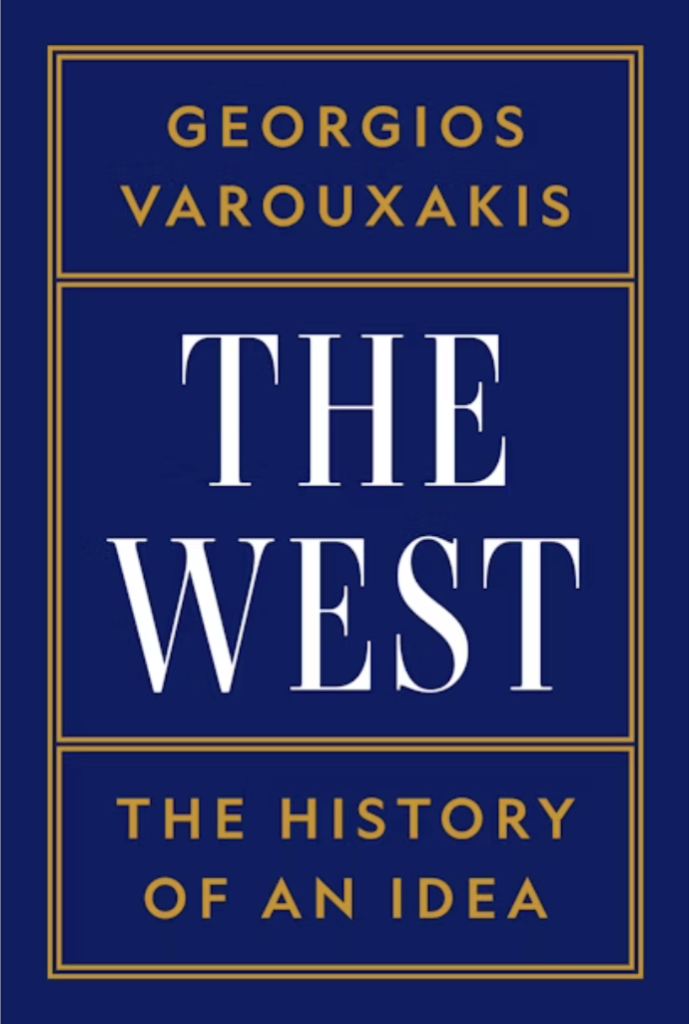
The West: The History of an Idea, Georgios Varouxakis, Princeton University Press, 2025.
The problem with this idea arises when this normative capacity is posited as an essential attribute or property of a racial community or people, which then leads to a historical process that critiques this essentialisation. And this movement will arise of necessity, since we have linked a universal capacity with a contingent metaphor. This self-critique plays itself out in historical time. It manifests itself in the shape of a Western critique of the idea of the West. And if that is so, then Varouxakis’s book (which participates in this larger critique made of the West from within the West) is not merely a history of the idea of the West; it is a defence of that idea, a defence of normative force itself as it has historically incarnated and embedded itself in the various uses of the contingent solar metaphor ‘the West’.
History of Ideas: Progressivism and Genealogy
A history of ideas usually occupies a place within a spectrum defined in its extremes by two poles: that of teleological progressivism on the one hand and genealogical analysis on the other. The two philosophers who incarnate these poles are both Germans from the 19th century: Hegel and Nietzsche. For progressivists like Hegel, an idea finds its way, incrementally sometimes, through qualitative leaps at others, to a more defined version of itself. Time hews away at it until it is finally what it was always meant to be. On the other hand, genealogical analysis as used by Nietzsche finds the different uses that an idea has been put to over time; rather than an idea being better shaped in modernity than in the past, different forces have taken it over and subjected it to different ends. The genealogy of the idea is as diverse and untotalisable as our own genealogies, which are always various, multiple and infinitely proliferating.
Varouxakis’s attempt to write the history of the idea of the west puts this neat intellectual schema in jeopardy. This for two reasons. First of all, it shows the limits of progressivism, since we cannot find the different uses of the idea of the West demonstrating any real logical progress from one to the other. Secondly, it also manifests the limits of genealogical analysis. This is because the very survival of the idea of the West, in the vast majority of its iterations, is nothing but an infinite demand for the normative force of self-critical thinking.
This is quite apparent to Varouxakis himself. In his conclusion to the book he is quite clear that his methodology of looking at the history of the idea of the West is genealogical; what he leaves unsaid is that the very idea he has been considering, the idea of the West demands and requires normative force as something intrinsic to both its own self-definition as well as operation. This tension between the method and the project is not, however, Varouxakis’s own conundrum: it is in sum the paradox of the West itself, caught between assuming the force of self-critical thought that makes it the exception and the example among civilisations, and an inevitable self-aggrandisement which leads to racist, supremacist, and even fascist tendencies that are then critiqued in their turn.

The ancient occident of the Roman Empire. Photo: This file was provided to Wikimedia Commons by Geographicus Rare Antique Maps, a specialist dealer in rare maps and other cartography of the 15th, 16th, 17th, 18th and 19th centuries, as part of a cooperation project.
Why the ‘West’ and not ‘Europe’
Varouxakis’s major contributions in the book are to challenge the facile assumptions guiding our definition of the West: as if it is a continuous line from ‘Plato to NATO’, or something crafted in opposition to Oriental Asia and Islam, or even something that emerges relatively recently, either during the period of high European imperialism in the 1890s or after the Second World War. For Varouxakis, the idea of the West or L’Occident emerges in a specific historical period and in the works of a unique thinker: the positivist sociologist from the 19th century, Auguste Comte. It was Comte who was the first to use the term ‘Occident’ and ‘Occidentalite’ as a unity and developed a sense of Western political unity based on a cultural commonality. Before Comte it was the more natural geographical division of Europe between North and South that was considered more significant, as it is even today, with the distinction between Global North and Global South being more important now than ever before.
Yet what is of greater interest is that in transforming this geographical distinction between North and South Europe into a cultural distinction between East and West, Comte remained faithful to the idea of a division within Europe rather than one between Europe and its other. This is exactly Varouxakis’s point: the West is not synonymous with a Europe opposed to the East or the Orient, but an inter-European distinction, made between the peoples and cultures of Western Europe (France being its centre) and Russia. Thus in the chapter titled “The West as an Alternative to Europe in the nineteenth Century” Varouxakis recounts the origin of the term West as firmly based in opposition to the growing might of the Russian Empire: “it was primarily in contradistinction to Russia that the term ‘the West’ was to be needed, to replace ‘Europe’”.
While there were many before Comte who used the term Occident in the early 19th century, they did not make as neat a distinction between Europe and the West as Comte did. It was the latter who fully articulated a supranational and cultural conception of the West in opposition to Russia, and thus as another name for Europe itself. Comte’s West had France and Latin Europe at its core and Britain and the Americas as its periphery; but it was not simply a political and cultural division of Europe into East and West, but part of a larger theological and political project which he called ‘The Religion of Humanity’. This was supposed to be a glue binding society together, based not on dogma and mystery, but on truth, the only truth Comte held to be acceptable: that of science. A scientific religion, then, was the normative horizon that bound together the West as a political, cultural and above all spiritual entity that would usher in the end of European empires and the rise of a common civilisation of Humanity.
The West as Spirit and the Spirit of the West
Throughout Varouxakis’s book, it is this spiritual aspect of the West, its projection of a normative horizon that remains a constant in all definitions and redefinitions of the term. In his chapter on how Britain became part of the West, we find British writers like the historian Edward Freeman, opposing East and West on the basis of freedom and tyranny, civilization and barbarism. But the uses of the term in Britain were often inchoate and confused; it was only the British followers of Comte who were able to impose the meaning developed from their master, one which was anti-imperialist and therefore not in the service of legitimizing Britain’s vast empire as has usually been thought.
When America joined the ranks of the West, it too had to do so by resolving a tension between the West as a racial term (Cis-Caucasian in the writings of the Americanised German writer Francis Lieber) and as a normative term as used by the 20th century columnist and journalist Walter Lippmann, who coined the phrase ‘the Atlantic community’. In the same way, in the chapter on the First World War, Varouxakis recounts how it is the German novelist Thomas Mann who makes a pivotal distinction between Kultur and Zivilization, placing Britain, America and her allies on the side of Western civilisation as reason and moderation, against Germany as the last revolt of culture against the universal civilizing mission being carried out by the West. Around the same time, Oswald Spengler, author of the famous two volume work The Decline of the West highlighted how the Western consciousness “feels itself urged to predicate a sort of finality inherent in its own appearance” even if that is simply a fiction belied by the fact that every culture, including that of the West, transforms itself into a civilisation as its inevitable and periodically ordained end.
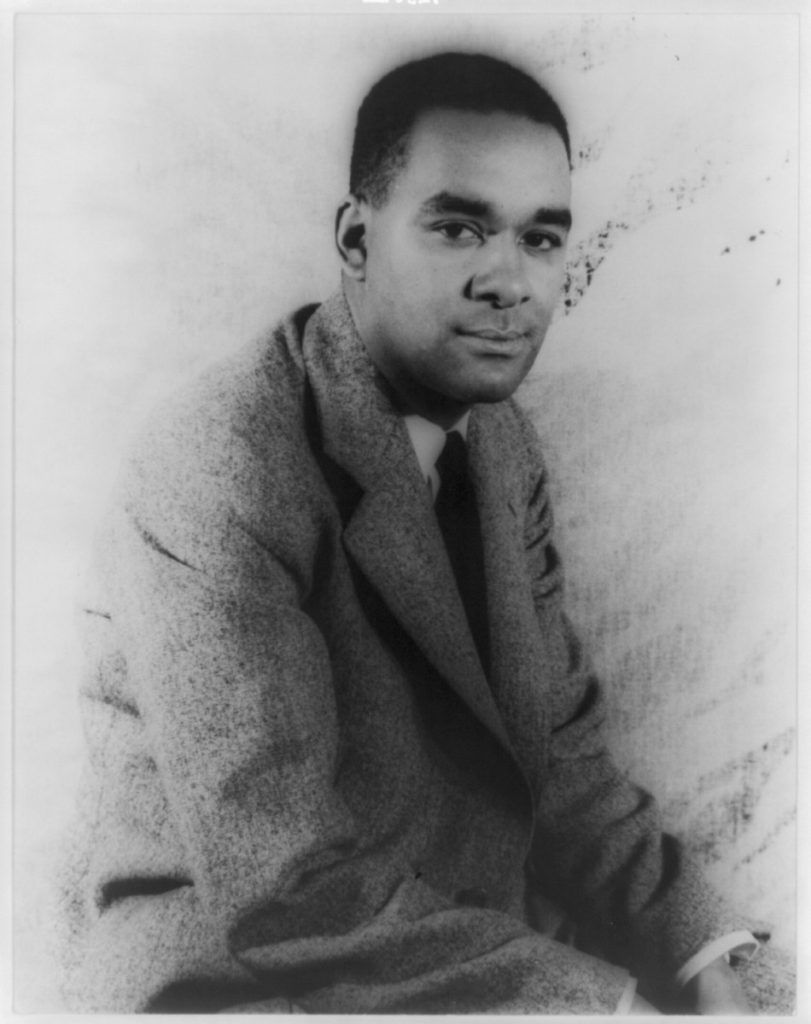
Richard Wright in a 1939 photograph by Carl Van Vechten. Photo: Public domain.
Similarly, in the interwar years as well as during the Second World War, the defence of the West took various forms, comprising different, sometimes incompatible blocs that composed the ‘West’. Yet at the heart of this was a defence of Western civilization, not simply as a political force but as a spiritual ethos threatened by the barbarism of Russia or Communism, by the Orient’s irrationality, or by rampant Americanisation as the case may be. In the Cold War, the hardening of borders and ideological blocs might lead us to believe that the West simply became a geographical term, but rather as Varouxakis traces the intricate lines joining Cold War intellectuals ranging from the German Jewish émigré Hannah Arendt to the French anti-communist intellectual Raymond Aron, it is the capacity for self-criticism that separates the West from the Rest. Even Richard Wright, a black American, self-educated in segregated and racist Mississippi, who escaped to Paris to write, defended the same civilisation that had racially oppressed him by appealing to its “chronically skeptical, irredeemably critical outlook”.
It is significant that throughout the history that Varouxakis recounts the term spirit recurs again and again when it comes to the question of the ‘West’. Rabindranath Tagore uses it in his lectures on nationalism, Thomas Mann uses it when he distinguishes between culture as the heritage of every people and civilisation as reason and moderation, the African American intellectual Alain Locke uses it when he is finding a lineage between black Americans and Egypt, even Henry Kissinger uses it in a memo he writes for the supervisor of his doctoral thesis, arguing for “spiritual resistance to Communism” as does the dissident Czech writer and intellectual Milan Kundera. This conjunction of the West with the term ‘spirit’ is so ubiquitous that Varouxakis himself has to note it in a parenthesis in the chapter on the Cold War.
This ubiquity of spirit, remarked in passing by Varouxakis but not rigorously considered, shows the limits of a genealogical analysis of the term ‘West’. We must remember that the philosopher of teleological progressivism is Hegel, the author of the monumental history of thinking titled The Phenomenology of Spirit. Spirit is the name for the normative horizon that is intimately linked with the term ‘West’ throughout its long and tortuous history. And in no way does Varouxakis seek to challenge that, despite his adherence to the genealogical method. His defence of the West is the defence of the West as spirit, as normative force and horizon: it is the spiritualisation of the West.
At the same time this normative horizon, the development of a fulfilled conceptual idea of self-criticality, depends for its consistency on a metaphor: a solar metaphor, L’Occident. This paradox is worth noting. In noticing this paradox perhaps we can begin to delink the metaphor that is the West from the normative horizon it projects, and retain, as Varouxakis piquantly puts it, the baby by throwing out the bathwater. Perhaps in order to save the idea of the West, we have to discard it as still too metaphorical, too limited to a particular geography, too provincial. Yet the paradox will persist, nevertheless: since even a new name will always be metaphorical, necessitating further historical critique. The end of the West, then, will not be the end of history.
Beyond the West: The Global South?
One has to commend Varouxakis for having gone through two centuries worth of literature on the idea of the West, providing close readings of authors as diverse as Comte, Walter Lippmann, Simone Weil, Tagore, Bergson, Thomas Mann, Francis Fukuyama, WEB Du Bois and T.S. Eliot. His erudition and scholarship, as well as his passionate zeal to uncover the tortuous paths by which this idea has travelled is admirable and shines through this monumental book. To be able to construct a coherent history of an idea that is so ubiquitous, that has been used by every pamphleteer and commentator, philosopher and demagogue, warmonger and peacenik alike is a monumental endeavour that sets an incredible example for what rigorous scholarship can still manage to achieve.
The book is a timely one. In 2025, the term West is already being sought to be replaced in academic and general parlance alike by a new set of terms and divisions: between the developing Global South and the developed Global North. In doing so we in the Global South are attempting to defuse the normative force of the term West, marking a return to more ‘natural’ divisions on the basis of geography, culture, civilisation and so on. The multipolar world that we will very soon inhabit will be one deprived of normative force, the force most often indicated by the term ‘West’. In that sense Varouxakis’s book is timely: it traces the history of the term at a moment when it is being overwritten by new terms. It is not simply a defence of the West, but a defence of the idea of the West as one which bears the capacity to be self-critical as something which is inherently universalisable and worth striving for.
In this shifting multipolar world, West is no longer a direction one looks towards. Yet it is to the immense credit of Varouxakis’s book that he alerts us to the dangers of wholly abandoning the West for terms that might seem more appealing such as the Global North and Global South. Perhaps our normative horizon might no longer be linked with the solar metaphor of the West; yet it is incredibly important for us to find new terms, new metaphors even, that would allow us to retain this self-critical force even if the ‘West’ has exhausted its spheres of possibility.
Huzaifa Omair Siddiqi is assistant professor, Department of English, Ashoka University.
This article went live on October eleventh, two thousand twenty five, at eleven minutes past seven in the evening.The Wire is now on WhatsApp. Follow our channel for sharp analysis and opinions on the latest developments.


