

The Double Life of Non-Alignment


"If the revolutions of the twentieth century tell us anything, it is that the peoples of the Third World have repeatedly refused the terms of domination handed down to them, and in so doing, they have written themselves into world history."
– John Foran, Taking Power: On the Origins of Third World Revolutions
It is one of the Modi government's great ironies: no leader is blamed more, and invoked more, than Nehru. For the Bharatiya Janta Party, he is at once the architect of every national failing and the unavoidable shadow against which its own claims of Vishwaguru are measured. At a time when headlines warn of foreign policy in free fall and strategic autonomy in tatters, Swapna Kona Nayudu's The Nehru Years: An International History of Indian Non-Alignment lands with bracing clarity. Far from the caricature of saint or sinner, Nayudu restores Nehru as an improviser of ambiguity, the leader who fashioned non-alignment into an armature of survival.
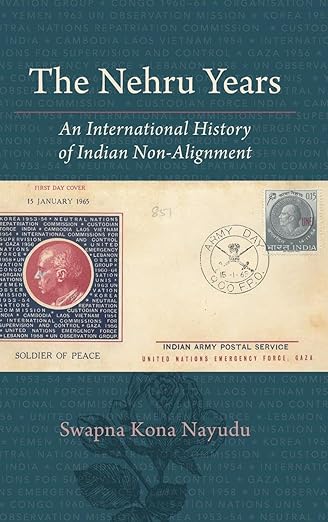
The Nehru Years: An International History of Indian Non-Alignment, Swapna Kona Nayudu, Cambridge University Press, 2025.
At the height of the Cold War, when politics seemed reduced to the grim calculus of security and the starkness of opposing blocs, India's founding moment offered an uneasy counterpoint. The Nehru Years asks what it meant for a newly independent state, perched in the centre of power yet resisting its binaries, to imagine solidarities and political horizons beyond the inevitability of conflict.
Nayudu's central claim is precise. Non-alignment, she argues, was never a fixed doctrine. It was an armature of strategic ambiguity that Nehru used to navigate Cold War crises. At times, it was constructive, opening space for India to mediate; at times, it was justificatory, defending selective choices; at times, it was coercive, legitimising intervention. By reconstructing Nehru's diplomacy through painstaking archival work, she demonstrates how this strategic ambiguity served both as a shield and an instrument, showcasing Nehru's diplomatic imagination.
Her archival excavation deepens the paradox of the present: the very framework the government disowns is the one it still practises, underscoring the enduring relevance of India's foreign policy.
This is not hagiography. The Nehru who emerges is less prophet than improviser, balancing principle and expediency in conditions that offered no easy consistency. The book's achievement is to restore contingency to history: Nehru's choices appear as decisions made under pressure, not abstract ideals betrayed by later leaders.
A lonely furrow
The story begins with Nehru's intellectual inheritance. Nayudu traces his foreign policy to Tagore's cosmopolitan humanism and Gandhi's ethic of non-violence. From these sources, Nehru derived the conviction that India's diplomacy should be morally distinctive, resistant to the Cold War's binaries. The furrow was lonely because ambiguity was mistrusted by both superpowers and misunderstood by many allies.
Nayudu insists that ambiguity was innovation, not indecision. It created diplomatic space for a post-colonial state to act with autonomy. Here, her narrative resonates with A. P. Rana's theoretical distinction between "principled" non-alignment – an ideology of autonomy and solidarity – and "instrumental" non-alignment, a tactical method of manoeuvre. Nehru's early vision aligns with the principled register: ambiguity as a form of ethics.
Nayudu's archival reconstruction in 2025 can be read as the empirical counterpart to A. P. Rana's normative framing of India's foreign policy in the mid-1960s at the Graduate Institute in Geneva. A pioneering theorist of international relations, Rana transformed his doctoral thesis on non-alignment and the balance of power into the celebrated monograph The Imperatives of Non-Alignment: A Conceptual Study of Nehru's Foreign Policy Strategy in the Nehru Period (1976), later hailed as a classic in a 1981 issue of International Studies.
The Korean War provided the first significant test. In 'The Outbreak of Peace,' Nayudu reconstructs India's role in negotiating the armistice and prisoner-of-war arrangements. Without hard power, India nonetheless became a trusted intermediary. Its abstentions at the UN were not abdications but calculated silences that created credibility. This was ambiguity as mediation. India's rhetoric of sovereignty and humanitarianism gave it a voice heard by both Washington and Moscow. Abstention allowed participation without entanglement. Again, here Rana's categories illuminate this: instrumental tactics (abstention) served principled ends (peace and autonomy).
The Korean episode shows non-alignment at its most constructive. Ambiguity was a resource, enabling India to punch above its weight in great-power negotiations.
The fog of war
Nehru’s political enterprise rested on a conviction in the indispensability of the state, a sharp departure from the Gandhian and Tagorean suspicion of nationhood, which he redefined not as a derivative of European sovereignty but as a form capacious enough to hold India’s paradoxes while navigating a Western-dominated order. Non-alignment, in this light, was less the theory itself than its operationalisation: the foreign policy modality through which Nehru sought to translate his vision of a sovereign, ethically responsible state into practice. If the theory was expansive, projecting the state as both necessary and reimagined, the practice was constrained – its successes visible in India’s mediatory diplomacy at the UN and its failures in the ambiguities of Hungary, the reversals in Congo, and the 1962 debacle with China. To conflate the two is to miss the nuance: Nehru’s theory of the state was an audacious intellectual wager that politics need not be doomed to empire or bloc, whereas non-alignment was the pragmatic armature by which this wager was tested, contested, and often diminished in the fog of Cold War realities.
The simultaneity of ethics and evasion becomes most evident in 'The Fog of War,' which addresses the dual crises of 1956. At Suez, Nehru denounced Anglo-French aggression against Egypt with moral clarity. In Hungary, he remained hesitant to condemn Soviet repression. The juxtaposition invited charges of hypocrisy. Nayudu does not reduce this to a verdict. She reconstructs Nehru's improvisation, showing how he attempted to reconcile universalist principles with geopolitical necessity. Ambiguity here was not creative but equivocal. What had been enabling in Korea now looked like evasion.
Rana's vocabulary again clarifies the dilemma. Principled non-alignment required condemning both imperialisms. Instrumental non-alignment demanded restraint to preserve relations with Moscow. Nehru attempted both at once, and the result was simultaneity that satisfied no one.
This chapter captures the fragility of Nehru's project. Nehru’s state was imagined in theory as a sovereign promise, but non-alignment was the battlefield where that promise was forced to reckon with history. It reveals how difficult it was to sustain moral rhetoric when survival depended on strategic hedging, and how quickly ambiguity could slide from innovation to compromise.
The Congo crisis
The Congo crisis of 1960-65 stands as one of the most turbulent episodes of decolonisation, a crucible where the aspirations of African independence collided with the Cold War's ruthless contestations. Within weeks of proclaiming independence from Belgium, the Congo spiralled into mutiny, secession, and foreign intervention. Patrice Lumumba, the charismatic first prime minister, became the symbol of a continent's hopes and the victim of its betrayals, assassinated with Belgian complicity and under the shadow of Western paranoia. The United Nations dispatched one of its largest peacekeeping missions, drawing in newly independent states like India, which sought to balance the rhetoric of decolonisation with the complex realities of enforcement. For Nehru's India, the Congo became the stage where the idealism of non-alignment met the perils of coercive power.
If one wishes to glimpse not just the geopolitics but the cultural texture of that moment, Johan Grimonprez's film Soundtrack to a Coup d’État offers a remarkable entry point. The Congo crisis thus lives on not only in the annals of international history but also in its visual and sonic afterlives, a reminder that decolonisation was narrated as much through images and rhythms as through cables and treaties.
The Congo crisis marks the point at which ambiguity turned coercive. In 'Bad Ethics and Worse Policy,' Nayudu details how India, presenting itself as champion of decolonisation, contributed one of the largest contingents to the UN mission. But as the operation became entangled in the violent politics of Katanga, Indian troops found themselves enforcing order rather than simply maintaining peace. The ethic of peacekeeping gave way to accusations of hypocrisy. African states criticised India for aligning with Western interests; opposition voices at home accused Nehru of betraying his own ideals. Nayudu's judgment is pointed: ambiguity here functioned as justification rather than principle. What had begun as solidarity became coercion.
In Rana's terms, the instrumental had absorbed the principled. The structural logic of ambiguity now authorised practices far removed from its original ethos.
Why the book matters
The chapters draw on Nehru’s own signal phrases – 'a lonely furrow,' 'an outbreak of peace,' 'the fog of war,' 'patched-up unity' – to illuminate how his political thought navigated Cold War turbulence in Korea, Suez, Hungary, and Congo. By overlooking Nehru’s translation and redefinition of the state, we risk reducing his project to a reactive foreign policy rather than recognising it as an original attempt to articulate sovereign agency and ethical responsibility for the postcolonial world.
The five-page epilogue crystallises the book's thesis. Nehru did not leave behind a doctrine but a structural code of ambiguity. This allowed India to act with agency in a hostile world, but it also exposed it to charges of inconsistency. It enabled mediation yet legitimised evasion. Nayudu insists that ambiguity must be understood as repertoire rather than pathology. For states without overwhelming power, ambiguity is often indispensable. The uniqueness of India was to elevate it into a principle of diplomacy.
Nayudu's book is elegant and deeply researched, but it also invites further questions. The first concerns accountability. If ambiguity has no internal mechanism for self-limitation, how does one distinguish between creative silence and evasive alibi? By showing how ambiguity shifted from constructive to coercive, Nayudu gestures at this problem but leaves it unresolved.
The second concerns Nehru's blind spots. While the book highlights his moral debts to Tagore and Gandhi, it pays less attention to the limitations of his universalism. In the Congo, for instance, Nehru underestimated the racial and colonial dimensions of the conflict. His universalist rhetoric sometimes muted the specificities of African decolonisation.
The third concerns contemporary resonance. Nayudu gestures to the continuities between Nehru's lexicon and present practice – abstentions on Ukraine, equivocations on Gaza, hedged commitments in the Indo-Pacific – but the engagement is implicit. A more explicit dialogue with India's current foreign policy would have strengthened the conclusion.
Despite these open questions, The Nehru Years is a significant contribution. It rescues non-alignment from caricature, neither idealising it as visionary doctrine nor dismissing it as evasive opportunism. By tracing how ambiguity mutated across crises, Nayudu provides a map of how a post-colonial state carved agency from asymmetry. For contemporary debates, this matters. Critics of India's abstentions on Russia or its hedging on Gaza often reduce them to hypocrisy. Nayudu shows that this doubleness is structural. It is not an aberration but an inheritance. The grammar of ambiguity remains the mode through which India navigates international order.
The result is a book that will not satisfy those seeking either vindication or condemnation. Instead, it offers something more valuable: a critical map of how ethics, power and mediation changed meaning across the arc of Nehru's diplomacy. In doing so, it illuminates not only a pivotal period in India's past but also the armature that continues to shape its present.
The book ultimately shows that non-alignment was never just posture: it was Nehru’s wager that politics was not doomed to the binaries of empire or bloc, but could be reimagined through the state as a vehicle of autonomy, dialogue, and moral purpose—even if that vision proved fragile over time.
If A. P. Rana gave us the theoretical vocabulary to parse non-alignment's doubleness, then Nayudu now provides the archival anatomy of how it was lived. Together, they remind us that ambiguity is not a failure, but rather a condition of survival and agency in a divided world. The Nehru Years redeem Nehru not by defending him, but by showing how his imagination continues to shape India's foreign policy. In the face of ritual denunciations, this is the most subversive vindication possible: Nehru's relevance endures precisely because the syntax of his diplomacy remains intact.
Narendra Pachkhédé is a critic, writer and essayist who splits his time between Toronto, London and Geneva.
Disclaimer: Pachkhédé studied International Relations under A.P. Rana in the 1980s.
This article went live on September seventh, two thousand twenty five, at forty-one minutes past nine at night.The Wire is now on WhatsApp. Follow our channel for sharp analysis and opinions on the latest developments.


