

The Nightmare in Gaza


The following is the writer Jessica Traynor's essay in the volume For Gaza: Art Against Genocide, edited by Jeet Thayil and Pascalle Burton. The anthology, published by Harper Collins, gathers a range of artists from across the globe who are using their work to show solidarity with Palestine, bear witness to the ongoing live-streamed genocide in Gaza, and hold power, complicity and silence to account.
§
The Nightmare
The dictionary has let me down. It turns out the word ‘nightmare’ has nothing to do with horses. The idea of bad dreams as horses galloping through our night-time hours resonates with me. But ‘mare’ comes from the old English ‘maere’, the word for a goblin who sits on a sleeper’s chest—an incubus or succubus. The Nightmare, the famous 1781 painting by Henry Fuseli, hedges its bets, depicting a squat gargoyle-like figure crouched on a swooning maiden’s chest, and a donkey-ish horse looking on from the shadows. Though called The Nightmare, the experience depicted is more akin to sleep paralysis, that strange phenomenon where we wake up unable to move. I’ve experienced this eerie sensation several times – waking with a shrill buzzing in my ears and panic rising as I realize I’m boxed in, a mind trapped in an unresponsive body. An experience represented in art dating back to Mesopotamian times, we now know that sleep paralysis ‘represents the blurring of lines between wake and REM sleep’, during which the mind might still be conscious, but the paralysis of muscles necessary for deep sleep has set in.*
But nightmares are a broader spectrum of experience. They can be full of stock horror-film tropes we’ve absorbed from the world around us, or troubling, uncanny images that spark terror in us as individuals, but are otherwise untranslatable. My earliest memory of a recurring nightmare was terrifying precisely because it was devoid of images, and seemed fuelled by a deeper knowing that had no access to the conscious level of thinking that translates sensation into meaning. For the purposes of writing about it, I have to translate the ideas in the dream into images, but they are only close approximations – weak symbols I’ve used to try and capture what I experienced.
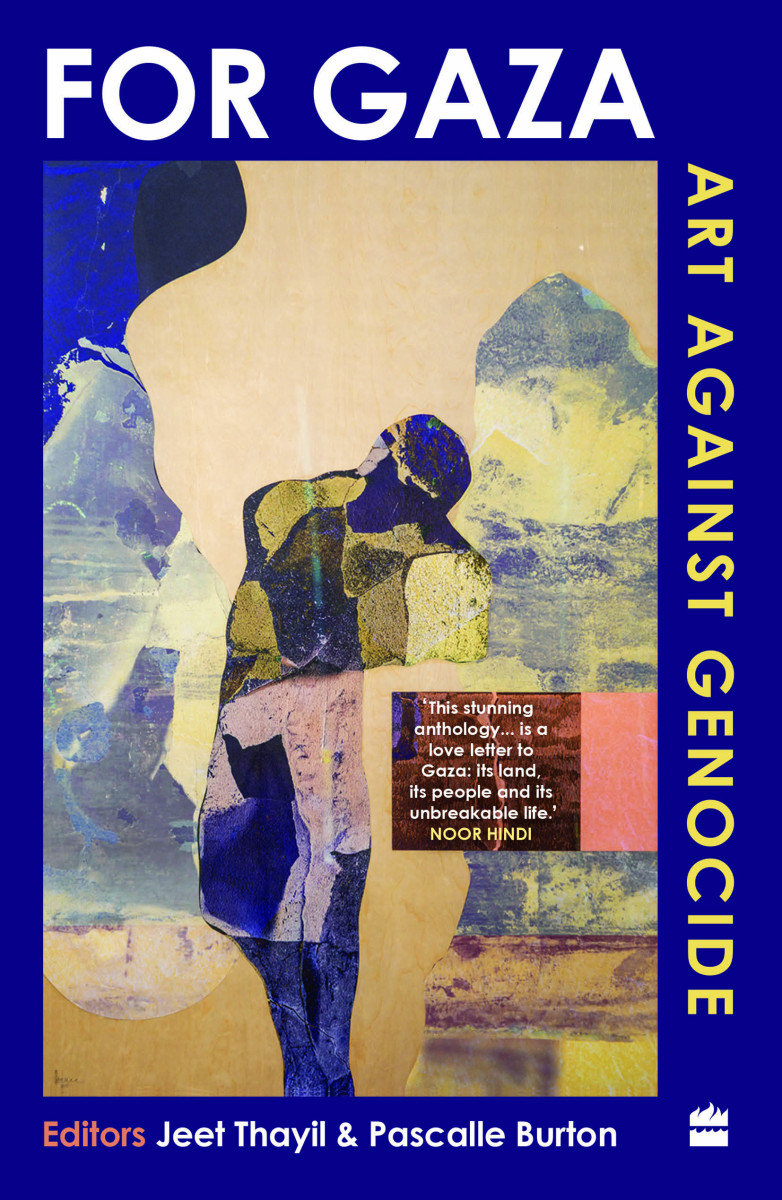
For Gaza: Art Against Genocide, edited by Jeet Thayil and Pascalle Burton, Harper Collins, 2026.
In the dream, I was in a desolate place. It was not a desert, but this is the nearest approximation I can think of. In it was a vast pyramid like form. The pyramid was about to be turned upside down, onto its tip, and I had to prevent that from happening. In the dream, I was both a floating geometric shape and a small child (I am often two things in dreams; I am the viewer and the character in the dream). There was nothing that could prevent the pyramid from being turned on its tip, and I would have to hold it up. Then, the pyramid turns above me, blotting out the sky, and bears down on my body. The pressure in my head builds and builds until I wake, but even though I’m back in my bedroom, the pressure is still there and part of me is trapped in the desert under the pyramid’s tip. I scream and scream, and it isn’t until my mum comes into the room that I wake properly.
When I think about this dream, the thing that strikes me is that I’ve spent so long trying to put language on it, that the version of it I tell myself has been infected with that language. But the real fear in this dream is about language’s irrelevance. There is a whole universe without language, and we are so reliant on words. Without it, what are we, and how are we to survive? When language fails, we have symbol. The inverted pyramid is the alchemical symbol for water. It’s the nabla or Phoenician harp. It’s an inversion in social order and hierarchy. It symbolizes the kind of epochal shifts that often leave small, crushed bodies in their wake.
What is the function of nightmares? Carl Jung suggests, of dreams in general, that the ‘language of dreams is a survival from an archaic mode of thought’. For Jung, the significance of our unconscious thought is just as great as those produced by our conscious minds. Dreams are subjective, filled with meaning constructed by the dreamer out of things we know on a conscious level and things we don’t realize we know. The nightmares I remember throughout my life all seem to hint at some evil worming its way towards the surface of reality—a very simple fear, but one that comes straight from the lizard brain. I know that there are not supernatural forces at work which shape my life and the lives of those around me. There are just selfish, petty, frightened, greedy individuals who manage to amplify their failures in a manner that causes mass destruction. We have all experienced these people or manifested these failings at times in our lives.
While I’m writing this, and the war on Gaza rages, I have a nightmare. I am spending time at a writing residency on the outskirts of Berlin, in Wannsee. The history of the villa where the residency is located is troubling. Owned by a Professor Paul Otto Rosin in 1935, it was seized by the Nazi government when he emigrated to England in that year. Transferred to the War Treasury, it was used by the German navy. And directly across the lake, invisible behind its screen of beech, poplar and willows, stands the House of the Wannsee Conference, where Hitler’s ‘final solution’ was agreed. On a sunny afternoon, I walk around the lake to visit it. I look at a cartoon from the London Evening Standard from the late 1930s. It depicts a line of Jewish families at a crossroads. The signs at the crossroads, variously struck out, point to Czechoslovakia, Hungary, Poland ... There is nowhere for these displaced people to go. The museum shows pictures of happy Jewish families who were later starved or slaughtered under the Nazi regime. Their happiness breaks my heart. I can’t understand how we get from these beautiful family portraits to the concentration camps, and then to Graeme Wood, a staff writer for the Atlantic in May 2024, writing ‘It is possible to kill children legally’. What knowledge have we synthesized from all this death? Jung tells us that if we don’t learn from our nightmares, they recur. While I walk back around the lake towards my residency, I read the local and European election campaign posters. The far-right AfD posters read, ‘ASYLCHAOS BEENDEN’—‘end the asylum chaos’.

Henry Fuseli's 'The Nightmare'.
In Rafah, 1.5 million Palestinians have been told to move again to Khan Younis, where the IDF have obliterated all infrastructure. They cannot leave Gaza. While I’m in Berlin, I attend a Nakba Day commemoration and marvel at the number of police trucks and the police in riot gear hanging around the periphery of a sedate crowd, who are listening to speeches in German and Arabic and English. I meet artists at the Irish embassy who are sharing information about fundraisers and Zoom meet-ups with artists trapped in Gaza. After one such event, a few other Irish and German writers and I stay up chatting for a while. When I sleep that night, my dream is a warped continuation of the evening. We are all sitting around the table, but some authority is telling us we have to go somewhere, to do something; what that is, is unclear. Outside the house, in the villa’s sweeping front garden, there is a long pile of autumn leaves, neatly gathered, ready for burning. But some of the pile has collapsed and blown away, and I can see protruding from the leaves the feet of a corpse—an old woman’s decaying feet. We are not supposed to know these bodies are here. We are all trying to communicate the situation to each other without speaking out loud.
The next morning I wake and scroll through Instagram at 5.30 am. I watch a video on Al Jazeera of journalist Bisan Owda walking around Khan Younis, talking to families trying to clear piles of rubble from the concrete shells of apartments that list alarmingly around them. Everything has been burned away. The lines of the concrete skeletons of buildings against the dust-hazed sky seem utterly alien. Two young boys, Ismail and Hamdan, show Bisan the shell of their apartment. They tell her that their father came back to check on their home and was killed in a vehicle along with sixteen others. They climb a collapsed wall to bring Bisan to the roof of their building to show her the view across an endless vista of broken concrete and twisted metal; now that the IDF has razed the city, they can see the sea.
Later, Bisan visits the Nasser Medical Complex, where she lived in a tent for seventy days before the IDF ordered its evacuation. She visits the mass graves behind the hospital where almost four hundred bodies have been found, some without heads, some without organs. Shroud wrapped corpses litter the ground, awaiting reclamation. A mother with a shovel comes every day and digs from 7.30 a.m to 4 p.m. She still hasn’t found her son.
As she walks the obliterated streets, Bisan says: ‘This cannot be real. I must wake up.’ A few days after I watch the video, Israel drops bombs on Rafah, incinerating forty-five people in their tents. The world watches a video of a man holding up a decapitated infant against a burning sky. Nothing in the image makes sense, not the orange of the night sky, not the wall of flames, not the man’s face deranged by horror, and not the baby with its head burned away. And yet, these things are real, and not a dream.
What do nightmares teach us? That we haven’t yet understood what we need to understand. And that we’re right to be afraid.
Jessica Traynor is a poet and poetry editor at Banshee. Her third collection Pit Lullabies (Bloodaxe, 2022) was a Poetry Book Society Recommendation, an Irish Times Book of the Year, a Guardian Best Read of 2022 and was shortlisted for the Yeats Society/ Irish Independent Poetry Prize. New Arcana (Bloodaxe Books) was published in 2025.
This article went live on October twenty-eighth, two thousand twenty six, at fifteen minutes past twelve at noon.The Wire is now on WhatsApp. Follow our channel for sharp analysis and opinions on the latest developments.


