

The Rise of Dravida Munnetra Kazhagham


When we study social movements, we often come across the question of how movements rooted in cultural and social reform transform themselves into durable political institutions. This transition can take various routes; many of these movements falter; they dissipate into factionalism, are co-opted by dominant elites, or accept their fate of remaining forever on the margins of formal politics.
However, the Dravidian movement and the rise of Dravida Munnetra Kazhagham (DMK) show us that a transition not only occurred, but succeeded so profoundly that it reshaped the contours of Indian democracy itself.
Born in the early 20th century, driven by the critique of Brahmanical dominance and entrenched social hierarchies, it achieved what many social movements aspire to: the transformation of societal reform into institutionalised political power.
The movement and its rise demonstrate that a politics of social reform, grounded in the empowerment of historically marginalised communities, could be successfully woven into the fabric of democracy.
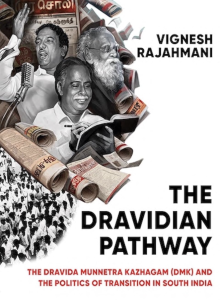
Vignesh Rajahmani,
The Dravidian Pathway: The Dravida Munnetra Kazhagam (DMK) and the Politics of Transition in South India,
C Hurst & Co Publishers (July 2025)
Two key questions
In The Dravidian Pathway, Vignesh Rajahmani undertakes the ambitious task of tracing one of the most striking political transformations in modern India. The meticulous data, which is a product of sustained fieldwork, adds enormous depth to the analysis.
By tracing the intellectual, organisational and ideological roots of the DMK’s politics, Rajahmani shows how questions of social justice, linguistic pride and anti-caste mobilisation were translated into policies of welfare.
As Rajahmani notes, there are two underlying questions. First, how and why does a socio-cultural movement transition into party politics, and second, which social groups, particularly in terms of caste, carry out and sustain this transition?
The book’s core argument is quite straightforward: that the DMK, since its inception and persisting into the present, has functioned not merely as a political party but as a force positioned against hegemonic forms of Indian nationalism.
Elections were never understood as ends in themselves but rather as instruments or tools employed by the party to advance broader cultural and ideological objectives. Rajahmani approaches the party as a transient formation, a political vessel that was shaped and reshaped by the broader Dravidian movement. The notion of transitivity further explains not only the DMK’s ability to challenge entrenched structures of power but also the flexibility with which the movement generated new forms of identity and opposition.
The book is equally attentive to the historical sociology of Dravidian identity. Rajahmani traces its formation, transformation and dissemination with considerable detail, showing how cultural idioms of “Dravidian-ness” were politicised and embedded into electoral practice.
A fascinating contribution of the book lies in its sociological mapping of electoral outcomes. By reconstructing the caste and community profiles of winning candidates across constituencies in the state elections between 1951 and 1967, Rajahmani provides a granular perspective on the changing social bases of Dravidian politics. This allows readers to grasp, with greater precision, the dynamics of inclusion and exclusion, success and failure, within the larger trajectory of the movement.
Any serious attempt to understand the necessity of a movement, or the logic behind its transition into formal politics, must begin with a careful consideration of its origins. The opening chapter explores the origins of the intellectual and ideological genealogy of the Dravidian movement.
He draws upon extensively on the vast body of scholarship on the Dravidian movement. Periyar’s ideas provided the base through which leaders such as C.N. Annadurai, M. Karunanidhi and later generations of DMK cadres could adapt and reframe the project of social justice within the political realm.
The intellectual inheritance from Periyar was never seamless or uniform but marked by adaptation and selective translation. Rajahmani also highlights Periyar’s“unusual” relationship with electoral politics, as he puts it. Periyar himself harbored a deep skepticism for electoral participation. For him, the logic of parliamentary politics was inseparable from compromise, opportunism and the risk of diluting the radical energy of a social reform movement.
Electoral contests, in his view, risked entrenching precisely the inequalities that the anti-caste struggle sought to dismantle. To this extent, Periyar insisted that the true work of the Dravidian movement was not to capture state power but to remake the foundations of social relations.
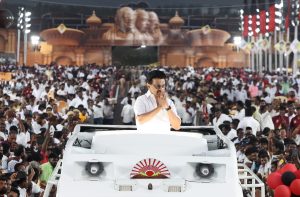
Tamil Nadu Chief Minister MK Stalin at DMK's 'Mupperum Vizha' event, in Karur, Tamil Nadu, Wednesday, Sept. 17, 2025. Photo: PTI
Yet, Periyar was not blind to the paradox. While he may have distrusted the compromises inherent in electoral politics, he nevertheless acknowledged its instrumental value as a medium for representation and as a vehicle through which the ideals of social justice could gain institutional expression.
Electoral politics, despite its risks, provided a means of cementing the principles of self-respect and equality within the wider political consciousness. This uneasy relationship ultimately set the stage for the eventual alliance and divergence between Periyar and Annadurai. If Periyar represented the uncompromising reformist strand of the movement, Annadurai embodied the recognition that political institutions could not be ignored.
One of the recurring and underlying themes of Rajahmani’s book is transitivity – the transient, plural and fluid character of the Dravidian movement. This capacity for adaptation, he argues, is what allowed the Dravidian movement to remain politically relevant. He also provides as an example: the support extended by sections of the Hindu Nadar community to the DMK. Their allegiance was due to the party’s symbolic integration of Tamil folk deities, apart from other concerns. By valourising these deities, the DMK offered a counterweight to Veda-based Hinduism, thereby creating space for communities marginalised by Brahminical orthodoxy.
The fissures between Periyar and Annadurai came to the fore at the time of India’s independence. For Periyar, independence signified little more than a transfer of power from the British to the Brahmin elite. Annadurai, by contrast, framed independence as a moment to honour the sacrifices of Dravidian lives in the freedom struggle, even as he concurred with Periyar’s critique of Brahmin domination.
The DMK’s trajectory thus reflects a dual inheritance of radical anti-caste reform and political pragmatism, and its subsequent success lay in its capacity to move fluidly between the two.
The significance of reading rooms
A very original and insightful part of the book is his study of padippakams or reading rooms. This chapter is particularly significant because much of the existing scholarship, as Rajahmani notes, on the dissemination of Dravidian politics has emphasised theatre, street plays and other forms as the principal sites through which the DMK mobilised the masses. Such accounts have rightly highlighted the role of orators, public speakers and dramatists in mobilising sentiment.
Yet, Rajahmani makes the case that the reading room deserves equal attention, through which the ideas of the Dravidian movement were internalised. He also likens these reading rooms to the addas of Bengal. He refers to the padippakams as offering access to a wider range of participants, including those who had been historically denied intellectual spaces.
The DMK drew increasing numbers of young activists with no prior political experience. Reading rooms became one of the conduits through which these new entrants encountered the ideological canon of the movement and internalised its messages.
For Annadurai, these spaces were indispensable: they fostered civic engagement, circulated the party’s ideology and functioned as training grounds for cadres. Another feature of the reading rooms was their lack of uniformity. Unlike formal party organs, these spaces allowed diverse discussions, allowing a wide spectrum of social discontent. Pamphlets, newspapers and journals published by Periyar, Annadurai and other leaders were readily available, alongside popular regional periodicals. Crucially, there were no formal entry barriers, which meant the social composition of readers reflected the DMK’s core support base among non-Brahmin castes.
Rajahmani includes vivid anecdotes that illustrate the inventiveness of Dravidian mobilisation. For instance, cartoons from DMK-affiliated newspapers were often pasted on the ceilings of salons so that customers could read them while being shaved.
A mass-mobilising political force
The numerical evidence related to recruitment that Rajahmani presents is striking. Between 1944 and September 1945, party membership grew by an astonishing 361%. In the following year, from September 1945 to July 1946, it expanded by another 45%.
These reflect a shift in the recruitment base of the movement, marking the transformation of the party into a genuinely mass-based political force. Within just 17 months of its formation, the DMK under Annadurai had already begun organising large-scale conferences.
Periyar’s reluctance toward electoral politics rested on his conviction that social movements, unburdened by the compromises inherent in the pursuit of power, were better equipped to advance the cause of Dravidian upliftment. Annadurai, aware of these concerns, did not abandon the social dimension but folded it into his or the party's political practice.
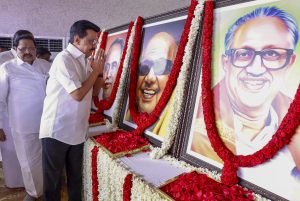
DMK President and Tamil Nadu Chief Minister M.K. Stalin pays tribute to his father and former M Karunanidhi as he arrives to participate in the party's General Body meeting in Madurai, Sunday, June 1, 2025. Photo: PTI
The scale of this mobilisation was staggering. By the 1950s and 1960s, an estimated 300 to 400 magazines and newspapers were produced by DMK cadres, a number that, if expanded to include small pamphlets and one-off compilations, could approach a thousand.
Despite its refusal to participate in the 1952 elections, DMK and the Dravidar Kazhagam (DK) nonetheless emerged as a formidable popular collective whose influence extended beyond the formal sphere of electoral competition.
Equally significant was the DMK’s recognition of the economic dimensions of subordination in mid-20th-century Tamil Nadu. The dominance of Marwari capital over trade, finance and commodity circulation was perceived not merely as an economic imbalance but as a continuation of caste-based hierarchies in new forms.
Yet, the DMK carefully resisted the temptation to endorse a simple transfer of monopolistic power to Tamil business elites. To do so, in their analysis, would have reproduced exploitation under a different ethnic-capitalist guise, leaving non-business-oriented communities vulnerable to renewed forms of dependency.
The Dravidian critique of capital was thus not reducible to ethnic rivalry; it was part of a larger effort to imagine an economic order aligned with social justice, redistribution and genuine empowerment. Any alliances with Tamil capitalists or sympathetic business elites had therefore to be situated in this broader ideological frame, rather than as mere tactical accommodations.
Entry into the electoral fray
At the 1956 conference, the DMK resolved to enter the electoral fray with a clear manifesto. Significantly, the promises articulated therein shifted attention from abstract principles to issues of immediate material relevance: land reform, free secondary education, minimum wages, the construction of a classless and casteless society, etc.
The results of these elections marked a decisive shift. Congress was compelled to adopt increasingly Dravidianised politics. It was also during this period that the demand of ‘Dravida Nadu’ for self-determination became central to the DMK’s claim.
However, by 1962, the party’s manifesto reflected that the immediate focus had shifted towards economic and social demands, while the Dravida Nadu claim was repositioned as a longer-term aspiration.
The Union government’s push in the mid-1960s to impose Hindi as the sole official language, combined with amendments mandating its compulsory study in schools, proved to be a decisive moment in the consolidation of a Dravidian political consciousness in Madras State.
What had begun as a cultural assertion against Brahminical domination and linguistic homogenisation now acquired the force of a mass agitation. The Congress, in contrast, appeared increasingly tone-deaf and politically inflexible.
The DMK was quick to recognise the opportunity. It simultaneously delegitimised the Congress as both an alien and ineffective ruling elite, and projected itself as the authentic voice of Tamil aspirations. DMK, learning from such failures, produced a manifesto that clearly articulated demands in concrete and accessible terms.
The result was that even the Congress was compelled to modify its own manifesto to incorporate elements of Dravidian social policy, acknowledging the ideological terrain that the DMK had successfully redrawn.
What the book ultimately leaves the reader with are the challenges that Dravidian politics would come to face in its subsequent trajectory: how a movement so deeply embedded in questions of caste, language and social justice would respond to the new dilemmas. The representation of Muslims, women and Dalits within this framework remains an especially important dimension.
While Rajahmani refers to the inclusive potential of the Dravidian movement, it is equally true that the contradictions of caste and community persisted within its structures, shaping both its possibilities and its limitations.
The history of Dravidian politics, in this sense, cannot be read through the simple trope of “consummation”. One might argue that the book could’ve engaged with the DMK’s politics after the 1970s.
However, the choice to concentrate on the formative decades is quite justifiable. That the only criticism of the book is that it could’ve been longer speaks to his abilities. His core concern is not with the longue durée of DMK rule, but with the very moment of transition. His observations on caste alliances, reforms and cultural mobilisation are detailed, giving a sense of the forces that made the movement possible.
Rajahmani ends the epilogue by raising a few questions: Does the Dravidian movement, or the parties that claim to represent it, still possess what it takes to remain faithful to the dynamic aspirations of the people? Do the parties that have drawn their strength retain the capacity to sustain their electoral dominance by aligning themselves with the social and economic questions of their time? Or has the passage from movement to institution blunted the transformative edge that once defined Dravidian politics? There are no easy answers and as Rajahmani says, “these are questions for the times ahead.”
Ananya Singh is a writer. She posts on X @anannnya_s.
The Wire is now on WhatsApp. Follow our channel for sharp analysis and opinions on the latest developments.


