

The Scientist Who Took on Homeopathy, Astrology and the State


The following is an excerpt from P.M. Bhargava: The Man and The Making of Modern Biology in India by Chandana Chakrabarti, published by Hyderabad Book Trust.
P.M. Bhargava never missed an opportunity to cite homeopathy as an example of extreme irrationality. His position was blunt: if homeopathy were right, the rest of science would have to be wrong.
The Method of Science Exhibition included a section on homeopathy, placing it alongside other irrational practices such as voodoo and witchcraft, since it violated every known principle of science. One panel laid out the argument step by step:
- Here is a bottle of the homoeopathic drug natrum mur (an actual bottle was displayed).
- This drug is claimed to cure, among many others, the following ailments: (Several pages reproduced from homoeopathic Materia Medica, listing the ailments.)
- The recommended dose would probably not exceed 24 pills (strength “6x”) per day.
- Each pill contains, as its active ingredient, millionths of a gram of sodium chloride – common salt.
- The maximum amount of salt consumed through these pills would therefore be 2.4 millionths of a gram per day.
Now consider the facts of science.
- An individual consumes 5–20 grams of salt daily through food.
- This is 20–80 lakh times more salt than what the pills provide.
- The salt from food is chemically indistinguishable from that in the pills.
- The additional salt from the pills cannot, therefore, make any difference to the body.
- If we accept science, the pills cannot cure the ailments they claim to cure.
- Any perceived cure must be due to other causes – such as psychosomatic effects – which can be tested experimentally by administering sugar pills without the patient’s knowledge.
The conclusion that natrum mur cures disease has not been arrived at using the method of science.
On 5 July 2003, PMB spoke at a meeting organised by the Federation of Atheist and Rationalist Associations. He called for the de-recognition of homeopathy as a medical system and for an end to government funding. In a democracy, he said, people were free to pursue their beliefs, including consulting homeopaths or witch doctors. What the government could not do was endorse or subsidise practices that were unscientific, particularly when the Constitution committed it to scientific temper.
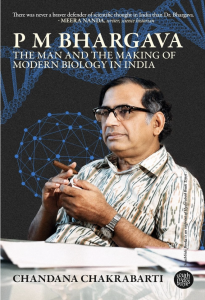
Chandana Chakrabarti's,
P.M. Bhargava: The Man and The Making of Modern Biology in India,
Hyderabad Book Trust
Around noon the next day, I received a call from Rajagopal, a scientist at Indian Institute of Chemical Technology. He sounded alarmed. A large, unruly crowd of homeopaths had gathered outside the gates of CCMB, shouting slogans against PMB. When security informed them that PMB no longer had an office there, some mounted motorbikes and headed towards our office in Tarnaka. Rajagopal urged that PMB hide.
I informed K. P. C. Gandhi, then director of the State Forensic Laboratory, and an IPS officer. I asked PMB to stay indoors and not come out. As I went downstairs to tell my colleagues to remain inside, the mob arrived. Maria, PMB’s secretary, and I stood braced against the closed door from inside as shouting and pounding echoed outside.
I tried to speak to them through the door. When I stepped onto the balcony to address the leaders, stones were thrown at the building. Some climbed the walls; others stood on cars and the gate. Before they could break in, the police arrived and dispersed the crowd. By then, the damage was done – the gate, letterbox, signboard, lights, and vehicles had all been vandalised. The next day, newspapers reported the incident. Not a single homeopath apologised. PMB did not relent. He continued to describe homeopathy as unscientific in his subsequent speeches and writings.
The episode was instructive. Practitioners of a supposedly gentle and harmless medical system were capable of remarkable violence. Barely a week earlier, a group of young homeopathy students had visited our office. They spoke of unanswered questions, ineffective treatments, and patients who continued to suffer. They said they had learnt little, seen through the hypocrisy, and feared they had chosen the wrong profession.
What happened outside our office was not an exception. It showed how quickly criticism could slide into intimidation once belief found institutional shelter. The Method of Science Exhibition, which relied on the same tools – public demonstration, simple arithmetic, verifiable claims – met a comparable response. There, the opposition was less noisy, more organised, and more successful.
Astrology
PMB had written and spoken extensively against astrology, deploying every available argument to explain why it was unscientific, internally incoherent, and at best a nuisance. In 2001, under the BJP-led NDA government, the University Grants Commission nevertheless decided to promote university courses leading to BSc and MSc degrees in Vedic astrology, rebranded as Jyotir Vigyan.
The UGC went beyond endorsement. It formalised staffing norms – one professor, one reader, two lecturers, a library attendant, and a computer operator—and sanctioned a non-recurring grant of ₹15 lakh per department, with assurances of continuing support. The inducement was explicit.
The move formed part of a broader programme of saffronisation of education, which included tampering with school history textbooks and ensuring that key positions in scientific institutions were filled by reliable fellow travellers, or at least compliant ones. Leading scientists across the country objected on straightforward grounds. They also cited the 1976 statement Objections to Astrology, signed by 186 scientists worldwide, including eighteen Nobel laureates.
In 2003, PMB and I filed a writ petition in the Andhra Pradesh high court challenging the UGC’s decision as illegal and unconstitutional. Our affidavit stated that astrology had never been, and could not be, regarded as science; that it was unsupported by research; and that it served no national purpose. Article 51A of the Constitution, we argued, placed a duty on citizens to develop scientific temper. The UGC’s action did the opposite. Public funds, we said, could not be used to institutionalise superstition.
The high court dismissed the petition at the admission stage, for reasons that bordered on the comic. It relied on the second edition of the Encyclopaedia Britannica, published in the early nineteenth century, despite the fifteenth edition being freely available online. While the second edition did not explicitly describe astrology as pseudo-science, later editions did. The fifteenth edition, while acknowledging astrology’s persistence as a belief system, noted that the Copernican revolution of the sixteenth century had dealt its geocentric foundations a decisive blow.
The case was admitted in the Supreme Court and heard, with Prashant Bhushan representing us. The Court eventually dismissed it, observing that expert opinion could vary and evolve, and that the judiciary was ill-equipped to decide such matters. It therefore exercised self-restraint and left the issue to expert committees constituted by the UGC.
Commenting on the judgment in Frontline, Justice Alladi Kuppuswamy, former chief justice of the Andhra Pradesh high court, disagreed. Judges, he wrote, were not expected to know everything, but they were expected to learn with the help of expert testimony and decide. Courts routinely adjudicated on unfamiliar technical matters—from medical negligence to aviation accidents – by weighing competing expert views. Abdication was not an option.
Murli Manohar Joshi, then Minister for Human Resource Development, did not take PMB’s challenge kindly. He made a habit of criticising PMB even in meetings PMB did not attend. Journalists obligingly relayed these remarks to us.
The country was soon awash with debates on whether astrology was science or superstition. One such meeting in Hyderabad, attended by over 600 people, was announced as an open debate between astrologers and scientists. The organisers, however, had carefully selected scientists who already believed in astrology. Journalists, recognising the design, urged PMB to attend uninvited.
When PMB arrived, the organisers had little choice but to include him. He dismantled astrology point by point and then issued a challenge. He had brought horoscopes of four individuals – aged between twenty and a hundred – whose lives were well documented; one of them was dead. For every correct prediction made without knowing identities, he would pay Rs 10,000. For every incorrect one, the astrologers would pay Rs 1,000. The money could be deposited with any referee the organisers chose. PMB made it clear he was not wealthy, but that he was willing to risk what he had.
There were no takers. By this stage, the response had stabilised: critique was acceptable as display, but not as policy. Beyond that boundary, it was shut down. The case for scientific temper was rarely in doubt: its acceptance remains so to this day.
This article went live on September seventeenth, two thousand twenty six, at forty-seven minutes past five in the evening.The Wire is now on WhatsApp. Follow our channel for sharp analysis and opinions on the latest developments.


