

Tracing the History of India's Universities


A version of this review was first presented at Jawahar Bhawan, at the book release and discussion of The Indian University: A Critical History, organised by 'Nehru Dialogues' and Orient BlackSwan.
The theme of Debaditya Bhattacharya’s book The Indian University: A Critical History intrigued me: truly, we may spend a lifetime teaching at universities, and we may have a fair idea about our own institutional spaces. But we rarely – if at all – reflect on what the concept of the university implies, what it has been and what it can become, as a specific site of learning.
I congratulate Bhattacharya for this important work and Orient BlackSwan for publishing it. The monograph draws from a wide range of theoretical concepts; it is both thoughtful and provocative, and it is also a great read. It is especially welcome in the light of – or should I say the darkness of – the new National Education Policy guidelines of 2020 which the author presciently analyses here. I will mention just a few points that I found especially valuable – there are many more of them. I will also put in a few questions as I go along.
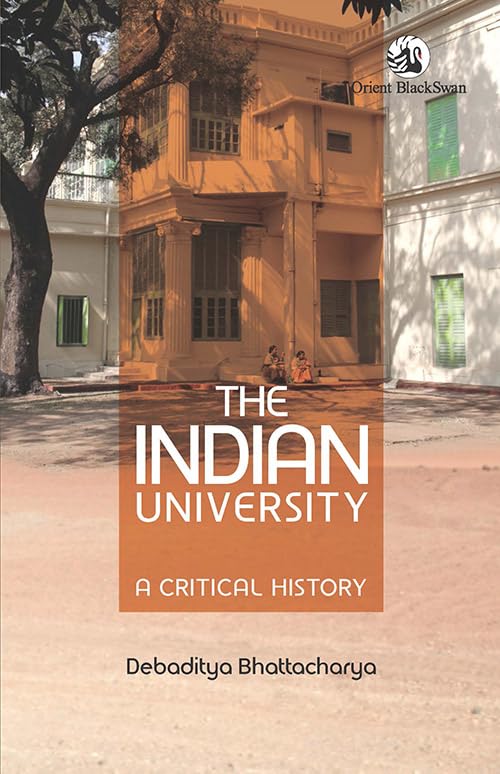
Debaditya Bhattacharya
The Indian University: A Critical History
Orient BlackSwan, 2025
Bhattacharya provides an impressive history of our modern university education, from the colonial times to the present. Actually, the first chapter on “ancient universities” goes much further back.
This is a long and crowded time span and he presents it through two prisms. The first is predominantly historical. After a brief exposition of the instrumental nature of colonial universities, the author presents an extended history of anti-colonial youth/student movements of various stripes: nationalist, revolutionary, Left-wing. The second prism provides a detailed study of postcolonial state educational policies: starting with the Radhakrishnan Commission Report of 1948 and finishing off with the new National Education Policy (NEP) 2020 document and its consequences. Bhattacharya parses state strategies meticulously, and identifies the changes and breaks therein. That is a very useful context for us to think about our present predicament and its past roots.
I am glad that in the process he rejects two standard assumptions: one, we had a splendid, inimitable university system in the ancient past; second, this should be the model for our present institutions – in other words, that we should thoroughly “Hinduise” the present system in the name of an imagined ancient splendour. And then turn it around to serve the ideological interests of our present ruling class. Bhattacharya challenges both assumptions with two marvellous bits of myth-busting. First, he reveals the limits of the ancient sites of advanced learning. Besides, he also exposes the way statistical data is now manipulated and falsified, so that the present regime may claim that it has worked a miracle of ‘inclusiveness’ in terms of Dalit and women’s empowerment in higher education.
The introductory chapter begins with Rabindranath Tagore’s speech on the swadeshi idea of the “National University”. As Bhattacharya reminds us, Tagore opposed colonial pedagogy not because it originated in a foreign context, but because it lacked organic connections with the material lifeworld and socio-cultural experiences of the Indian ‘public’ that it sought to educate. Bhattacharya clarifies and extends the concept of ‘publicness’ of education which should be sustained by, and also sustain, the immediate local environment: a cooperative model, co-partnered by the public and the university.
May I underline yet another remarkable imperative which put Tagore at odds with most nationalists of his time? Tagore was an internationalist, in an intellectual, cultural and political sense: keen to be grounded in, and to ground his university in, global cultures and ideas, as well as in Indian ones. The Gandhi-Tagore debates are significant in this context and in this sense Tagore had much in common with Nehru. This is important to recall today when the entire national educational agenda is geared towards keeping the world out of Indian thinking, to confine the universities to navel gazing and self-congratulation.

Debaditya Bhattacharya.
But this definition of ‘publicness’ may come with its problem too. It assumes an organic connection with and reliance on the immediate community. It is certainly an attractive and important idea. But does this not run the risk of mortgaging the university to majoritarian community perspectives? Even a local ‘public’ – be it urban or rural – has every chance of being deeply conservative and ethnocentric. In any case, all ‘publics’ are heterogeneous and cannot have a singular monolithic educational perspective.
A few words about the historical contexts where I found two rather minor issues. One, while discussing the restrictive nature of colonial education, Bhattacharya somehow slips entirely away from the university to focus on the school or pathshala, using William Adam’s excellent work on Bengal. The pathshalas were indeed multi-caste and inclusive, but they taught basic literacy and numeracy to elementary and primary level students alone. They did not provide reading matter to students, the stress being to develop their writing skills – as Paramesh Acharya’s excellent study has shown. So those two sites of education – pathshala and university – are actually non-commensurate. The precolonial analogues to the modern university would be the Brahmanical tol-chatushpathis and the Muslim madrassas, where the medium of instruction was Sanskrit or Arabic-Persian. Courses were largely scripture-centred. Tol-chatushpathis, moreover, admitted higher castes alone; they taught Sanskrit texts from which, in any case, lower castes and women were barred.
The rather long and extended excursus into various strands of anti-colonial youth or student movements fits a little too loosely into Bhattacharya’s own scheme. The history of student activism in freedom movements may certainly be useful, but there is no discussion of the latter’s educational ideas, if, indeed, there were any. Also, Gandhi did have his own educational vision and Bhattacharya could have spent some more space discussing that.
Bhattacharya’s commission-by-commission chronology of postcolonial governmental policy on higher education is extremely instructive. Each, he shows, had ignored the problems of caste and class, despite the rhetoric of ‘fairness’. While this is largely true, that may push an impression of sameness, of unchanging insensitivity to social injustice a little far. We do have to remember that educational reservation for Adivasi-Dalits was a stupendous step for the immediate post-independence period; even several decades later, there was mayhem over the Mandal Commission’s recommendations. In the 1940s and '50s, the opposition would have been far more intense, and it was no mean feat to carry the reservations through. Later, too, notwithstanding the outrage, the violence, the suicides over the Mandal Commission recommendations, OBC reservations did get implemented. Surely, these were meaningful changes in university caste profiles – even if we read them as merely small incremental gains, and even if the governments of the day did not think it necessary to increase the number of universities and the intake of students at the same time? Bhattacharya is of course a hundred percent right about the deliberate exclusion of the religious minorities from the remit of reservations.
We commonly define ‘publicness’ in opposition to private investment: state-funded universities as against private ones, which come out of corporate funding and are, ultimately, dependent on corporate directives and interests. Our postcolonial public universities, like their colonial predecessors, were funded by the state. But they did not significantly intrude upon the institutions’ pedagogical and curricular arrangements for many decades after independence. Those matters were, by and large, left to the decisions of the individual academic communities. By and large, too, at least some universities did admit subaltern social segments, who received higher education – sometimes of excellent quality – at affordable costs. Jawaharlal Nehru University’s admission policy used to be remarkably inclusive; in 2017-18, I found many working class students were studying at the postgraduate levels at Delhi University. Of course, gross caste inequality and inequality among religious communities remained dominant; but the fractures, however small, cannot be forgotten.
Bhattacharya focuses on plans and recommendations. There is often a gap however between the theory, which he elaborates meticulously, and the actual university practices on the ground. Education moreover is a ‘concurrent’ subject, and many regional universities were free to develop on their own for a long time. But in West Bengal where the Left Front had enjoyed an unprecedented sixth term in office, caste was systematically denied as an important factor in education or in social life. Even in Tripura, the Adivasis were quite marginalised in state policies by all accounts. Did the Left envision higher education in a distinctly different way and see the universities as a real site for possible social and intellectual transformation, or did it see them as a site for patronage distribution and electoral mobilisation?
It is also necessary to consider the RSS agenda for higher education at some length. As I have written, RSS has systematically developed elaborate plans for universities and research institutions from the 1970s. It formulated its own pedagogical methods with utmost care. Since 2014, they have occupied the commanding heights in the world of education at all levels and their Hinduising or Hindutva-ising methods were clearly revealed during the Orientation Courses for college teachers at DU in 2017. NEP 2020 is at least partly shaped by its perspectives. Right now, the syllabi and the question papers for the Value Added Courses undoubtedly reveal large Hindutva footprints. Religious nationalism offers the sacred glue that binds neoliberal privatisation of higher education with an overriding ethnocentric pedagogy.
Bhattacharya has amassed massive material – and insights – and it is unfair to ask a single monograph to do more. Mine are but minor quibbles, or a request for yet another book. And I must express profound gratitude for his very perceptive and sophisticated critique of the NEP’s intentions and calculations. I have long wondered what was the point of totally dumbing down higher education, rendering it into an absurdity, an impossibility. This book at last uncovers the hidden logic, the sinister intelligence behind the seeming insanity. And here Bhattacharya busts a third myth, a very fashionable one too. NEP 2020, as he shows, fragments the university as an academic site, a site for intellectual subject formation; it ruptures the integrity of academic disciplines; and it does all this in the name of reckless “multidisciplinarity” – ranging from economics to pasta-cooking or ayurvedic treatment or havan. It evaporates disciplinary rigour in a play of insubstantial multiples of university-based “assets” or degrees. This, Bhattacharya says, is done to insulate the student against an anticipated crisis in jobs, or to make her hope that the multiples will provide for some cushioning somewhere in a vanishing job market.
I thank Bhattacharya for teaching me so much and I hope the book will be widely read and seriously discussed.
Tanika Sarkar is a historian who retired as professor, Centre for Historical Studies, Jawaharlal Nehru University.
This article went live on September eighth, two thousand twenty five, at twenty-four minutes past two in the afternoon.The Wire is now on WhatsApp. Follow our channel for sharp analysis and opinions on the latest developments.


