

What 'Great Speeches' From Parliament Can Teach Us About India's Democracy


Compiled and edited by seasoned journalist Smita Gupta, The Voice of the People is a collection of significant speeches made by Members of Parliament and other leaders during moments of national importance or policy discussions. This is a comprehensive and authoritative anthology of great speeches by India’s best lawmakers.
An award-winning journalist who has covered parliamentary proceedings for more than three decades, Gupta has collated and organised these extraordinary speeches thematically. Readers will learn about the evolution of India’s relationships with its neighbours, its financial policies, and its quest for gender and caste equality, as well as national integration and harmony.
Gupta explains the genesis of the idea of this book in her introduction:
“For over three decades, from 1987 to 2019, I reported on the proceedings of India’s Parliament, especially that of the Lok Sabha. I had a ringside view as the never-ceasing drama of the world’s largest democracy played out, the mood of its members changing with bewildering rapidity. I sat in the Press Gallery, which overlooked the semi-circular green chamber of the Lok Sabha, of the old Parliament House. For close to ten years, as the Times of India correspondent, I sat directly above the Prime Minister (PM) of the day; and for another seven years or so, as The Hindu’s representative, I sat just above the Leader of the Opposition. Theatre seats don’t get any better than that! So, when I embarked on a project to put together a collection of the best speeches made in Parliament since Independence, I thought it would be a breeze. After all, I had covered it myself for almost half the period. But when I got down to it, selecting speeches proved to be much harder than I had anticipated.”
She has divided these 54 speeches into 12 sections. In the first section of the book, ‘Setting the Stage – A New Dawn for India’, she chooses three speeches made at the midnight hour on August 14-15, 1947: ‘Build Freedom for All’ by Dr Rajendra Prasad, ‘Tryst with Destiny’ by Jawaharlal Nehru, and ‘The Body Politic May Be Divided but the Body Historic Lives On’ by Dr S. Radhakrishnan.
Nehru’s ‘Tryst with Destiny’ is undoubtedly one of the greatest speeches of the 20th century – eloquent, poetic, passionate, full of hope and yet tinged with sadness. Nehru made a "pledge of dedication to the service of India and her people and the larger cause of humanity". But a clutch of noteworthy speeches, not as well known, were made by other stalwarts of the freedom struggle, as the ‘midnight hour’ approached on August 14, 1947.
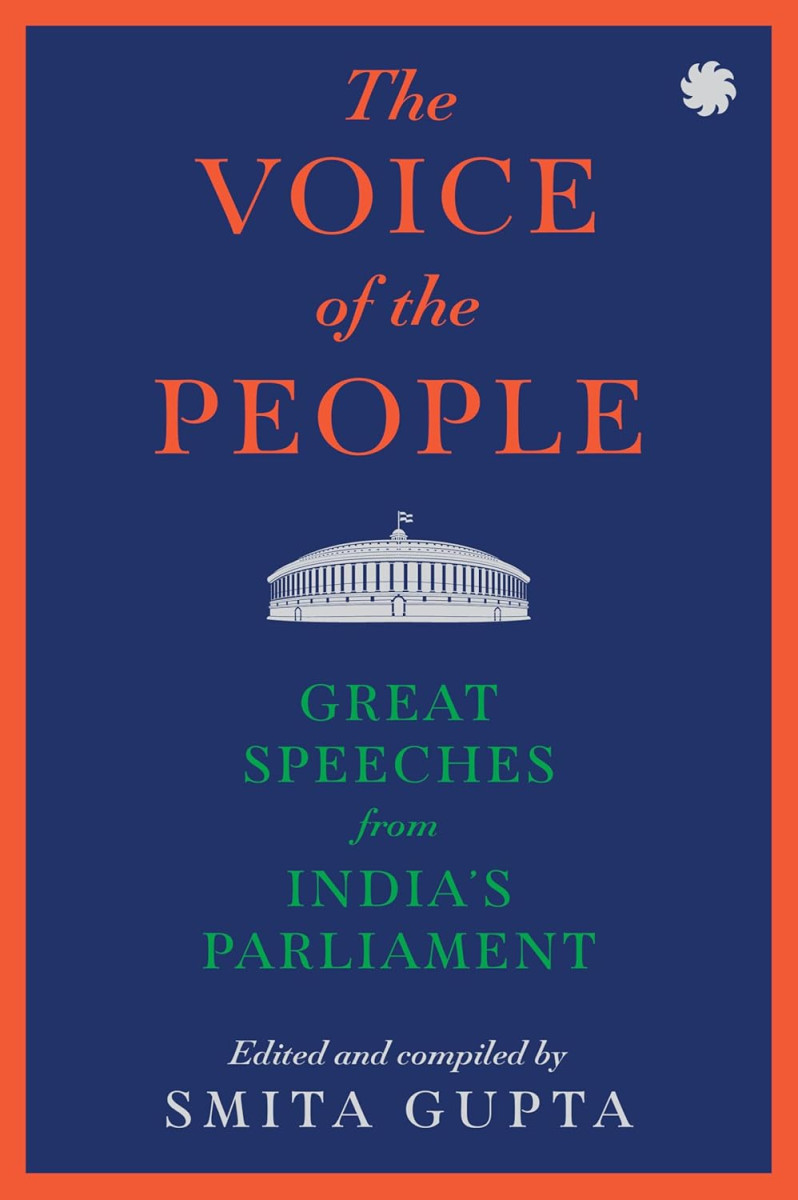
Smita Gupta (ed.)
The Voice of the People: Great Speeches from India’s Parliament
Juggernaut, 2025
Prasad exhorted his fellow citizens of free India to contribute to the "building up of freedom for all and peace among mankind", sent his good wishes to the newly born Pakistan, expressed his sadness at the division of India, and sent out a much-needed assurance to the minorities.
Radhakrishnan, describing Indians as ‘ready victims’ of ‘separatist tendencies’, asked his newly free countrymen “to correct our national faults of character, our domestic despotism, our intolerance which has assumed different forms of obscurantism, of narrow-mindedness, of superstitious bigotry”.
The fourth speech in this section is Dr B.R. Ambedkar’s last speech in the Constituent Assembly, titled ‘A Constitution for the Masses’. This iconic ‘Grammar of Anarchy’ speech critiqued the Constitution’s critics, dwelt on the difficulties that lay ahead in sustaining the independence that had been won at such great cost, and expanded on the idea of India as a ‘nation’ and the ideals and components of democracy.
In the second section of the book, she deals with Sino-Indian relations and the 1962 War, with the section titled ‘Dragon in the Room’. This section begins with India’s defeat in the India–China War in 1962 and ends with concern over Chinese incursions across the still-disputed border over the last few years, highlighting how little progress has been made. It includes Nehru’s speech ‘India Gets a Bloody Nose’ in the Lok Sabha on November 8, 1962, seeking the assent of the two Houses for the Emergency declared by the president after the defeat in the war. This was possibly the lowest point in his tenure.
Bharatiya Jana Sangh member Umashankar Muljibhai Trivedi’s intervention, ‘On Resolution Regarding the Proclamation of Emergency and Aggression by China’, and defence minister Rajnath Singh’s statement, ‘Trouble on the Line of Actual Control – Redeployments on Our Borders in Ladakh’ on September 15, 2020, are also included in this section.
The third section, ‘The People Next Door’, focuses on relations with another significant neighbour, Pakistan. It begins in 1965 with the India-Pakistan War, discusses the birth of Bangladesh – not just its political significance, but also the human cost – and concludes with the historic bus ride the then Prime Minister Atal Bihari Vajpayee undertook to Lahore in 1999, a rare moment of optimism in India-Pakistan relations.
The fourth section, ‘Pokhran and the India–United States Nuclear Deal’, opens with ‘Operation Smiling Buddha’ and ‘Operation Shakti’ – the official names for India’s nuclear tests in 1974 and 1998. These tests reshaped India’s international standing. The 2008 India-US Civil Nuclear Agreement further marked a defining shift. This section includes speeches by Indira Gandhi, Indrajit Gupta, Atal Bihari Vajpayee and Manmohan Singh.
‘The Journey to a Liberalised Economy’ – the fifth section – is dominated by budget speeches and, therefore, by the voice of the government of the day. The first speech reflects the concerns of a newly independent nation and addresses the challenges of the separation of India from Pakistan and the task of creating a new narrative. Indira Gandhi’s introduction of the nationalisation of banks, and Manmohan Singh’s piloting of the opening up of India’s economy, are landmark speeches that changed the course of the country’s economic history. The Opposition’s voice comes through in a speech by India’s most influential socialist leader, Rammanohar Lohia, in which he takes on Nehru directly on the ‘Daily Earnings of an Indian’ issue, known as Teen Ana Banam Pandrah Ana.
The next section, ‘Gender’, covers the journey between the intense, heated debates on the Hindu Code Bill and the relatively smooth passage of the Transgender Bill – even though it was moved as a Private Member’s Bill – over 60 years later. This is perhaps a sign of the way times have changed. Sandwiched between those speeches are debates relating to women. There is the debate on legalising abortion (1971), a law that helped women gain control not just over their bodies but also their ‘destiny’, as a woman MP at the time said. The discussions (1985–86) that followed the Shah Bano verdict (dealing with maintenance for divorced Muslim women) in the Supreme Court and the Congress government’s unconscionable flip-flop on the subject had a long-lasting impact on the Muslim vote. (It includes a powerful speech by Arif Mohammad Khan in favour of the Supreme Court verdict.)
The Triple Talaq Law (2018), far from empowering Muslim women, ended up only penalising Muslim men; and the debate on the Commission of Sati (Prevention) Bill, 1987, followed shortly after a young widow, Roop Kanwar, jumped onto her husband’s funeral pyre.
There is also a speech on the contentious bill that took 27 years to be made into law – the bill to reserve one-third of the seats in Parliament and legislative assemblies for women. To possibly delay its implementation, the Narendra Modi government announced that the bill (which was passed in 2023) would not be applied in the general elections of 2024 but would only come into effect after the delimitation of constituencies in 2026.
Then come the twin sections, ‘Deepening Democracy’ and ‘The Civic Space’. The first focuses on efforts by successive governments to spread equality and justice to all sections of a diverse society; the second features speeches by individuals – in this case, Opposition MPs – who pushed back to preserve the autonomy and freedom of the ordinary citizen. In ‘Deepening Democracy’, speeches heralding the legalisation of Mahatma Gandhi’s dream of Panchayati Raj as the foundation of India’s political system, the strengthening of democratic roots, and the acceptance of the Mandal Commission Report in 1990 have been included.
The latter decision – creating a 27% quota for the Other Backward Classes (OBCs) in Union government jobs and public sector undertakings – was taken by the National Front (NF) government headed by V.P. Singh, and was an act of great courage. The other speeches in this section deal with governmental efforts to end crimes against Scheduled Castes and Scheduled Tribes, and highlight the mood of the Muslim community during Manmohan Singh’s tenure as prime minister: his emphasis on inclusive politics helped him to connect powerfully with the minorities.
In ‘The Civic Space’, there are speeches that vehemently oppose the notorious Maintenance of Internal Security Act (MISA) steered through by the Congress in 1971, frontal attacks on the imposition of the Emergency in 1976; firm defences of the principle of diversity by supporting the right to eat beef in 1996; and sharp criticisms of the BJP’s ‘narrow, selfish and arrogant’ nationalism in 2016.
The other speeches in this section critique the Aadhaar project, oppose the controversial Citizenship Bill before it became an Act, and defend the right to protest.
Religious conflict led to the Partition of India and its bitter aftermath. But the resurrection in recent decades of those divisions through the rise of Hindutva – of which the BJP government is a votary – made a section on ‘The Religious Fault Line’ necessary. It focuses on one event in post-Partition India that critically deepened that divide – the destruction of the Babri Masjid on December 6, 1992.
The speeches included touches on different aspects of the destruction of the mosque. One defends the demolition of the Babri Masjid; another details its impact on minorities; while a third provides an official account of what happened, along with the limited options that lay before the government on that fateful day. With the construction of a grand Ram temple at the site of the Babri Masjid by a BJP government more than three decades later in 2024, the message of 1992 has been re-emphasised. As a coda to this section, there is a solitary speech by a subaltern voice critical of the attempts to bring in the Uniform Civil Code, which remains part of the BJP’s unfinished agenda.
A section of parliamentary speeches is on ‘Politics’, since that lies at the core of much of what is said and done. Ministerial resignations and Votes of Confidence that marked inflection points in the history of free India’s politics saw many of the speakers quoted here use the occasion to articulate the point of view of the losing side.
In 1951, Ambedkar resigned from Nehru’s cabinet, primarily prompted by the latter’s inability to push through the Hindu Code Bill. In 1969, Morarji Desai quit Indira Gandhi’s government to protest against the nationalisation of major banks through an ordinance. In 1996, Vajpayee preferred to put in his papers as prime minister before the trust vote. Less than a year later, another Prime Minister, H.D. Deve Gowda, sought a vote of confidence he knew he would lose so that he could use his exit speech to list his achievements for posterity.
In 2018, Prime Minister Narendra Modi proved he still had the numbers in the Lok Sabha. But it was one of those rare occasions when the Congress’s Rahul Gandhi set the tone, with an unequivocal message that love and tolerance, not hatred and lynchings, were the way forward for India. The section concludes with another speech by Modi, delivered on the occasion of the 75th anniversary of the adoption of the Constitution.
The ‘Trouble in Paradise’ section deals with Kashmir. If the region’s integration with India at the time of Independence was marked by bloodshed and conflict, 78 years later, it remains a major sticking point in India-Pakistan relations. Speeches by the two men who best articulated the opposing views on how Kashmir should be integrated with India have been excerpted in the book.
Nehru gives a detailed account of the situation leading up to 1952, when the Delhi Agreement – a pact between the Indian and Kashmiri governments – was signed, formalising the state’s special status. The speech summarises the international complications, as well as the arrangements that had to be made between Kashmir and India regarding the future Constitution of Kashmir, underscoring the need for Article 370 in the Indian Constitution – a provision that defined the special relationship between Jammu and Kashmir and the Union of India.
Then Nehru’s foremost critic on the subject, BJS founder Syama Prasad Mookerjee, counters his arguments for the insertion of Article 370 in the Constitution. Sixty-seven years later, when Mookerjee’s political heirs in the BJP abrogated Article 370, Ghulam Nabi Azad – at the time a senior Congress leader – made a moving speech opposing its revocation.
The book concludes on a sombre note, with ‘Death, Disease and Famine’. In this section, a princess weighs in on whether a law should be enacted to prevent those certified as insane from having children; a Communist talks about ‘hunger and death ... stalking various parts of the country’; and a Socialist speaks on behalf of the people about the devastating impact of the Covid pandemic.
This is not the first time a collection of important parliamentary speeches has been published. In 1998, former Lok Sabha Secretary-General Subhash C. Kashyap published 100 Best Parliamentary Speeches between 1947–1997, and some of these speeches are reproduced by Gupta. However, she has meticulously curated and presented these 'great speeches’ in her book, which is a must-read. It’s a commentary on parliamentarians, their work and the state of Indian democracy.
Qurban Ali is a trilingual journalist who has covered some of modern India’s major political, social and economic developments. He has a keen interest in India’s freedom struggle and is now documenting the history of the socialist movement in the country.
This article went live on August twenty-first, two thousand twenty five, at fifteen minutes past ten in the morning.The Wire is now on WhatsApp. Follow our channel for sharp analysis and opinions on the latest developments.


