

Why it is Necessary to Reclaim a Hindu Vision of Human Dignity


The title of our anthology, Seeing Equally, draws from the Sanskrit concept of samadarshini. In the Bhagavad Gita, the wise person is described as one who sees all beings equally. Wisdom and virtue are expressed in overcoming the tendency to arrange human beings into hierarchies—whether based on birth, caste, sex, religion or nationality. The wise recognise the equal dignity and value of all and rejoice in their flourishing.
The theological foundation of samadarshini is one of the most profound and widely shared teachings of the Hindu tradition: the One Divine exists equally in all beings. The Isha Upanishad begins with the famous affirmation that everything in existence is pervaded by the Divine. There is no life outside of the Divine and nothing that is not sustained by the Divine. The equal presence of the Divine is therefore the source of the inherent dignity and equal worth of every human being.
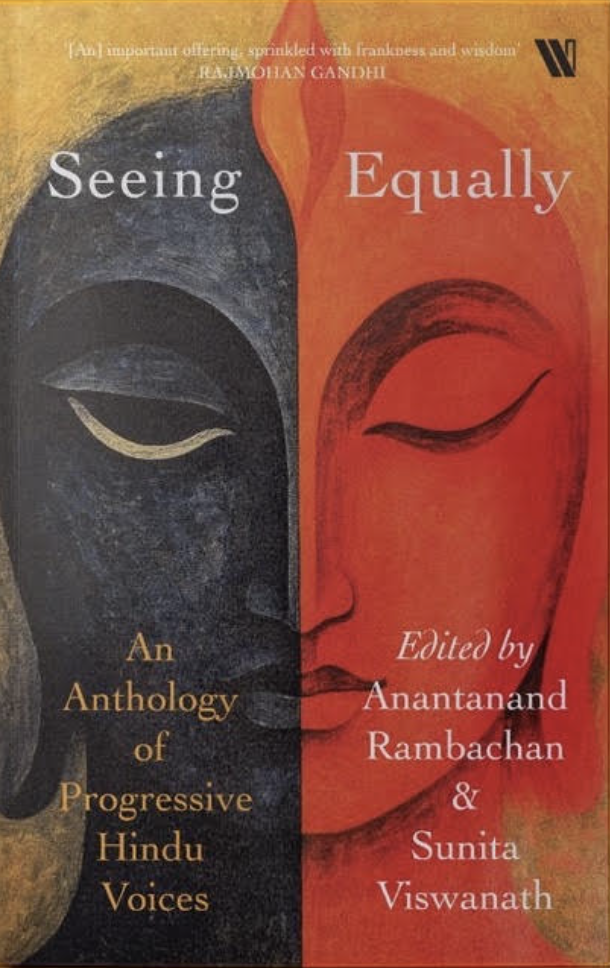
'Seeing Equally: An Anthology of Progressive Hindu Voices,' Anantanand Rambachan and Sunita Viswanath, Westland Books, 2026.
This teaching offers a powerful spiritual antidote to every attempt to deny the personhood, worth or dignity of another. If the Divine is equally present in all, we cannot honour the Divine while devaluing human beings or practicing injustice towards them. We cannot support social, cultural, political or religious systems founded on inequality and indignity. The vision of samadarshini requires us not only to see differently but also to act differently.
We draw inspiration from the Hindu tradition, but we do not do so uncritically.
Seeing Equally brings together 13 Hindu practitioners and religious leaders from India and the United States. Several lead temples, ashrams, congregations and religious organisations. They are nurtured by the Hindu tradition and love it deeply. It has filled their lives with purpose and meaning. At the same time, they share the conviction that the theological vision at the heart of Hinduism invalidates the assumptions of inequality, impurity and indignity that sustain caste and patriarchy. It also challenges a narrowly defined religious nationalism that excludes and marginalises communities.
As editors, we recognise that we ourselves come from places of privilege within the Hindu tradition. We also recognise the voices that remain insufficiently represented in this first volume, particularly those of women and people from caste-oppressed, non-Brahmin and non-Vedic traditions. We understand Seeing Equally not as a completed project but as the beginning of an ongoing and dynamic process. We hope that future volumes will bring many more such voices into public conversation.
Sunita Viswanath is co-founder, Hindus for Human Rights.
Anantanand Rambachan is Professor Emeritus of Religion, Saint Olaf College.
§
The following excerpts are from Seeing Equally: An Anthology of Progressive Hindu Voices, edited by Sunita Viswanath and Anantanand Rambachan. The chapters are by Swami Korneshwar, Pujarin Perley Kutayiah and Sadhvi Madhuri, three Hindu religious leaders whose lives and ministries challenge inherited boundaries of caste, gender, and sexuality.
The Saint Within You
Swami Korneshwar
Karnataka, India
Translated by Tarang Sinha
Among Lingayats, this is our way of greeting each other. It carries a spiritual significance and expresses reverence. It means, “The saint within me bows to the saint within you.”
The ishtalinga is different from the Shivalinga, which is a kind of idol. We worship Nirguna—the formless Divine. Contrary to common belief, we revere a historical Shiva, who we believe was an exceptionally valiant and blessed figure who lived nearly 7,000 years ago—the Primordial Being who established a great civilisation.
There’s a prevalent proverb in our society: “Don’t ask the caste of a swami”. This means a swami rises above the boundaries of caste when he renounces his family and devotes himself to the nation, religion and society. However, this is not the ground reality.
Although I haven’t personally faced harsh or humiliating remarks on this score, my experience in the matter of caste discrimination has been rather disappointing. Ideally, there should be no caste system in the Lingayat community as all its members are considered equal. However, even within the Lingayat community, some people identify themselves as Brahmin.
Casteism is poison for Indian society. It creates many “Indias” within the nation called India. It has divided India into many parts, which diminishes the feeling of equality and brotherhood among its citizens. People from the upper castes tend to discriminate against those from lower castes, which leaves the latter deprived of social and economic opportunities. Moreover, it gives rise to an inferiority complex among many communities.
How unfortunate it is that Indian society, which often makes grand statements, suffers from a disease that fails to grant the grace of humanity to all human beings.
Swami Korneshwar is a renunciant from the Lingayat community and a board member of Satya Dharam Samvad. He runs the Shri Tontadarya Anubhava Mantapa, in Aland, Karnataka.
§
There Would Be No Gate Around Maa
Pujarin Perley Kutayiah
Queens, NY, USA
There was another temple that had to close down because of financial problems, and we knew that all their beautiful murtis were in storage. Some of us started to plan a new temple for Maa. We found a dilapidated sewing factory that we liked because of the skylight—we thought Maa would sit under the sunlight in this space.
Our first meeting had seventy-five attendees and, astonishingly, they made me president. We got most of the murtis from the other temple that had closed. And thus the Shri Shakti Mariammaa Temple was born in 2012. It has been 14 years since then, and there have been very many beautiful experiences there.
When we have pujas we can’t accommodate everyone. Our temple includes everyone. We are known for welcoming the LGBTQ community too.
I remember a young girl who always went to other temples wearing a dhoti. Everyone looked at her funnily and would mock her. Once, a couple of aunties told her directly, “We don’t like your kind. We don’t appreciate girls dressing like boys and coming to the temple.”
My daughter told that girl she was welcome here at our temple, and she has been worshipping with us ever since.
Once, before we opened the temple, we were all standing under the skylight at one of our mass meetings and my brother Dave asked everyone, “Name one reason why we are opening this temple. Why here?” And I knew instantly how to respond: Our temple would give equal opportunity to everyone to touch Maa’s feet. There would be no gate around Maa.
I had worshipped in so many different temples, but ever since I left Guyana I had noticed one thing. Women were not allowed to do the same things as men. They handled all the preparations, but during the rituals the men took the lead while the women stayed in the background.
I also knew that elders were not respected in many temple communities. Families often took financial advantage of seniors. Finally, I recognised that people who identified as LGBTQ didn’t fit in any temple. They didn’t enter the space without heads turning. I decided that we would change these practices in our temple.
We also serve food to all visiting devotees without charging for it. We have stuck to these principles all these years. The Shri Shakti Mariammaa Temple community holds hands tight and stands in an inclusive circle to this day. At the temple, everyone is welcome.
Pujarin (Priestess) Perley Kutayiah is President and the Marlo Pujarin (the spiritual leader in the temple, entering trance, becoming a vehicle for the Goddess to manifest) of Shri Shakti Mariamman Temple in Queens, NY, founded in 2012 as a safe space for people of all colors, races, castes and genders to come together to worship the Goddess.
§
Nobody Will Ask Your Caste
Sadhvi Madhuri
Chhattisgarh, India
I was perhaps in the seventh or eighth standard when I first saw sadhus and renunciates gathered at my home, and the first memory I have from that day is of asking my grandfather, “Dadaji, are women not sadhus?” Little did I know that one day I would become a sadhvi—a female renunciate.
Now I feel that the profound impact of spiritualism on my subconscious was due to my family background, particularly the pivotal role played by my grandfather. Our family’s religious life consisted of satvik conduct (pure, balanced and virtuous behaviour) and the practice of singing the soulful songs of Kabir every morning and evening before our meals.
I was born on 1 November 1991 into a Hindu Sanatani community. From the social and constitutional perspective, the community falls under the category of Scheduled Caste. My ancestral village is Samhauta, located in the Durg district of Chhattisgarh. My father is a small-scale farmer and my mother a homemaker.
I received my early education at a local school, where I became aware of my caste. I studied till the third standard at my ancestral school, after which I moved to my maternal grandmother’s place to continue my education. During the lunch hour, I noticed that the other children drew away from me.
Now I realise that although Kabir Saheb’s teachings tried to bridge the social gap between castes, over time the gap had grown wider yet again.
In fact, social harmony should flow like a river. It’s not something that stays eternal once established. It requires constant effort because ambitious political leaders exacerbate societal divides as they advance, and there has been a long history of this.
Anyway, the sanyasa ashram I belong to places a high value on forgiveness. May God bless those who encourage untouchability among human beings with wisdom.
I was inclined towards icons like Gandhi, Ambedkar, Buddha and Kabir because of my personal life experiences and family background. We have put up Ambedkar’s photo in our ashram. Although I have some disagreements with his religious thoughts, I am impressed by his social philosophy. He is an inspirational leader of modern India, a man of resilience who bestowed dignity upon human beings.
A person rarely detaches himself from his background. In my opinion, Gandhiji fell a little behind in this aspect. But I do believe he was a yugpurush, a visionary leader who studied every religion in the world.
Both Gandhiji and Ambedkar Saheb made unwavering efforts towards social reform. However, they had differing opinions on several issues. Gandhiji, for instance, sought to eradicate untouchability from society, whereas Ambedkar Saheb aimed to abolish the entire caste system itself.
In recent years, a remarkable shift has been observed among Hindus towards religious radicalism, which has brought about cultural change and negative consequences. And this change hasn’t occurred suddenly. It involves those forces that have been driving people apart for centuries.
No country in the world seems unblemished by extremist forces. Earlier, the participation of people from different communities in festivals or common functions was part of cultural camaraderie. In recent times, this space appears to have narrowed with growing segregation and suspicion. Dialogue that had been a natural part of communication is now often replaced by trolling on social media.
On the one hand, the enhanced extremism in Hinduism has evoked a renewed interest in traditional customs and long-standing beliefs, with people actively participating in religious rituals and ceremonies. On the other hand, it is sad to see that the rise in Hindu fanaticism has made Hindus superficial and arrogant.
The religious ceremonies these days are more focused on zealotry than on lifestyle or values. Many Hindu political leaders have emerged in support of the concept of building a Hindu nation, advocating for the protection and preservation of Hindu culture and traditions.
They must realise that Hinduism does not have a single deity or religious messenger. It’s a light of diversity, which makes it unique. However, this surge in extremism has impacted society in a negative way.
Sadhvi Madhuri is a renunciant initiated into the Kabir sect. She is from Raipur, Chhattisgarh.
The India book launch of Seeing Equally will be held at Jawahar Bhavan, Delhi, at 5:30 pm on September 30, 2026.
This article went live on September twenty-ninth, two thousand twenty six, at fourteen minutes past four in the afternoon.The Wire is now on WhatsApp. Follow our channel for sharp analysis and opinions on the latest developments.


