

Why Jane Austen Matters at 250 Even in Modern India


This December 16 would mark the 250th anniversary of the English novelist, Jane Austen's birth. Hers is a name familiar to most readers in the English-speaking world. Austen’s novels of realism are a witty, satirical commentary on her society and they are largely about women and marriage, income and manners.
The youngest child of a poor clergyman, mostly educated at home, Austen was not a stranger to the importance and value of an assured and independent income. After the death of her father, she, her sister and mother, rather like the Dashwood women in her novel Sense and Sensibility, had to depend on the financial support of her brothers, especially her wealthy brother Edward.
She lived her life surrounded by nieces and nephews, bound to family duties which might have been the more expected of a dependent spinster aunt such as she was. The absence of livelihood opportunities for women in her day and the lack of any income of her own would have provided her with a first-hand experience of the lower and secondary status of women in her times.
Unlike her heroines, she was not destined for a marriage which would have united love with fortune. It is indeed remarkable how she, constrained by relative poverty, the lack of private space, and the obligatory family commitments, wrote her novels based on such minute observation of, and insight into social life.
Why is Austen’s 250th anniversary being celebrated and commemorated all over the English-speaking world (and perhaps beyond) today? What is her especial relevance for us in India? Do her novels touch upon political reality as well as social realism? Would it be right to regard her as a feminist? A staple of the English literature syllabus in our universities always, does she still merit study when there is a strong reaction to anything that smacks of colonial England?

The conflict in Jane Austen’s novels centres upon independent-minded heroines who yearn to carve their place in society on their own terms. Photo: Shutterstock.
“It is a truth universally acknowledged that a single man in possession of a good fortune must be in the want of a wife.” This famous ironic opening sentence of Austen’s enduringly popular novel Pride and Prejudice is a good starting point to attempt answers to the above questions. Women, marriage, social rank, wealth and the comedy of manners, all the principal subjects of Austen’s writing are universal themes. However, within the context of women in society, Austen wrote from a position which underlined the need for recognition of them as individuals, human beings who ought to have the right to make personal and social choices and the freedom to express themselves. But she wrote also with a very clear understanding of the reality of women’s standing in early nineteenth-century England. Those were times which provided no opportunity for women to secure economic stability or social standing except through marriage.
Austen’s six novels illustrate how her heroines negotiate their continued existence in such a real world on the strength of their understanding, wit, intellect, compromise and integrity. Hers is the voice not of strident feminism seeking to place women in command, but a firm unequivocal assertion of the position of women as equal to men and therefore entitled to recognition and acknowledgement on par with men. It is a subject and a stand which would require reiteration through the ages.
Austen did not write overtly of the political situation, philosophical questions of religion, or the debates of the day centring on social equality, justice, economic questions or the rights of man. Yet her fine delineation of socio-economic relations, human relationships often qualified by the struggle for wealth or power or status brings out covertly the political reality and the economic structure in society which shaped and informed all social transactions.
The world, for some, would appear to have made great strides towards equality for women today. Access to education, the right to remunerative employment, the opening up of careers in politics, industry, science and a host of professions mean that women in the 21st century are no longer confined and restrained as they were in Austen’s 19th century England. So why are the themes of patriarchy, marriage and the inferior social status of women still relevant ? The answer is that while the world has made a tremendous advance in espousing the rights of woman as equal to man, in principle, the continuing mindset of society, the political perception of women and the sheer overwhelming inequality in numbers of women occupying public spaces as compared to men, indicate that patriarchy is alive and flourishing.
Austen analyses marriage and the business of entering matrimony not as the means of entering into a social contract with a likeable, desirable person of the opposite sex but as the only means, for a woman, of gaining some measure of financial support and social standing. Money and income determined one’s place in society for a man and for a woman, by marrying a man with a comfortable income.
Also read: Geeta Kapur’s 'Speech Acts' Reimagines Modernism for Our Times
The conflict in Austen’s novels centres upon independent-minded heroines who yearn to carve their place in society on their own terms but who often have to compromise, with the harsh reality of economically and socially suitable marriages in which their own individual standing as intelligent and sensible women becomes secondary to their prescribed social role.
The more uncomfortable aspects of ‘arranged’ marriages in Indian society can be recognised as a parallel to the ‘suitable’ matches in Regency society. But the significance for us of what Austen is critiquing goes well beyond this. The larger issue is whether women in India today are perceived as individuals with the right of self-determination any more than they were seen as such in Austen’s times. The answer is, sadly, an overwhelming No.
I wish to illustrate my point with specific examples of the general perception of women in the minds of those who govern and those who frame policy, viz the governments in India. Insofar as our federal, state and local governments are democratically elected, they may be safely seen as reflecting the mindset of our society and people.
India’s constitution guarantees liberty and equality as well as universal adult franchise to all citizens, has struck a resounding blow for the recognition of women as equal to men. But when it comes to business and industry, government policies consciously promote women as a group, not as individuals. Access to bank or financial credit to women is more easily available when women form a group. The notion of self-help groups for economic advancement is more frequently applied to women than men.
Experience has shown that self-employment is a much harder route to poverty alleviation than wage employment. Yet nearly all government beneficiary schemes are geared towards promoting self-employment over wage employment for women. Why? The reason is that women’s remunerative market employment is considered secondary to their role as homemakers and reproductive agents. So self-employment can mean flexibility in work schedules to fit in household duties first. Women’s incomes are seen as ‘additional’ incomes. It is no case that an individual woman may opt for remunerative employment or a career first, over marriage and household duties.
Wage employment would mean ensuring safety in and access to public spaces for women. It would constantly raise issues of why unequal pay for women and men.
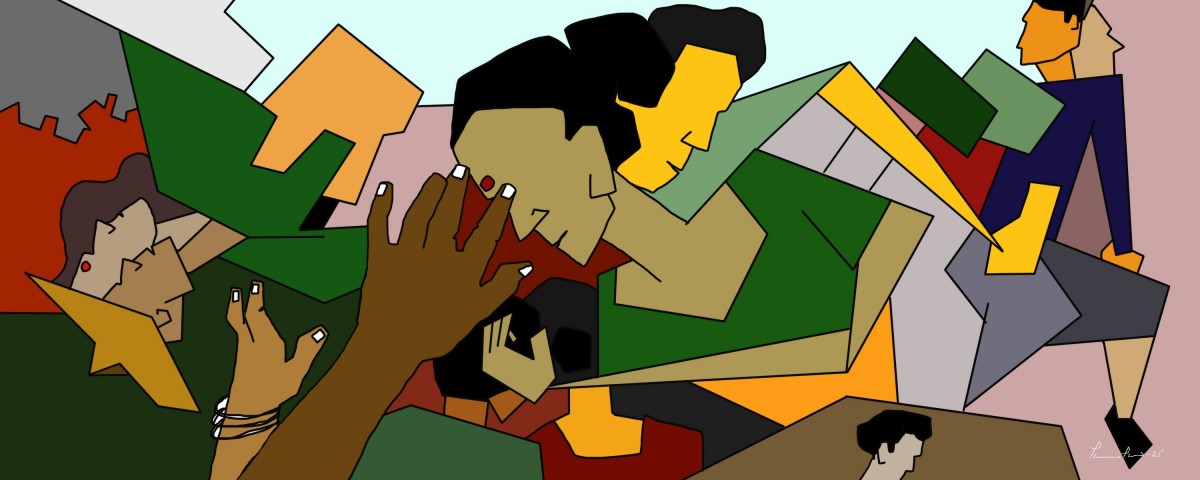
Illustration: Pariplab Chakraborty
The slogan for advocating women’s education in India has been ‘educate a girl and you educate a family’. This negates woman’s right as an individual to acquire education. Women can only be seen as human beings when in relation to family, the family denoting male relatives primarily. Likewise recent financial aid schemes, Mukhyamantri Ladli Behena Yojana (Madhya Pradesh) and Mukhyamantri Mazi Ladki Bahin Yojana (Maharashtra) see women only as appendages of male relatives. Women are selected as beneficiaries of government schemes in relation to their village of residence after marriage, not as residents of their natal village.
Politically, posters campaigning for a woman candidate prominently depict her husband or brother or father. She, with her head demurely covered, occupies only a small space in one corner of the poster. Despite the much-touted legislation for 33% reservation of seats for women elected representatives, the membership of women across political parties is probably less than 10% of the total membership.
The unconscious upholding of patriarchy even by those mandated by the constitution to think and act differently shows that acceptance of women’s equality has simply not been reached. This is detrimental to women’s right to self-determination and to women’s safety in homes or social spaces. We live in a world where India has tacitly acquiesced in the Taliban intolerance of women.
The novels of Austen with their foregrounding of the attitudes to women, of women and by women hold up a mirror to our society too. We need Austen and her writing, an intelligent woman’s deft and precise capturing of reality with warm, humorous but sharply penetrating observations, where some women can still hold their own against all odds.
Austen will continue to matter, in India and everywhere, as long as equality, dignity, civility and decency are seen as desirable virtues for society and for individuals. The unpalatable reality of social injustice is conveyed to us with an art and a skill which makes its sting sharper even as we chuckle over the acute description of follies and vanity.
The celebration of the 250th anniversary now is probably as much about the attractive screen adaptations and an often facile reading of Austen’s novels as romances. But the real reason to celebrate is the rewarding enriching experience her novels will always offer.
Juthika Patankar is a Senior Fellow in Pune International Centre, a visiting faculty in Gokhale Institute of Politics and Economics and also a former civil servant.
This article went live on November seventh, two thousand twenty five, at thirty-five minutes past five in the evening.The Wire is now on WhatsApp. Follow our channel for sharp analysis and opinions on the latest developments.


