

New Data Indicates that Direct Tax Share in Economy is at Decade Low


Gujarat and Tamil Nadu, while having bigger economies, contribute substantially less in terms of direct tax collection when compared to Karnataka and Delhi.

For the first time since 2000, the government has released income tax data. Credit: GotCredit/Flickr, CC BY 2.0
New Delhi: How effective has India’s push to widen the direct tax base and crack down on black money been? According to recently released data by the income tax department, there’s still a long way to go.
The government, on April 29 released its first dump of income-tax data since 2000, which is when the India Income Tax Statistics publication was discontinued.
This data transparency has been called for by a number of academics and think-tanks around the world, the most prominent of which is French economist Thomas Piketty. Piketty, who in his trip to India in January, publicly debated with Chief Economic Adviser Arvind Subramanian on the need for data transparency and the need to increase tax revenues.
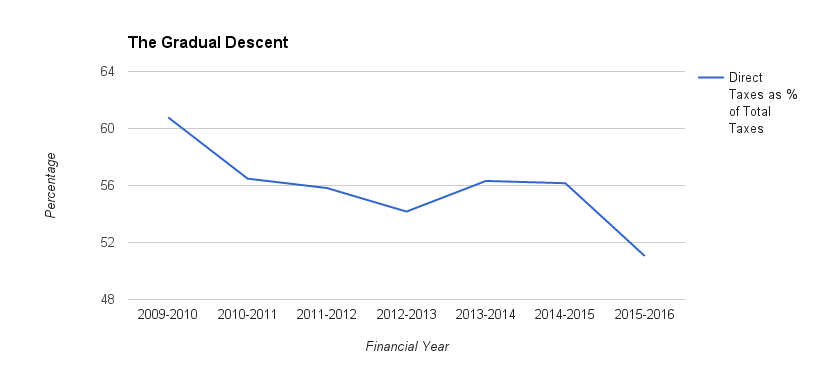
The greatest amount of detail in these documents is on direct tax collection - a combination of personal and corporate income collection - which doesn’t paint a very strong picture. For instance, while direct tax collection nearly doubled from 3.7 lakh crore rupees in 2009-10 to 7.4 lakh crore rupees in 2015-16, its share as a percentage of total taxes has dropped by 10 percentage points over the same time frame.
| Financial Year | Corporate Tax | Income Tax | Other Direct Tax | Total |
| 2009-2010 | 244725 | 132833 | 505 | 378063 |
| 2010-2011 | 298688 | 146258 | 1049 | 445995 |
| 2011-2012 | 322816 | 170181 | 990 | 493987 |
| 2012-2013 | 356326 | 201840 | 823 | 558989 |
| 2013-2014 | 394678 | 242888 | 1030 | 638596 |
| 2014-2015 | 428925 | 265772 | 1095 | 695792 |
| 2015-2016 | 454419 | 286801 | 1075 | 742295 |
In 2009-10, direct taxes accounted for 61% of total taxes in 2009-10, which dropped to 56% in 2013-14. Since Prime Minister Narendra Modi has assumed office, it has dropped a little further, with direct taxes accounting for 51% of total taxes last year.
Source: Income Tax India
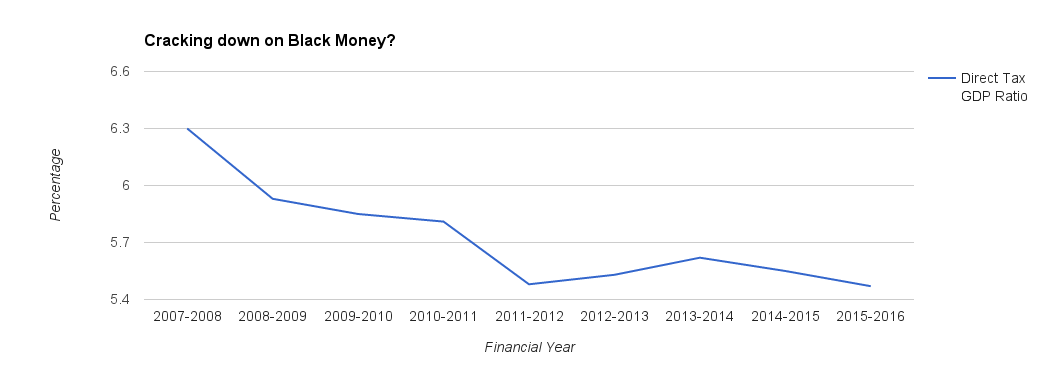
In terms of a share of the economy, the direct tax GDP (gross domestic product) ratio has dropped from 6.3% in 2007-08 to a decade low of 5.47% in 2015-16.
 This isn’t overly terrible news though. The fiscal deficit is currently at a respectable 3.9% of GDP (gross domestic product); though there a number of people who doubt whether the fiscal target for 2016-17 can be achieved. However, more government revenue clearly needs to be found to make up for the neglect in social sector spending.
Curious case of states
The data released also shows how much each state has contributed in terms of direct taxes collection. The biggest contributors are Maharashtra, Delhi, Karnataka, Tamil Nadu and Gujarat.
For the year 2014-15, Maharashtra brought in a whopping 2.77 lakh crore rupees in direct taxes - which is nearly 40% of all direct taxes collected in that year. Delhi is the second biggest contributor at 91, 247 crore rupees. While the industrial states of Tamil Nadu (44,732 crore rupees) and Gujarat (35,912 crore rupees) also place highly, they are beaten handsomely by Karnataka which is the third highest contributor of direct taxes at a significant 60,592 crore rupees.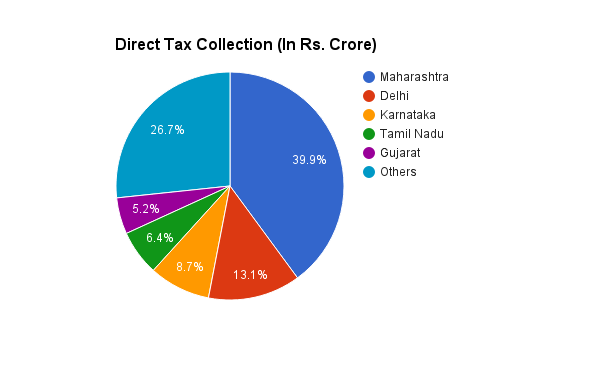 While Karnataka’s place reflects its strong minerals and automobile manufacturing presence, its contribution also speaks volumes to the strong continued growth of the information-technology industry and the currently booming start-up and e-commerce ecosystem.
Another interesting fact to note here is that the residents of Gujarat - a highly industrialised state with an urbanisation rate of nearly 65% - appear to pay a lot less tax when compared to the popular perception the state enjoys. A glance at the table below shows that Tamil Nadu suffers from the problem.
When The Wire compared the GDPs of the states and their direct tax contribution, it shows that while the GDPs of Delhi and Karnataka are substantially lower than that of Tamil Nadu and Gujarat, they actually contribute much more when it comes to direct tax collection. The table below shows that Karnataka’s state GDP was 7.02 lakh crore rupees in 2014-15 and yet it contributed a little over 60,000 crore rupees in direct taxes. Gujarat’s state GDP, on the other hand, was recorded at 7.6 lakh crore rupees in 2014-15. It contributed only 35, 912 crore rupees in direct taxes in the same year though.
| State (2014-2015) | State GDP (In Rs. Lakh Crore) | Direct Taxes Collected (In Crore) |
| Maharashtra | 16.8 | 277720 |
| Gujarat | 7.66 | 35912 |
| Tamil Nadu | 9.76 | 44732 |
| Karnataka | 7.02 | 60595 |
| Delhi | 4.51 | 91247 |
Piketty’s search for inequality
Researchers like Piketty who are eager to incorporate income-tax data as a means of studying inequality may be left slightly disappointed as the most recent data on the number of contributors within various income tax brackets appears to go back only to 2012-13.
This article went live on April twenty-ninth, two thousand sixteen, at twenty-one minutes past eight in the evening.The Wire is now on WhatsApp. Follow our channel for sharp analysis and opinions on the latest developments.


