

Tariff Day | Job Loss, Unviable Exports and GDP Growth Rate Drop: Experts Decode Impact of Levies


New Delhi: The US's high tariffs on India's exports, which come into effect today, will have an effect on India's economy that can lead to mass unemployment and a lowered growth rate for the country's GDP, say experts.
Ajay Srivastava, founder of New Delhi-based think tank Global Trade Research Initiative has predicted that India’s exports to the US are set to fall steeply – from $86.5 billion in FY2025 to about $49.6 billion in FY2026, due to Washington’s new tariff regime. While 30% of exports ($27.6 billion) will remain duty-free and 4% ($3.4 billion, mainly auto parts) will face a 25% tariff, the bulk of 66% ($60.2 billion) covering apparel, textiles, gems and jewellery, shrimp, carpets, and furniture, will be hit with a 50% tariff, rendering them uncompetitive.
Exports, the GTRI says in a report, from these sectors could plunge 70%, dropping to $18.6 billion, causing an overall 43% decline in shipments to the US and endangering hundreds of thousands of jobs.
The report notes that this is a strategic shock that threatens India’s long-standing foothold in US labour-intensive markets, risks mass unemployment in export hubs, and could weaken India’s participation in global value chains. Competitors like China, Vietnam, Mexico, Turkey, and even Pakistan, Nepal, Guatemala, and Kenya stand to gain, the report says. This could potentially lock India out of key markets even after tariffs are rolled back.
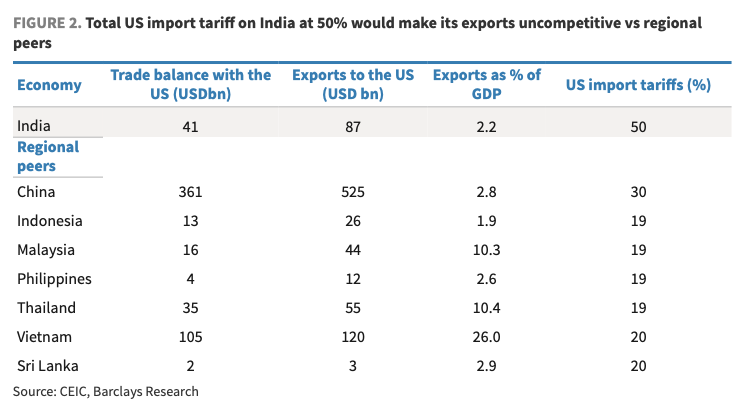
A note by Barclays carries the following figure, displaying the situation of India's competitiveness is the post-tariff markets:
Source: CEIC, Barclays Research.
The GTRI report finds that India’s nominal GDP was $4,270 billion in FY2025 and was expected to grow at 6.5% in FY2026 under normal conditions. However, the $36.9 billion export loss to the U.S. lowers the FY2025 base to $4,233.1 billion. At 6.5% growth on this adjusted base, FY2026 GDP would reach $4,508.25 billion, implying an effective growth rate of 5.6% – a 0.9 percentage point drop.
This, the report says, is a worst-case scenario. With tax reforms, ease-of-business measures, and aggressive export diversification, India can offset the shortfall and sustain robust growth, it feels.
The Financial Times has cited how Standard Chartered has forecast that the tariffs could knock as much as 1 percentage point off India’s GDP growth. Anubhuti Sahay, the bank’s head of India economic research, told the paper that New Delhi’s domestically-focused economy is less exposed than more export-oriented Asian peers. A Bloomberg report also notes that India's private consumption market can act as a cushion as it makes up about 60% of India’s GDP. The US amounts to only 2% of India’s total GDP.
Citigroup Inc. had earlier estimated that the combined 50% tariff poses a 0.6-0.8 percentage point downside risk to annual gross domestic product growth.
The US currently accounts for nearly 20% of India’s total exports and is its biggest export market.
Citigroup’s Samiran Chakraborty had been quoted by Economic Times earlier this month as having said that with the tariffs, exports could become “economically unviable”.
Chakraborty also said the move could hit both current and capital account flows. "With the rupee already near its record low, the RBI may have to step in to prevent a sharp fall," he said.
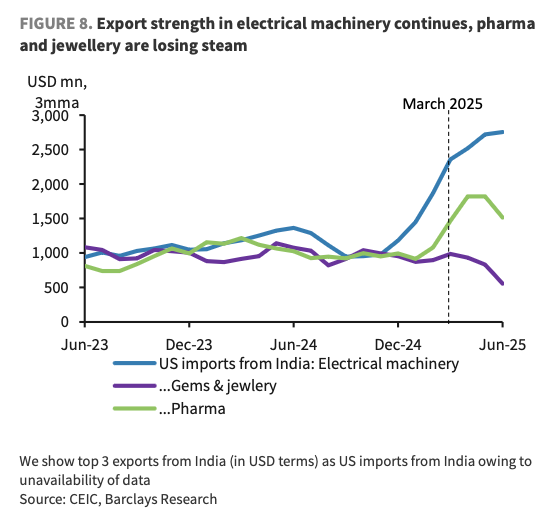
Source: CEIC, Barclays Research.
Meanwhile, chief India economist at Goldman Sachs, Santanu Sengupta, was quoted by CNBC TV18 as having said that India’s GDP could "slip below 6% if US tariffs continue to remain at 50%."
The incremental 25% tariffs affect 60-65% of exports, Sengupta said, noting that the impact will be severe because “at a 50% tariff, it is very difficult to export,” putting sectors like textiles, gems and jewellery, and marine products at risk.
True enough, the exporters body Federation of Indian Export Organisations on August 26 expressed serious concerns over the high US tariffs and said that textiles and apparel manufacturers in Tirupur, Noida, and Surat have “halted production amid worsening cost competitiveness due to these steep duties.” As The Wire has reported, the body has underlined the “immediate need for government support.”
Sengupta pointed out that fiscal pressures are building up due to weaker nominal GDP growth.
The CNBC TV18 report also quotes Soumya Kanti Ghosh, group chief economic advisor at State Bank of India, who said that tariffs could weigh on GDP growth in the second half of the year.
Warning of more strain on the rupee, Ghosh said “the nominal GDP numbers… will give an indication of how the economy is doing in terms of domestic demand.”
This article went live on August twenty-seventh, two thousand twenty five, at zero minutes past three in the afternoon.The Wire is now on WhatsApp. Follow our channel for sharp analysis and opinions on the latest developments.


