

Videocon Shows What Debt and Bad Brand Management Can Do to a Company


The current ICICI Bank-Videocon loan controversy, where Venugopal Dhoot is being linked with NuPower Renewables owned by Deepak Kochar, has rekindled interest in Videocon, whose current market situation is largely being blamed on its staggering debt of Rs 47,000 crores.
But the other half of the story might well be that Videocon as a brand failed to build its brand values adequately when it was still doing well in the marketplace.
When Videocon launched in the mid-80s with their range of electronics from televisions to home appliances to audio systems, everyone thought it was a phenomenon. But consumers always tended to buy it for its price discount, rather than perhaps for it being an attractive brand. The old Videocon logo was a solid steel ‘V’ and one of its longest running baselines ‘The Indian multinational’ might have failed to pitch it against multinationals, besides not saying much more than it just being cheaper than multinational brands at that time.

Videocon chief Venugopal Dhoot. Credit: Reuters
Constant changes in positioning might not have helped. The brand went through a slew of changes in the early years from “Bring home the leader" to “New improved life” to “Eco logic for sustainable life” but none of them had a ring of a winner.
Textbook marketing says that a price warrior has a limited life because he will sacrifice long-term brand values for short-term sales.
And that is exactly what Videocon might have inadvertently done. By constantly pricing themselves 10-20% lower than the competition with the use of cheap technology, they managed to hold double-digit market share in most of their categories and were a constant threat to other international brands.
If they were careful about nine years ago they might have averted the bad situation they are in today. If one looks at a piece of Videocon history from 2009-2014, you can tell that the company was headed for an inevitable disaster.
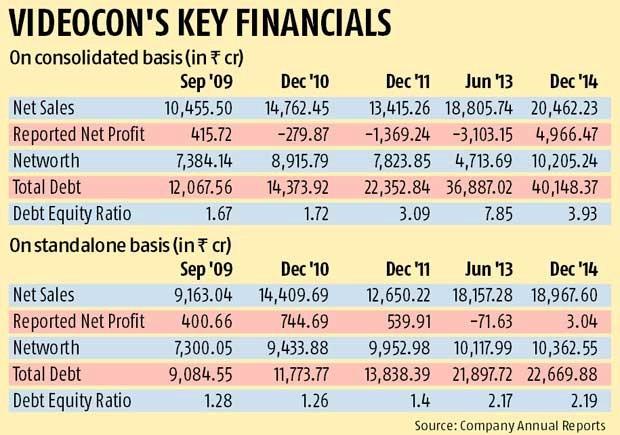
Source: Business Standard
The constant increase in debt and debt-equity ratio year after year in a critical phase in the brand’s history might have been damaging. In fact, senior journalist Sucheta Dalal may have spotted something going wrong as early as 1998.
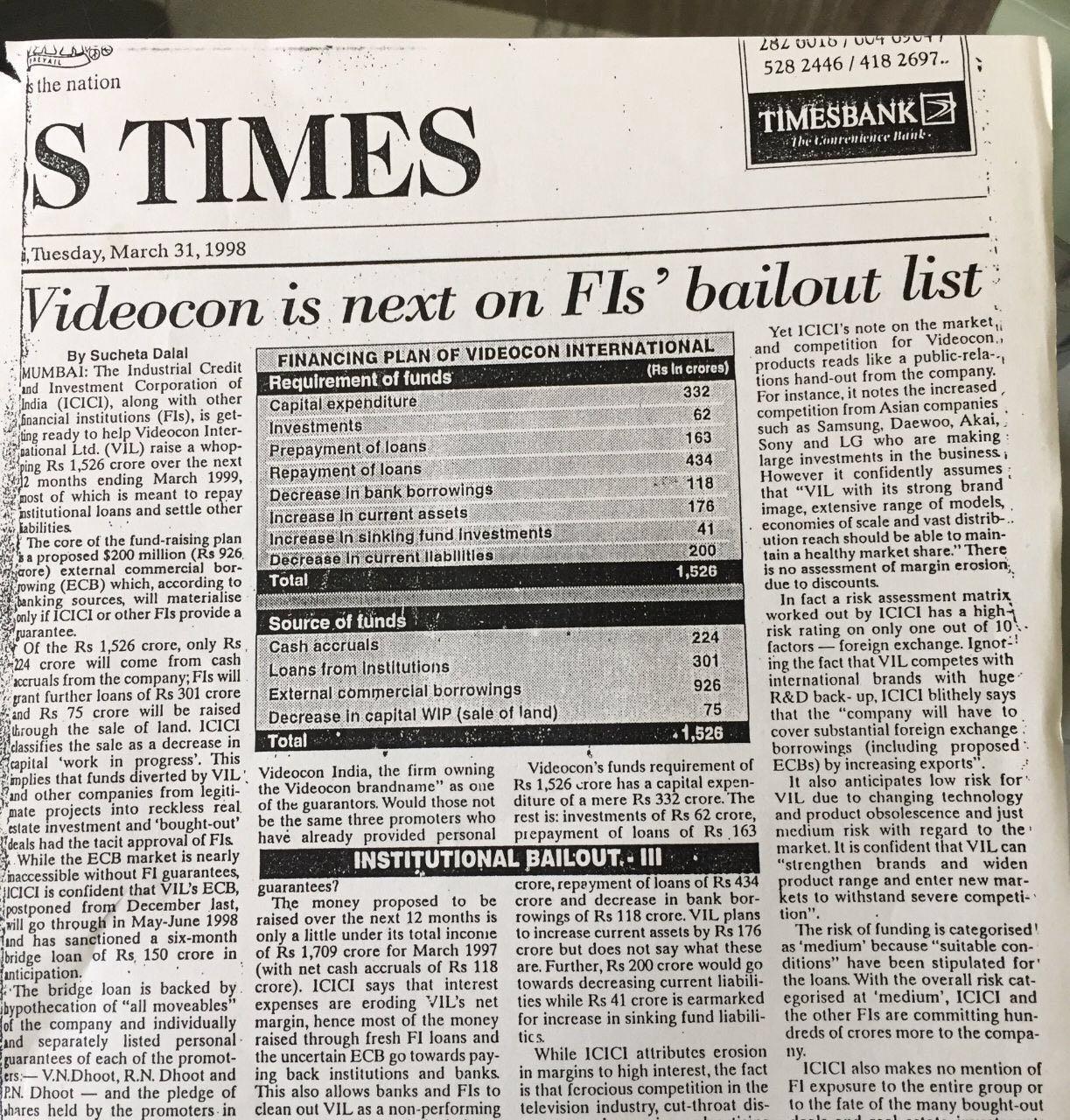
Source: Moneylife
But 2009 was an important year for Videocon and perhaps a realisation that the brand was not keeping up with the times and that it was not contemporary. They hired Interbrand Singapore for a brand makeover. The brand embraced a new identity with a more fluid lava like “V” with the baseline “Experience Change”.
Some mistakes that Videocon might have made in retrospect? Firstly, moving beyond their core competence.
While forays into telecom seemed attractive for a country sporting the largest mobile subscriber base, Videocon’s foray into mobile telephony caused the company a Rs 7000 crore loss. Fortunately, they had a buyer for their insurance business (Liberty Videocon) from Enam Securities and D.P. Jindal Group. Videocon D2H had about 12 million subscribers and they were lucky to be acquired by Zee which already had 15 million subscribers. In the television sets business, they might have made the mistake of acquiring TV tube manufacturing facilities. TV technology was changing rapidly and therefore technology was becoming obsolete very quickly.
Although diversification into oil and gas might have worked well for the group in the 90s. In the new millennium, they acquired a stake in hydrocarbon blocks in Brazil, Australia and Indonesia, among other countries. The sale of some of these businesses might help them in settling their large debt.
A price brand with low aspirational values
Videocon started off well with its large portfolio of brands like Sansui, Kelvinator, Electrolux Kenstar, in addition to the marketing of Akai and Philips Televisions. But the Korean and Japanese brands quickly overtook Videocon and made it no 4 in the market. This was largely due to Videocon’s emphasis on price rather than quality and brand image.
Samsung, LG and Sony had won the hearts of the Indian consumers. So Videocon’s premier position in the Indian market in the 90s was full of weaknesses that they did not see in time.
Devangshu Dutta, CEO of retail and consumer products consulting firm Third Eyesight once told the press, "International brands have a significant weight and aspirational value in the consumer’s mind, as they are perceived to be up-to-date with global product standards.”
Slump in value
The Videocon brand has shown decline over the years. From a rank of 26 in the Brand Finance Report of India’s top 100 brands in 2014, it has slid to no 59 in their 2017 report. This might largely be because of the focus on short-term sales rather than long-term brand value.
Early success with price cutting, which made them market leaders in the 90s, helped immediate sales but failed to build a brand of lasting value which meant something to consumers.
The weakness of the brand reflected in their 2017 market shares for LED Televisions. In 2017 Videocon slid to sixth place with a volume market share of 3.36% behind Intex a relatively less known brand which stood at no 5. For a brand that dominated market shares for televisions with double digits, that is a huge fall. In comparison, it had an ambition of a 18% market share only in 2013, just five years ago.
Do price warriors always fail?
For most brands price is a double-edged sword. Cutting prices always results in larger volumes but drives consumers to keep looking for discounts from the brand. Also, there is a very thin line between being a ‘budget brand’ and being a ‘low priced brand’. Many budget brands are eminently successful. There will always be a market for consumer products with cheaper prices. But success will always depend on whether consumers perceived the product to be ‘cheap’ or ‘affordable’.
Also, the brand needs to mean something tangible to consumers beyond price for it to really succeed. It needs to build a strong emotional connection with consumers. India’s first price challenger in recent history perhaps was Nirma detergent. But in their very first commercial they showed an Ahmedabad bungalow with a Premier 118-NE ( those days a premium car in India) parked in the bungalow compound. Making the point that it wasn’t cheap, but that it was affordable.
There are many successful budget brands both in India and overseas. For example, Ryanair and Easyjet are budget airline in the UK that have done exceedingly well as brands. Emphasising value and quality over price needs to be a compulsory element of a well laid-out marketing strategy. Closer home, brands like Indigo Airlines which started as budget airlines have built great emotional connections with consumers, so much so that one is perhaps even proud to fly Indigo rather than any other airline.
Videocon is a good example of what debt and bad brand management can do to a company. Once upon a time it was a home-grown brand with promise. Today, it is being held up, in certain quarters, as a poster boy of what is wrong with Indian industry.
Prabhakar Mundkur is an ad veteran with over 40 years in advertising in India, Africa and Asia.
This article went live on April eighteenth, two thousand eighteen, at zero minutes past seven in the morning.The Wire is now on WhatsApp. Follow our channel for sharp analysis and opinions on the latest developments.


