

VIT Bhopal Set to Reopen, Scarred by Violent Protests, Jaundice Cases and Student Allegations


Sehore, Madhya Pradesh: On November 28, two days after violent unrest swept through the Vellore Institute of Technology (VIT)'s remote Bhopal campus, only a few students remained over the weekend as security guards completed their afternoon rounds.
What began as a protest over water and food quality had spiralled into vandalism, where college property was burned and destroyed on the intervening night of November 25 and 26 by some 4,000 student protesters.
Following the violence, an officially formed committee has reportedly portrayed the institute as run by a centralised decision-making system that overlooks everyday student issues, and has recommended that Madhya Pradesh's private university regulatory arm establish a link or cell to receive complaints from students.
The state government's public health engineering department also found that four of 18 water samples that were collected from various points on campus were contaminated with the E. coli bacteria that can cause diarrhoea, stomach cramps, vomiting and fever.
The protests of November 25 and 26 were the culmination of days of student frustration over allegedly poor water quality, unsafe food and misbehaviour with students, despite VIT Bhopal's claims of maintaining proper hygiene and oversight.
One bus, three cars and an ambulance were completely burnt on the night of November 25, according to Akash Amalkar, the sub-divisional police officer (SDPO) of Ashta tehsil in Sehore district.
The campus canteen and at least one hostel block were vandalised, windows of several buildings were shattered, and firecrackers were burst, police and students told The Wire.
When the situation became violent, the university administration called the police to contain the situation inside the campus overnight.
As police probe arson and abuse allegations in complaints filed by the university and a student, respectively, and officials inspect campus conditions, the prestigious VIT faces one of its most serious crises to date.
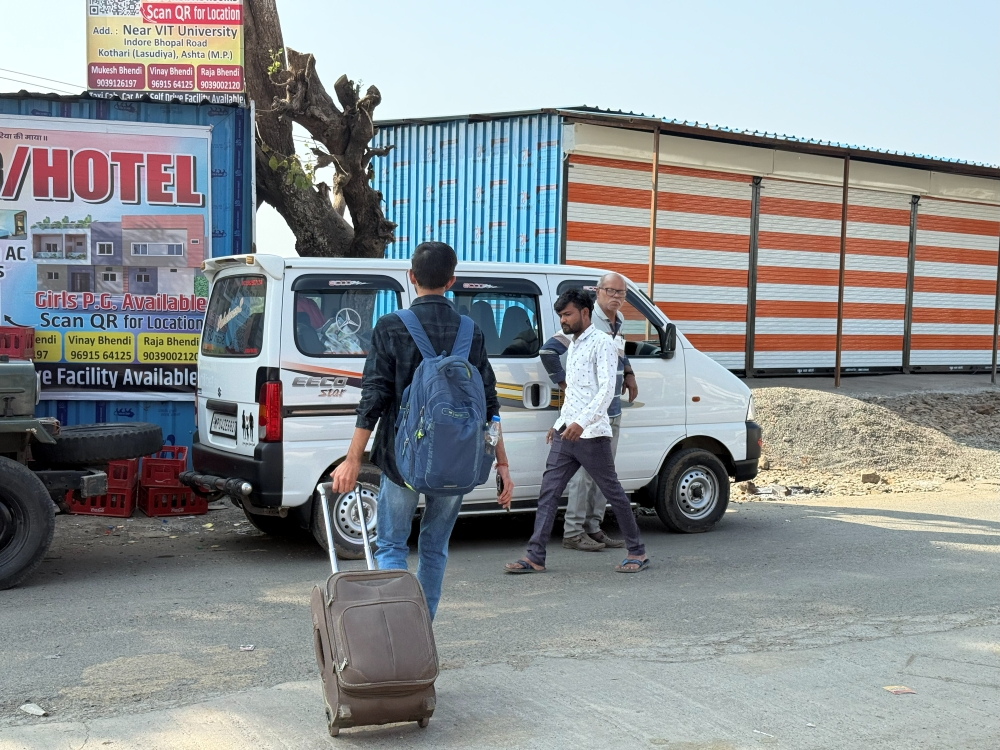
A VIT Bhopal student prepares to leave campus. Photo: Pallav Jain.
On November 28, students pulled their trolley bags with them outside the campus gate as the university administration declared holidays till December 8. “Almost the entire campus is empty,” said one student to The Wire. “Only ten to 15 students would be left in the boys' hostel block.”
Along the Indore-Bhopal highway, where the VIT Bhopal campus is situated, students waited at a roadside shed for buses to either city.
Though marketed as ‘VIT Bhopal’, the college is located almost 80 kilometres from the state capital. “This makes accessing necessities slightly tricky,” one fourth-year student preparing for placement said. “We rely on the canteen for food, and we inevitably have to live on campus.”
Privately run paying-guest accommodations and messes line the campus’s outskirts. But students said emergency medical access remains limited. The nearest civil hospital is 10 km away in Ashta; the Chirayu Medical College is nearly 55 km towards Bhopal.
VIT Bhopal, established in 2017 on a 300-acre campus, has 17,000 students. The founder-chancellor, G. Viswanathan, heads the university. He was an MP, an MLA and a minister in the Tamil Nadu government.
Given the prestige of VIT's flagship campus in Tamil Nadu's Vellore, students join with expectations of a good campus life. However, these expectations have been belied by the way the administration has run the institute, students say.
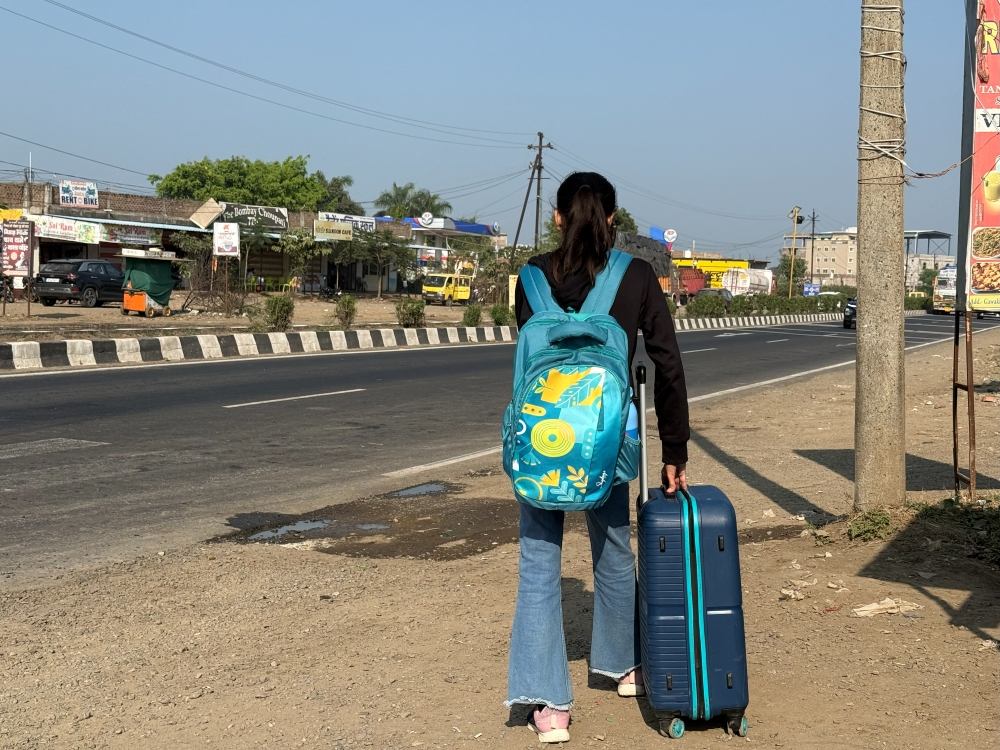
A VIT Bhopal student leaves campus. Photo: Pallav Jain.
How it started
“Some students had jaundice … a message circulated that 100 students had jaundice and three to four had died,” Harshit Mewada, member of the regional working committee of the Akhil Bharatiya Vidyarthi Parishad (ABVP) – the student wing of the Rashtriya Swayamsevak Sangh – said.
Over the phone, Dr Ajay Goenka of the Chirayu Medical College confirmed that two students from VIT had come to his hospital on November 26. They had reported symptoms such as nausea and fever. “Their tests confirmed jaundice,” he said. “I have personally reviewed their reports.”
Per a formal press note released by VIT Bhopal and signed by its registrar, K.K. Nair, a total of 11 female students and 22 male students were diagnosed or preliminarily detected with symptoms of jaundice as of November 26, and all were allowed to return home after consulting doctors.
“The number of reported cases has been decreasing over the past two days,” the institute had said.
The situation took a turn for the worse when one student, Neha Sahukar (19) from Bilaspur, died on November 24 at her home. Later, on November 27, the college administration said she died due to tuberculosis and not jaundice.
But students organised protests on November 25, linking her death with the jaundice cases on campus and the allegedly poor food and water served there. “A message circulated saying ‘it's today or never’,” Mewada said.
The protests turned violent as students alleged that they were attacked and physically handled by the staff. College property was vandalised and torched by masked assailants.
Videos circulating online showed a hostel block engulfed in flames. Amalkar said students “might have used firecrackers to set the vehicles on fire” during the unrest.
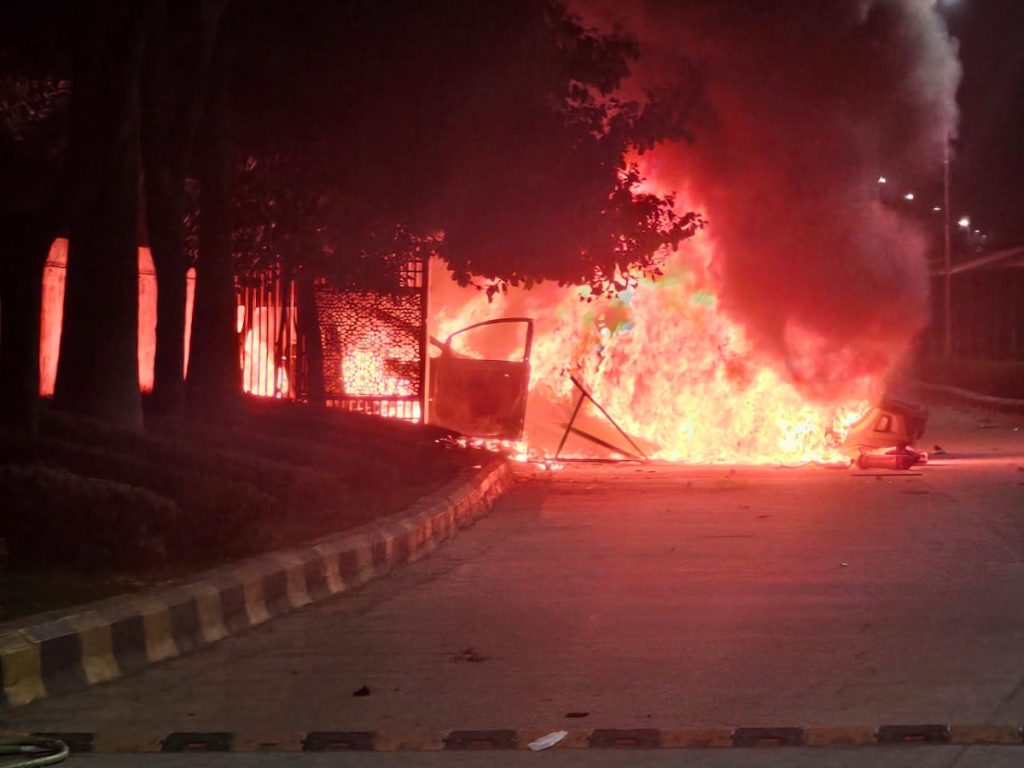
A fire during the November 25-26 protest on the VIT Bhopal campus. Photo by arrangement.
At 3:30 am on November 26, “the campus was inspected by the sub-divisional magistrate, Nitin Tale, and SDOP, Akash Amalkar,” VIT Bhopal's press note said. Amalkar later confirmed the same.
Nair said that “no death has occurred due to jaundice”. “A few jaundice cases were reported, and they received proper medical care. The news of three student deaths is completely unfounded.”
On November 26, Bharat Soni, a first-year B.Com student, alleged in his police complaint that VIT warden Prashant Kumar Pandey and “four or five others” assaulted a student on the night of the protests, used “filthy abuses,” and threatened to “ruin his future and kill him” if he complained. Soni said he saw a video showing them “beating a VIT student together”.
Police registered an FIR against Pandey under non-arrestable sections of the Bharatiya Nyaya Sanhita. After the incidents of vandalism, the university’s own complaint led to an FIR against unknown students. “As of now, no one has been identified,” Amalkar said on November 28.
Yet students remained fearful when these reporters visited the institute last week, hesitant to speak openly about their concerns on campus, worried that doing so could mean disciplinary action. Their fear was palpable.
Earlier this week, Madhya Pradesh's education minister Inder Singh Parmar, when asked in the assembly about the FIR against VIT students, said that no action would be taken that “may harm” them or ‘ruin their future’ “because this problem has arisen due to the management of the university and not due to the students”, the Indian Express reported.
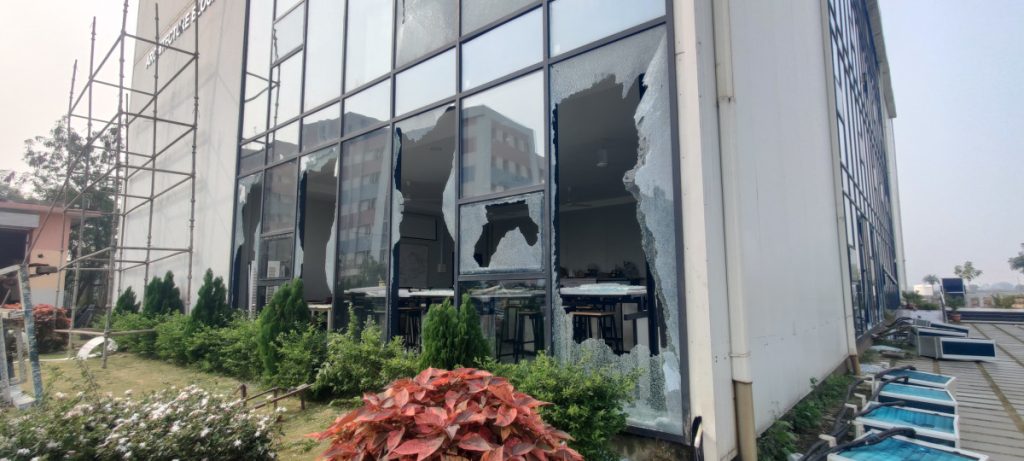
Vandalised property at the VIT Bhopal campus. Photo by arrangement.
Authorities intervene
A team from the state's public health engineering department visited the campus on November 26 after receiving complaints from students. Besides conducting health check-ups for students, the team also sent food samples for testing.
The university claimed in a press note that “they expressed satisfaction with the hygiene standards and food quality maintained on campus”.
Food department officials who visited the institute on November 26 “collected 45 samples, including paneer, lentils, rice, vegetables, spices and other food items”, Dainik Bhaskar had reported. These samples were sent to the state-level laboratory for testing and a report will be available in 15 days, the newspaper said.
Nair also denied reports that there were 600 jaundice cases. “Around 2,000 students have left the university, and those who remain are being provided proper facilities,” Nair said on November 28.
The morning after the violence, the Private University Regulatory Commission also formed a three-member committee to look into what caused the violent protests. Its members were Anil Shivani, principal of Hamidia College; Sanjay Dixit, professor at MVM College; and Lokendra Dave, professor at the Gandhi Medical College, all in Bhopal.
Management under scrutiny
The three-member committee's findings were reported by some newspapers earlier this week. According to the Indian Express, the panel charged the university administration with ‘attempting a cover-up’ of the jaundice cases “despite being aware of the spread of the disease”.
Mess services in the institute's hostels “are extremely unsatisfactory” and the “quality of food and refreshments has received largely negative feedback from most hostel residents”, IE quoted the panel as saying in a report.
“Complaints regarding food arrangements are not addressed, and students are simply told that they must eat whatever is served,” it also said. The “basis of discipline in the university”, it added, “is not mutual trust but an atmosphere of fear-based discipline”, with the administration operating with a “dictatorial attitude”, the committee alleged.
It also recommended that the state Private University Regulatory Commission set up a cell to receive student grievances as well as place a representative to coordinate student concerns on campuses hosting more than 5,000 students, if it finds it appropriate to do so, according to Dainik Bhaskar.
Shivani declined The Wire's request to comment on the report's findings.
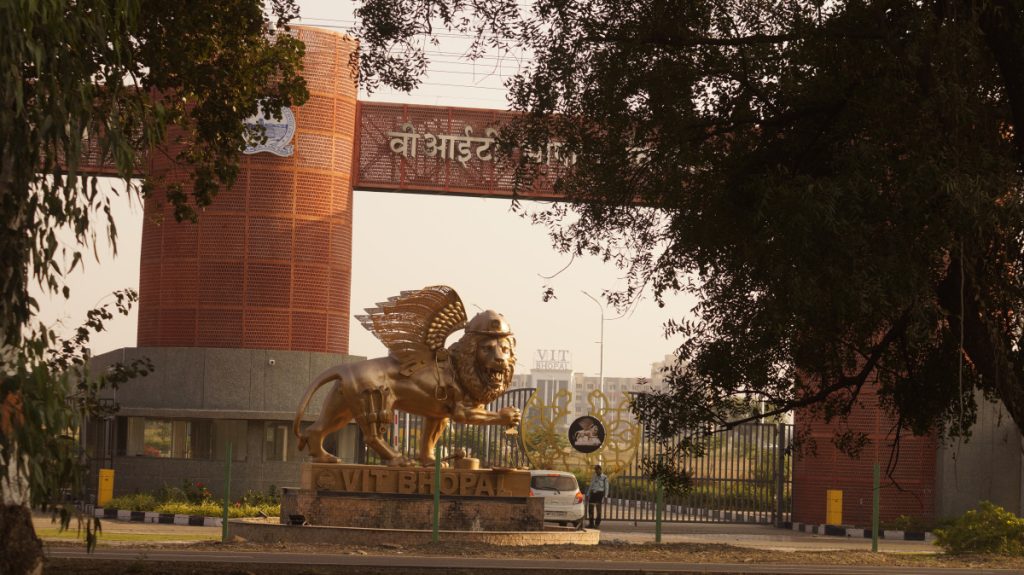
A vehicle enters the VIT Bhopal campus. Photo: Pallav Jain.
Nair said on November 29 that the university administration had not received any report at their level. “It is difficult to handle 12,000 students,” he said to The Wire when briefed about the report's findings and recommendations. “Anyway, the reasons [food and water quality] behind the protests were baseless,” Nair added.
Meanwhile, the state's public health engineering department detected the presence of the E. coli bacteria in four of 18 water samples collected from the campus's tube well, ground tank and RO system, Nair confirmed.
E. coli contamination can cause diarrhoea, stomach cramps, vomiting and fever, and in severe cases can lead to dehydration or kidney complications. However, E. coli doesn't directly cause jaundice.
When asked about this finding, Nair said: “Only two samples had detected E. coli … They were detected in samples collected in used mineral water bottles.” “It was detected in samples from Hostel 1; there are no jaundice cases from Hostel 1,” he said.
Nair added that the university administration is taking “further action by putting UV filtration, adding alum, etc.”
Scarred by the sheer scale of the protests, students' allegations and the three-member official panel's reported findings, VIT Bhopal prepares to reopen on December 8.
Ahead of reopening day 8, a student said they weren't hopeful that anything would change.
“It's not the first time. At best, the administrator will say it [the water supply system]'s cleaned, but it won't be,” they said.
Rajeev Tyagi is an independent science journalist. Pallav Jain is an environmental journalist based in Sehore, Madhya Pradesh.
Shishir Agarwal, a journalist with Ground Report, contributed reporting.
This article went live on December seventh, two thousand twenty five, at twenty-six minutes past four in the afternoon.The Wire is now on WhatsApp. Follow our channel for sharp analysis and opinions on the latest developments.


