

Meritocracy of Mirrors: Caste, Education, and the Politics of Absence in Kerala's Aided Sector


Ambedkar had returned. Not as the boy who once sat on the floor, away from the common bench, forbidden even a sip of water unless poured from a height – but as a man who had walked the prestigious halls of Columbia University, whose eyes had soaked in the great philosophies of justice, equality, and history under the vaults of Morningside Heights. Yet, in Baroda, all it took was a name, a surname that likely gave him away, to unhouse him. The Parsi inn had offered a room for rent, but once the proprietor came to know his caste, the walls withdrew, the air turned cold, and the welcome was revoked. He was asked to leave. Not for a crime, not for a debt, but for the body he was born into. Perhaps, in the Sanatan scheme, his birth was already a sentence – punishment for sins in some conveniently unverifiable past life. But this isn't about past lives. This is about the here and now, where the only visible crime is being born untouchable, and the punishment is lived in plain sight.
That night, in the city where he had returned to serve the princely state, with his degrees folded and dignity clutched like a broken umbrella in the monsoon rain, he stood without shelter. What does a nation do to a man when it decides he cannot belong, not even for a night?
The moment must have been a reckoning. He was not merely unwelcome – he was disposable, like a pail of garbage set out to rot. And it was a moment of nauseating isolation: no one from the caste world to glimpse the wound carved inside, no one from his own people to read the storm of his mind. For them, illiterate as they were, such degradations were ordinary. For him, it was a shattering – silent, slow, and soul-deep.
For Chaplin, the rain was a kindness – it spared him the pity of onlookers by hiding his tears. But for an untouchable like Ambedkar, the rain was a luxurious silhouette; it veiled nothing, for there were no eyes that cared enough to see his sorrow. Rain or no rain, nobody really cared why people like him cried.
Caste and the everyday life of aided education
Like that shelterless night in the then-Bombay, many Dalit and Tribal students in Kerala’s aided institutions find themselves adrift, unwanted, uncared for. They walk the corridors like the ghosts of Ambedkar: brilliant, yet unseen; present, yet without belonging. In a social context where inherited privilege is recast as 'merit' and chanted like a sacred hymn, their presence is structurally rendered invisible. Rain or no rain, nobody cares why they weep.
When a Dalit or Tribal student walks into the principal’s chamber in a Government College, even if no chair is offered, they can still invoke the quiet authority of constitutional belonging. That office is funded by the state – their state – and they enter it as a rightful citizen. But in an aided college, even that minimal assurance dissolves. There, when only the accompanying parent is offered a seat, the slight may appear customary, even traditional. For students from dominant castes, such gestures are often interpreted as part of a legacy of respect – guru-seva, humility before the teacher. But for Dalits and Tribals, tradition is not a space of gentle submission; it is a haunted corridor of remembered humiliation. To be made to stand is not just an oversight, it is a reenactment. A reenactment of ancestral postures: standing at thresholds, sitting outside classrooms, being refused entry into spaces of knowledge. The insult does not begin in that room. It arrives from history, fully formed.
In the absence of Dalit and Tribal faculty and staff – those who could reflect back the students' histories, embody their aspirations, defend their dignity in classrooms, staffrooms, and college council meetings – many students from these communities move through these institutions like ghosts. There is no one to emulate, no one to confide in, no one to teach them that their presence is not a mistake. They sit in rooms where no one sees them, walk corridors where no footsteps echo theirs.

Illustration: Pariplab Chakraborty
Therapy for structural violence
And yet, no legislature debates this, no minister senses the silent implosions of these young lives. Why would they? When the very machinery of governance is complicit in their erasure, when those who could intervene are the quiet architects of their abandonment. The state's answer, if at all, arrives with the seemingly bureaucratic smugness of misplaced empathy: appoint psychologists in all institutions – as if the psychic wounds of caste exile could be treated like the adolescent angst of a white boy who shoots his classmates in suburban America, or as if the war-zone trauma of a child in Gaza could be healed by the same protocol as the fatigue of a corporate intern. It is a category mistake so grave that it borders on cruelty – this belief that what is structural can be medicated, that what is historical can be counselled away.
Frantz Fanon, the psychiatrist of colonial Algeria, understood with rare clarity how systems of oppression do not merely govern through laws or institutions, but through the body – through posture, gesture, and the forced choreography of humiliation. In his clinical and political writings, he showed how colonial power sculpted the colonised self: bending it to obedience, carving into it the knowledge of inferiority. This is not a metaphor. It is muscle memory. Oppression trains the body to know when to speak, when to shrink, when to stand, and most crucially, when it is not welcome. In a caste society, too, the trauma is not just felt in the mind but carried in the limbs. It teaches the Dalit and Tribal child to occupy space with hesitation, to sit only when allowed, and to interpret the refusal of a chair not as omission, but as ancestral command.
So, when a High Court judge raises questions about the opaque appointment procedures and the murky nexus between the Education Department of Kerala and private managements – expressed in court as a “big nexus” undermining merit – the intervention, though necessary, barely grazes the surface. It stops at the threshold of transparency, without stepping into the darker interiors where the real rot festers. What the grammar of legality cannot touch is the cultural asphyxiation that occurs within these walls – what the activist-educationist O. P. Raveendran once called “caste colonies.” These are not just sites of exclusion; they are silent slaughterhouses of imagination, where Dalit and Tribal students arrive with dreams and leave with doubts. In these corridors, creativity doesn’t die in protest—it dies quietly, unheard, like a poem no one ever tried to read.
The relevance of judicial scrutiny becomes starker when viewed alongside the grim statistics revealed through an RTI application filed by Abhishek Sabu. As per the RTI reply, of the approximately 90,238 teachers employed in Kerala’s aided schools, only 808 are from Scheduled Castes (0.89 %) and a mere 76 from Scheduled Tribes (0.08 %) – figures that suggest systematic exclusion rather than exceptional deviation. These statistics lay bare a structure that perpetuates caste-based exclusion across generations. In this light, even a cautious high court observation on the opaque appointment procedures and the murky nexus between the Education Department and private managements becomes more than procedural – it cracks open the façade of legality and exposes the underlying caste enclosure funded by public money but shielded from accountability. Even when framed in bureaucratic terms, such interventions gesture toward the quiet violence that sustains the aided sector’s everyday normalcy in Kerala.
The merit of mirrors
Of course, there is another way the same data is interpreted—one that arrives with the polished certainty of caste confidence. The unapologetic Savarna gaze reads these numbers and sees not exclusion, but evidence of merit. “There is no reservation in aided schools,” they say, “and hence, only the truly deserving get appointed. If Dalits and Tribals are absent, it only shows they couldn’t compete.” The sleight of hand is breathtaking. The system that denied access, mentorship, visibility, and networks for generations now invokes the very absence it engineered as proof of inferiority. It’s a familiar song: that the presence of Dalits corrupts standards, and their absence confirms merit. The argument loops on itself, elegant and brutal, as if history were a fair contest, and the finish line hadn’t been moved every decade.
And yet, what’s truly miraculous – almost divinely comic – is how “merit” in aided institutions tends to be deeply loyal. In Christian-run schools, it is Christians who shine. In Nair-managed schools, the Nairs emerge as natural scholars. In Ezhava institutions, it’s the Ezhavas who clear the bar. And in Muslim-managed schools, unsurprisingly, Muslims rise to the top. It’s as if merit as a being were caste-literate, community-conscious, and astonishingly obedient to managerial faith. That the deserving candidates always already seem to resemble the managers – ritually, genealogically and in belief as well – is never questioned. What a curious coincidence, this meritocracy of mirrors!
And then there is yet another reading – one that does not blink at the data but sees in it the confirmation of a truth spoken nearly a century ago. That, without constitutional safeguards, without structural correctives, without the audacity of reservation, Dalits and Tribals would still be where caste society left them: outside the gates, beneath the eaves, standing in the rain. If the aided sector today resembles a carefully guarded citadel, it is because Ambedkar was not just correct, he was prophetic. He knew that merit, left to itself, would miraculously become caste in disguise. He knew that access, if not legislated, would never be granted. The absence of reservation in these institutions is not an accident, it is a structure designed to preserve the moral grammar of caste while pretending to speak the language of excellence.
Sadly, even those who speak loudest for the marginalised on global platforms – the internationalist Left – show little discomfort echoing the belief that appointments in aided schools are purely merit-driven. This observation is based on the Kerala government’s affidavit in the Salim case, which defended the existing appointment system in aided institutions as merit-based – echoing a pattern that is also reflected in the absence of a single Dalit minister in the current cabinet and the consistent non-appointment of Dalits as Vice-Chancellors in state universities. The deserving rise, they seem to suggest, and if Dalits and Tribals are absent, it must be due to a deficit in merit. Their silence hums with the old tune of caste, rephrased in the language of performance. From the Congress, such reasoning is predictable – they remain, after all, the ideological and material heirs of the Vimochana Samaram, a movement as much against Communism as against caste reform. But when the Left echoes this logic with a straight face, it stings deeper. It is not just a lapse – it is a repetition. A return to that old refusal to read Ambedkar while he was alive. For Ambedkar, the Communists of his time were merely a bunch of Brahmin boys with revolutionary vocabulary. Today's communists may come from a broader spectrum of caste and gender, but the spirit they carry often remains indistinguishable from that of the Brahmin patriarchs, the founding fathers of Indian communism – spirited in speech, but timid before caste. To defend caste-neutral merit in the aided sector today is to once again avert their gaze from the most important thinker this country produced, and to side – knowingly or not – with the structures that continue to exclude the people he fought for.
Courts, caste, and constitutional evasion
The story begins, as such stories rarely do, with a glimmer of constitutional courage. In W.P.(C) No. 32393/2010, a single-judge bench of the Kerala high court did something almost radical – it read the constitution as if it had a moral spirit. It ruled that since aided institutions are funded by public money, they are morally and legally bound to implement SC/ST reservations. That moment, brief as it was, dared to imagine justice not as charity but as obligation. But the rejoicing was short-lived. In 2017, a Division Bench, hearing W.A. No. 1664/2015, swiftly overturned this fragile victory. The argument? That appointment powers in aided colleges rest with private managements, and any state-imposed reservation would violate their sacred autonomy. There it was again – that hallowed, shape-shifting word, autonomy – invoked not to protect dissent, academic freedom, or excellence, but something more enduring: the privilege of the management.
Then came M.K. Salim v. State of Kerala (W.P.(C) No. 41271/2018), in which the petitioner, appearing “in person”, alleged that appointments in aided institutions often required donations and bribes and violated Articles 14 and 16 of the constitution. Salim’s petition was not an abandoned cause. From December 2018 to January 2020, it appeared on the court’s schedule no fewer than seven times, passing through multiple benches and list types. Initially placed on the Daily List – a conveyor belt of fresh matters and routine adjournments – it eventually moved to the Separate List, where matters are specially marked for detailed hearing. That shift signifies judicial seriousness; it tells the petitioner, and the public, that the court is listening.
Importantly, Salim's core demand was that appointments in aided institutions be made through the Kerala Public Service Commission. While the petition foregrounded corruption in the recruitment process, the mechanism he proposed carried far deeper constitutional implications. In Kerala, PSC recruitment is closely tied to the implementation of caste-based reservation. It follows constitutionally mandated quotas for SC, ST, and OBC candidates. To demand PSC oversight, then, is not merely to seek procedural transparency – it is, in effect, to insist on reservation. Salim was not just asking for fair play; he was asking for structural inclusion, for the insertion of constitutional equity into a space systematically guarded by caste and management privilege.
On January 28, 2020, the day his case was finally listed for admission before a new bench, he was absent. Perhaps he missed the listing. Perhaps he was out of station. Perhaps he simply forgot. We do not know. What we do know is this: the court, which had adjourned the matter six times before, made no room for any such uncertainty. It dismissed the petition, unceremoniously, in his absence, as “misconceived.”
It’s hard not to think of a scene from the Malayalam film C.I.D. Moosa. The protagonist, a long-time aspirant to the post of Sub-Inspector, clears the written test and completes every stage of the physical exam. But just when his chest measurement is to be taken – his final hurdle – his brother-in-law, a lifelong rival, appears as the officer in charge. As the hero stands tall, chest fully expanded, ready to pass, the officer casually tickles him. He exhales in surprise, and the measurement is taken in that instant. “Unfit,” declares the brother-in-law, disqualifying him with a smirk. The audience laughs. But the scene, beneath its slapstick, captures something real: how institutions with power can turn even the rules into weapons, and effort into farce.
However, the political clarity of the moment came not from the bench, but from the government itself. On page 4 of the judgment, the Left government’s position is recorded unambiguously for posterity: “By Ext.P4 it was replied that the Government has not got any plans to consider any change in the existing policy.” With this one line, the government made clear that it had no intention of reforming the appointment process in aided colleges. The rest was paperwork.
With that, the constitutional question Salim had raised – whether the state can publicly fund institutions that remain privately shielded from a transparent appointment process – was closed without being heard. When the caste privilege of the management and the consequent right to bribery are the subject, and when the petitioner stands alone, it appears that even a missed listing can become a judgment. Justice, it turns out, is like a railway ticket – miss your timing, and you lose your seat, no matter how long you waited on the platform.
The consequence? Public funds remained public only in budget lines; in spirit and consequence, they became the private inheritance of the managerial caste. The constitution, meanwhile, waited outside the college gate – like a student denied admission for want of pedigree.
On all occasions, what followed in the visual media was an exquisite silence. The Single Bench judgment that dared to imagine reservations in aided institutions passed without a whisper. And when the Division Bench swiftly nullified it, the quiet deepened. No outraged anchors, no tickers flashing "Judicial Earthquake," no panels of experts debating constitutional morality late into the night. The same visual media that turns a judge’s casual courtroom quip into national theatre suddenly forgot how to read a verdict. Not a glitch, just muscle memory. After all, when private managements speak, media houses don’t need to be told. They nod. They understand. Sometimes the caste networks don’t shout. They just hum in perfect, synchronised silence.
I love this freedom of the press. They call it press freedom – I call it the freedom to turn away.
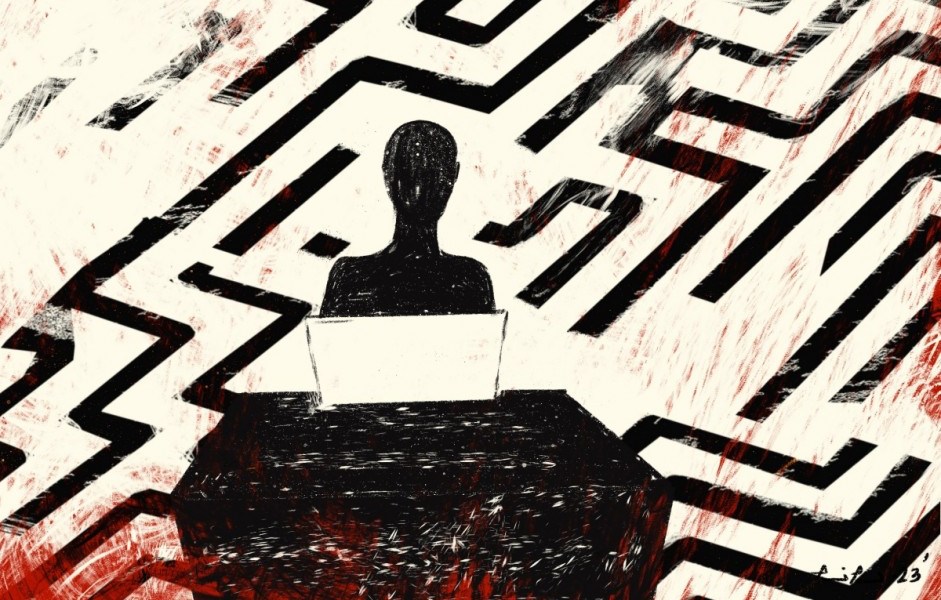
Illustration: Pariplab Chakraborty
It’s fascinating how constitutional clarity arrives with such grace when the question is disability. The Rights of Persons with Disabilities Act, 2016 doesn’t merely invite interpretation – it commands compliance. It is a law, written in ink, enacted by parliament, and enforced with admirable firmness: take public money, and you honour public obligations. No ambiguity or discretion, and no deference to managerial sentiment. But when the matter concerns SC/ST reservation in aided institutions, that firmness melts into interpretive restraints. Articles 15(4) and 16(4) of the constitution, though historic in spirit, are treated as discretionary clauses – generous if acted upon, harmless if ignored. The very same institutions that must reserve posts for the differently abled are told they may exercise “autonomy” when caste walks in the door.
Is it because physical disability, unlike caste, does not threaten the caste order? Because it includes without disrupting? Because it might even benefit a Savarna applicant, offering justice without unsettling genealogies? But caste-based reservation? That doesn’t just extend opportunity; it redistributes power. It redraws boundaries where entitlement had long wandered unchecked. And so, what is legally permissible becomes politically unpalatable.
One begins to wonder: is there a deeper form of disability – not physical, not mental, but structural – etched into the system itself, or perhaps into the very mirror held up by its interpreters?
The judiciary seems to nod wisely: “Yes, yes, the Constitution permits it… if the State so chooses.” And if the State doesn’t? “Ah well, who are we to interfere?” The governments of the day throw up their hands in performative helplessness: “See, what can we do without the court’s direction?”
Once, I watched two novice painters wait for the other to begin, each hoping to follow suit – neither lifted a finger, and the job never started.
Then there’s that unforgettable line from a Malayalam film, where a love-struck youth writes his first letter to his beloved: “If you love me, also I love if you!” A declaration so circular, so confused, it almost mirrors our democracy’s approach to caste justice – delayed, deferred, and forever dependent on someone else to act first.
To be fair, one must acknowledge the structural limits of the judiciary. Law-making is not its assigned role; interpretation is. And interpretation, by its very nature, is a human act – shaped by perspective, experience, and yes, ideology. That is why a single bench of the Kerala high court could, with moral clarity, mandate SC/ST reservations in aided institutions, only to be overruled by a Division Bench invoking a different constitutional logic. The law did not change. Only its reading did. And in that shift – from one set of eyes to another – entire generations are either welcomed into the republic or kept waiting in the rain.
The ball, ultimately, lies within the court of the lawmakers. The constitution, as Ambedkar warned us, does not create laws on its own. Even the finest constitution, he said, in the hands of the wrong people, could become a mere document of privilege. And he was dead right. It is the solemn duty of our elected representatives – in parliament and in the legislative assemblies – to ensure that the spirit of the constitution is not confined to ceremonial speeches, but enacted in every sphere of public life.
The zombie-like existence of Dalit and Tribal students in many aided institutions in Kerala is stark evidence that, even after 75 years of independence, the constitution has not yet reached the hands of those willing to wield it with moral courage and conviction. It is still in the hands of the wrong people.
The demand for reservations in aided colleges has gathered momentum in Kerala only over the last 25 years. Not coincidentally, this was also the period when the first/second generation of Dalit students began clearing the UGC-NET in significant numbers, when the margins started producing scholars. O. P. Raveendran, eight years ago remarked dejectedly, “More than 10,000 Dalits are waiting for jobs. Around 2,000 of them have cleared the National Eligibility Test conducted by the University Grants Commission. But the aided college managements are just ignoring us.”
Savarna Marxists and the Manusmriti state
The present Left government has been in power for the last nine years. Its cabinet includes individuals who are, by all accounts, well-read – people who have consumed Marx, Che Guevara, Gramsci, Paulo Freire, Frantz Fanon, Raúl Prebisch, Augusto Boal, and the like. In that sense, Kerala’s cabinet is unlike most others in the country: intellectually richer, with access to the most radical and transformative literatures in the world. But when it comes to actually enacting laws on caste justice, they seem to draw inspiration from the Manusmriti.
If this is the state of the most radically informed Savarnas, the ones who quote Marx by day and Fanon by night, then why bother expecting anything from the masters of bulldozer raj? What can we demand from those who govern by spectacle and fear, when even the so-called vanguard of the revolution won’t lift a legislative finger? When those who recite Pedagogy of the Oppressed in seminars hesitate to write the oppressed into law, one sees clearly: it is not a lack of knowledge, but the luxury of caste that sustains this silence.
Anilkumar Payyappilly Vijayan is a professor of English at Government Arts and Science College, Pathiripala, Palakkad. Under the name a/nil, he is the author of The Absent Color: Poems. A/nil’s book, Is There a Dalit Way of Thinking?, is forthcoming from Navayana.
This article went live on August eleventh, two thousand twenty five, at fifty-five minutes past three in the afternoon.The Wire is now on WhatsApp. Follow our channel for sharp analysis and opinions on the latest developments.


