

Despite Politicians' Attention Now, Core Issues of Dalits in Punjab Have Always Been the Same


Jalandhar: A fortnight ago, Punjab’s first Dalit chief minister Charanjit Singh Channi visited Dera Sachkhand, the ‘Mecca’ of the state's Dalit people, especially of the Ad-dharmi community (followers of Guru Ravidass), in Ballan village of Jalandhar district.
Channi announced a grant of Rs 25 crore for a Guru Ravidas Bani Research Centre.
Heartfelt congratulations to all on the auspicious occasion of laying the foundation stone of Sachkhand Sri Harmandir Sahib, a symbol of brotherhood and equality. pic.twitter.com/RKC389DKmd
— Charanjit S Channi (@CHARANJITCHANNI) January 14, 2022
This was followed by the visit of Aam Aadmi Party (AAP) convener and Delhi Chief Minister Arvind Kejriwal, Shiromani Akali Dal president Sukhbir Singh Badal and Bharatiya Janata Party's Punjab incharge Gajendra Singh Shekhawat.
It has been a norm in Doaba that whenever elections are around the corner, politicians make a beeline at Dera Ballan to woo Dalit voters.
Dera Sachkhand Ballan spokesperson Sat Paul Virdi said, “Dera Sachkhand Ballan is the headquarters of Dalits in Punjab. As Dalits follow the dera in large numbers, politicians from across parties come here to pay obeisance. But we have never made any announcement about whom to vote for."
Virdi said that in the past few days, many politicians have visited them. “Whenever any politician visits, we raise the issues of Dalits verbally and sometimes hand over memorandums too. We handed over a memorandum to Kejriwal demanding focus on health, education, the plight of homeless and discrimination against Dalits," he said.
But do these visits help in solving the problems of Dalits in Punjab? Experts say that it does give a moral boost to the people but the core issues of Dalits remain the same – that of caste-based discrimination, access to the post-Matric Scheduled Caste scholarship scheme, poor budget allocation under the Scheduled Caste Sub Plan, health and unemployment.
While social issues persist, Dalits in Doaba comprising Jalandhar, Hoshiarpur, Kapurthala and Nawanshahr districts have overcome some of its economic problems by migrating abroad – initially to the Gulf, and then to Europe, the United Kingdom, the US, Canada and Australia.
The Wire spoke to one such Dalit woman, Poonam Kainth from Dhadde village in Jalandhar, whose husband has been working in the Gulf for last 15 years. “Earlier, my husband was working in Dubai but then he shifted to Bahrain some years ago. We are glad that at least he is earning a decent amount and we are able to live a comfortable life back home in the village," she said.
Poonam has been staying with her son and in-laws in Dhadde village, where nearly every second house has its breadwinner abroad.
“With too many liabilities of bills, taxes, skyrocketing prices of essential commodities and petrol diesel prices, it is difficult to survive as a labourer in India. Members of many families in the villages of Doaba are working abroad," she said, adding that villages should also have some work models to help women earn a living.
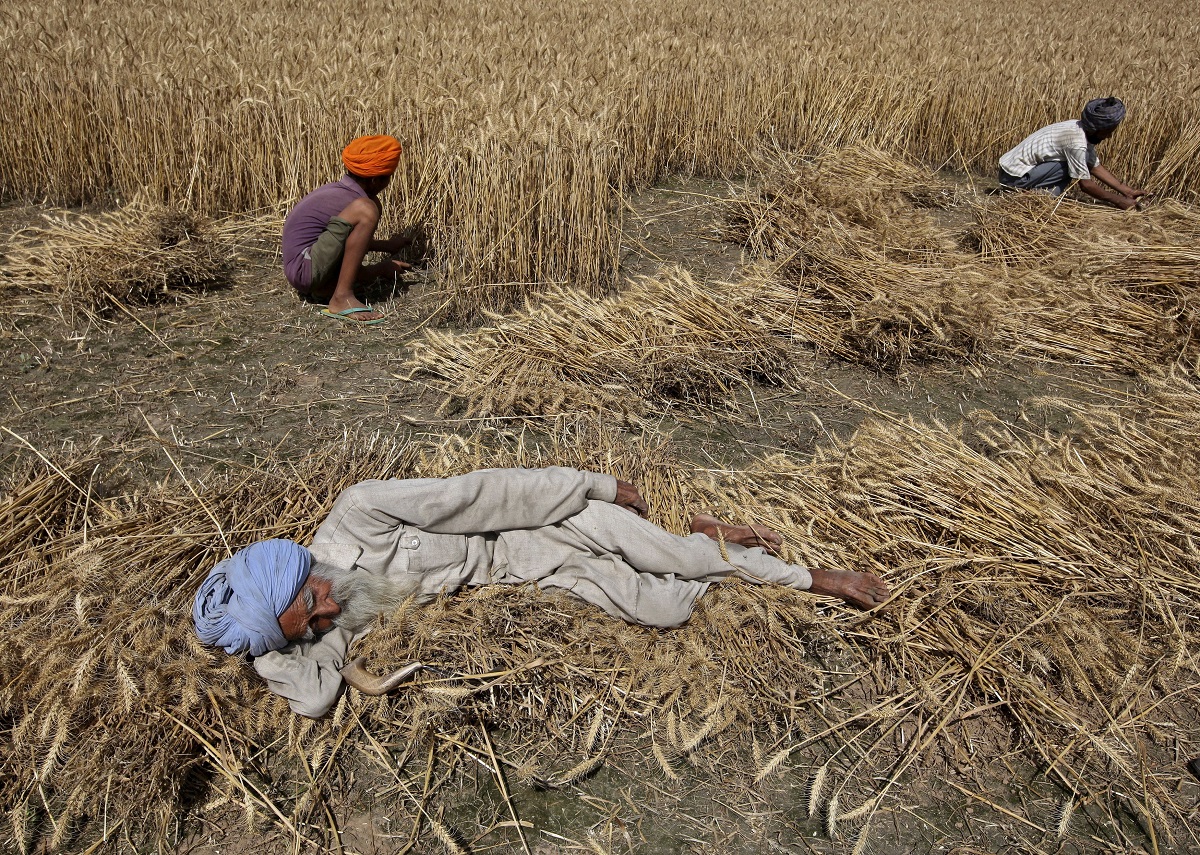
Farmers in a field of wheat crop in Punjab. Photo: Reuters/Ajay Verma
Core issues of Dalits in Punjab
A Dalit student from Saido Patti village in Hoshiarpur said that she completed her graduation under the post-matric SC scholarship scheme in 2019 from the Government College at Hoshiarpur but could not get her Detailed Mark Sheet (DMC) till date.
“What is the point of having a Dalit CM in Punjab if I cannot even get my DMC and apply for a Master’s degree? The college authorities asked me to pay Rs 9,000 to claim my own DMC, which I failed to provide. I lost two precious years of my education. Nothing has changed for Dalits," she said, requesting anonymity.
Advocate Rajesh Kumar from Chandigarh who has been fighting Dalit students’ scholarship cases in the court said, “A whopping amount of Rs 1532 crore as scholarship for the year 2017-18 to 2019-20 is pending till date. I am flooded with cases of Dalit students whose lives have been ruined by the governments.”
National Scheduled Castes Alliance (NSCA) president Paramjit Singh Kainth also said that though the Congress appointed Channi as "accidental CM" for 100 days, the issues of Dalits remained unsolved.
“Leave everything aside, Congress has failed to appoint a chairman of Punjab SC Commission. Whether it is budget allocation under SC sub-plan, providing 5 marla plots under common gram panchayat land or getting fast track courts to hear SC/ST atrocities cases, Channi has failed to deliver on these pressing issues of Dalits. Channi held late night meetings to announce major welfare schemes, he should have acted on these too," he said.
However ex-BSP leader Sukhwinder Singh Kotli, who recently joined Congress said, “Channi has done remarkable work to uplift Dalits, the impact of which is visible on the ground. If the budget is also announced along with these schemes, it will ensure accountability.”
Dalits in Doaba
Punjab has an approximately 38% Dalit population, which is the highest in the country with a sizeable concentration in the Doaba belt.
While in Doaba region, Ad-Dharmis, Valmiki and Mazhbi Sikh communities dominate the Dalit socio-political sphere followed by Kabirpanthi and Bhagat community, in Malwa and Majha region, the predominant castes are Mazhbi Sikhs, Valmiki, Ramdasia and Bazigar community.
The influence of Dalits in Doaba region can be gauged from the fact that 15 out of the 23 assembly seats have maximum Dalit presence. On these seats, Dalit population varies between 35 to 50% approximately.
These include Phagwara, Phillaur, Adampur, Kartarpur, Jalandhar Cantt, Jalandhar West, Shahkot and Nakodar assembly seats in Jalandhar district, Banga, Nawanshahr and Balachaur in Nawanshahr district, Garhshankar, Chabbewal, Hoshiarpur, Sham Chaurasi in Hoshiarpur district.
Chandigarh based advocate, Yagyadeep Singh, who has a keen interest in Dalit history and issues related to Dalits of Punjab said, “Despite having brute majority in Punjab, Dalits were facing the same problems which they faced 100 years ago as they are divided among 39 sub-castes, three religious Gurus and numerous Deras. And political parties irrespective of their ideology have flourished on the division of Dalits.”
On the socio-economic difference of Dalits of Doaba and Malwa belt, Yagyadeep said, “Doaba was never a feudal or princely region. Since 1926, Jalandhar and Hoshiarpur remained the centre of Dalit religious, social and political movements. However, 99% of Malwa belt was feudal and that legacy is still continuing there, hence the difference. Another reason is that since beginning leather trade remained the exclusive domain of Dalits in Doaba, bringing economic prosperity. Later, when the Middle East opened its gateway for migrant workers in the 1960s and 1970s, Punjabis from Doaba started going to Dubai, Saudi Arabia, Kuwait, Qatar and Bahrain to name a few. However, that is not the case in the Malwa belt."
Notably, last year during paddy transplantation season, a Dalit farm labourer – a woman from Matti village of Mansa district in Malwa was slapped by a landlord over demand to increase the rates of paddy transplantation per acre, leading to protests by Mazdoor Mukti Morcha in the village. Later an FIR was also lodged under the SC/ST (Prevention of Atrocities) Act in this case.
Also Watch | Exclusive: 'Rumours of a Rift Between Channi and Me Being Used to Fool Voters', Says Sidhu
Dalit politics
Yagyadeep Singh said that contrary to popular belief, Dalit politics is over 95 years old.
“It didn’t start with the rise of BSP, rather it started from Ad-dharam Mandal launched by Babu Mangu Ram Mugowalia in 1926. BSP on the other hand is an extension of the political movement of Ad Dharam mandal. In the 1931 census, Ad-Dharam mandal was considered as a separate religion. Six years later in 1937, Dalit politics was started by Ad-Dharam mandal, when they won seven out of the total eight seats in Doaba in united Punjab," he said.
He pointed out that in 1942, Ad-Dharam Mandal went into oblivion and the Scheduled Caste Federation was launched as a political party.
“After 1952, Dalit politics came in the hands of Republican Party of India (RPI), which is famous for the morcha of 1964. The morcha gave agricultural rights to Dalits. RPI remained active from 1957 to 1980, after which Kanshi Ram established BSP in Punjab in 1981. Infact Kanshi Ram also started his innings from Hoshiarpur reserve Lok Sabha seat in 1996," he added.
Since the mid-90s, Dalits votes have fluctuated between Congress and SAD. The BSP on the other hand has been losing its vote share since 1996. But it witnessed a change during 2019 Lok Sabha polls, when its vote share increased to 3.5% from 1.9% and 1.5 % in the 2014 Lok Sabha and 2017 assembly polls respectively.
This article went live on January fifteenth, two thousand twenty two, at fifty-one minutes past six in the evening.The Wire is now on WhatsApp. Follow our channel for sharp analysis and opinions on the latest developments.


