

The 2022 Caste Survey Hovers Over the 2025 Bihar Assembly Polls. Here’s How


New Delhi: What by all means appears to be an evenly poised contest, making the prediction game more precarious than ever, the 2025 Bihar assembly polls have caught attention for a range of reasons. The incumbent chief minister Nitish Kumar’s fading health, BJP’s “ghushpathiya’ rhetoric, the Election Commission’s controversial Special Intensive Revision (SIR), Prashant Kishore’s spirited entry into the fray, and Tejashwi Yadav’s rather radical promise of giving every household a government job have become topics of heated discussions and debates.
Beneath these optics, and out of the spotlight, however, the most crucial battleplay occurs in ticket distribution, as they say, in a state where caste factions and lobbies fight it out to determine the outcome. As all camps seek to widen their social umbrellas, their bid to outsmart each other is shouldered by candidates whose ability to consolidate support from a majority of caste groups will finally be clinching.
Against such a backdrop, the distribution of tickets by all parties in the run-up to the 2025 assembly polls points at a new pattern that reflects a fundamental churn in caste-based social justice politics of Bihar – something that really can be termed as Mandal 2.0.
Parties return to their core support base
All the major parties – Rashtriya Janata Dal (RJD), Janata Dal (United) or the Bharatiya Janata Party – have relied heavily on candidates who belong to their core support base, contradicting their own efforts to bring a diverse set of social groups in their fold.
Arvind Kumar and Pankaj Kumar’s analyses show that out of the 143 candidates that the RJD has fielded as part of the INDIA bloc or Mahagathbandhan, 53 belong to the Yadav community, while 18 are Muslims. The Tejashwi Yadav-led party has fielded nearly 51% of its candidates from backward classes (BC), including a significant number of Kushwaha candidates (13). Its Extremely Backward Classes (EBC)’s share has come down nearly 2% when compared to 2020 polls, which is surprising as the RJD has been seeking support from EBC groups rather enthusiastically.
The extent of its EBC outreach can be gauged from the fact that the Mahagathbandhan has devoted an entire set of separate promises for EBC groups in its manifesto.
Similarly, the Janata Dal (United), which currently enjoys the maximum support among EBC groups, has fielded 22 EBCs that make up nearly 36% of its 101 seats. Since JD(U)’s traditional social support has always been among EBCs and upper caste groups, it has also given a disproportionately high number of candidates to the latter (22). While trying to represent its core, JD(U) was forced to field only 38 BCs, as opposed to RJD’s 73.
However, even the JD(U) has represented 13 Kushwahas in its limited pools of BC candidates, while also fielding 12 Kurmis – the social group to which chief minister Kumar belongs.
Knowing that its strongest support comes from upper caste groups, the BJP, too, has stuck to its core, fielding 49 candidates (nearly 50%) from dominant groups from its total tally of 101. The party’s upper caste candidates have jumped by around 4%when compared to 2020, while the remaining groups like EBC, BC, Dalits, and SCs have found lesser representation. Kushwahas have found the maximum nominations (7), followed by Yadavs (6) among BJP’s 25 BC candidates.
Why is it that the parties decided to consolidate their core support, instead of taking a more risky approach towards a wider social representation?
After all, the last few elections saw these parties expanding their social support by fielding candidates who represent those groups that are not considered their own. CM Kumar represented EBCs, while Lalu Prasad received solid backing from Muslims and Yadavs.
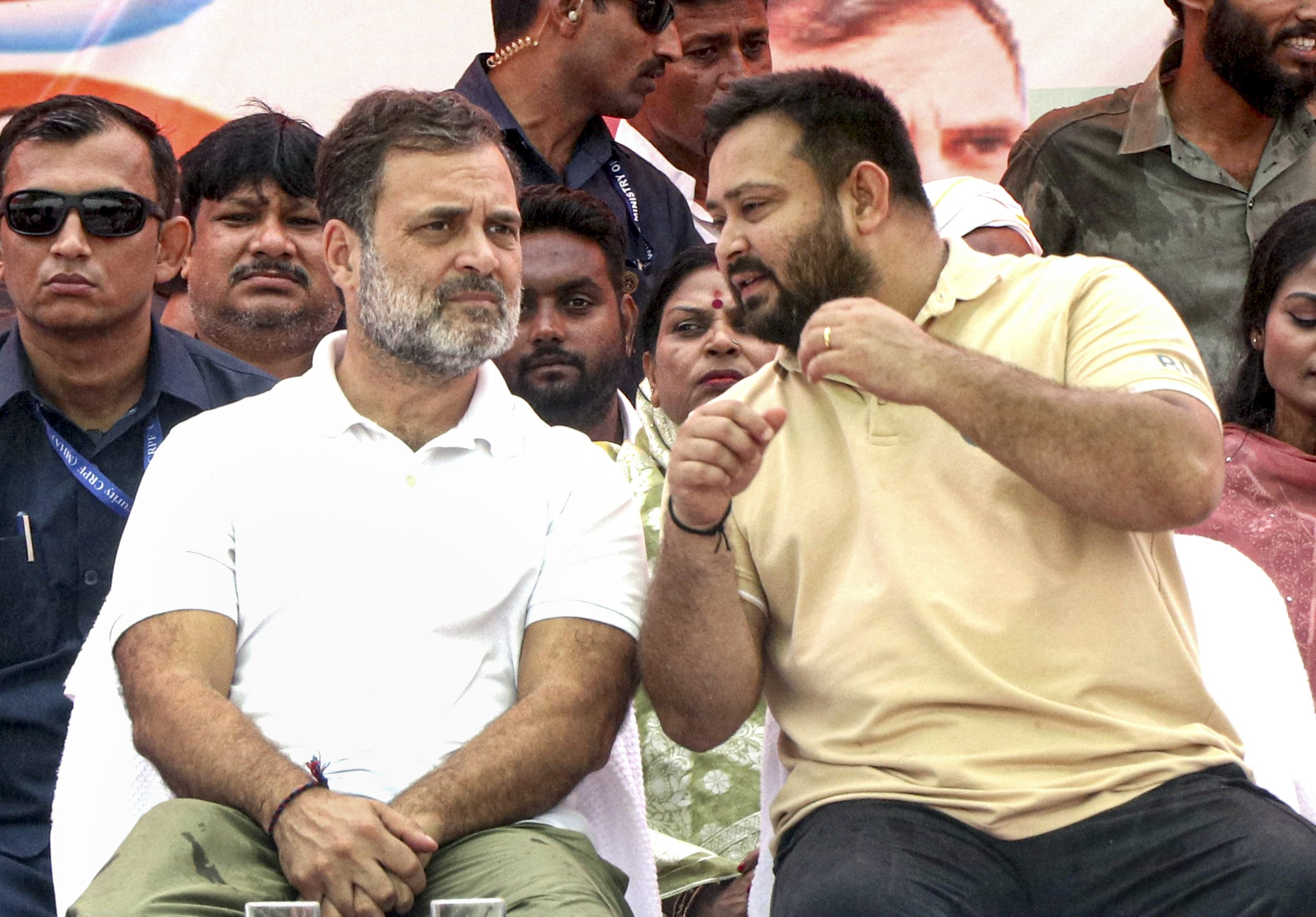
LoP in the Lok Sabha and Congress leader Rahul Gandhi with RJD leader Tejashwi Yadav during a public meeting ahead of the Bihar Assembly elections, in Muzaffarpur, Bihar, Wednesday, Oct. 29, 2025. Photo: PTI
The BJP, on the other hand, has always been seen having unflinching support of the ‘upper caste’. Yet, they walked out of their comfort zones in a highly competitive political environment and tried to represent more and more of those candidates who could bring newer groups into their fold.
But not this time – because the 2022 caste survey has kicked in a new consciousness among social groups that has in turn fragmented the polity even further. For a long time, Kumar was seen as the sole spokesperson of the EBCs, which, according to the caste survey, make up 36% and the biggest chunk of the state’s population. However, the caste survey also ensured a systematic unpacking of each and every caste group that otherwise were generally clubbed into the EBC whole.
However, growth of single caste parties in Bihar, along the lines of what the neighbouring Uttar Pradesh is already witnessing, indicate that the caste survey has ushered in a new Mandal era, the foundations of which lie in the now popular slogan: Jinki Jitni Sankhya Bhaari, Unki Utni Hissedari. Translated, it means, the greater a community’s numbers, the greater its political representation. The slogan was popularised by Bahujan Samaj Party (BSP) founder Kanshi Ram in the eighties but found renewed resonance among Mandal parties and the Congress during their demand for a pan-India caste census.
Now that the caste survey has been undertaken, there appears to be a new-found awareness of their strengths and weaknesses among smaller castes who felt left out from the traditional Mandal politics, and are now looking for a window to leverage them politically and electorally.
For instance, the prominence that Mukesh Sahani-led Vikasheel Insaan Party (VIP) has received in the INDIA bloc, in spite of the fact that he represents only a single caste group called Mallahs, who constitute merely 2% of the state’s population and are concentrated in pockets, points towards the significance of such smaller parties in the future. Similarly, I.P. Gupta, leader of an even smaller social group called Tatva/Tanti, has also risen in importance in the here-to-stay coalition politics.
All these smaller groups have come to represent a significant part of coalition politics across the Hindi heartland and are now seeking to have an independent voice, unwilling to be governed by the interests of established parties, including the national ones.
Look at how NISHAD Party of Sanjay Nishad, or Suheldev Bharatiya Samaj Party led by O.P.Rajbhar, or Anupriya Patel’s Apna Dal have made an indelible mark in the already-complex politics of Uttar Pradesh. Even among Muslims, parties like the Peace Party have registered their presence to voice the concerns of the Ansari community.
Some have been successful, some not, but the trend of forming single caste parties under the leadership of a representative leader continues.
The BJP was perhaps the first party to acknowledge their significance, and could accommodate them in the NDA. However, Bihar still remained under the influence of two major blocs even when UP saw a fragmentation of the polity, as chief minister Kumar led the politics of non-dominant communities from the front.
Leaders representing smaller groups assert their presence
With Kumar being at the fag end of his career, leaders representing smaller groups have now begun to assert their presence. The NDA now has two separate streams of even Ambedkarite politics – Chirag Paswan representing Dalit groups like Dusadh, Paswans, and Chamars, and Jitan Ram Manjhi as the spokesperson of Mahadalit groups like Musahars and Valmikis.
In Bihar, the JD(U) was known as Lav-Kush party, representing Kurmis and Kushwahas respectively. However, over the last few years, Kushwahas have asserted their separate presence under the leadership of Upendra Kushwaha, who is currently with the NDA. Since he lost the 2024 Lok Sabha polls, there is a significant churn among Kushwahas – also the second largest BC community after Yadavs – to be represented by a new leadership.
As a result, all parties have pre-empted the flux, and have therefore given the maximum nominations to the community. Both RJD and JD(U) have fielded 13 Kushwahas, while the community leaders also figure as the largest group in BJP’s BC representation.
Similarly, among the EBCs, the parties have tried to represent more candidates from Teli community than any other, as the social group has been looking to find new leadership quite ardently.
While smaller groups finding their own leaders, the established parties have followed the hissedari rule, and were forced to represent their own traditional support base with a new zeal, while letting autonomous political voices among smaller caste groups leveraging their own position vis-a-vis the two primary political fronts in Bihar.
Such a trend has created a flutter among established parties. While they have attempted to become more representative in recent times, the electoral fragmentation along caste lines has offset their efforts, as more and more caste groups want to speak for themselves and are reticent in giving legitimacy to established parties to speak on their behalf.
A moment of great flux in Bihar
The big questions that have emerged is will such an increasingly transactional nature of politics reduce the established parties to speak only for the interests of their traditional support bases, and will it lead to a situation where they may not find it necessary, or have the legitimacy, to stick to their ideological plans. There may be a situation where some of these regional groups could be reduced to being mere spokespersons for their traditional support bases.
It is indeed a moment of great flux in Bihar, when established parties may be struggling to widen their tents in their own terms and conditions. Instead, the fragmentation of social justice politics has marked a turn towards more and more autonomous voices with it.
Mere electoral promises may not do the trick anymore in the complex arithmetic play of heartland politics. Only those political formations which can engineer a more representative social coalition will have an electoral edge. That is why established parties have attempted to first consolidate their core support in Bihar, instead of over-relying on smaller caste groups that are increasingly becoming autonomous.
This article went live on November second, two thousand twenty five, at zero minutes past ten in the morning.The Wire is now on WhatsApp. Follow our channel for sharp analysis and opinions on the latest developments.


