

Ahead of Panchayat Polls, Is There Any Such Thing as Bengal's 'Muslim Vote'?


The idea of a Muslim vote bank in West Bengal has been a subject of much discussion. The Trinamool Congress (TMC) has been successful in gaining support from the Muslim community, and this support has strengthened over the years, reaching its peak in the 2021 assembly elections.
According to the CSDS-Lokniti post poll analysis, around 8 out of 10 Muslims voted for the TMC in the 2021 polls.
According to the 2011 Census, Muslim constitute around 27.1% of the total population in Bengal. There are two Muslim majority districts, Murshidabad (66.8%) and Malda (51.27). Three more districts, Uttar Dinajpur (49.92%), Birbhum (37.06%) and South 24 Parganas (35.57%) have a sizeable minority population.
However, it would be wrong to label Muslims in West Bengal as a single vote bank.
Historically, the Muslim community in the state has displayed diverse voting patterns based on a range of factors, including financial and regional considerations, and socio-economic issues. While it is true that a section of the Muslim community had shown support for the Congress party earlier, voting decisions were not solely determined by religion.
Muslims in north and central Bengal have shown an inclination towards the Congress party, while the TMC has enjoyed stronger support from Muslim voters in south Bengal since 2008. CSDS surveys show that TMC has been able to consistently increase its support base among Muslim voters in Bengal. Between 2006 to 2021, the party's support among Muslims increased from 22% to 79% – 22% in 2006, 35% in 2011, 40% in 2014, 51% in 2016, 70% in 2019 and 79% in 2021 – indicating a significant consolidation among this demographic.
Bengal journalist Kazi Golam Gaus Siddiqui notes that while it is in the interest of minority communities to align themselves to the ruling power, Bengal may be witnessing the first signs of the ruling power's hold waning.
Also read: Will Muslim Votes in 6 Districts Play Decider in the West Bengal Elections?
The TMC nonetheless continues to enjoy strong support from a significant portion of the Muslim population, particularly in south Bengal districts like South 24 Parganas, Howrah, Hooghly, and Kolkata. One key factor for this loyalty can be attributed to the perception that it is the most capable party to effectively counter the growing influence of the Bharatiya Janata Party and its Hindu nationalist politics in the state. The astonishing consolidation of Muslim vote in favour of TMC in 2019 and 2021 are directly proportional to the fear stoked by the BJP in wake of the Citizenship Amendment Act and the National Register of Citizens.

Muslims protest against CAB and NRC in Howrah district of West Bengal, Friday, December 13, 2019. Photo: PTI
However, local sentiments and rampant violence in the run up to the Panchayat election this time reveal a slightly different picture.
Out of the 10 people who have died in pre-poll violence in the state in recent months, eight are from the Muslim community. Domkol, Chopra and Bhangor – areas that have been in the news for clashes between the opposition and ruling parties – have a sizeable Muslim population.
“It's not just the minority, but even the majority has been affected by this regime. The TMC has treated us merely as a vote bank, using the Sachar Committee Report to consolidate Muslim votes and gain political advantage. Let them shed light on the actual work they have accomplished for the betterment of the community as a whole,” said Indian Secular Front leader and Bhangor MLA Naushad Siddiqui. In January of this year, Siddiqui was arrested and detained for 42 days on charges related to violence. Hailing from the religious seat of the Furfura Sharif, Siddiqui holds significant influence over his community, and his arrest had sparked discontent among a section of Muslim youth.
“This shift in support is noteworthy and reflects the broader sentiment among the population, where livelihood and economic concerns take precedence over religious identities and ideologies,” said economist Sudipto Bhattacharya.
Over the past decade, there has been a sharp rise in the politics of religious and caste identity at the cost of ‘party society’ in Bengal.
The 2021 assembly elections saw the use of religious rhetoric and communal narratives leading to a degree of polarisation, with identities playing a role in political discourse and voting patterns. Of the 118 assembly seats where Muslim voters play a significant role in determining the outcome, 91 went to Trinamool, 26 to BJP and one to ISF.
However, factors on the ground reveal that there is more than party loyalty at play.
Mafoza Khatun has been a committed BJP worker. For the last four years, she has been working from her rented accommodation in Baharampore to increase the party's footprint in Murshidabad – which has a 66% Muslim population and has been a Congress stronghold. BJP has fielded quite a few Muslim candidates in the district but has failed to make an impression.
For local BJP leader Mohammad Yunus, with whom the likes of Khatun work, the Congress-Left alliance is the main challenge.
"I don't think any Muslim will go to BJP with political ideals in mind," said intellectual Kazi Mohammad Selim.
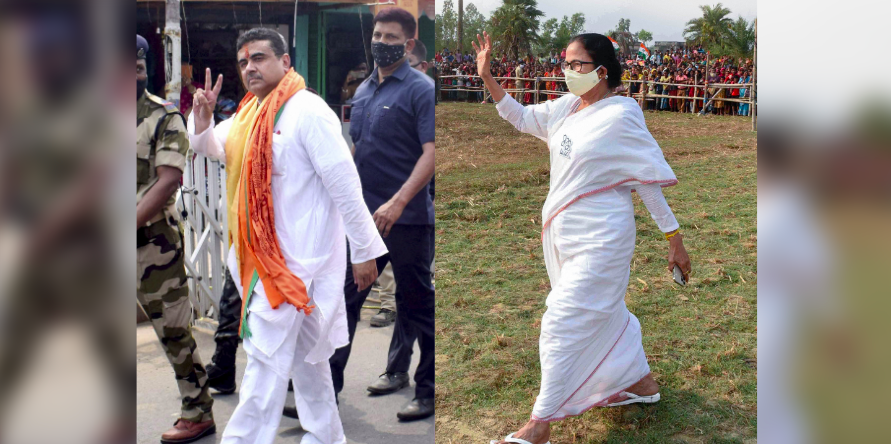
Suvendu Adhikary (left) and Mamata Banerjee, in Nandigram. Photos: PTI
The TMC had wrestled the Murshidabd Zilla Parishad from the Congress in 2018 thanks to the efforts of Mamata Banerjee's former trusted lieutenant, Suvendu Adhikari. With Adhikari now the opposition leader and leading the BJP's campaign in the state, the dynamics have changed. The infighting over candidate selection is also a cause of worry for the TMC.
The Murshidabad district secretary of the Communist Party of India (Marxist), Jamir Molla, placed firm hopes on the alliance defeating both TMC and BJP this time.
The TMC had made significant gains in the 2021 elections by winning 18 out of 20 seats. However, a recent by-election in the Sagardighi constituency, where 63.5% of the population is Muslim, saw Congress candidate Byron Biswas win with support from the Left parties, by a wide margin of 22,986 votes. Biswas has since joined the TMC.
Nevertheless, political analysts believe that the results show that a section of the Muslim community in the state is displeased with the party due to increasing incidents of violence against minorities, including in the brutal massacre at Bogtui, and the mysterious death of student activist Anis Khan.
Anis's brother Shamshuddin is now contesting the election as a CPI(M) candidate. “My brother’s killing was not just a random act of murder, rather Anis was killed for protesting against social and political injustice. People will now give a befitting rely to TMC,” said Shamsuddin.
A few family members of those who lost their lives in the Bogtui tragedy are now contesting as BJP candidates too.
In Uttar Dinajpur, where Muslims constitute nearly half the population, clashes between TMC and the Left-Congress alliance have been bloody, resulting in death of one CPI(M) supporter.
Unemployment
A key issue that the CSDS-Lokniti post-2021 poll analysis revealed was that development and unemployment were more significant issues for voters than corruption, contrary to what the mainstream media had suggested.
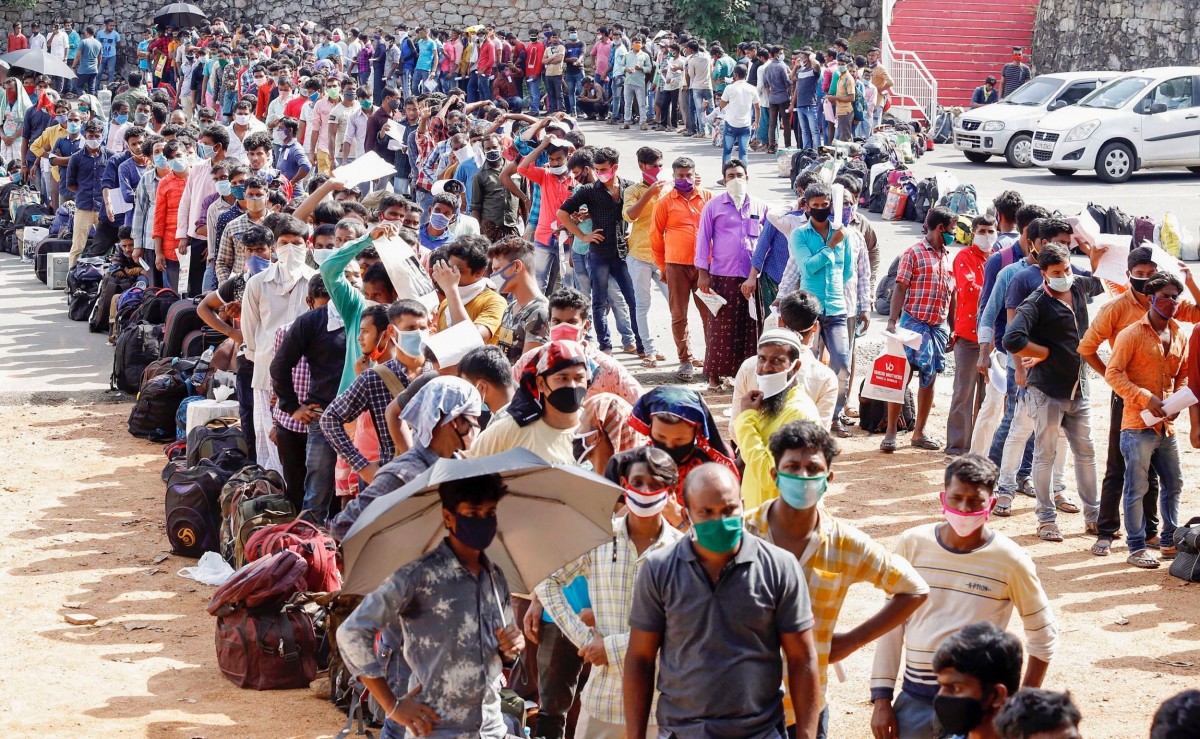
Migrants waiting to travel from Kochi to West Bengal amidst the lockdown in 2020. Photo: PTI
The TMC has gained electoral advantages through various development schemes such as Kanyashree, Swastha Sathi, Sabuj Sathi, Khadya Sathi, and Lakshmi Bhandar.
Also read: In Industry-Starved Bengal, Mamata Banerjee's Poll-Winning Welfare Schemes Face a Cash Crunch
However, for close to two years now, the Union government has withheld funds for several welfare schemes in West Bengal, including the Mahatma Gandhi National Rural Employment Guarantee Scheme (MGNREGS). The lack of unemployment, fall in agricultural income, low wages and corruption at the rural level have been pushing people to move to other states for better prospects.
Away from his hometown of Murshidabad and working at Tiruvannamalai in Kerala, Jiyaul Haque said, "Here, workers get benefits of various government schemes. The wages are good. I am thinking of bringing my family here. What is the point of going there and risking lives? There is go guarantee we would be able to cast our vote either."
In Malda district which neighbours Murshidabad, BJP has been organising meetings with Muslim voters, especially in the Gazole area. Despite humiliation in the 2021 assembly election, Congress still holds significant power in this district. For the TMC, which won five out of nine seats in the district, infighting is a challenge. A section of leaders of the minority cell recently announced mass resignations alleging corruption in ticket distribution.
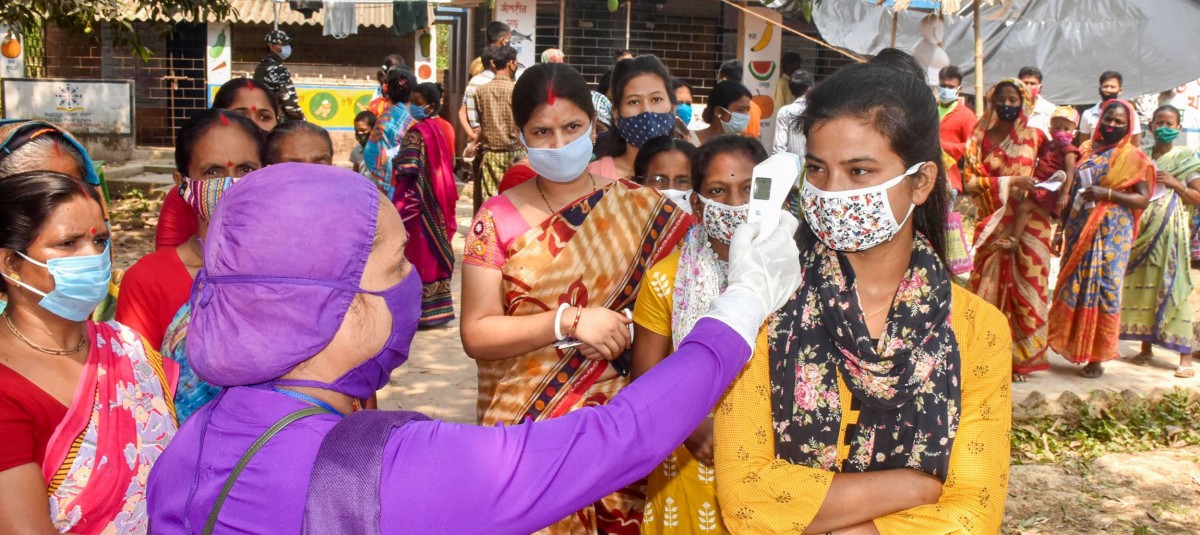
A voter goes under thermal screening at a polling booth during the 8th phase of West Bengal State Assembly Election at Malda District, Thursday, April 29, 2021. Photo: PTI
Sabina Yasmin, the Cabinet Minister of State for Irrigation and Waterways, North Bengal Development, and an influential leader in Malda district, blames the situation to a larger conspiracy. "I am confident that Muslims will support Mamata Banerjee," she says.
Former minister and Trinamool Congress MLA from Islampur in Uttar Dinajpur district Abdul Karim Choudhury, however, has openly expressed his dissatisfaction with the party. “This is not like 2011, when people thought of TMC as their own party. I myself have decided to support independent candidates in the panchayat poll," he said.
A section of the Muslim community is also unhappy with the way they have been reduced to a tool of vote bank politics.
In English Bazar, the commercial hub of Malda, Eid is a busy time for businesses. Cloth merchants like Mubarak Hossain have already stocked their shops, waiting for their accounts to be settled. They expect things to pick up in in the next few days as campaigns gain momentum.
But what does the panchayat election have to do with Eid? Mubarak Hossain said, "Many candidates will be distributing money to lure voters. This impacts my business. This is an investment – if they win, they will reap the benefits for the next five years. It's good investment. Even if they spend thousands to woo voters and buy tickets, they would still make a profit."
Muslims in West Bengal defy categorisation as a homogeneous voting bloc. The political landscape in Bengal remains dynamic and the outcome of the panchayat polls will shape the trajectory of the state's politics too.
Joydeep Sarkar is an independent senior journalist with over 20 years of experience in covering Bengal politics. Aparna Bhattacharya is a Kolkata-based political analyst with experience in campaign strategy, communication and public affairs.
Translated from the Bengali original by Aparna Bhattacharya.
This article went live on June twenty-seventh, two thousand twenty three, at five minutes past six in the evening.The Wire is now on WhatsApp. Follow our channel for sharp analysis and opinions on the latest developments.


