

As Ayodhya Votes Today, a Temple Subsumes All Poll Issues


Ayodhya (Uttar Pradesh): As the Bharatiya Janata Party (BJP) places the construction of the Ram Temple in Ayodhya at the centre of its campaign in the 2024 Lok Sabha elections, openly appealing to religion to woo voters, nowhere is its impact more apparent than in the temple town. Once marked by communal violence surrounding the demolition of the Babri Masjid in 1992, the the city is now swarming with devotees who queue for hours despite the scorching summer heat, the scars of its violent past forgotten.
Illustration: Pariplab Chakraborty
But 25 kms away, in Dhannipur construction is yet to begin on the proposed mosque on land granted following the Supreme Court verdict in the Ram Janmabhoomi-Babri Masjid title dispute.
Just on May 7, at a rally in Madhya Pradesh’s Khargone and Dhar districts, Modi said that the BJP needs 400 seats so the Congress does not overturn the Supreme Court’s 2019 verdict on the Ram Janmabhoomi-Babri Masjid title dispute case and succeed in its plan of “putting the Babri lock” on the Ram Temple in Ayodhya. He then retracted it.
If Modi’s attempt has been to woo Hindu voters by getting them to rally around the under-construction temple, it has found takers among devotees in Ayodhya, which will vote today (May 20) in the fifth phase of the Lok Sabha elections.
“Earlier this whole area was like a jail; there were so many barricades all around. Now everything is running smoothly. If Modi has got the temple made, why shouldn’t he speak about it as one of his achievements? If someone has done good work he should speak about it. Vikas [development] and mandir [temple] are on the same plane, he has done both,” said Pradeep Kumar Mishra, a resident of Bhadohi, while sitting in the waiting area inside the Ram Janmabhoomi complex.
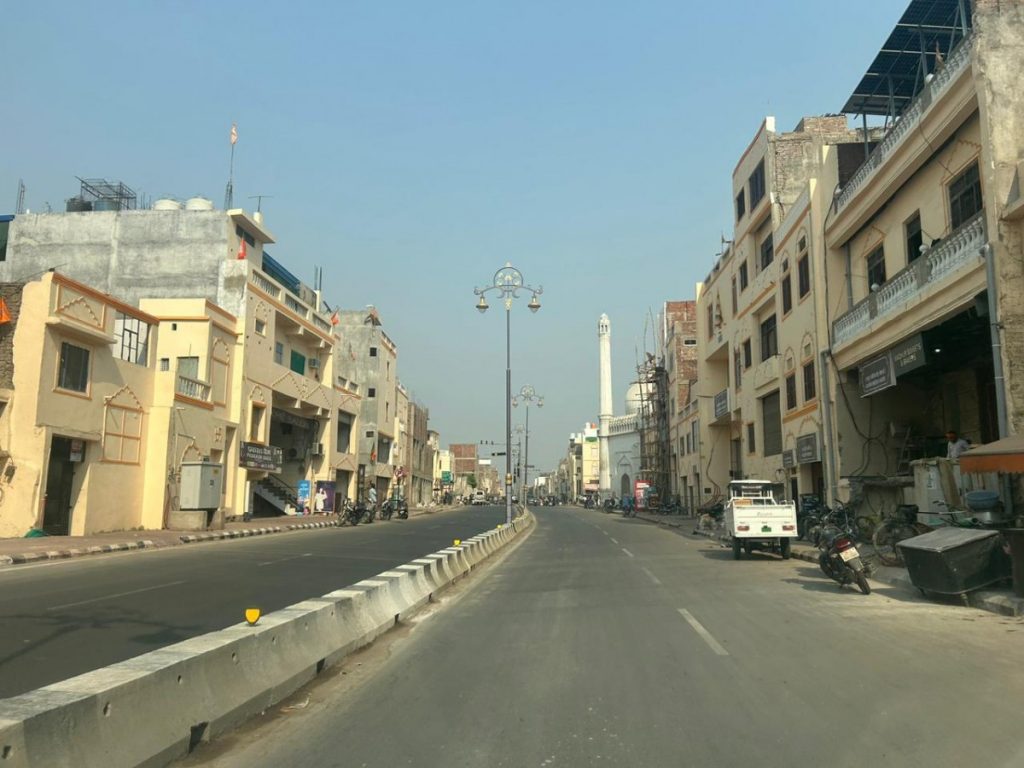
Roads in Ayodhya.
Just two days ago, while addressing a rally in UP’s Barabanki, Modi alleged that if the Samajwadi Party and Congress come to power, they will use a bulldozer to break the Ram Temple in Ayodhya and “send Ram Lalla back to the tent”, and asked them to take “tuition” from Uttar Pradesh chief minister Adityanath on where to use bulldozers.
While the Ram Temple has been a poll plank for decades and its construction a culmination of a long drawn political project by the Sangh parivar, including a longstanding poll promise of the BJP, its open use in election campaigns has raised questions on the violation of the Model Code of Conduct, which expressly bars appeals “to caste or communal feelings for securing votes”. While the use of religion in election speeches is not new in India, and neither is it new for Modi or the BJP, the impunity given to the prime minister and the BJP has also turned the spotlight on the role of the Election Commission, as well as whether these speeches constitute “corrupt practices” under the Representation of the Peoples Act, 1951 that deals with references to appeals on the ground of religion.
Swarnabha Khare, a resident of Rae Bareli, who had come to visit the temple said that the BJP cannot be blamed for using the temple in its poll pitch.
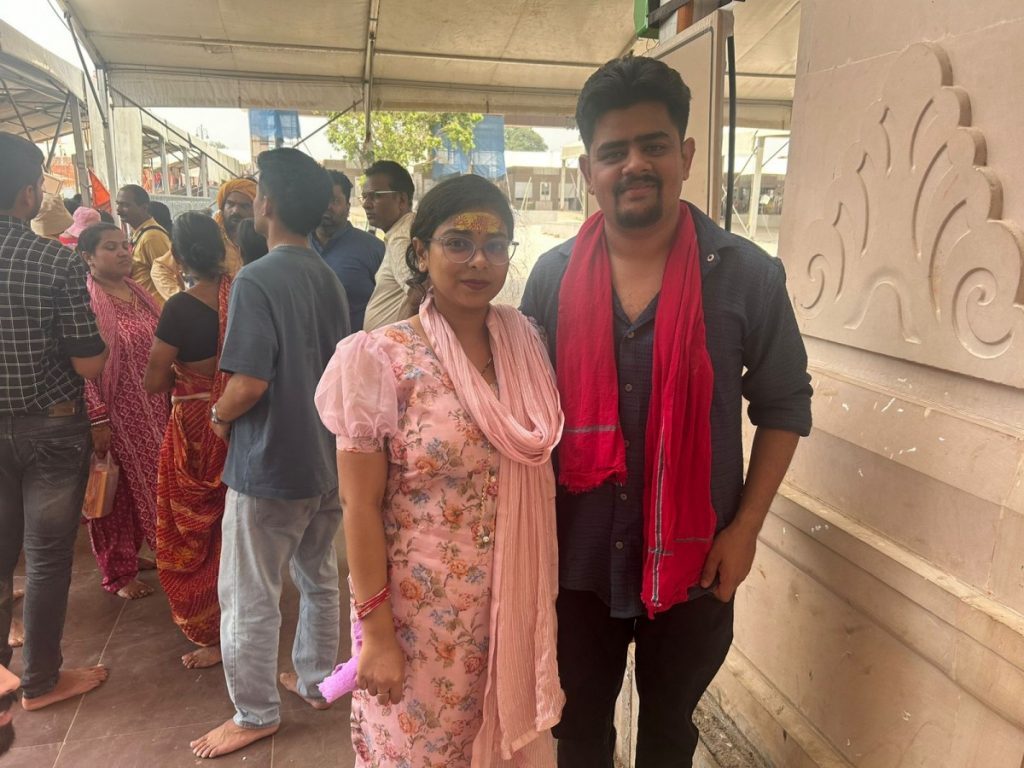
Swarnabha Khare (left) with her husband Sahil inside the Ram temple complex.
“We cannot blame the BJP for using the mandir in its campaign. Since they have got it made they will try to reap political benefits out of it. Any other party would too. But the biggest issue is that the matter is now settled and no other party will be able to use it for political gains,” she said.
“Because of the temple, a lot of people have got employment. This whole area has become very well developed, roads have been repaired as well. It’s not just about religion but this has brought vikas as well here. In comparison, just look at Rae Bareli and Amethi. Even after so many years they have remained villages,” she said.
While the Ram Temple complex is still under construction, its gates have been thrown open for devotees since the consecration ceremony by Modi in January. In the last year, Modi has visited Ayodhya three times, once to inaugurate development projects worth Rs 15,700 crore, including the new airport, redeveloped railway station in December, then in January for the consecration ceremony and as recently as earlier this month on May 5, when he offered prayers at the temple and held a grand roadshow.
“The biggest issue is nationalism and Hindutva and since I am a Hindu, I will vote for BJP,” said Sujit Yadav, a resident of Jaunpur who sells saffron scarves outside the temple complex.
Yadav said that he had a business selling mobile accessories which went under three months ago, following which he decided to come to Ayodhya.
“This was a big issue that was not resolved for 500 years, even though the Congress had been in power for 70 years. Modi has worked for Hindu sentiments. I knew that a lot of people would be coming here so I decided to come here and earn as well,” he said.
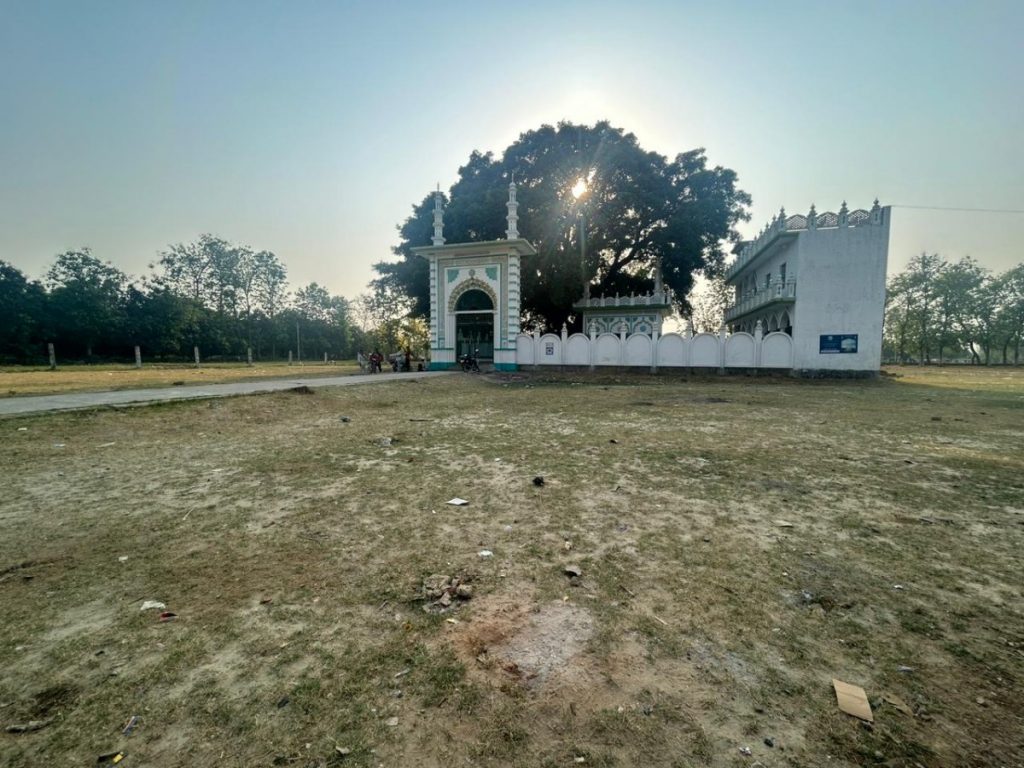
The empty plot in Dhannipur that has been sanctioned for the mosque.
Mosque yet to be built
About 25 kms away from the bustle of Ayodhya Dham, an open field lies vacant at the site which has been sanctioned for the construction of the mosque. While the Ram Temple is bustling with activity after its inauguration, in Dhannipur, an empty plot of land lies unattended where children play and cattle graze.
The Supreme Court verdict in the Ram Janmabhoomi-Babri Masjid title dispute on November 9, 2019, paved the way for the construction of a Ram temple – at the disputed site – and a mosque, at an alternative five-acre plot.
“This land has been lying vacant like this since it was sanctioned. The way the mandir was built this mosque should have also been built. Thousands of crores were spent on the mandir, that same money could have been used to help the poor. The government should take everyone forward together and not work in a one-sided manner,” said Mohammad Shanu, who sells carpets in adjoining areas of Ayodhya.
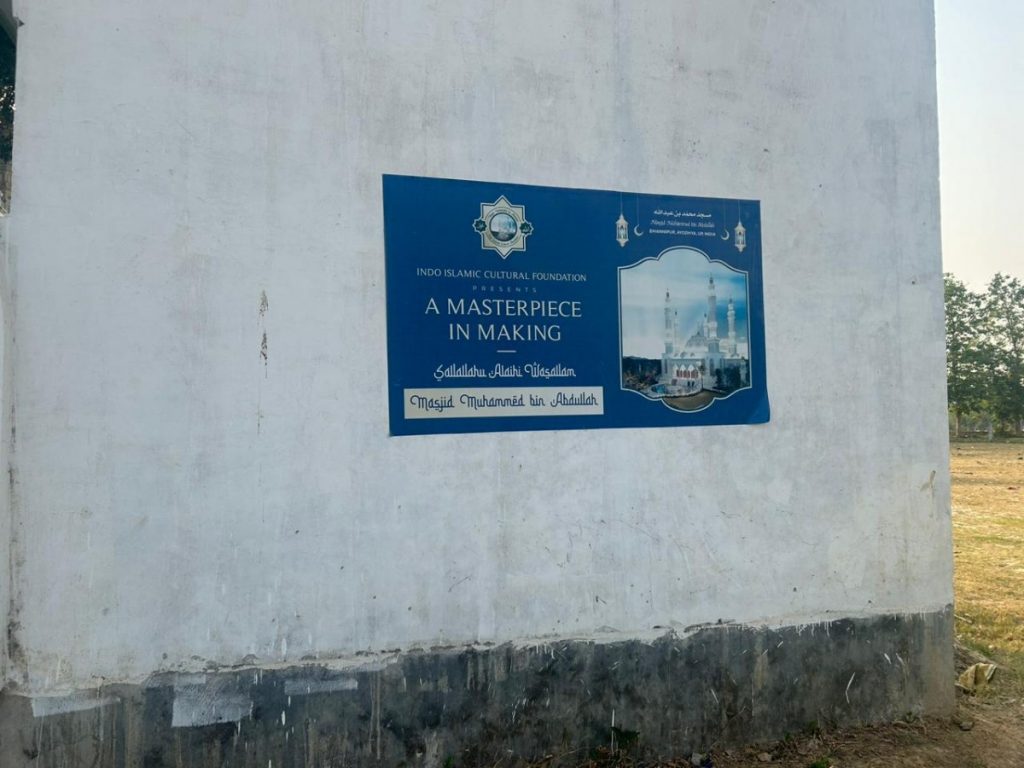
A poster at the site of the sanctioned mosque.
In January, The Wire reported that the Indo-Islamic Cultural Foundation (IICF), which is handling the construction of the mosque, is struggling to get the mosque's map sanctioned and reeling from a lack of funds. The laying of the foundation stone is the only activity that the land has seen.
Mohammad Gufran, a resident of Dhannipur and a steel welder said that there has been no progress on the mosque at the site.
“The other day a few people came from Barabanki and wanted to visit the new mosque. They didn’t even know that it has not been built. Sometimes people come from as far as Uttarakhand and Bengal to see the mosque. No one even knows what the status of the mosque is,” he said.
Gufran said that as the temple has already been built, the focus should be on tackling unemployment.
“I have not got any work in the last three months. I have just been sitting at home. Inflation is rising everyday. It does not make a difference to us who comes to power, but what about unemployment?” he said.
Redevelopment at a human cost
Back in Ayodhya, it is no news that redevelopment work has come at a price for some residents. A three storey multi-level parking complex has been built about a kilometre from the temple complex. To make way for the multi-level parking building, residents who lived in the area were moved out in 2021 and given homes about 6 kms away to the Kanshi Ram colony, which was first built under the Mayawati government but was not completed. Residents said that while they were moved out of their homes within two days of being informed, they are yet to receive documents that state that they own these homes.
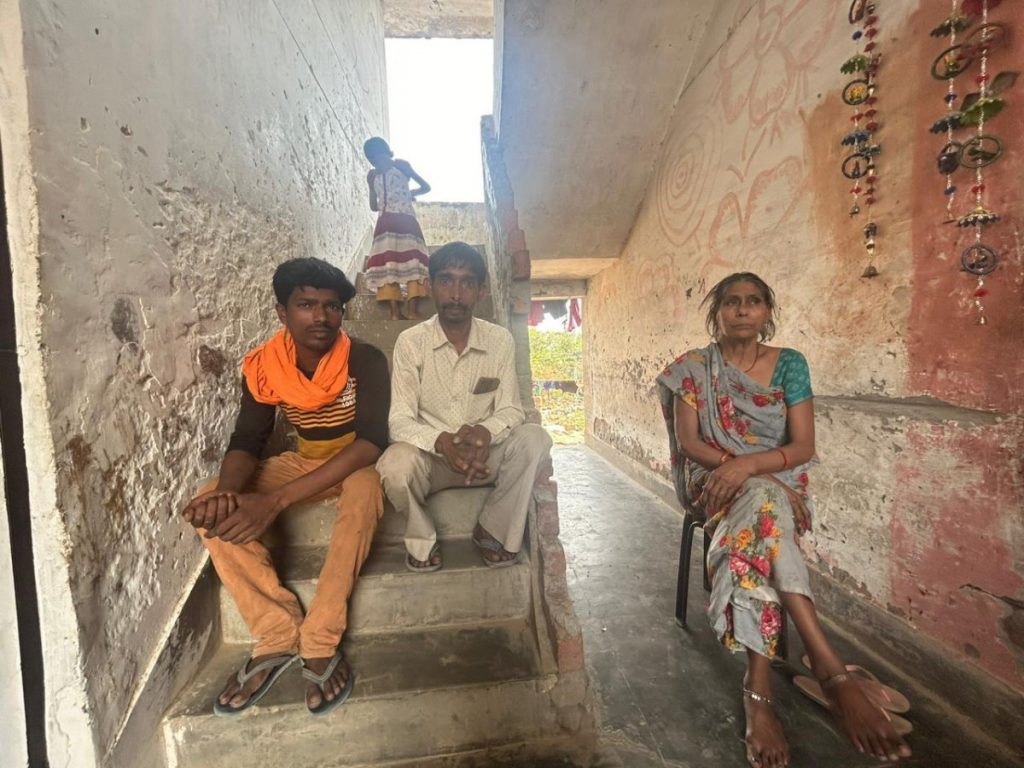
Sikander Paswan (left) and Mukesh Kumar (centre) at their Kanshi Ram Colony building.
“We had to shift in two days. We could hardly gather our belongings because of heavy rains and flooding at the time. Before we could do anything, the bulldozers had arrived. They had promised that we would get papers stating our ownership of these homes but we still have not. The only property papers we have are those of our old house, where the multi-level parking stands,” said Sikander Paswan, a labourer.
About 36 families were moved out of the area to the Kanshi Ram Colony. Mukesh Kumar, who moved into the colony, sells namkeen (salty snacks) on a push cart, earning money for his family of five.
“Our house in Ram Katha Park had everything as we were living there for 40 years. But here we don’t even have a water connection. There is a tank outside and we have to carry water upstairs to the third floor. We still don’t have papers for our house. Some of the families who live here don’t have toilets. The partitions have been made but the toilets have not been constructed. We will vote for BJP because if we don’t as Ayodhya residents, and they lose then we will lose face. But we want them to look into our problems as well.”
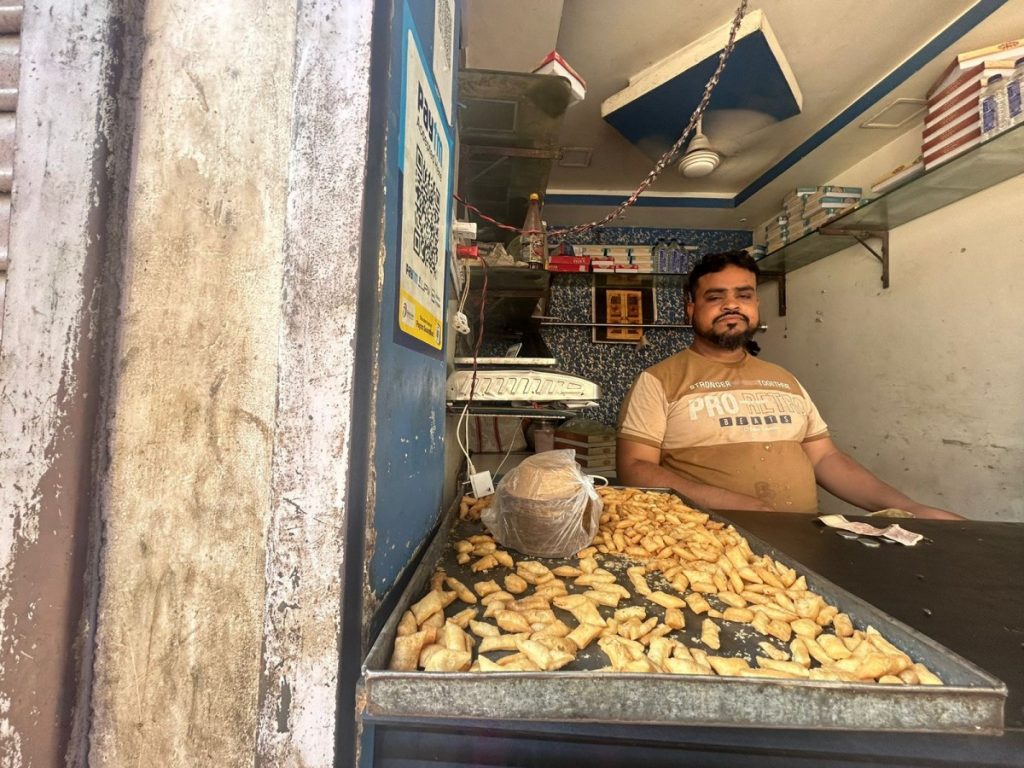
Arshad, a sweetmeat seller in Beniganj.
In Ayodhya’s Beniganj where there is a sizeable Muslim population, there is disquiet on equating matters of faith with votes but there is no open criticism.
“Our sitting MP Lallu Singh (who is contesting from the BJP again) has openly said that they need 400 seats to change the Constitution. The country that is run on the constitution they want to change it. Instead of doing this should they not focus on health education and reducing inflation? It’s not that the government has not done development. But it is wrong to connect matters of faith with votes. The mandir matter should have been kept out of elections,” said Arshad Ahmed who runs a sweet shop in the area.
This article went live on May twentieth, two thousand twenty four, at forty minutes past nine in the morning.The Wire is now on WhatsApp. Follow our channel for sharp analysis and opinions on the latest developments.


