

Backstory: The Right Way to Talk About the Growing Cancer of Vigilantism


The seemingly inexplicable, inexorable rise in incidents of vigilante attacks that have come to mark contemporary Indian society should possibly –as a prime marker of aberrant public behaviour – come to occupy the minds of our finest historians, philosophers and psychoanalysts of the future. How did a country that swore by its high democratic and multicultural ideals emerge as the stomping ground for lynchers?
How indeed, but please spare a thought for us poor hacks, ordained to function as sense-makers in the here and now, even as people are being killed not only for what they eat and wear, but merely for being there. When the public sphere, far from being the site of rational discourse as Habermas first envisaged it, turns into an echo chamber within which manufactured hatreds, cultivated suspicions, instant surmises endlessly circulate, we are left without a familiar framework to analyse it. Even the staple one of morality no longer suffices. Many of those who have become moving parts in the machinery of a murderous mob would possibly view themselves as god-fearing, good people contributing towards regenerating their environs by cleansing it of evil. This is possibly why Hannah Arendt had argued that human evil originated not from a failure of goodness, but a failure of thinking. As journalists who contribute to the thought processes that animate society, what role have we played in providing an understanding of these acts of hate-fuelled violence in order to end them?
Historically, the media has had a major role to play in quelling such violence. As The Wire piece, ‘What Lynchings in 19th Century US Can Teach Us About ‘New India’' (July 12), tells us, lynching had an unbroken run in the southern states of the US thanks to the “sheen of justification” provided to it by the newspaper reporting of those days. The piece goes on to examine how most reportage in the Indian media on vigilante violence – in 21st-century India – has failed to build public abhorrence of such crimes precisely because of the manner in which these stories are routinely framed to provide a “sheen of justification”.
There is a false equivalence drawn between the circumstances in which the crime took place and the crime itself. The nature of the meat in his fridge is given as much media attention as the beating of Mohammed Akhlaq to death, even as the police book cases against both Akhlaq's family and his assailants. One could add that the media’s narrative voice changes perceptibly depending on the subject. The lynching of Abhijeet Nath and Nilotpal Das in West Karbi Anglong district of Assam took place a few weeks before that of Qasim and Samiuddin in Hapur, Uttar Pradesh. The media coverage given to Nath and Das was far more empathetic than that accorded to Qasim and Samiuddin (the last escaped within an inch of his life). Was it because the former were middle-class Hindus and the latter, small town Muslims? Incidentally, while justice delivery in the first instance has been fast-tracked, one of the killers in the second instance has already got bail.
The endless subterfuges that have marked the way vigilantism is framed need to be exposed and stripped away. There is an arc that connects the police packing FIRs against the criminals with wrong information, judges citing lack of evidence in order to grant them bail and politicians rushing to honour them with marigold garlands and boxes of sweets. Disinformation, misinformation, lack of information and dissimulation lace the entire process, from beginning to end. As purveyors of information, this should concern every media person. Vigilantism – whether it takes place in flesh-and-blood or in the online space – has emerged as the new barometer by which to assess the credibility of media content.
The developments of the last few weeks indicate that the building blocks of hate are being placed together in tidy heaps to pave the road to a 2019 victory, much like the bricks to build a grand temple in Ayodhya were, a quarter of a century ago. Prime ministerial lack of response on the issue, even when one of his senior colleagues becomes a victim of virtual lynching, is strategic. There may have been rare occasions in the past when Prime Minister Modi felt driven to express disapproval of the excesses of party minions, or when party president Amit Shah would doggedly claim that there were more lynchings in the UPA era.
That time is past, now with state and central elections imminent, the BJP’s drive to consolidate the larger Hindu identity in its favour requires that every potential vote, even if it comes with the markings of bloodied hands, is valuable. This also means that every minister has to do his or her bit – and there can be no exception for the Harvard returned. Jayant Sinha, for instance, “carried out his assigned task with great vigour and then refused to equivocate about it” (‘Jayant Sinha Is No Different From the Garden Variety, Saffron-Clad Sanghi Bigot’, July 9). For his grand gesture of garlanding the lynchers of Alimuddin Ansari, he attracted a lot of lot of adverse comment from “pseudo-secularists”, which included a battery of formal civil servants outraged that a Union minister of state should felicitate these felons as if they were revolutionaries, and demanded his resignation (‘Former Civil Servants Issue Statement Demanding Resignation of Jayant Sinha’, July 9). But Sinha, who finally came up with a weak apology, knows where his interests lie. His public stance has possibly secured a ticket to contest the next election, so we really need to ‘Quit Grumbling About Jayant Sinha’ (July 10).
But more than the Jayant Sinha issue, it is the one concerning the cyber lynching of Sushma Swaraj that resonates with hypocrisy. As the piece, ‘Sushma Swaraj’s Reaction to Bitter Trolling Was Graceful but Inadequate’ (July 3) calls out, the attacks on Swaraj – over her intervention to get an inter-faith couple their passports after a clearly ideologically-driven passport officer made gratuitous remarks on their marriage – far from inviting prime ministerial rebuke, took place at a time when he fulsomely embraced his online army of vigilantes whose “frank method of conveying opinions” he found “extremely endearing” (endearing?). If Swaraj caught the signaling and hunkered down, so too did most of her colleagues, including those of her gender. Realisation dawned that “trolling is one element in the panoply of hate – it is central to the creation of a febrile mood and the capture of attention, and serves as a bonding ritual for the party faithful” (‘BJP Is Mum on Sushma Swaraj Being Trolled Because It Needs Hate to Remake India’, July 5).
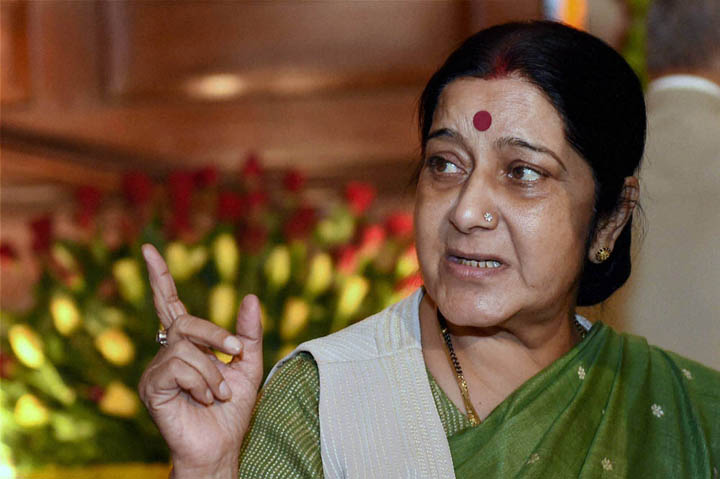
External affairs minister Sushma Swaraj. Credit: PTI
Even as all this was going on, we heard some breathtaking doublespeak. The piece, ‘The BJP Wants Its Activists to Forget Sushma and Keep the Focus on Muslims’ (July 6), points to RSS/BJP functionary Ram Madhav expressing disquiet in a recent newspaper article on “the language of obscenity, hate and worse, violence that we employ in our social media conversations”. But he promptly went on to the more serious task of Muslim baiting by highlighting the “love jihad” angle in the passport case. It’s also curious that Ravi Shankar Prasad, our information technology minister, who scolded WhatsApp roundly and urged it to take immediate action to stop rumour mongering, didn’t have a single tweet to spare for Swaraj.
WhatsApp has to address the problem without a doubt (‘Horrified by Terrible Acts of Violence, Must Work Together: WhatsApp Tells Modi Government’, July 4). More important though is the BJP’s need to act. The piece, ‘If Mob Violence Has Gone Viral, Politicians Trading in Fear Must Share the Blame’ (July 4) puts it this way, “The Bharatiya Janata Party and Sangh parivar cannot evade responsibility for the culture of permissiveness and impunity they have encouraged, thanks to which mobs and ‘mob justice’ have become a signifier of contemporary India…. WhatsApp is merely a conduit…”
The immediate triggers are rumours that reach people through Facebook and WhatsApp, but they “rest on an ecosystem of fear and hate, which has been nurtured with care and clear intent” (‘If Hate Has Been Normalised, Can WhatsApp-Triggered Lynchings Be Far Behind?’, July 6). It was not, after all, social media that fanned the attacks on the Nath Panthi Davari Gosavis, members of which community were recently lynched in Dhule, but the normalisation of violence against people living on the periphery (‘State Apathy, Not WhatsApp Rumours, Behind Victimisation of Maharashtra's Nomadic Tribe’, July 5).
§
At one point, independent authorities with sources deep in the pores of government could provide outstanding critiques on what really went on within. Now with most of the whistleblowers of the earlier governments safely ring-fenced by power – Vinod Rai is an excellent example of such an individual, and who can forget Bibek Debroy’s charge, made in his book co-authored with Laveesh Bhandari, Corruption in India: The DNA and RNA’ in 2011, that Indian bureaucrats may be cornering 1.26% of the country's GDP through acts of corruption. Today deep dissatisfactions within the extremely secretive power structure are useful, but we need experts to piece scattered bits of information together. The Wire piece, ‘M.M. Joshi-led Panel Summons Arvind Subramanian, Hasmukh Adhia over NPA Crisis’, is a good example of just such journalism. A lively eye on social media can also help. The analysis, ‘Modi Government Has Different Benchmarks for IAS Officers in Different States’ (July 13), shows up the government’s double-faced approach when it come to reprimanding its bureaucrats.
§
I get a lot of letters from readers on placing their unsolicited pieces in The Wire. To take three recent ones …
JD: “I am writing this mail in continuance to my earlier mails requesting you to publish my article/opinion in the Opinion section of The Wire. I am waiting for a reply from your respected selves on the status of my request. If you do not want to publish it I would like to know the reasons so that I can improve the article to suit your audience and target. On my part, I am ready to explain why I wrote the piece, cite references, etc. I am sure that the number of articles you receive are many, and time is of value to you as anybody else.”
A postdoctoral fellow from the Centre for Urban Ecological Sustainability of Azim Premji University, Bengaluru, wants to know the ideal procedure to be followed in sending an article, and its typical length and format.
Another reader, Purabi Bose, says she is “curious if The Wire ever responds to pitches. If it does not, this should be clearly mentioned in your website so that people are not disappointed.”
First, I would like to say that this column is meant for reader observations, thoughts, questions – preferably focused on The Wire’s editorial content – and welcomes them very warmly. However, as the public editor/ombudsperson, I do not take editorial decisions. So questions like the possibility of getting a particular piece published, and so on, had best be addressed to editorial@cms.thewire.in Unsolicited pieces should ideally be 800 to 1,200 words in length (including hyperlinks) in MS Word.
Having said this, here’s the thing. It may not be possible for The Wire to respond to each mail, given the modest size of its operations and the fairly large quantum of traffic on this score. I would, therefore, agree with Bose that some disclaimer of this kind should be clearly mentioned on The Wire website.
§
One reader wishes to know whether the regular subscriptions he is making to The Wire qualifies him for deduction under 80G. This is to reiterate that all donations made to the Foundation for Independent Journalism (FIJ), the publisher of The Wire, are tax exempt.
Another reader contributed an amount of Rs 5,000 to The Wire on June 6, but has not received an acknowledgement for it (an email saying that they received the funds), after repeated requests. Although he did get an automatic e-mail from Instamojo, he would be greatly obliged if The Wire responded.
§
Mandar Gupte, while congratulating The Wire on its consistent and amazing work in the spirit of true independent journalism, has an important critique of its content. He believes a “youth-based show” is the need of the hour. “The Wire produces a daily segment of news by Mr Vinod Dua, which is fantastic and informative. However, the youth, more so the untapped youth of our generation that detaches itself from politics, can be made to look at news in a different perspective if it is narrated in a more vibrant and current format… A segment where the news is internalised and not bombarded on them and that also touches other pop cultures with equal dollops of politics, will be more engaging, even as the ground realities are not lost sight of. The show could be narrated by a couple – a guy and a girl – chatting or discussing issues in a more laid-back way. In other words, what is needed is a chill show for the youth, by the youth, with just the right amount of concern in it.”
The mail then goes on to cite programmes in other countries. Such shows, Gupte argues, are far more influential on the millennials than the actual news itself. “Such formats of fresh, smiling, active faces and personalities internalising and discussing or conversing in general about the things happening around them is unexplored in India and I think The Wire has the potential to tap into this sector.”
Thank you, Gupte, for your thoughtful suggestions. By the way, The Wire’s LiveWire segment, of which you seem to be aware, is a happening place. Please continue to check it out…
§
When we began editing decades ago, a useful rule of thumb handed down to us was to never use the concluding paragraph of an article as the introduction to it and that it was far better that the reader is gently led to it by going through it. This piece of advice struck me when I read the evocative sentence, “The buffet-table of ‘Muslim appeasement’ the Sangh was hoping to feed off has collapsed now that all the facts about Tanvi Seth’s passport are out….” which formed the concluding paragraph of the piece, ‘The BJP Wants Its Activists to Forget Sushma and Keep the Focus on Muslims’. It was used as the introduction to the piece as well.
Write to publiceditor@cms.thewire.in
This article went live on July fourteenth, two thousand eighteen, at zero minutes past two in the afternoon.The Wire is now on WhatsApp. Follow our channel for sharp analysis and opinions on the latest developments.


