

Bihar SIR: Villages Along the Kosi Are Battling Confusing Texts, a Silent EC and Annual Floods


Supaul (Bihar): Satish Kumar Suman was anxiously waiting for August 1, the day Bihar’s draft electoral roll would be made public by the Election Commission. As soon as it was published online, Satish checked his name using his electoral photo identity card or EPIC number. It was there, but a message told him to contact his booth level officer or BLO, and submit his documents.
Suman is registered to vote in Pipra assembly constituency near Supaul, but lives in Madhepura. His father submitted his enumeration form under the 'special intensive revision' in July, along with Suman's Aadhaar card and EPIC number as proof. Suman later tried to upload a copy of his passport, since the Aadhaar is not among the original list of 11 documents accepted by the Election Commission, but got a message saying his form had already been submitted.
“I have to spend time and money going through the entire process again,” Suman said over the phone. “The message I got doesn't have any other directions on what to do.”
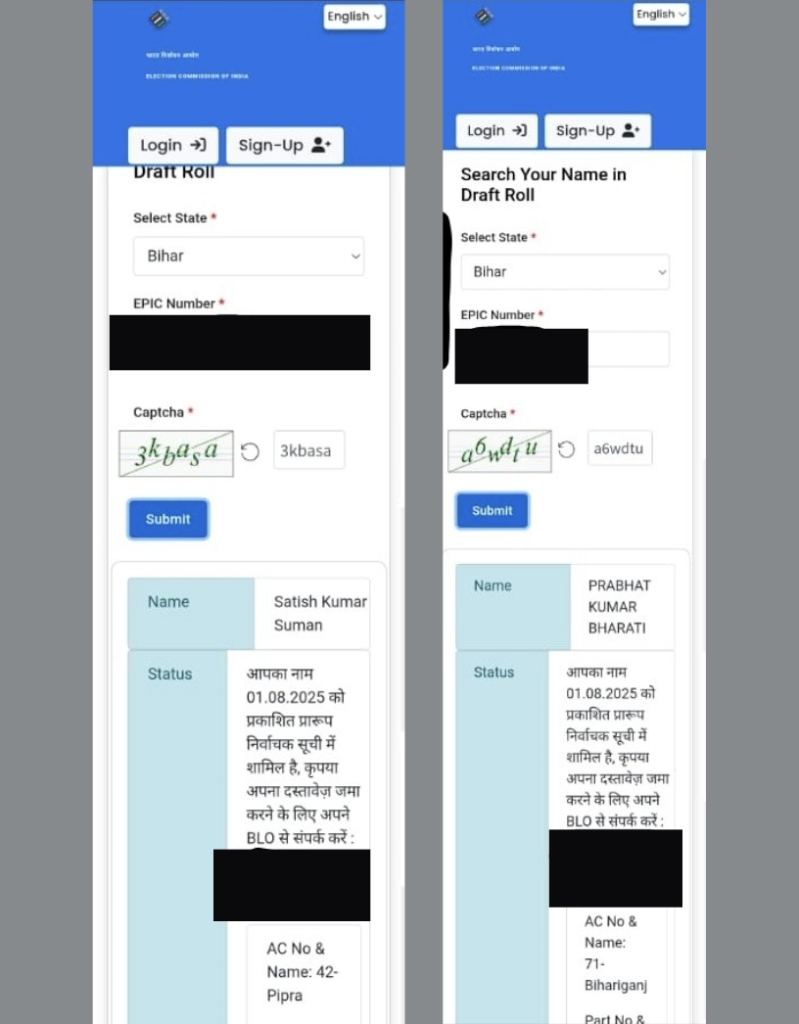
Screenshot of the message that Satish Kumar Suman and Prabhat Kumar Bharti got after checking his name in the draft roll.
Prabhat Kumar Bharti, a retired serviceman, also got the same message. The veteran is a voter of Bihariganj assembly constituency. He says that he did not submit his documents as the BLO never visited his house, or the area where he stays. So he has no idea how his name made it to the draft list.
“The BLO was supposed to go door to door, collecting forms and documents. That's what the rules say and that's what the Election Commission had assured voters would happen,” the former armyman said in a phone interview. “I thought they would have some respect for the Army.”
At Surti Patti village, located on the banks of the Kosi river near Supaul, Imtiyaz Rahmani has a similar story. He says that a person in the village submitted his passport with the SIR enumeration form, but got a message to "submit his documents". Although Rahmani’s name is on the draft list, he said many others' names were missing.
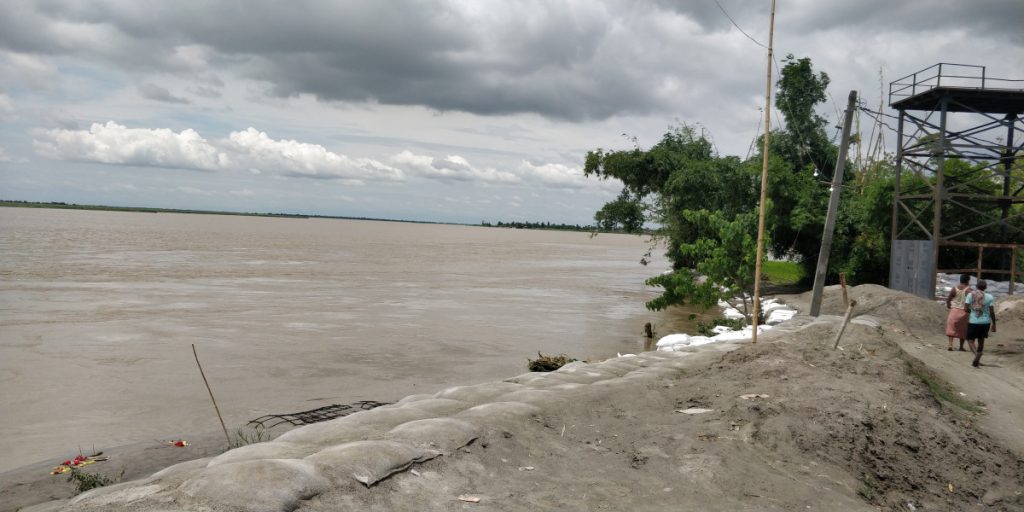
The Kosi river near Supaul in Bihar on 25 July. Photo: Tushar Dhara.
These are just some of the inconsistencies following the massive and hurried SIR process in which the poll body asked the state’s entire electorate to submit documents to prove their citizenship as a pre-condition to having their names entered afresh in the electoral rolls. The phase – including house-to-house verification as per the EC’s rules – lasted from June 25 to July 26. The publication of the draft electoral roll took place on August 1. The claims and objections period is from August 1 to September 1.
Floods
What complicates matters is that Supaul district of North Bihar – through which the Kosi river flows – is vulnerable to floods. It has been raining heavily the past few days and people are anxiously keeping an eye open for any sign of rising waters. In effect, the state is demanding citizenship proof from residents who have a hard time safeguarding their lives, property and documents.
All through July, Indra Narayan Singh surveyed the Kosi for signs of flooding. The rains were scanty, but people could not afford to let their guard down, given the devastating floods of 2024. Singh retired from the Central Reserve Police Force (CRPF) in 2017 and came to live in his paternal village of Boruari, a few kilometres outside the Kosi river basin. He is associated with the Kosi Nav Nirman Manch, an NGO that works to rehabilitate the flood affected in Supaul and Madhepura. Singh has an Aadhaar card, an EPIC card and a residence certificate. Besides, he has papers that certify that he served in a central paramilitary force for 34 years. Nevertheless, the veteran is anxious. “In Assam even soldiers were excluded from the NRC,” he said. “It seems even service to the nation is not proof enough of citizenship.”
The original rationale given for SIR was rapid urbanisation, frequent migration, young citizens becoming eligible to vote, non-reporting of deaths and inclusion of the names of undocumented workers – whom the EC called "foreign illegal immigrants". However, in subsequent communication, the poll body seems to have dropped the reference to “foreign illegal immigrants” after criticism from political parties and civil society groups. The EC in a press release on July 27 claimed that of the 7.89 crore voters in Bihar, 7.24 crore had submitted enumeration forms. Those whose names are in the 2003 electoral list – the last time an SIR was held – do not need to submit supporting documents. Everyone else had to attach one of 11 documents, a list which does not include the most commonly held documents like Aadhaar, ration card and voter ID card. However, in many instances, BLOs have only taken Aadhaar and/or voter cards along with enumeration forms.
The objections and claims process is meant to getting voter details corrected. However, there is confusion on the ground. In a press release dated August 3, the poll body said it had received zero claims and objections from six national parties and six Bihar state parties, 941 objections directly from voters and 4,374 'Form 6' submissions for inclusion from new voters who had just turned 18.
Badami Devi lives in Nirmali village on the eastern bank of the Kosi. The original village – also called Nirmali – was on the other side of the river, but it was flooded and some of the residents were shifted to the new Nirmali. Badami Devi is a Malla, a fishing caste classified as Extremely Backward and does not know the exact year she was resettled. She estimates that she has voted thrice since then. Her name is on the 2003 list, but none of her seven sons names are. All have migrated out due to poverty. Only three managed to submit their documents. Badami keeps her identity papers securely locked in a box, ever ready to flee with them at a moment’s notice.
The Kosi river system is one of the most challenging in terms of flood management. The river originates in the Nepal Himalayas and drains the areas east of Kathmandu and west of Kanchenjunga. It enters India at Bhimnagar and has long been considered a problematic river because it floods frequently and changes course rapidly. The river and its tributaries also bring down enormous quantities of sediment due to cloudbursts, monsoons and landslides in the higher reaches.
The government of India built a barrage at Bhimnagar on the Indo-Nepal border in the late 1950s and two parallel embankments on either side of the river which run south for a hundred kilometres each, trapping the flow of the Kosi. These efforts have only been partially successful, with the river breaching the embankments and causing extensive damage to the lives of the nearly 10 lakh people who live in close proximity.
The Kosi Nav Nirman Manch held an online meeting on August 2 to discuss the draft roll. “The consensus was that the organisation should try and help voters sort out claims. However, the ongoing monsoon means that any voter verification exercise will be delayed,” Mahendra Kumar, the founder of the Manch said. The Manch monitors and releases water discharge data from the Bhimnagar barrage every day on its WhatsApp groups to alert residents. Former CRPF personnel Indra Narayan Singh said that on August 3 the barrage had opened 24 of its 56 gates, resulting in a flow of 2,51,000 cusecs. That is a higher-than-average discharge, and although the situation is stable so far, the water level upstream in Nepal is rising.
The village of Mungrar is situated inside the eastern embankment, with river water skirting it. Last year, as Mungrar was inundated, residents packed whatever possessions they could and fled to higher ground.
“The 2024 flood was the most destructive in memory,” Hari Nandan Yadav recalls. His family’s home was under five feet of water. Hari Nandan’s name is not in the 2003 roll as he was born in 1996. He studied at Manipal University and worked as a banking executive in Bengaluru till last year, and was one of the few from this region with a higher education degree. Hari Nandan returned home to help his family construct a new house. His uncle Srigosai Yadav says that if it comes down to proving their Indian citizenship, they will use their land ownership documents. However, with the river washing away land every year, even that route is uncertain.
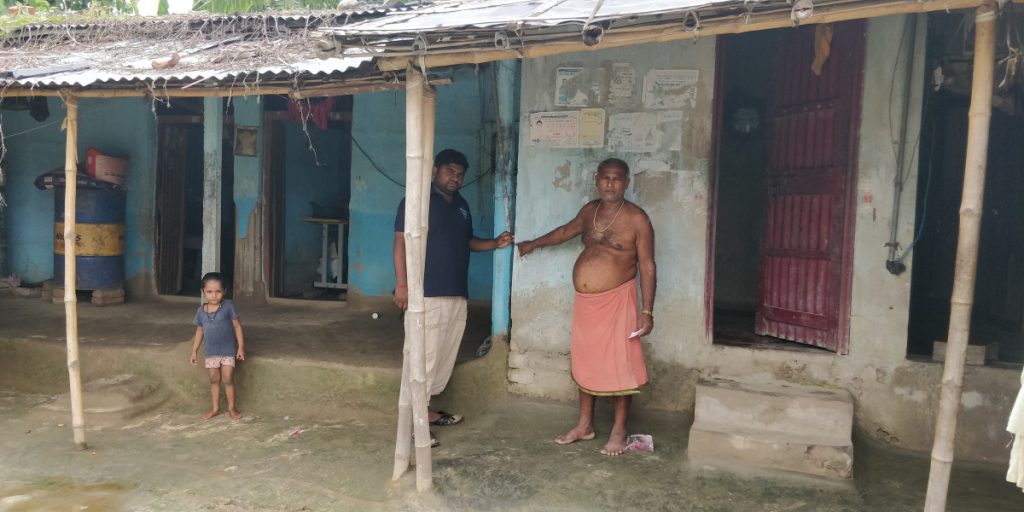
Hari Nandan and Srigosai Yadav outside their home in Mungrar, pointing to how high the water level rose during the 2024 floods. Photo: Tushar Dhara.
Hari Nandan said in a telephone interview on August 4 that his name was on the draft electoral roll. Although he himself was not asked to submit documents, the BLO came around to collect some. It has been raining and although the are is not in a flood situation currently, Hari Nandan knows that it may turn into one in a few days.
'But Aadhaar is used to obtain residence certificates...'
Situated on the embankment, a few kilometres from Mungrar is Surti Patti, a Muslim-majority resettlement. Very few residents have a birth certificate, but almost everyone has a residence certificate, along with Aadhaar, ration cards and voter IDs. When the SIR commenced and it was announced that Aadhaar would not be accepted, villagers were worried. They scrambled for documents to prove their residency and citizenship. There was a rush to get domicile certificates, and now, almost everyone here has one. Mohammad Samiullah got his made in July 2025 for Rs 200 from the block office. He gave his Aadhaar as a supporting document, but since Aadhaar is not proof of citizenship he is not hopeful as to whether his residence certificate will be accepted.
“Aadhaar is used to obtain ration cards, bank accounts and residence certificates, so why is it not valid for the SIR?” he asks. Samiullah worked for 25 years in Ghaziabad as a driver, and his driving licence is registered there. But he recently got it transferred to Supaul, in case anyone accuses him of being an illegal migrant.
Mohammad Zulqarnain is the imam of the local masjid. “The intention of SIR is to harass people,” the imam said jovially. “First it was the waqf Act, then documents, and now they have given the lollipop of free electricity,” he says, referring to the Bihar government’s decision to slash electricity charges. Zulqarnain says that when the river threatens to flood, people first save their documents, then their lives.
“There are no Bangladeshis or Myanmarese here, only Biharis,” he says. Zulqarnain found his name on the draft roll, but many others in Surti Patti have been asked to submit documents.
It is evident that Muslims are tense and scared. There is widespread sentiment that the SIR has been designed to target Muslims and strip them of their citizenship. Most have taken a photocopy of the SIR enumeration form to keep as proof.
Many of the resettled have built their hutments on government land after they have lost heir homes in the monsoon. Since they do not have ownership rights to government land, many fear that they can be evicted anytime. Imtiyaz Rehmani remembers spending 30 hours on the roof of his house during the 2024 floods, before being rescued. “The government is doing all this to divert peoples’ attention. What they really want to do is abolish elections and electors,” he says in a tone of resignation.
Update at 4.45 pm on August 7:
After this article was published, the district administration of Supaul released a statement on August 6 on its Facebook page calling it "misleading" and "devoid of facts". However, it has not contested any of the facts mentioned in the story. It has issued a set of clarifications, noting that voters' documents will be collected and uploaded and BLOs will contact voters in the draft electoral list to collect their papers. Additionally, the authorities will 'consider' documents pertaining to disaster relief from flood affected people in Kosi as a special measure and accept government issued land documents given to those who have been resettled.
Read The Wire's coverage of the Bihar SIR here.
This article went live on August fifth, two thousand twenty five, at eighteen minutes past twelve at noon.The Wire is now on WhatsApp. Follow our channel for sharp analysis and opinions on the latest developments.


