

SC Says 'Bring Them Back', What Happens to the Pregnant Woman Pushed to Bangladesh?


Kolkata: The Union government on Tuesday (November 24) faced sharp questions in the Supreme Court over the case of six people, including a pregnant woman from West Bengal’s Birbhum district – Sunali Khatun – who were pushed to Bangladesh without any verification of their citizenship.
Khatun and five others, who were detained from Delhi in June this year, were sent to Bangladesh within three days of detention.
A bench of newly-appointed Chief Justice of India Surya Kant and Justice Joymalya Bagchi was hearing the matter.
When the Union government requested an additional day’s time, the top court orally observed that as an interim arrangement, the government must first bring all six individuals back to India. Only after their return, the court said, can the authorities examine their documents and decide on their citizenship status.
The matter has been listed for further hearing on Monday, December 1.
The issue reached the Supreme Court after the Union government failed to act on an earlier directive from the Calcutta high court. On September 24, the high court had ordered the government to bring back all six persons within four weeks. Instead of implementing this, the Union government appealed to the Supreme Court, which is now examining the matter.
Also read: Family of Pregnant Worker Pushed into Bangladesh Pin Hopes on High Court
Despite the expiry of the high court’s deadline, no steps were taken to secure their return, prompting the fresh judicial scrutiny.
Material submitted to the courts suggest that Khatun, and at least one other woman sent to Bangladesh with her, have longstanding and well-documented links to India. The names of her parents also appear in the 2002 electoral roll, indicating that they were enrolled as voters more than two decades ago.
The list also mentions Khatun's father Bhodu Sheikh and his father, Hatim Tai Sheik. Her family has also produced land records dating back to 1952, showing continuous residence and property ownership in the country.
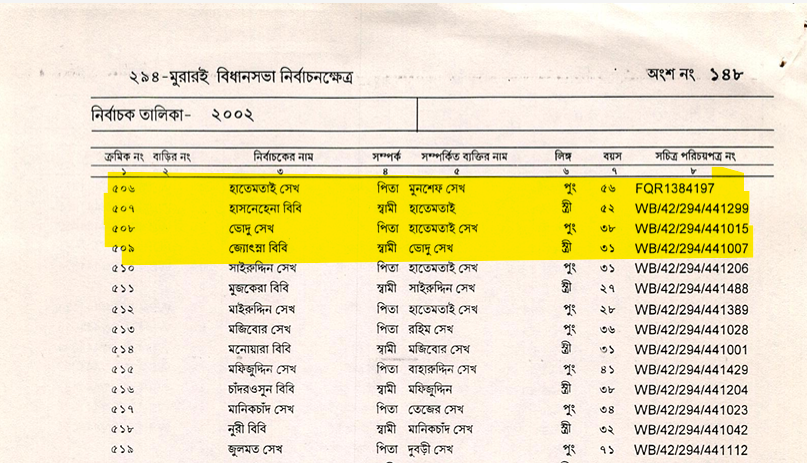
Sunali Khatun's parents' names on the 2002 electoral roll of Murarai Assembly constituency, Birbhum district, West Bengal. Photo: By arrangement
Speaking to The Wire, Bhodu Seikh recounted how the family’s move to Delhi was driven purely by economic desperation. He said his daughter, son-in-law and grandchildren had gone to the capital hoping to earn a living by collecting waste paper and selling scrap.
“We are poor people. We never imagined that we would come under such hostile scrutiny from the government there,” Bhodu Seikh said. “I am waiting to see when I will get my descendants back, in accordance with the court’s orders.”
A similar situation reportedly applied to Sweety Bibi, who was sent to Bangladesh along with Khatun. Lawyers for the petitioners argued that such documentation should have been examined before any deportation decision was taken and that sending them out of the country without verification violates due process.
In a rare development, a court in Bangladesh has also asked the Indian high commission in Dhaka to facilitate the return of the individuals to India. Despite this, there has been no visible action from the Indian side to comply either with the Bangladeshi court’s request or the Calcutta high court’s order, according to the petitioners.
With the Supreme Court making it clear that the question of citizenship can be settled only after the six are brought back to India, the onus is now on the Union government to comply with judicial directions and follow a fair, evidence-based process in deciding their fate.
Translated from Bangla by Aparna Bhattacharya.
This article went live on November twenty-sixth, two thousand twenty five, at eighteen minutes past four in the afternoon.The Wire is now on WhatsApp. Follow our channel for sharp analysis and opinions on the latest developments.


