

Full Text | 'Accept Equality and the World Improves – It’s Really Not Complicated': Saeed Akhtar Mirza


In a recent podcast, filmmaker Saeed Akhtar Mirza spoke at length with Sidharth Bhatia, founding editor of The Wire, on Hindutva-oriented films and what they mean for India today.
Their conversation was transcribed by The Wire's former intern, Anya Rajgarhiya. It has been edited lightly for style and clarity.
§
Sidharth Bhatia (SB): Hello, and welcome to The Wire Talks. I'm Sidharth Bhatia. In the late 1970s, Saeed Akhtar Mirza’s first feature film, ‘Arvind Desai Ki Ajeeb Dastaan’ hit the screens. This was followed soon by ‘Albert Pinto Ko Gussa Kyoon Aata Hai’. The films had not just interesting long names that instantly became popular, but showed a slice of everyday life in Bombay city at the time.
Other films followed, with similar long titles – Mirza had arrived as a filmmaker. But his final feature, named just ‘Naseem’, was released exactly 30 years ago. It came out soon after the demolition of the Babri masjid and the brutal killings in Bombay, and it had a one-word title, but [it was] also a very evocative story.
The film, set in the months before the demolition, was about an aging Muslim poet (played by Kaifi Azmi) and his family's growing despair at the violence all over the country in the aftermath of BJP [Bharatiya Janata Party] leader L.K. Advani Rath Yatra. The film opened with a title card that said one act of demolition wrote the epitaph of an age that has passed, perhaps never to return. It was Mirza's cry from the heart about an India he saw slipping away.
Since then, Mirza has not made a feature film. But he is busier than ever, making documentaries, writing books – and he's also now the chairman of the K.R. Narayan National Institute of Visual Arts and Sciences in Kochi. Most of all, Mirza, whom I know, likes to call himself an internationalist.
‘Naseem’ and its message of a changing India seem very relevant today. I invited him to join The Wire Talks to discuss not just the film but also how he views contemporary India. Saeed Akhtar Mirza, welcome to The Wire Talks. Thank you.
Saeed Mirza (SM): Thank you. Thank you for having me, Sidharth.
SB: ‘Naseem’ was made immediately after the demolition of the Babri masjid and the violence in Bombay. What was in your mind when you decided to make it? Did you react to the events of that time emotionally?
SM: I did, Sidharth. To me, it was like a final act. It was the final nail on a coffin of the idea of a nation. The idea of a nation that I saw [was] slowly over – much before the Babri masjid issue. I'd seen signs of the collapse that's occurring, the slow growth of hate and anger. And in that, when the actual act occurred in 1992, of the Babri masjid [demolition], I just thought, ‘My God, there ends the dream.’
You could see it happening in the late 70s and 80s – ethnic riots and linguistic riots. But finally, when it boils down to fighting over... communal riots... you saw a kind of writing on the wall. So then the Babri masjid epitomised the final collapse of the idea of India as a sovereign, secular, democratic republic, equal for all [and representing] equality and justice. You saw it collapse in front of your eyes. It set me thinking. It set me in despair. I was also very angry, I think. That's why I waited for a little time to be able to write that script.
I wanted to make a very quiet film. Not in anger, but to be able to chronicle our times, chronicle where my country was heading. And that's what I did. I made the film and then, uske baad, I started making documentaries and writing books and travelogues and just to perhaps regain confidence in this nation that I saw, that I love actually – and that's it, that's been my journey.
I was not intending to be an oracle [who could say] 'I saw it coming', but in those events from the 70s and 80s, you could see things happen and nothing being done, and it was all considered [actions of] 'fringe elements', and you realise that the so-called fringe element is no longer fringe. It has the support of very large numbers of people and... therefore, you're seeing, in a sense, a degradation of the idea of our country as in our constitution. And after the demolition, a party of almost nothing became a party of plenty and they went from 2 to 82 [seats in the Lok Sabha].
What worried me most was the support it got – not from the poor and the disenfranchised – but from the middle class and upper middle class, the so-called educated classes. That disturbed me, it worried me.

Changing India? A Rashtriya Swayamsevak Sangh parade in Udaipur, October 2013. Photo: Daniel Villafruela, CC BY-SA 3.0, via Wikimedia Commons.
SB: Many of us remember the 70s and 80s, yes, there were episodes of violence and communalism and they were rising, but still, I think the idea of India held the idea of secularism. You also mention the educated upper middle class and the middle class – is it because you could see changes in your immediate environment?
SM: Absolutely. Another thing that is important to note is the response, if you remember, to the 1984 riots in Delhi and across India after the assassination of [the then prime minister] Indira Gandhi. The fury with which the Sikh community was attacked set me thinking: look at how much anger was there. I said, my God, this anger has been unleashed and supported. Was it supported really by political parties? I think it was supported by large numbers of people, simultaneously. It's worrisome.
These were all incredibly worrisome signs to me and, of course, uske baad, we reached the stage where there's no such thing as truth. Today we live in a post-truth world where it [communitarian violence] is accepted. There's no such thing as being morally right. It just has to be accepted like look, this is the way things are, and this is the way things are going to be. And there's no such thing like right or wrong. That is very critical.
SB: Your ‘Naseem’ begins with this background of the demolition of the Babri Masjid and you say that this is the end of an era that has passed, perhaps never to return. Was that a kind of an outburst or was that where you were sure that this was the end?
SM: At that time, I was absolutely sure, absolutely sure that this hate will build up and get more and more takers. Then, it was built up over an idea, through an interpretation of history, led by historians of questionable credentials. And now, post-2014, with the coming of this particular regime, it is openly payback time to right all the wrongs, all the sins of the past, with no remorse, no shame, no guilt, I suppose. And that's why I said, it [moral right or wrong] doesn't matter. And that's the frightening part of it. That's the frightening part of it.
SB: In the movie, you have a young girl and her relationship with the poet, her grandfather, is very interesting. You have sons in the house who are angry when they watch the television, while the schoolgirl is innocent, asking questions, and the grandfather, strangely, interestingly enough, I felt, offers some hope, but he then – I'm not giving away spoilers – but he dies. I know one should not overinterpret, but was that the last gasp of a time? Because he dies just before the masjid is brought down.
SM: To me, it means the end of poetry. That's 1995-96, and I saw it happening and, to me, it [means] despair, frustration, but also that you can see, at times, immense pushback by young people, which gives you hope. It gives you hope!
The only thing I have, in terms of a positive note, is for how long can hate last, you know, how long? And, therefore, there is an expiry date, I would imagine. But in the meanwhile, we'll have to live with it. And, unfortunately, people are going to die in the process. And the other unfortunate part of it is that the poor and the disenfranchised, who have no recourse to law or justice or equality, are going to die. That's a truth we have to live with now. It's not a happy feeling and, quite honestly, I feel so helpless [that] I can't do a thing. And Sidharth, it's incredible that it is a chronicle based on a fundamentally flawed idea of a history. If you scrutinise that history, it's so full of flaws and questionable conclusions. Can I give you an example?
SB: Yes...
SM: The thing [recreated historical narrative] is very simple – the Muslims were bastards, terrible rulers, rapacious... and they were looters and killers and whatever else they did. And the Hindus were helpless about it. It's a binary. Now, let's take this idea of history of the so-called coming of Islam via invaders. Islam came to India much before: it came through trade, and all kinds of things were happening, like people being employed by Hindu kings, etc.
Then tell me about the kingdoms before the coming of Islam, 'the invaders'. The hundreds of kingdoms that changed from one to another. Now, how did that change happen? Over a cup of tea and biscuits or through the shedding of blood? It's a simple thing.
Look at the whole legend of Ashoka slaughtering 99 of his first cousins to gain power. Look at the legend of Parshuram, slaughtering the Kshatriyas. The point is that if one makes a case, any feudal system, judging by our standards, is unjust. It doesn't matter who [ruled]. Any feudal system is unjust because it can never deliver [justice]. It cannot be democratic as a system. You require other laws to take shape and then a certain kind of democracy occurs.
Also read: What We Can Learn From India’s Medieval Past
Are you aware of the book about the financiers of the Delhi Sultanate? Do you know who financed those kingdoms? Does anybody know? They were Multani – Hindu – merchants, financiers. To me, if one sees it honestly, across the board, earlier and later, this Hindu-Muslim binary seems so incredibly stupid.
You take the example of a man called Malik Ambar. He was a vazeer [prime minister] of the Bijapur Empire and he was [later] the king. He was an Ethiopian slave and a Muslim. His command was a man called Maloji Bhosale. Now, he and Maloji Bhosale were fighting the armies of [Mughal ruler] Jahangir. Jahangir is another Muslim king. Who was Jahangir’s commander? Man Singh – a Hindu.
You want to hear another story? Maloji Bhosale had a problem because he had no male children. So he went to a dargah of Sufi Pir Shah Sharif. He prays for male heirs. And when the heirs do arrive, after two or three years, he names one Shahji and the other Sharifji, after the same Sufi saint. Shahji is the father of Shivaji. Get your history clear! Did you know that?
SB: But do you think true history is playing a part here at all?
SM: Otherwise, how can you hate? They [the Muslims] have to have done something – they have to have done something! So, [they decide] let us go into history and paint them in a manner that they cannot be redeemed in any shape or form. There's no redemption [for them]. That's it. Now, God bless these historians – they're celebrated, lovely people. There's one fellow who looks incredibly professorial, called Sampat something. Another lady called Meenakshi Jain. Lovely people...
SB: You mentioned that you find the younger Indians and what they say quite encouraging. Are young Indians are now beginning to ask questions?
SM: I think they are. But young Indians of a certain kind. Yes, they are asking questions. But there's also a lumpenisation that's occurring. A lumpenisation of minds – of the middle class minds – and that's an incredibly dangerous thing... you remember the famous Shaheen Bagh protests that were occurring all over the country?
SB: Yeah.
SM: Look at the young people who joined up, and that's an indicator. Look at the farmers protests that were also happening at the time. That's also an indicator of what is happening. So, there were and are forces aligning in a certain way and I think it gives you hope.
But somewhere down the line there is a fear inside me that every single year, Sidharth, every single year, approximately 10 to 15 million young people pass out from class 10 and 12... that means about three-fourths of the population of Australia is passing out from our schools every year. And they all have dreams for jobs, aspirations. They all want to partake in the good luck they've seen on television. They've seen the weddings of the Ambanis and the Adanis and they've seen the fantastic cars and fashion shows. They've seen the good life and they probably want a part of it. Why shouldn't they? But they're not going to get it. That's a fact. It's [the] truth.
Now, where do they go? Where does this energy go, Sidharth, in our country? It's going to be galvanised. It's going to be channelled. And who is going to channel that? And why? And how – that is my fear. Every single year, Sidharth, every single year: 10 million young people every year. Where are they going to go?
They are going to ask questions – they hopefully ask the right questions and get the right answers, but if they get the wrong answers – like, for instance, that the reason why this is happening is because of the 'Other', there’ll be hell to pay. Just think it over, Sidharth, just think it over. Poori duniya main shayad aisey hi ho raha hai.
Where are young people going to go in terms of jobs and a future and who is going to manage that future or tell them how things really are? It's frightening. I don't have an answer, but I have a question. I worry, because this is going to be used by any political party that knows that it cannot deliver.
SB: Do you think, leaving politics aside for the moment... Let’s say I'm a citizen, I'm young, impressionable in many ways. I'm not just getting the message of the political parties... That's just one way of reaching me. There are a lot of [other] ways of reaching me – let us say, social media or culture. Culture reminds me – you belong to an industry which, for what it was worth, had a particular value system in its operations and content. Now. don't you think that your film industry has become complicit in sending out these messages of hatred?
SM: I think, by and large, that it's not true, but there are sections of it that have capitulated, which is a fact – and not just here. Most of Hollywood cinema capitulated to building up the case for America and its wars and their patriotism. The problem is that this is being done very deliberately; perpetuating the hate and the Othering.
Other countries have played the game [too] and built up a kind of patriotism that [I'm] there for my country, right or wrong. That's why [we see] the use of popular entertainment for these purposes in India and [we see] people participating in it very directly and deliberately. They know – they know exactly what they're doing.
Also read: India Out of Work: Unemployed Youth Become ‘Discouraged Workers’
And, in a strange way, I believe, they think they're doing no wrong because this is the time for 'retribution' and 'payback' for a people who happen to belong to a community that happened to be ruling this country – not realising that the rulers were someone else... But the attitude towards the idea of the Muslim is sad. It’s sad.
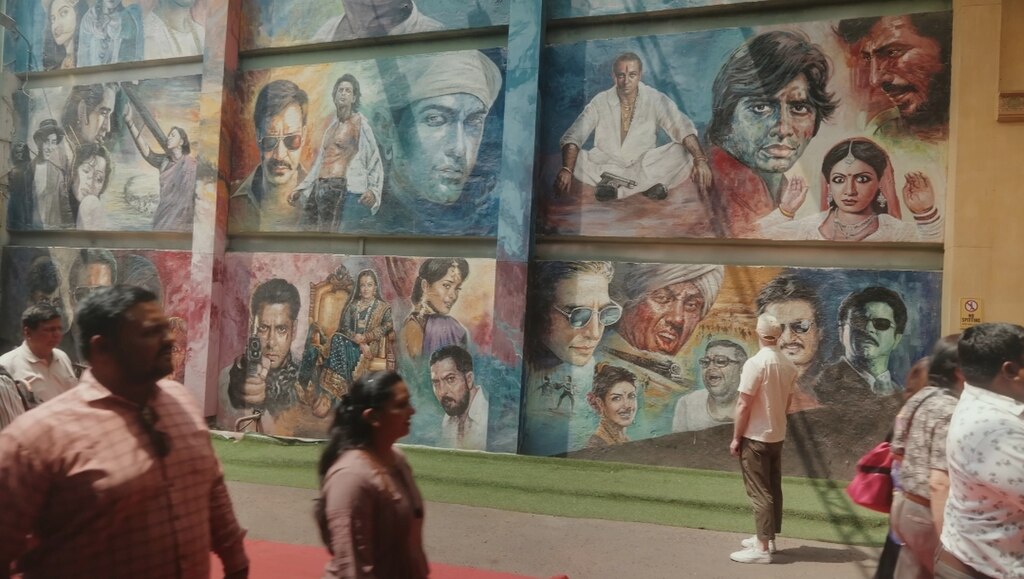
Film City, Mumbai: a mural featuring Bollywood actors and characters. Photo: Parminder Sarwara, CC0, via Wikimedia Commons.
Look at the support the mainstream media and the OTT platforms of the right-wing gave to the slaughter and genocide in Gaza. I couldn't believe it. I think India was only the only country from the [Global] South that had this kind of response towards what's happening in Gaza. Shocking! And the affinity with the apartheid regime in Israel – affinity with it. And why? Primarily because again, the binary, very simple. The pounding of Muslims, killing Muslims. These are truths and there's a problem with it. There's a problem with it.
SB: Absolutely fcorrect. Absolutely correct on all counts, including what the Indian mainstream media and, of course, what Hollywood has done for a long time. But at the same time, as an observer, I find it very shocking that there are very good films being made – but at the same time, there are films being made that distort medieval history, or recent history, and they are completely straightforward propaganda for the ruling regime.
This kind of thing never happened in the film industry in India [before]. How do you, as an elder statesman of Indian cinema – I'm bestowing this title on you – as somebody who has held to a particular standard, how do you feel about it? I know you've stopped making movies, but how do you feel about it?
SM: The question you're asking, I think, a lot of young filmmakers are asking the same question right now. I mean Sudhir Mishra, Anurag Kashyap, Anubhav Sinha – they were asking the question: what is happening? In the South [Indian cinema] it's very clear, but there are filmmakers here who cowed down and, for them, I suppose, it's also, maybe, a firm belief. Maybe it's an act of faith. I believe that it is also an act of faith with them – that is what they believe.
You take a film like ‘Chhaava’, an incredibly successful film on the life of Sambhaji Maharaj, Shivaji’s son, and the gruesome way in which he was humiliated and slaughtered by [Mughal rul] Aurangzeb, from what I gather. Aurangzeb beheaded his brother Dara Shikoh for treason. His son, Akbar Khan, happened to be friends with Sambhaji Maharaj. [Mukarrab Khan] one of his [Aurangzeb's] generals, had his son's friend killed.
Now, the point I'm getting at – and here's a story which is also true – did you know that Shivaji also had his son imprisoned because he found him to be hotheaded and wild? Did you know that? Did you also know that Mr V.D. Savarkar wrote a note about Mr Sambhaji being a bad ruler because he killed so many Brahmins and had them crushed by elephants? Did you know that? This is all history.
The problem is here. But it doesn't matter, [because] there's no right or wrong. Now these things do not matter – what matters is another idea of India. That is the issue. And I think, fundamentally, it's an issue that is, I think, born out of fear of a nation losing their grip on power which they had for centuries and millennia. The RSS and the Hindu Mahasabha are fundamentally, very clearly upper caste movements, and they existed because the bhakti and sufi traditions were savage in their critiques of rituals and power and the system and made fun [of them].
Imagine what these guys must have gone through when, after millennia of unquestionable power, impunity, you're being questioned. You're being ridiculed. You're being made fun of – both the cleric and the priest. Now, what do you want in return for that? Then let’s get back our power.
And with the growth of subaltern languages of Marathi, Gujarati, Telugu, as opposed to Sanskrit or Persian, there's a whole process of revolt. Now how do you frame this argument? You frame it in a manner which doesn't point to yourself. You frame it in a manner as a larger, more noble idea of India, chitrabhumi, mathrubhumi, etc.
So the inside and the outside is first framed over there, and then, simultaneously, to retain a power structure that was that was being shaken by the constitution of India and by the rise of subaltern languages and subaltern people. I believe that.
SB: So, going back to what you said in the film – an epoch is gone, an era has gone, a period is gone, an age is gone where there was some, say, decency, and some secularism and some noble idea of India, even if it was not on a daily basis fulfilled, there was at least that vision. Where do you see us heading in the next few years, or few decades? Where do you see India going?
SM: Oh, we're going the way the way Israel is going. We are chest thumping – a superior people, incredibly superior people, better than the best, better than the best in the world. That's who we claim to be. We are chosen by God as the Israelis [were], I suppose. And a superior people regaining their lost glory. And, unfortunately, I feel that it cannot be backed up by facts on the ground.
The facts on the ground are still that you have to feed 800 million [over 80 crore] people rations every single day. That's a fact. The largest number of stunted children in the world happens to be in India... The thing is all that is circumvented for this so-called larger idea.
The other thing I must say is [that] they tried that in Pakistan, I think, also when you have this entire religious regime of Zia ul Haq and the return of fanaticism and the Wahhabi faith over there. It was sad seeing it there and if you see it over here and you wonder to yourself, where are we heading?
I don't know. We're not going forward, I know we’re going backwards. That I know. How far backwards, I don't know until we stop, because some sense will prevail somewhere. But what I do know is you can't run a country on hate for such a long time.
SB: Well, actually, Saeed, I think that's a kind of statement of hope even if it's not a plan or whatever. But you're right. You can't run a country on hate. You've got to run a country on values, on achievements, on science, on so many other things. You've got to feed those people.
SM: Very clear. Absolutely.
SB: So I see a glimmer there. I see a glimmer there. After all, I can say this as a friend, you're an old lefty and lefty is never–
SM: I wear it on my sleeve as a badge of honour. What does a leftist mean, son?
SB: No, my point is never to lose hope. They never lose hope.
SM: Hold on, hold on. I'll tell you why. You people believe that leftism started with Karl Marx? It started with Gautama Buddha, my friend. Get the idea right. The first fellow who laid down ideas of compassion [and] solidarity was a man called Gautama Buddha. Another man, of course, also called Zarathustra, he was also there.
Read the laws of Hammurabi on equality and justice. It's not new, son. It's not new. It's old. These guys come and go but Guru Nanak Ji, Bulleh Shah, Baba Farid, Sant Tukaram, Namdev, Kabir. Come on. Who are these people? They're all lefties. They're all lefties. Get the idea right about lefties. Yeah. The left is a much larger idea.
SB: Exactly. Exactly.
SM: This tucchapan of hate is so incredibly ghettoised. [There is] a tunnel mind behind it; that's what I can see. It's so sad. Rise up because you’re a human being, for God's sake. And human beings are equal. Beyond colour, gender, caste, creed, religion: they are equal. Once we understand that, we'll make the world a better place. It's as simple as that. As simple as that.
SB: So, I'm really happy that after all that you talked about India and with a note of despair, frustration etc., you still retain that passion and hope for the future.
SM: Guru Nanak can't be wrong. Kabir can't be wrong. Bulleh Shah can't be wrong. Come on. That's the future.
SB: Yes. So, on that note, Saeed, I've had and I'm sure the listeners will also say that this was an extremely satisfying chat. I just want to express one hope you should make a new film now on all this.
SM: Too old, [I'm] too old. But it requires a lot of energy, physical energy and I don't have it. I have the mental energy I don't have the physical.
SB: This is really disappointing that you are feeling too old to make a film but I forgot to mention something, which he [Saeed Mirza] also was very much the father of ‘Nukkad’, that fantastic show on Doordarshan which he and his brother made.
SM: And Kundan Shah.
SB: Of course, how can we forget the great Kundan Shah [and his] ‘Jaane Bhi Do Yaaro’. So this was Saeed Mirza as our guest on The Wire Talks today. I have known Saeed for a very long time and I know that this was a glimpse of the passion he brings to any discussion, any venture. Thank you, Saeed, once again, and we'll be back again soon with another episode of The Wire Talks. Until then, from Sidharth Bhatia and the rest of The Wire Talks team; Goodbye.
This article went live on December first, two thousand twenty five, at forty-two minutes past three in the afternoon.The Wire is now on WhatsApp. Follow our channel for sharp analysis and opinions on the latest developments.


