

The Malegaon Case Had Shown Us How Hindutva Terrorist Networks Behaved


Last week, the verdict of the Malegaon terror blast case exonerated the accused of the explosion which killed six people in front of a mosque in the town in September 2008.
The judges have made clear that there is not enough to prove that this blast was part of a conspiracy. This interpretation contradicts the 2011 confession of Swami Aseemanand and the report that had been prepared by Hemant Karkare, the chief of the Mumbai Anti-Terrorism Squad who was killed in the Mumbai attacks of November 2008.
This document is particularly interesting for two reasons. First, it provides rich pieces of factual information regarding the actors of the Malegaon plot who belonged to Abhinav Bharat. Second, it presents us with the discourse of the Hindu nationalists when they speak between themselves in camera since the report includes the transcripts of meetings they held in 2007-2008 and that one of the participants recorded. The most relevant excerpts are available at the end of the article.
Abhinav Bharat and the Malegaon plot
Abhinav Bharat was named after the movement V.D. Savarkar started in 1905 in Poona.
Himani Savarkar, 61, the daughter of Gopal Godse (the brother of Nathuram Godse, who killed Mahatma Gandhi in 1948) and the wife of Savarkar’s nephew, claimed that Abhinav Bharat had been started by Sameer Kulkarni, who asked her to be the chairman of the organisation. At that time, Himani Savarkar was the president of the Hindu Mahasabha, a party V.D. Savarkar directed from 1937 to 1942.
She told the police that she was elected president of Abhinav Bharat in April 2008 during a meeting in Bhopal. This meeting was attended by Swami Amritananda Dev Tirtha (a man also known under the names of Sudhakar Dwivedi, Sudhakar Dhar, and Dayanand Pandey and whom she calls the “Jammu and Kashmir Shankaracharya”), Sadhvi Pragya Singh Thakur, Major Ramesh Upadhyay, Sudhakar Chaturvedi and Lieutenant Colonel Prasad Purohit whom, she said, she had known for two years – their families being related for a long time.
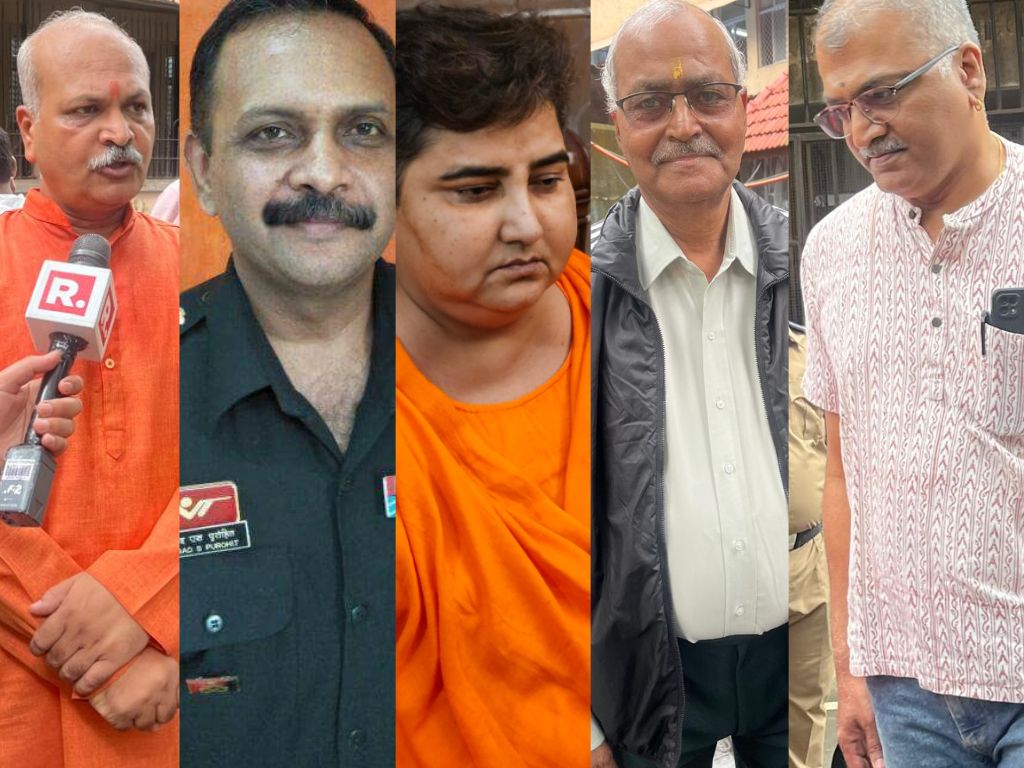
From left, Sameer Kulkarni, Prasad Purohit, Pragya Thakur, Ramesh Upadhyay and Ajay Rahirkar – five of the seven Malegaon blast accused. Photos: File and by arrangement.
According to the confessions of other accused of the Malegaon case, Abhinav Bharat was initiated by Purohit himself in June 2006. A key meeting took place in June 2007 in Nasik district, in the Deolali camp where Amritananda Dev Tirtha was meeting his disciples. One of the participants the police interrogated declared that, in this meeting, Purohit made a strong plea for fighting Muslims by resorting to bomb attacks, something others objected to. Another meeting took place in Deolali, in September 2007, again with the Mumbai people and Purohit. This time, there was a new recruit, B.L. Sharma, the former Bharatiya Janata Party (BJP) Member of Parliament from East Delhi, who had met Amritananda Dev Tirtha in Delhi in 2004 while touring his constituency where he was popular among the Pandit refugees who had fled Kashmir.
 According to the police, the plot regarding Malegaon was decided and fine-tuned during four meetings that took place in 2008. On January 25-27, 2008, Purohit, Upadhyay, Kulkarni, Chaturvedi and Amritananda Dev Tirtha met near Faridabad in a place where the latter was staying in a building of the Save Our Soul organisation. On April 11-12, 2008, the same people met with Pragya Singh Thakur in Bhopal and “conspired together to take revenge against Muslims in Malegaon by exploding a bomb at a thickly populated area. Accused Purohit took the responsibility of providing explosives. Accused Pragya Singh Thakur took the responsibility of providing men for the explosion. In this meeting all the participants agreed and consented to commit the explosion at Malegaon.”
On June 11, 2008, Pragya Singh Thakur introduced Ramchandra Kalasangra and Sandip Dange to Amritananda Dev Tirtha as two reliable persons who would plant the bomb in Malegaon. In early July, she asked Amritananda Dev Tirtha to direct Purohit “to give explosives” to Kalasangra and Dange in Pune.
On August 3, 2008, in a meeting held at the Dharmsala of Mahakaleshwar temple in Ujjain, Purohit was given the responsibility to procure RDX for Kalasangra and Dange. Purohit then asked Rakesh Dhawade, “a trained expert in committing explosions and assembling improvised explosive devices”, to provide explosives to Kalasangra and Dange at Pune, where they met on August 9 and 10.
Saffron clad activists, (ex-)Army men and Sangh Parivar cadres
The 11 accused of Abhinav Bharat who were involved in the Malegaon case come from three different milieus. They were either religious figures, (ex) Army men or Sangh Parivar cadres.
Amritananda Dev Tirtha claims to be the Shankaracharya of Sri Sharada Sarvagyapeeth, which is situated in Pakistan-occupied Kashmir (PoK). After his initial stay at Kanpur, Sudhakar Dhar shifted to Varanasi from where he reached Jammu in 2005-06 to float the Sarvagyapeeth.
Abhinav Bharat is the first such organisation in which at least two (ex) Army men have been deeply involved. Major Ramesh Upadhyay, a former defence services officer, was arrested first, and he immediately admitted that he had taken part in three meetings with Pragya Singh and her accomplices on the Nasik BMS premises to plan the Malegaon blast.
But the key figure of the group, as mentioned above, was Lt-Col. Prasad Purohit, who had approached Upadhyay when he was posted at Nasik as liaison officer. Purohit and Upadhyay imparted military training to young activists and were instrumental in procuring arms and explosives. Purohit forged documents during his stint in Jammu and Kashmir – where he was posted in 2004-05 – to obtain arms licence for others. After shifting to Panchmarhi (Madhya Pradesh) in July-August 2008, he organised training camps in which dozens of people took part and were taught to handle arms and explosives.
Even though there are only two (ex) Army men among the accused in the Malegaon case, the number of officers involved with Abhinav Bharat seems to have been more. At the meeting that took place in Faridabad in January 2008, one Colonel Aditya Dhar took part in the discussion, though very discreetly. Purohit also mentions a certain Major Parag Modak as “in charge of our international office.”
The case of Purohit is especially interesting because he mixed freely with Hindu nationalist leaders. Himani Savarkar, for instance, suggests that they met frequently and openly and that he made no secret of his admiration for Savarkar, including his craze for a more martial brand of Hinduism: “I am a member of the Maharashtra Military Foundation trust founded by Colonel Chitale and since Prasad Purohit always went to them he also came to visit me. Besides, he worships Savarkar and he was always borrowing and returning books by and on Savarkar.”
A third category of actors is made of members of the Sangh Parivar, including Pragya Singh Thakur, a “sadhvi”, who was an Akhil Bharatiya Vidyarthi Parishad (ABVP) leader in Ujjain and Indore until 1997, before becoming a member of the National Executive of the ABVP and taking up sannyas, a purported life of asceticism. In 2019, she was nominated by the BJP to contest a Lok Sabha seat in Bhopal and won against Congress’s Digvijaya Singh.
Sameer Kulkarni, who had created the Madhya Pradesh branch of Abhinav Bharat, was an RSS worker. During interrogation by the police on December 26, 2008, Himani Savarkar said: “I met Kulkarni some one and a half years ago when he was working as a full-time member of the RSS. Since my house is next to Savarkar’s, he would come often and I came to know him very well. Then he told me he would be in Madhya Pradesh to work for Abhinav Bharat.”
The best example of the Sangh Parivar workers who had been attracted by Abhinav Bharat, however, is B.L. Sharma. An RSS worker since 1940, Sharma was seconded to the BJP by the Sangh during the Ram Janmabhoomi movement, in which he was taking an active part on the VHP side. He won the Lok Sabha seat of East Delhi in 1991 and 1996, but resigned his seat and membership of the BJP in 1997. He then concentrated on VHP work as state secretary of the organisation.
Abhinav Bharat’s strategies
The strategy of Abhinav Bharat was to replace the Sangh Parivar where, according to its leaders, it had failed – in the domain of immediate action. The Sangh Parivar’s ideology and agenda are not questioned by them, its modus operandi is, hence, their rapprochement with Sangh Parivar leaders who shared their sense of activism. Purohit had been in touch with Praveen Togadia, for instance. He had suggested to him that Abhinav Bharat could organise bomb attacks and the Sangh Parivar could claim responsibility for it. In the Faridabad meeting, he said: “I asked Praveenbhai that I would make the action happen but, ‘Will you come forward to claim it? Will BJP come forward?’ He told me clearly that neither would come forward.” As Purohit put it, “They have come into power but don’t know what to do.”
In parallel, Abhinav Bharat was determined to change the constitution of India. At the Faridabad meeting, Purohit opened the discussion by saying, “We will fight the Constitution to fight for our nation.” He also said: “We have to establish this country in accordance with the Vedic procedures, we want the Sanatan Dharma, the Vedic Dharma.”
The constitution, according to him, should provide for “one-party rule”: “Any Hindu on earth will be an honorary member of this organisation.” The organisation was supposed to be militarised since “every member at all levels will have the basic knowledge of weapons”. “An academy of indoctrination will be established. At the end of the course members will be tested and those who pass will be finally admitted”. The concluding comment that was made in the draft of the constitution that was discussed in Faridabad was: “Very important point: political excommunication of people whose ideas are detrimental to Hindu Rashtra…some of them should be killed.”
But what Purohit wanted to do first was to terrorise Muslims in order to unite them, because he saw polarisation as a precondition for a battle to the finish – that Hindus were bound to win. He said at the Faridabad meeting: “The day Muslims get united that will be our biggest victory. […] The plan is to begin striking at them and let the Imam Bukhari stand up for the community. He has to say that I will not tolerate injustices in Maharashtra; let them unite, start shouting together…we are working for unification of Islam, Christians and Maoists against us.”
For this he wanted Abhinav Bharat to become a “Phantom organisation – like a ghost that appeared from nowhere” which would gain what he called “nuisance value”, blast after blast by striking Muslims without claiming responsibility for any of these attacks. Eventually, this “nuisance value” was supposed to give it some bargaining power, so much so the organisation could join the political process – by taking over the VHP and transforming itself into a political party.
Abhinav Bharat was responsible for three bomb blasts. Before Malegaon, it was responsible for two others. During the Faridabad meeting, Purohit disclosed this secret: “I will say something, which hasn’t been said before: we did two operations. They were both successful. I am capable of doing operations. I have no shortage of equipment. I can produce equipments (sic). I can get the equipments if and once I make up my mind. But to select the target, in my opinion, should not be my prerogative alone. We will decide this in the council or not?”
During his private conversation with Swami Amritanand on January 25, 2008, Major Upadhyay gave details about one of the two operations in question. He said that some of the Abhinav Bharat members “should be used to spread fear amongst the Muslim and Christian communities. This action has to be kept alive like the blast in the Hyderabad mosque. There was no one involved from the ISI [Inter-Services Intelligence] or anything. It was one of our men only. I can say this on basis of my knowledge. This was done in the name of duty.” The other attack could well be that of Nanded or that of Parbhani or Jalna, two bomb attacks in which Rakesh Dhawade – one of the accused in the Malegaon case – had been implicated.
For these operations, Purohit raised money and trained quite a few people. The Malegaon FIR reads: “Accused Prasad Purohit collected huge amount of funds to the tune of Rs. 21,00,000 for himself and for his Abhinav Bharat organisation to promote his fundamentalist organization”.
The Israeli and Nepali connections
The Abhinav Bharat leaders found supporters in Israel and Nepal. Purohit said, in the Faridabad meeting:
“I made contacts in Israel – one of our ‘captains’ has already gone and come back from there. We had a very positive response from their side. They told us, ‘you should show us something on the ground.’[…]. We demanded four things from them: i) continuous and uninterrupted supply of equipment and training, ii) allow us to start our office with saffron flag in Tel Aviv, iii) political asylum, iv) support our cause in the UN that a Hindu nation is born. They have agreed to two things. They don’t want to fly our national flag in Tel Aviv, the reason being that their relations with India are getting better and they want that, but by allowing this, relations will turn sour. Secondly, they will not support us in the international forum for the next two years - till the time our movement does not gain some momentum. Political asylum; any time, equipment and training once we show something on the ground. Even if I was achieving these targets I’d still think that I shouldn’t proceed with these decisions on my own. For this we must bring together a council. We must understand our requirements. I must also tell you this that our meeting was fixed with King Gyanendra for 25th June 2006 and 2007 last year. Technically this meeting was fixed telephonically on 13th February.
“There is one Col. Prajwal. He has been appointed as a Brigadier in Intelligence. We had tried hard to fix this meeting. I proposed him, which he accepted that my 20 men will receive training as officers. Every six months to a year I will have 40 men and my 200 men will receive training as soldiers. So in one year I will have 400 men. You [Nepal] being an independent nation should ask for AKS from Czechoslovakia. We will pay the money and the ammunition. That is not a worry. The King accepted this.”
The Abhinav Bharat leaders were in touch with Nepali royalist groups which had just been declared terrorist groups. R.P. Singh stated in the Faridabad meeting:
“In today’s date the Lok Tantric Madhesi Morcha and the Jana Tantric Madhesi Morcha have been declared terrorists. Some of their leaders are in UP and Bihar. We are continuously in touch with them. Jwalasingh’s group is in favor of a symbolic monarchy and this is also what we want. This is the democratic and symbolic time and we believe that this is the only way Hindutva will survive. A full monarchy is not possible in this world anymore. So that is why we are fighting continuously in favor of a symbolic monarchy. Through this development our powers have increased around and in Kathmandu. The result of this was that we did a small symbolic blast to instill terror but not to hurt anyone. We had a pact with a leading political party whose chief was arrested day before yesterday by Maoists. We are right now struggling to have him released. An important result of this was that we are going to open a new office in New Delhi and we will gather Nepalis in our army.”
The Malegaon case-related documents show that in the 2000s Hindu nationalists were prepared to resort to terrorism to fight Muslims and to introduce some regime change in India. Our analysis of these documents suggests that Abhinav Bharat had inherited the legacy of the Savarkarites who had always distinguished themselves from the RSS, whose methods were traditionally different as they wanted to convert society in a long-term perspective.
However, Sangh Parivar cadres have also been tempted by terrorism, as evident from the presence of some of them among the Abhinav Bharat leaders and from the confession of Swami Aseemanand, a man who belonged to both Abhinav Bharat and the VHP. This confession has been made under Clause 164 of the Criminal Procedure Clause before a magistrate and is, therefore, considered a legally admissible evidence.
The confession of Swami Aseemanand was particularly noteworthy because of the clear indications it gave that the bomb blasts of Malegaon (2006, 2008), the Samjhauta Express (2007), Hyderabad’s Mecca Masjid (2007), Ajmer Dargha Sharif (2007) and Modasa (2008) – which have been responsible for the death of 121 people – had been engineered not only by Savarkarites à la Abhinav Bharat, but also by Sunil Joshi, a pracharak from Dewas (Madhya Pradesh), Sandeep Dange – in charge of the RSS branches of Shapur district, near Indore – and, more importantly, Indresh Kumar, a senior RSS leader whose name figures in the chargesheet regarding the Ajmer Dargah Sharif case. The fact that none of the cases listed above resulted in the condemnation of any of the accused leaders suggests that some citizens of India are more equal than others before the law.
This op-ed draws from a longer and copiously footnoted 2010 article on the Economic and Political Weekly that the readers may consult for a more detailed analysis: ‘Abhinav Bharat, the Malegaon blast and Hindu nationalism: Resisting and Emulating Islamist Terrorism.’
All the documents below come from the 'List of FIR, Panchanama and CA Reports in (Malegaon Bomb Blast Case) ATS PS CR No 18/2008' which had been drafted by Hemant Karkare. The selected excerpts have been translated from Hindi and Marathi.
(i) Chargesheets and Miscellaneous Documents regarding the Malegaon Case
i) Chargesheets and Miscellaneous Documents Regarding the Malegaon Case by The Wire on Scribd
(ii) English translation of excerpts of the transcript of the conversation between Prasad Purohit, Sudhakar Dhar Dwivedi (SD), B.L. Sharma, Dr R.P. Singh, Ramesh Upadhyaya and others during the Faridabad meeting of Abhinav Bharat on January 26, 2008
ii) Conversation between Prasad Purohit, Sudhakar Dhar Dwivedi (SD), B L Sharma, Dr R P Singh, Ramesh Upadh... by The Wire on Scribd
(iii) Excerpts of the English translation of the conversation between Ramesh Upadhyaya and Sudhakar Dwivedi on January 25, 2008.
iii) Conversation Between Ramesh Upadhyaya and Sudhakar Dwivedi by The Wire on Scribd
(iv) Excerpts of the English translation of the transcript of the Abhinav Bharat Meeting that took place during the fall of 2007
iv) Excerpts of the Transcript of the November 27, 2007 Abhinav Bharat Meeting by The Wire on Scribd
(v) English translation of transcripts of interrogatories of some witnesses in the Malegaon case.
v) Transcripts of Interrogatories of Some Witnesses in the Malegaon Case by The Wire on Scribd
Christophe Jaffrelot is Senior Research Fellow at CERI-Sciences Po/CNRS, Paris, Professor of Indian Politics and Sociology at King’s College London, Non resident Scholar at the Carnegie Endowment for International Peace and Chair of the British Association for South Asian Studies.
This article went live on August sixth, two thousand twenty five, at zero minutes past twelve at noon.The Wire is now on WhatsApp. Follow our channel for sharp analysis and opinions on the latest developments.


