

'Biren Singh Told Me He Was in Charge of Hills, Not Amit Shah': Meira Paibi Leader


Imphal: Nearly two years have passed since ethnic violence erupted between the Meitei and Kuki-Zo communities in Manipur, plunging the state into prolonged turmoil. Over 260 people have lost their lives, more than 60,000 have been displaced, and entire villages have been reduced to ashes. Despite visits by Union home minister Amit Shah and repeated assurances from the Bharatiya Janata Party governments at the Union and in the state, complete peace appears elusive.
In June 2023, facing growing criticism over the government's response, the Chief Minister's Office released a statement claiming that Shah would take the bulk of the responsibility for the hill districts while instructing chief minister N. Biren Singh to restore peace in the valley.
This decision was welcomed by the hill districts and residents took it as a sign that the Union government was finally taking direct charge of their region.
Now, almost two years later, Lourembam Nganbi, a prominent leader of the Meira Paibis, an influential collective of Meitei women activists, tells The Wire that Biren Singh had privately denied that Amit Shah was handling the hill districts.
“I met Biren Singh at his residence,” Nganbi said. “He told me very clearly that he was the one managing the situation across the entire state. Not Amit Shah. The media misinterpreted his [Shah's] statement.”
When asked to confirm whether Biren claimed full responsibility for law and order in Manipur, she said firmly, “Yes.”
This correspondent met Lourembam Nganbi at her modest home in Bishnupur. Nganbi was resting but stood up as soon as she saw me and was ready to speak. In 2004, Nganbi had became a symbol of resistance when she joined 11 other women in the group's historic protest against the custodial rape and killing of Thangjam Manorama. The protest had forced the nation to confront the brutal reality of militarisation under the Armed Forces Special Powers Act (AFSPA).
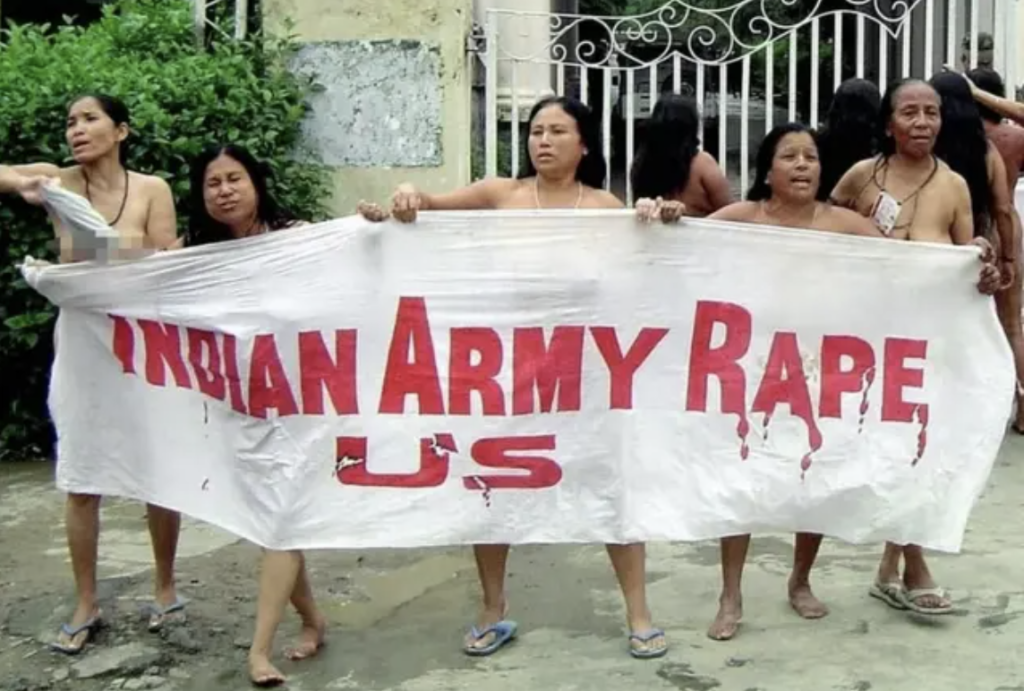
The protest by the Meira Paibis.
No NRC, no delimitation, no peace
On April 5, for the first time since ethnic violence began on May 3, 2023, representatives of the Kuki-Zo and Meitei communities sat together for a peace meeting organised by the Ministry of Home Affairs (MHA) in New Delhi. However, the meeting ended without any agreement between the two sides.
Nganbi accused the government of initiating ‘forced peace talks’. “We want to live peacefully with Kukis, Pangals, and Nagas. But those who came from Myanmar should go back,” she said.
Since the violence began, the Meira Paibis have been at the forefront of protests – demanding accountability, disarmament of militants, and pushing for a pause on plans of delimitation until the National Register of Citizens (NRC) is implemented.
“We do not want peace because there is no confidence. We want NRC first,” Nganbi said. “If there is no NRC, there should be no delimitation. Fencing should be done across all border areas of the country – not just in Manipur and Mizoram.”
Security forces
Both Meiteis and Kukis have accused security forces of bias. While the Meitei community claims that the Assam Rifles are siding with Kukis, the Kukis have alleged that Manipur Police is aligned with Meiteis.
Nganbi echoed these concerns, stating that formal security forces are ineffective. “Forces aren’t doing anything. It’s the village volunteers who are protecting lives, on both sides.”
She also questioned the logic of “buffer zones” being maintained by central forces. Since the violence, Meiteis in Manipur are living in the valley which includes the capital Imphal. Kukis have been living in the hill areas like Churachandpur and Kangpokpi. To reach Hill areas one has to cross buffer zones where there are multiple checkposts.
“Why do we have a buffer zone within the country?” she asked. “There should be buffer zones on international borders – not inside India.”
President's Rule
President's Rule was imposed in Manipur on February 13, 2025, following the resignation of chief minister N. Biren Singh. The decision came nearly two years after violence first erupted in May 2023.
Nganbi dismissed the imposition of President’s Rule as a mere formality, arguing that it did little to restore faith in governance. “It means nothing. What we’re witnessing is a complete collapse of administration,” she told The Wire.
She also delivered a scathing critique of the BJP’s much-touted “double engine sarkar,” accusing both the state and Union governments of prioritising control over the welfare of citizens. “They want the land, not the people,” she said. “All MLAs and ministers had forced Biren Singh to resign, and the people of Manipur also demanded his ouster."
But nothing changed, she said.
This article went live on April eighth, two thousand twenty five, at sixteen minutes past five in the evening.The Wire is now on WhatsApp. Follow our channel for sharp analysis and opinions on the latest developments.


