

Muslim Hawker in West Bengal Stabbed, Attackers Allegedly Tried to Force Him to Chant 'Jai Shri Ram'


Punisol (West Bengal): A 60-year-old Muslim hawker in West Bengal’s Bankura district was attacked on September 6 by three men who stabbed him in the neck and stomach and allegedly tried to force him to chant “Jai Shri Ram.”
The victim, identified as Maimur Ali Mandal, is a resident of Punisol village under Onda Police Station in Bankura district. The attackers are reportedly from Kadmapara, near Lokpur in Bankura town.
What followed after the attack was equally disturbing. As Mandal writhed in pain, bleeding on the busy road, the assailants allegedly threatened him – warning that if he went to Bankura medical college and hospital for treatment, they would kill him.
Mandal says that the accused also hurled abusive remarks targeting his community. Despite the incident happening in broad daylight on a crowded road, no one intervened.
“After lying there in a pool of blood for some time, another hawker finally picked me up from the road. All my belongings were scattered around. Hearing their threats, I was terrified and set off on my bicycle towards my village,” Mandal told The Wire, his voice heavy with pain.
This incident has raised pressing questions: Why did such violence erupt in Bankura – a place with no history of such communal incidents? Who is responsible for poisoning the atmosphere?
'Stabbed me in the neck and stomach, asked me to chant Jai Shri Ram'
When The Wire visited Mandal’s home in Mukshapara (also known as Riya Para), the mood was tense and fearful. Mandal, who was lying on a cot with bandages on his neck and stomach, was in visible agony.
He had returned from Bankura medical college and hospital the previous night after doctors stitched his wounds.
“I was returning from Lokpur on my bicycle with my day’s collections. Near Banerjee diagnostic centre in Kankata, an e-rickshaw hit my cycle and threw me off. One of the youths who was in the vehicle demanded Rs. 200 from me. When I refused, he stabbed me in the neck with a bhojali (sharp weapon) and asked me to chant ‘Jai Shri Ram.’ When I refused again, he stabbed me in the stomach. They wanted to kill me. I don’t know any of them,” said Mandal.
Mandal stressed that he has worked in Bankura town for 32 years and has always been treated with respect by people.
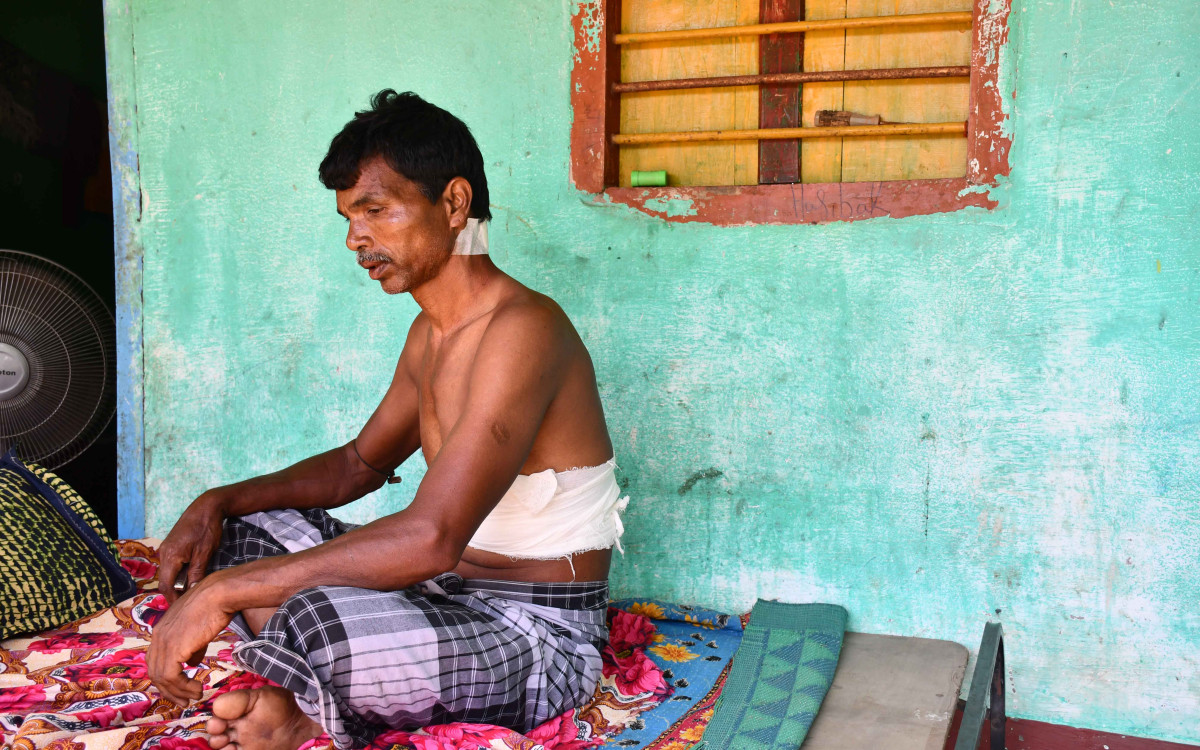
Maimur Ali Mandal sustained stabbing injuries on his stomach and neck as a result of the attack. Photo: Madhu Sudan Chatterjee
“The people of Bankura have always loved us like family. This has never happened before. Now we are very scared,” he said.
His son, Nazibuddin Mandal, explained how the family received the news late in the afternoon.
“We brought our father back from Benajira village, not far from Punisol. His entire body was soaked in blood, yet he was still trying to cycle home from Bankura, risking his life. Later, we admitted him to Bankura medical college, where doctors stitched his wounds and sent him home,” said Nazibuddin.
Following the attack on Mandal, the family stares at an uncertain future.
“My husband was the sole breadwinner. Now he cannot work. How will we survive? How will we even afford the medicines prescribed by the doctors?” said Manda’s wife Hasifun Bibi.
'Will we be able to work again? Will the administration provide us with security?'
Punisol village, situated around 12 kilometres from Bankura along the Jhargram state highway, falls under the Punisol Gram Panchayat in Onda block.
It is one of the largest minority settlements in the district, with a Muslim population of over one lakh. Except for a handful of primary school teachers, there are almost no government employees.
Most villagers are landless. They earn their livelihood through hard and hazardous labour and are engaged in activities such as stone breaking, tree cutting, digging and renovating wells, and other risky jobs.
Since such work is not available daily, thousands of villagers, young and old, set out before sunrise on bicycles to Bankura, Taldangra, Onda and Indpur.
They collect discarded items – broken furniture, old tin sheets, iron, aluminum, steel utensils, newspapers, and plastic – from households at low prices and sell them to scrap dealers. Locally, they are called “tin-bhanga” or “loha-bhanga” hawkers.
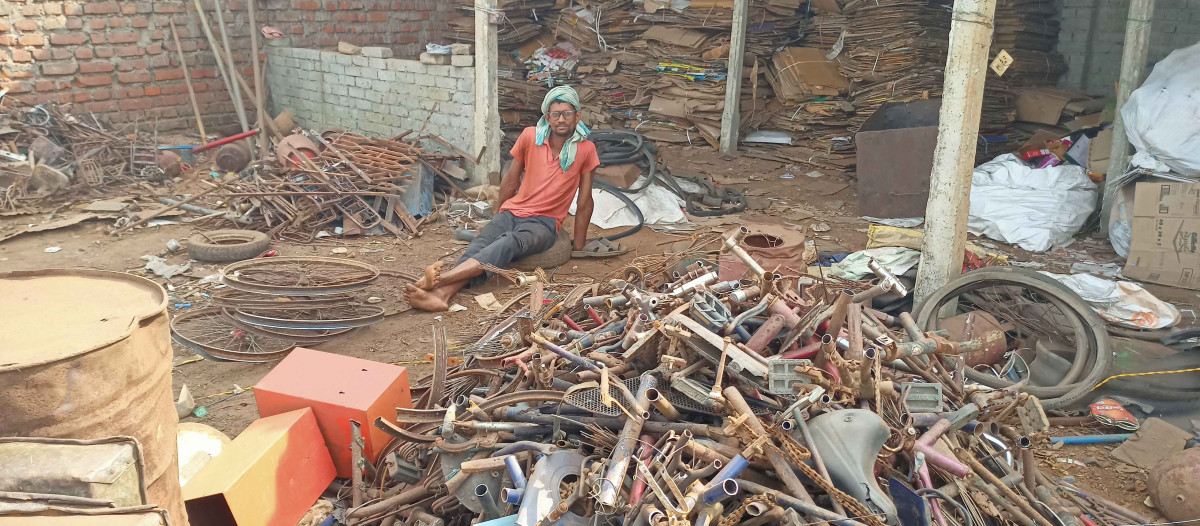
Most villagers are landless. They earn their livelihood through collecting discarded items – broken furniture, old tin sheets, iron, aluminum, steel utensils, newspapers, and plastic – from households at low prices and sell them to scrap dealers. Locally, they are called “tin-bhanga” or “loha-bhanga” hawkers. Photo: Madhu Sudan Chatterjee
“We don’t get work every day. On average, we earn around Rs. 100 a day, after working from morning till afternoon,” said Aktan Ali Khan, one such hawker from Punisol.
When this reporter visited Punisol on Saturday (September 6) evening, the entire village was gripped by fear. The only questions being asked were, “Will we be able to work again? Will the administration provide us with security?”
The Inspector-in-Charge of Bankura police station Sujoy Tunga confirmed that a youth named Samir Sahis from Lokpur Kadmapara was arrested based on the victim’s complaint.
Police say terming incident as communal 'factually incorrect', victim sticks to his version
On Sunday (September 7) evening, additional superintendent of police, Bankura (headquarters) Siddharth Dorji issued a press statement to the media about the attack on Mandal.
“It has come to our notice that some social media handles are portraying the incident as communal, claiming the victim was forced to chant religious slogans. This is factually incorrect and misleading. Preliminary investigation confirms the incident was criminal in nature, not communal. Allegations about forcing the victim to chant religious slogans remain unsubstantiated. Citizens are requested not to believe or spread false information,” said the statement.
However, Mandal maintains his version of the incident.
“I told the police clearly that I was stabbed because I refused to chant ‘Jai Shri Ram,” said Mandal.
Locals, too, argue that they have no intention of spreading falsehoods, but demand a thorough investigation.
“Unless the police dig deeper, such incidents will only increase. Bengal has already seen similar cases elsewhere,” said a villager.
Recently, a group of Calcutta University students residing at Carmichael Hostel were branded as “Bangladeshis” in Sealdah. Similarly, a perfume seller at Tollygunge metro station in Kolkata was also labeled a “Bangladeshi” for simply selling attar.
Last month, a group of Muslim men were attacked in the Durgapur when they were carrying cattle for agricultural work. Incidents like these underline a disturbing trend: the growing influence of Hindutva the ideology, propagated by the BJP.
This article went live on September eighth, two thousand twenty five, at twenty minutes past eleven in the morning.The Wire is now on WhatsApp. Follow our channel for sharp analysis and opinions on the latest developments.


