

Historical Records Debunk PM Modi’s ‘Vande Mataram’ Charge Against Congress


Kolkata: A long, meticulously argued essay by writer and academic Semanti Ghosh in the Bengali daily Anandabazar Patrika has directly countered Prime Minister Narendra Modi’s recent assertion that the Congress “removed key stanzas” from the 'Vande Mataram' song due to a “divisive thinking”.
On November 8, at the inauguration of the year-long commemoration of 150 years of the national song in New Delhi, Modi said, “The spirit of Vande Mataram illuminated the entire nation during the freedom struggle. But unfortunately, in 1937, the key verses of Vande Mataram – a part of its soul – were separated. Vande Mataram was torn apart. This division of Vande Mataram also sowed the seeds of the nation's division. Why was this great mantra of nation-building treated with such injustice? It is important for today’s generation to understand this, because that divisive thinking still poses a challenge to the country."
Ghosh’s argument underscores that this institutional limitation, which restricted the song to its first two stanzas, was not an act of political division but rather one of foundational prudence, largely guided by the counsel of Rabindranath Tagore.
Tagore's role
The essay traces the song’s journey from Bankim Chandra Chattopadhyay’s 1882 novel Anandamath to its present status, highlighting a crucial duality. Tagore both popularised the hymn by setting it to music and singing it at the 1896 Calcutta Congress, and later pressed to limit its official use so that it could be inclusive.
On November 9, Congress leader Jairam Ramesh amplified Ghosh's Bengali essay on X, and demanded apology from Modi.
This detailed article by Semanti Ghosh in today's Ananda Bazar Patrika totally debunks and exposes the PM's lies on Nehru and Vande Mataram. It explains how and why Rabindranath Tagore was responsible for it becoming the national song. The PM must apologise to the people of West… pic.twitter.com/vOOMOEE5eB
— Jairam Ramesh (@Jairam_Ramesh) November 9, 2025
Ghosh, a trained historian and the author of the book Different Nationalisms: Bengal, 1905-1947, argues in her essay that the song’s later stanzas, which invoke Durga, Lakshmi and Saraswati, and its placement in the novel, created a devotional-militant frame that clashes with a multi-faith polity. She credits Tagore with popularising the song, setting it to tune and singing it at the 1896 Calcutta Congress and later insisting on limits so it could serve a plural republic.
Ramesh also reproduced excerpts from Prabhat Mukhopadhyay’s 1994 biography, Rabindrajiboni (a Visva-Bharati publication), to argue that the 1937 Congress Working Committee decision to adopt only the first two stanzas of the song for official use was based on Tagore’s own recommendation.
Here are pages 110-112 from vol 4 of the authoritative biography in Bengali of Rabindranath Tagore titled Rabindra-Jeebanee by Prabhat Kumar Mukhopadhyay, published by Visva-Bharati in 1994.
The Master Distorian of a PM must render an apology. He has insulted our founding… pic.twitter.com/adCJw5I2I2
— Jairam Ramesh (@Jairam_Ramesh) November 8, 2025
What Tagore said
Mukhopadhyay collates Tagore’s own 1937–38 statements and contemporary reportage to show the poet’s reasoning. Praising the “tenderness and devotion” of the opening, Tagore explains that, raised in his father’s monotheistic tradition, he could dissociate those stanzas from both the remainder of the poem and the novel’s militant ascetic frame. He freely concedes that the full poem “read together with its context” could wound Muslim susceptibilities.
Rather, he writes that the national song, which had “spontaneously come to consist only of the first two stanzas,” had an independent and inspiring significance “in which I see nothing to offend any sect or community,” adding that these verses are “impossible to object to, unless maliciously inclined.” Mukhopadhyay cites Visva-Bharati News (October–November, 1937) and The Modern Review (December, 1938) for these.
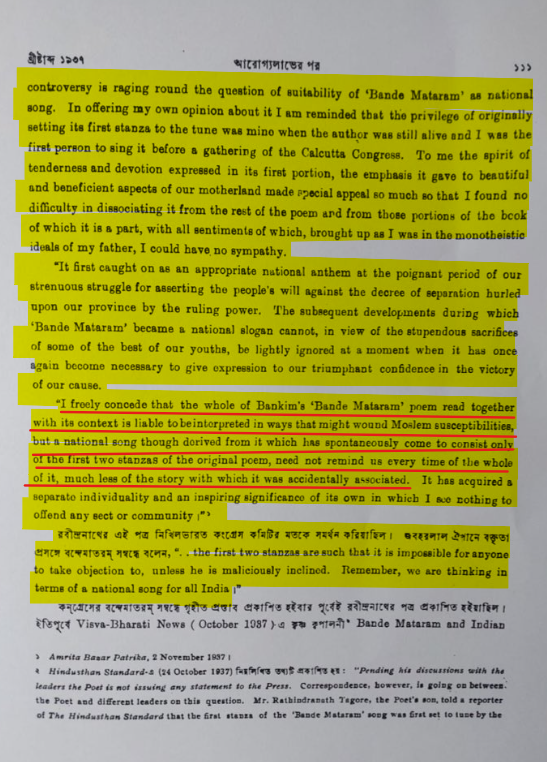
Tagore's own writings are testament to his premonitions that the whole poem is liable to divisive interpretation.
The text of the 1937 Working Committee statement explicitly mirrors Tagore’s logic. It notes the first two stanzas, written in “tender language” describing the motherland, contain “nothing to which anyone can take exception,” while the remaining stanzas carry “allusions and a religious ideology” not shared across faiths.
The committee also mandated a sub-committee, comprising Maulana Azad, Jawaharlal Nehru, Subhas Chandra Bose, and Narendra Dev, to consult with Tagore himself on the matter. This documentary trail suggests the 1937 policy was not a partisan compromise but a deliberate act of statesmanship guided by the poet’s “pluralist guardrails.”
The case of 'Jana Gana Mana'
In her op-ed, Ghosh, the daughter of celebrated Bengali poet Sankha Ghosh, also draws a clarifying parallel to show that caution, not hostility, guided the founders. Tagore’s 'Jana Gana Mana' originally has five stanzas. Independent India adopted only the first stanza as the official anthem text. The later, more overtly exhortatory stanzas were left out to keep state ceremony civic, inclusive, and non-sectarian.
Despite Rabindranath Tagore’s public clarification that the hymn did not glorify any monarch, limiting the national anthem to its restrained first stanza helped shield it from ideological or theological controversy. The same prudence of preserving what unites and limiting what can divide shaped both the anthem and the national song.
The essay is accompanied by an archival photograph from a Congress session showing leaders standing as a choir sings Vande Mataram, an image the newspaper uses to anchor how central the song once was to the anti-colonial mass mood.
This article went live on November tenth, two thousand twenty five, at twenty-eight minutes past three in the afternoon.The Wire is now on WhatsApp. Follow our channel for sharp analysis and opinions on the latest developments.


