

Non-Locals Asked for Aadhaar Cards, Denied Entry at Mathura’s Shahi Eidgah Mosque


Mathura: “Going to our own mosque has been made into a humiliating experience,” said Maqsud Ali. Ali is a part of Mathura’s 8% Muslim population. Since 2020, when Hindu petitioners filed a suit challenging a 1968 agreement and claiming that Mathura’s Shahi Eidgah was built over a temple at Hindu deity Krishna's birthplace, this community has found themselves living under a cloud.
In recent months, the Allahabad high court has mainly dealt with procedural aspects of the Krishna Janmabhoomi–Shahi Eidgah dispute rather than the core ownership claims. The court transferred multiple suits to itself, consolidated them, and designated one as a representative case. It has rejected a plea to officially term the Eidgah mosque a “disputed structure”, as well as a petition seeking to include Radha Rani as a party. Hearings continue with both sides presenting arguments, while the Supreme Court has kept a stay on any physical survey of the mosque. The high court has repeatedly adjourned proceedings, with fresh dates set through September 2025, leaving the substantive questions of title, worship rights and applicability of the Places of Worship Act still unresolved. The case will next be heard on October 9.
The Wire visited Mathura in August 2023 and September 2025, and was able to see why Muslims believe their mosque entry is being screened. The Mathura Police is stationed outside the Eidgah, and barricades have been placed outside the lane leading to the Eidgah. Locals from Mathura have also shared that they are required to present their Aadhaar cards or another ID with a Mathura address to be allowed into the mosque for prayers.
While locals have claimed that visiting the Eidgah feels like stepping into an open-air prison, Muslims from several parts of India told The Wire that they were indeed denied entry by the police after the personnel asked them to show their Aadhaar cards at the Eidgah entry.
Devotion denied
In April 2022, Abid Qureshi from Rajasthan’s Mahwa was in Mathura for a wedding when he first saw the Shahi Eidgah. After attending wedding programmes and finding free time, Qureshi wandered off to offer namaz at the Eidgah.
“They didn’t let me enter. I thought I would be able to pray on time. They asked for my ID, [and] the moment the police realised I’m not a local, they asked me to leave,” said Qureshi.
“They have wrapped the gates of the Eidgah in barbed wires. There is a metal detector at the entrance. It is heavily guarded. It is made to look like a forbidden piece of land,” he added.
Qureshi also said he was willing to leave his Aadhaar card and mobile phone with the police to satisfy their objections. “They still didn’t allow us non-locals,” he said.
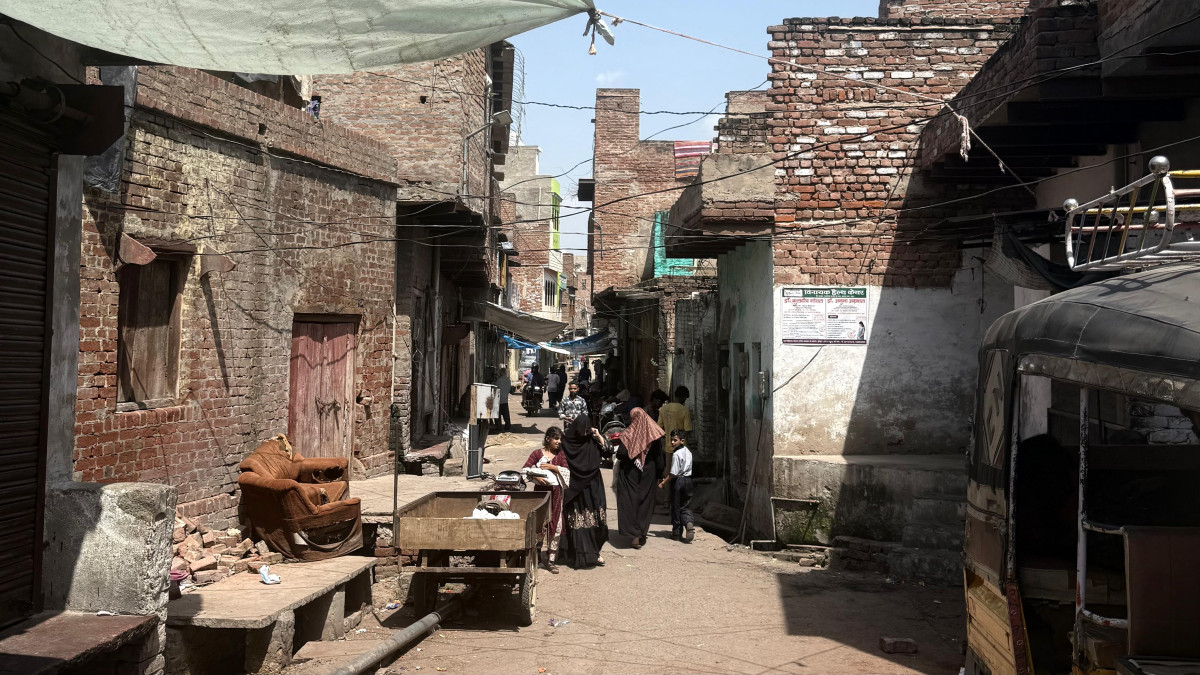
Muslims make up 8% of Mathura’s population and are housed near the now shut slaughterhouse in Manoharpura. Photo: Tarushi Aswani
In 2023, another non-resident was denied entry to the Eidgah. Parvez Hussain, 53, a local from Mathura, had been living in Delhi for the past two decades. Born in Mathura, with family and friends who fondly miss him in the city, Hussain moved to Delhi in 2005 to make a living.
Two years ago, on a trip to Mathura, Hussain decided to pray at the Eidgah. Upon reaching the Eidgah, the police immediately asked him for his ID, which he happily shared. But because his Aadhaar card had a Delhi address, the Eidgah of his childhood turned alien to him.
“I even tried talking to the police. I asked them a simple question – can only local Hindus from Mathura pray at the Janmasthan temple? Are they even required to show any ID?” Hussain recalled. After this, he was asked to leave without being able to offer prayers.
Mohammed Burhanuddin, a member of the Eidgah committee, views this reality with despair. “Since 2022, we see that there is police stationed outside the mosque and one must present their IDs to be granted entry to the mosque. Non-locals, Muslim or from any other religion, cannot enter the premises. This in itself builds pressure on Muslims and makes others question the structure,” Burhanuddin said.
Right to religion
After several other Muslim tourists in Mathura complained of being banned entry to the mosque, local Muslims took it upon themselves to seek answers on this from the authorities. On October 28, 2024, Shakir Hussain, a BAMCEF (Backward and Minority Communities Employees Federation) worker, filed an RTI application seeking responses from the Senior Superintendent of Police (SSP) Office, Mathura on the matter.
In his RTI, Hussain asks the following questions:
Under Articles 25–28 of the Indian Constitution, every citizen has the right to practice and protect their religion.
(1) Can any independent Indian Muslim be legally restricted from offering namaz in one mosque or another, or is he completely free?
Regarding the verification of identity cards (Aadhaar cards, etc.) upon entry to the Shahi Masjid Eidgah in Mathura for namaz:
(2) Are records of the said order (Aadhaar card checking) available? If yes, please provide a photocopy.
As per the Honorable Supreme Court order, the government was given the responsibility of security at the temple and Eidgah. Security was ensured at both places as per the same order. Is entry to the Eidgah for namaz granted after checking the Aadhaar card?
(3) Is entry to the Krishna Janmabhoomi Temple granted after checking the Aadhaar card?
(4) Does any devotee from India or abroad visit the Krishna Janmabhoomi Temple? Is it permitted?
(5) Can any Muslim from India or abroad come to offer prayers at the Shahi Masjid Eidgah, is this permitted?
The Office of the Senior Superintendent of Police, Mathura responded on November 30, 2024 giving replies to the questions Hussain asked. The SSP responded that in December 2021, various Hindu organisations had announced they would install an idol of Lord Bal Gopal at the Shahi Eidgah Masjid, Mathura, and celebrate it as “Shaurya Diwas” (Victory Day) on December 6. So to maintain security, Shri Krishna Janmasthan and Shahi Eidgah Masjid premises were secured by the district administration/police. Entry of officials, representatives, etc. of Hindu organisations into the Shahi Idgah Masjid was strictly regulated through identity verification using Aadhaar card, to ensure safety.
The SSP also responded that at the Shri Krishna Janmasthan temple, visitors from India and abroad are required to show ID proofs (like Aadhaar, passport, etc.) for verification from a security perspective. However, when The Wire visited the Janmasthan, no IDs were inquired for.
The SSP also responded that at the Shri Krishna Janmasthan temple, there is no restriction on devotees coming from India or abroad to offer prayers and also that at Shahi Eidgah Masjid, there is no restriction on any Muslim who complies with the security requirements to offer namaz.
Yet to this day, non-local Muslims are denied entry into the mosque.
Fighting for faith
On September 2, Arif Alam, a resident of Kolkata, was in Mathura to meet his friends. After visiting the Krishna Janmasthan, he began exploring other locations for sightseeing. Alam, who is a practising Muslim, asked a local around Mathura’s Deeg Gate about a mosque he could offer prayers at.
On being guided to the Shahi Eidgah, Alam made his way to the lane leading to the mosque. “But then when I went to mosque, the police didn't allow me to enter and told me that outsiders were not allowed to offer namaz in this mosque,” Alam told The Wire.
“I felt bad and confused when the police didn't let me enter the Eidgah. It's our right to offer namaz and our Constitution allows us all to freely follow our religion. If people from across India can visit the Krishna Janmasthan temple, then why are we being banned from our mosques?” Alam asked.

Syed Qamar Ali, after he was refused entry into the Shahi Eidgah mosque. Photo: Screengrab from video
Almost a month ago, on August 27, Syed Qamar Ali, a Delhi resident, visited Mathura to specifically offer namaz at the Shahi Eidgah. “The police told me that I cannot enter because I am not a resident of Mathura,” Ali told The Wire. Ali even made a video of being in Mathura, police deployment outside the mosque and being banned from entering the mosque. The video garnered several reactions on Facebook.
After being barred from praying at the Eidgah, both Alam and Ali have filed complaints with the police authorities in Mathura, expressing their deep disappointment concerning what they call ‘discrimination’.
The Wire has accessed their complaints to SSP Mathura, where both share that they were denied access and entry to the mosque.
Alam in his complaint has alleged that the denial of the right to practice religion at the mosque is a clear “violation of Constitutional Rights such as Article 25 of the Constitution guarantees freedom of conscience and the right to freely profess, practice and propagate religion. Article 26 guarantees every religious denomination the right to manage its own affairs in matters of religion. The denial of entry and obstruction of Namaz directly violates these fundamental rights.”
Alam added that since at the relevant time, neither Section 144 CrPC nor any order was in operation, the police could not restrict citizens’ movement or activities.
Alam has also asked that CCTV footage covering the time between 5:00 and 5:30 pm on September 2, 2025 from the Shahi Eidgah premises and surroundings be preserved for reference.
Ali filed a complaint alleging that police personnel stopped him from offering namaz at the mosque on August 27, 2025. Ali said he was barred entry without any written order or valid reason, despite a previous RTI response given to local resident Hussain that clearly stated no Muslim – whether local or outsider – can be prevented from praying inside the mosque. Calling it a violation of his constitutional right to freedom of religion, Ali has sought registration of an FIR against the police officials, preservation of CCTV footage from the incident, and assurance that such restrictions will not be imposed in future.
The police is yet to respond to these complaints. The Wire reached out to the SSP's office to ask whether there was a policy to disallow non-locals from entering, and why this may be so. This article will be updated once a response is received.
Tarushi Aswani is an independent journalist.
Note: This report was updated after publication to make the RTI questions, which have been translated from Hindi, clearer.
This article went live on October first, two thousand twenty five, at zero minutes past two in the afternoon.The Wire is now on WhatsApp. Follow our channel for sharp analysis and opinions on the latest developments.


