

Rewriting a Martyr: The Hindutva Push to Recast Guru Tegh Bahadur’s Legacy in Today's India


Guru Tegh Bahadur’s martyrdom in 1675 stands as one of the central moments in Sikh history and collective memory: a moral stand against coercion and a testament to freedom of conscience and pluralism. Over the centuries, his sacrifice has inspired generations of Sikhs to stand against injustice and oppression, from anti-colonial struggles to the recent farmers protest and ongoing mobilisation for minority rights.

Prime Minister Narendra Modi during a programme organised to mark the 350th martyrdom anniversary of Guru Tegh Bahadur in Kurukshetra district, Haryana. Photo: PMO via PTI.
The month-long large-scale commemorations marking the 350th anniversary of his ultimate sacrifice have just ended with a three-day Gurmat Samagan, including a light and laser show, organised by the Bharatiya Janata Party-led (BJP-led) Delhi government in the Red Fort, near the site of his execution. Meanwhile, the BJP-led Haryana government has been holding its own grand celebration in Kurukshetra, with the prime minister attending an event on November 25.
In parallel, on November 24, Punjab chief minister Bhagwant Mann and Aam Aadmi Party (AAP) national convener Arvind Kejriwal presided on over separate ceremonies hosted by the Punjab government in Anandpur Sahib. Founded by the ninth Guru, this city is central to Sikh history: his severed head was cremated here, and twenty six years later, his son, Guru Gobind Singh would establish the Khalsa order at the same site.
These highly visible public events reveal not only the contemporary significance of Guru Tegh Bahadur’s martyrdom, but also the political and ideological contestations surrounding his legacy. As India grapples with Hindu majoritarianism, his shaheedi (martyrdom) is reframed through a Hindutva lens. The current attempt to recast him as a defender of Hindu dharma, rather than as a champion of pluralism is part of a long-standing project to subsume Sikh identity into a homogenising Hindu nationalist narrative and neutralise Sikh resistance to the majoritarian reshaping of the nation.
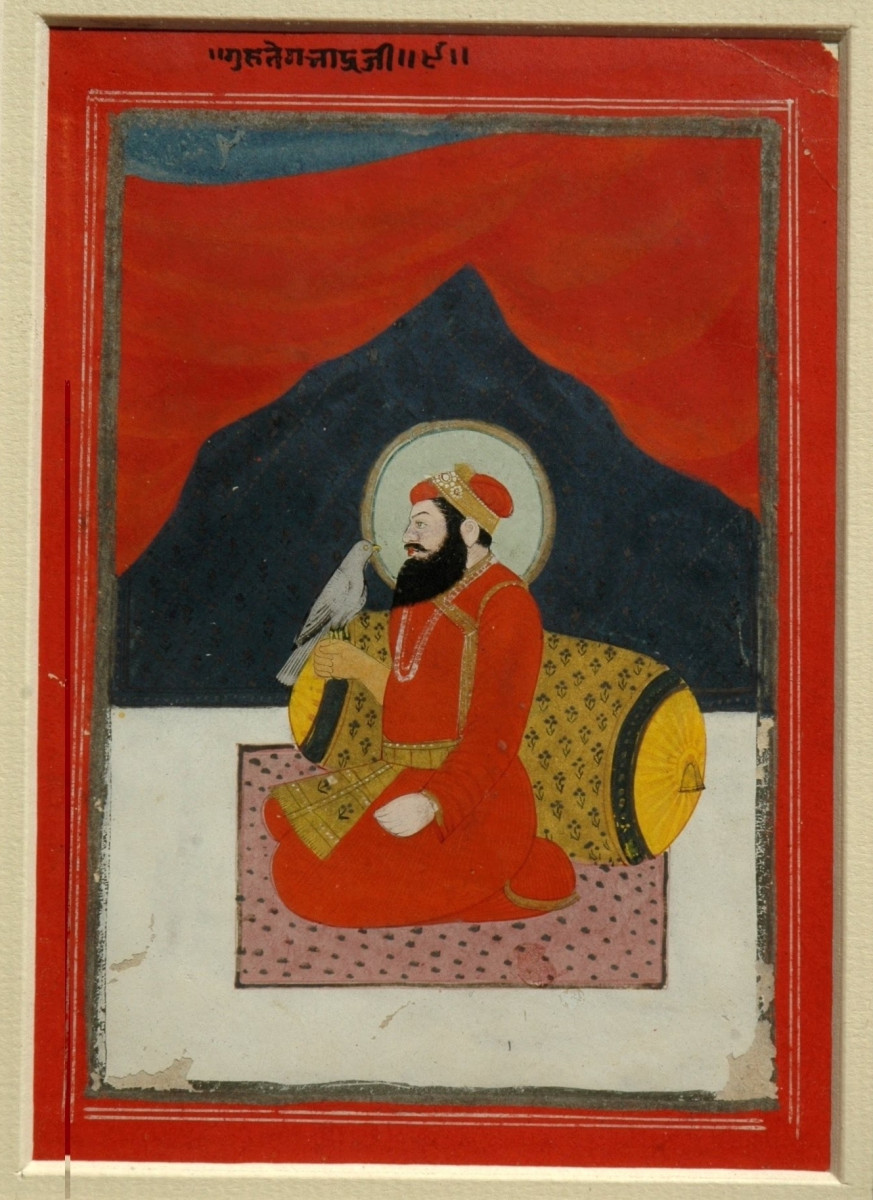
Portrait of Guru Tegh Bahadur. Photo: Public domain via Wikimedia Commons.
The struggle over Guru Tegh Bahadur’s memory is not new. In the 19th century, fierce polemics between the Arya Samaj and the Singh Sabha focused on whether Sikhism was a strand of Hinduism or a distinct religious tradition. Dayanand Saraswati dismissed Sikhism as a deviant branch of Hinduism that had strayed from Vedic truth, prompting Sikh reformers to assert Sikh distinctiveness.
Also read: Why Guru Tegh Bahadur Is Not the Anti-Muslim Icon BJP-RSS Claims He Is
V.D. Savarkar, the architect of Hindutva, incorporated Arya Samaj arguments: to him, Sikhs were ‘natural Hindus’– racially and culturally part of the Hindu nation – and a separate Sikh identity weakened Hindu unity in the face of threatening others – namely Muslims and Christians. This forms the foundation of Hindutva’s dual strategy towards Sikhs: forced incorporation into the Hindu fold and the portrayal of dissenting Sikhs as anti-nationals.
The rewriting of Sikh history has long been one of the Sangh Parivar’s key tools of assimilation, and Guru Tegh Bahadur’s shaheedi has become a focal point, with state-led commemorative politics serving as a major site of historical revisionism. According to Sikh historiography, Kashmiri Brahmins, threatened with forced conversion under Aurangzeb, appealed to the ninth Guru, who intervened on their behalf and was executed after refusing to embrace Islam.
For Sikhs, this episode embodies a struggle against tyranny and a defence of freedom of conscience – even for a community not his own. Hindu nationalists, by contrast, recast the Guru’s sacrifice as a defence of Hindu dharma, using this interpretation to assert that Sikhs belong within the Hindu fold. The April 1999 Khalsa tricentenary special issue of the RSS mouthpiece Organiser, explicitly framed his martyrdom as an evidence that Sikh identity derives its meaning from protecting Hindu society.
More recently, the 2022 state-sponsored celebrations for Guru Tegh Bahadur's 400th birth anniversary at the Red Fort further exemplified this appropriation. By portraying him as the shield of Hindus against an inherently oppressive Muslim rule, the event performed a symbolic act of historical revenge: a united Hindu-Sikh front resisting Muslim tyranny. This narrative erases the universalism of the Guru’s sacrifice and places his martyrdom within Hindutva’s reinterpretation of the past.
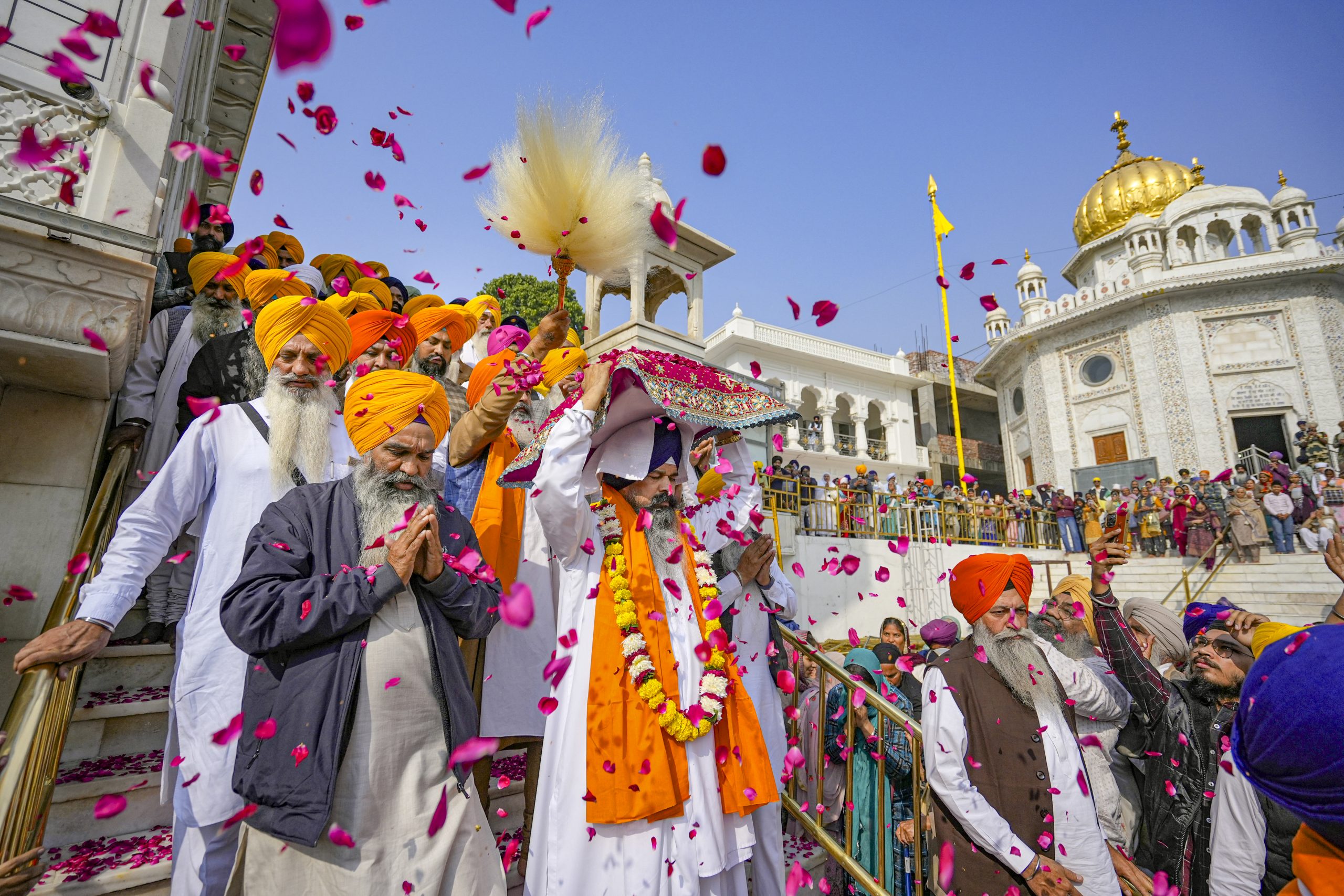
Amritsar: Members of the Sikh community take part in a 'Nagar Kirtan' procession commemorating the 350th anniversary of the martyrdom of the ninth Sikh Guru, Guru Tegh Bahadur at Golden Temple in Amritsar on November 24, 2025. Photo: PTI/Shiva Sharma.
As historian Lou Fenech argues, Sikh martyrdom is inseparable from Sikh collective identity. “In his horrific death, the Sikh martyr was made to resolutely proclaim the separate identity of the Sikh Panth,” he writes. The Sikh martyr emerges as the “ultimate embodiment of heroism, defiance, endurance, loyalty, fearlessness and altruism,” figures who animate Sikh liturgy, visual culture, and popular memory.
This lived, embodied understanding of martyrdom was vividly present during the farmers’ protest of 2020–21, where Guru Tegh Bahadur’s example served as a moral compass for many participants and shaped their interpretation of the farm laws – not merely as an economic threat but as another challenge to Sikh collective identity – one that had to be met with defiance, dedication, and readiness for sacrifice.
The ongoing battle over Guru Tegh Bahadur’s legacy is not only about historical accuracy, it is about protecting a pluralistic vision of India against a homogenising majoritarian ideology. Historians specialised in Punjab and Sikh history remind us of the close bonds between the Sikh Gurus, including the ninth, and their Muslim admirers and devotees. These inter-religious exchanges were integral to the world in which the Sikh tradition developed.
Drawing on this legacy, many Sikh intellectuals and religious leaders have criticised the ruling party’s projection of the martyred Guru as an anti-Muslim icon. For instance, former head of Punjab University’s history department, Gurdarshan Singh Dhillon told The Wire that such distortions aim at fuelling antagonism among minorities and undermines the universalism at the core of Sikh teachings. As he put it, “Had Guru Tegh Bahadur been alive today, he would have given his life to save Muslims.”
For the Sikh Panth, the Guru’s martyrdom remains a symbol of resistance to oppression and a reminder that martyrdom is about living with integrity, dignity, and moral courage. It affirms the duty to stand with the oppressed – visible in Sikh support for anti-Citizenship Amendment Act (anti-CAA) protesters or for Kashmiri students targeted after the Pahalgam attack in April 2025. The reciprocal support offered by the Muslim community during the 2025 Punjab floods shows the continued vitality of this ethics of solidarity, despite a divisive and polarising political context.
For Hindu majoritarianism, such potential for inter-minority solidarity and shared struggles for social justice is deeply unsettling – which is why, at a time when democratic spaces are shrinking and the right to dissent is under assault, Guru Tegh Bahadur’s message of standing with the oppressed and defending freedom of belief remains urgently relevant.
J.D. Emmanuel is the pseudonym of a foreign scholar working on Sikhism who has requested anonymity because of concerns about continuing research access in India.
This article went live on November twenty-seventh, two thousand twenty five, at ten minutes past three in the afternoon.The Wire is now on WhatsApp. Follow our channel for sharp analysis and opinions on the latest developments.


