

RSS at 100: Three Grand Defeats and a Fourth in the Making


The Rashtriya Swayamsevak Sangh is celebrating its centenary and unsurprisingly, a plethora of voices – from Prime Minister Narendra Modi down to various rented pen-pushers – has been heard in praise of the organisation. There seems to be an epidemic of RSS-ness. Predictably, we stand buried under acclamations about the organisation’s presumed exceptionalism – its unique selflessness, its unalloyed idealism, its extraordinary love for the motherland, its unmatched commitment to national glory and resurgence and much, much more.
Granted, the mere fact that an organisation has notched up hundred years of existence in itself becomes a legitimate occasion for some kind of observance. In the RSS’s case, the occasion is being exaggeratedly observed as a victory celebration. It is important, therefore, to talk about the Sangh’s failure, especially the three grand defeats that were inflicted on this organisation and its ideological shibboleths; and there is also need to talk about the fourth defeat that is in the making.
 The first strategic defeat the RSS suffered was at the hands of Mahatma Gandhi and his invocation of a kind of moral nationalism. K.B. Hedgewar and his successor, M.S. Golwalkar, simply did not have it in them to arouse even a minuscule part of India’s “Hindu” population to see any wisdom in their argument. Gandhi had already infused the Indian mind with his ideas and techniques, and at no point were the Nagpur warriors able to dislodge Gandhi from our collective imagination. In frustration, Nathuram Godse was assigned the assassin’s role and provided a pistol. In fact, January 30, 1948 was the most spectacular defeat for the RSS’s pretensions. Gandhi became a national saint.
Over the next four decades, the RSS and its ‘cultural nationalism’ was to face defeat after defeat in the ambience of ‘secular nationalism’ as formulated by Jawaharlal Nehru and Indira Gandhi. It was a strategic defeat foretold. The Nagpur brass’s concepts and ideas simply could not make headway against the joyful exuberance that Nehru was able to whip up in the country for building a new nation on our terms and as per our dreams. Those presumptuous custodians of the Hindu samaj just did not understand that their sectarianism was against our civilisational genius for inclusion and accommodation.
Nehru invited the nation to think progressively and tirelessly urged our old society to align itself with modern ideas and innovations. The RSS was harking back to a distant past. Nehru had a sanctified legitimacy that accrued to him and his Congress party from the freedom struggle against British colonialism. The RSS had no matching respectability, leave alone any hint of legitimacy, except a kind of divisive patter. Nehru infected the newly forged political community with an Idea of India, and brilliantly marshalled society’s cultural and emotional energies to produce a stable and strong Indian state. By contrast, all the RSS offered was a rendezvous with antediluvian cant, with an implicit invitation to maar-kaat, i.e. violence.
The only thing that animated the RSS partisan was the birth of Pakistan and the existence of a large number of Muslim citizens in India. In 1971, Indira Gandhi took the bottom out of the RSS’s central lament when she forged a Bangladesh out of Pakistan. The 1971 war was as much a strategic defeat for Mohammed Ali Jinnah’s Pakistan as it was for the ideas of the Hegdewars and the Golwalkars.
It must be emphasised that for all its self-applauded ideology and idealism, and for all its numerous “swayamsevaks”, not once did the RSS appear to find traction among the majority of the majority community. Its ideology of “Bharatiyata” ran against the harsh realities of another centuries old Hindu institution – the immutable caste system.
For decades, the RSS remained a fringe organisation, wallowing in its own self-scripted specialness. Its cadre won a few street skirmishes here and there in times of communal violence; but the Sangh could never win a fight in the face of a determined collector. And, for all its infatuation with martial paraphernalia, it has never once sought to take on the Indian state.
The RSS’s third defeat came at the hand of one of its own swayamsevaks – Atal Bihari Vajpayee, who had become the compromise choice of both the Washington-based quarterbacks of globalisation and the Mumbai-based corporate honchos. Both these lobbies wanted to put an end to the uncertainty and instability of the United Front government years.
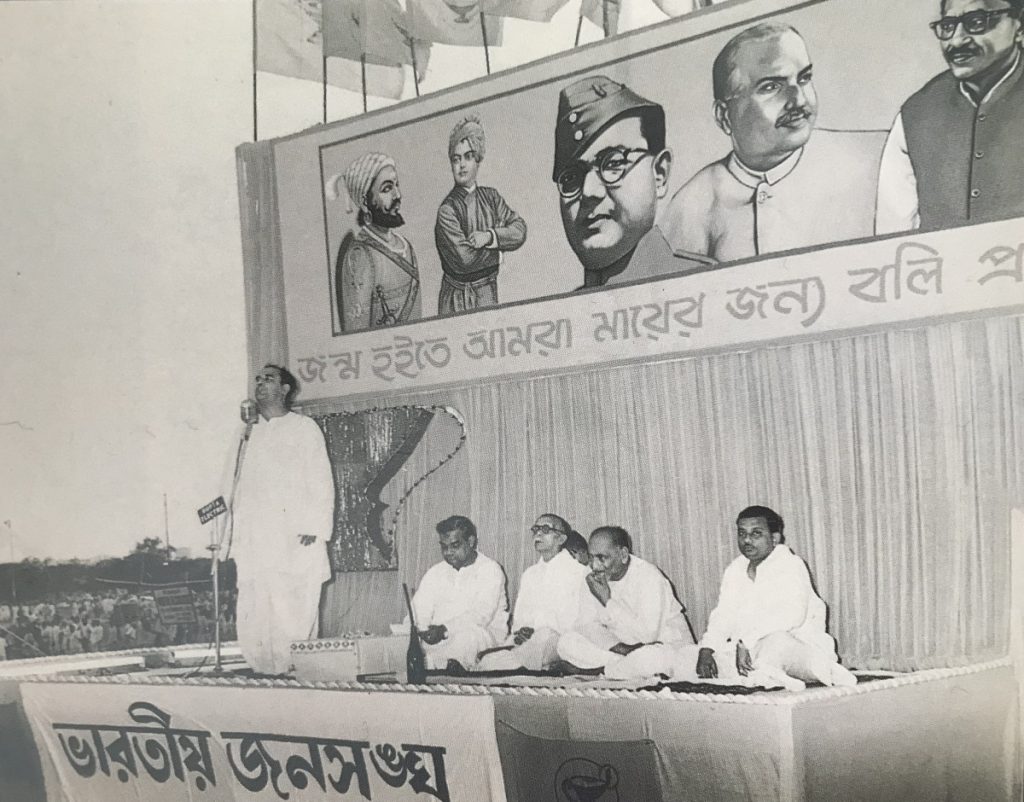
Vajpayee (sitting, left) at a 1971 party rally in Calcutta in support of Bangladesh’s independence. Photo: File.
Vajpayee became a fait accompli, without the RSS’s nod. The Sangh had the choice of remaining true to its pretence of being an uncompromising nationalist voice or of reconciling itself to becoming a cheer-leader, however reluctantly, for the Vajpayee regime. The Nagpur crew opted for the second role, and quickly became a party to all the compromises and concessions the BJP had to make in order to have the satisfaction of tasting national power. The RSS quietly caved in; but fortuitously, the Kargil conflict provided Nagpur an occasion to reaffirm its deshbhakti and rashtravad.
The RSS leadership was no match to Vajpayee’s realpolitik skills and cunning, and unprotestingly gave in to the prime minister’s demarche that senior pracharak Govindacharya be sent into exile. The Vajpayee regime, in fact, never gave the RSS commissars the time of day. And because the RSS acquiesced in Vajpayee and Advani’s electoral calculations, the Hindutva plank got devalued as an expedient jumla. Nagpur remained content with their own marginalisation within the Vajpayee regime. And for the ten years of UPA rule, the organisation was forced to play on the back foot.
Then began the era of ‘Hindu raj’ in 2014. Apart from enjoying a few crumbs of patronage, the RSS bosses found themselves having to play second fiddle to Modi’s personality cult as also having to bless the rampant corruption inherent in the organised crony capitalism that has become the Modi regime’s signature tune. A spiritual and moral barrenness now threatens to overwhelm the self-acclaimed custodians of our national renaissance. In its centenary year, the Sangh finds itself ensnared in the Modi project and mistakenly believes this entrapment is a great achievement and a matter of satisfaction. Clearly, Mohan Bhagwat and his colleagues are willingly walking into what is going to be the RSS’s fourth great defeat.
Harish Khare is a former editor-in-chief of The Tribune.
This piece was first published on The India Cable – a premium newsletter from The Wire – and has been updated and republished here. To subscribe to The India Cable, click here.
This article went live on October eleventh, two thousand twenty five, at thirty-nine minutes past eleven in the morning.The Wire is now on WhatsApp. Follow our channel for sharp analysis and opinions on the latest developments.


