

BJP Floats ‘Mother Tongue Day’ for Bengal, Opposition Sees Communalisation Plan


Kolkata: Facing charges from all its opponents in West Bengal for allegedly being anti-Bengali, the saffron camp has floated a new mother tongue day for West Bengal. It is to be observed on Sunday.
While campaigning for the event on Saturday, Bharatiya Janata Party (BJP)’s Bengal unit president Dilip Ghosh made a Facebook post that included a quotation from Syama Prasad Mookerjee, founder of the Bharatiya Jana Sangh (BJS), the ideological and organisational predecessor of the BJP, highlighting the importance of the mother tongue.
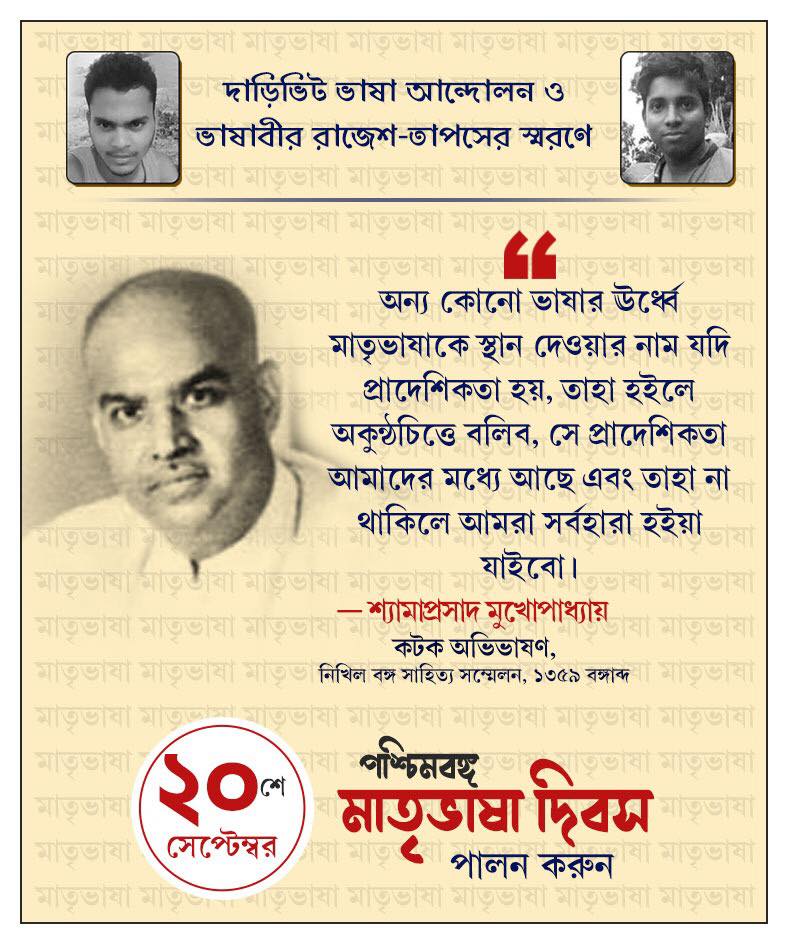
Bengal BJP president Dilip Ghosh shared this post carrying a quotation from Syama Prasad Mookerjee placing the mother tongue over every other language.
The post quoted Mookerjee as saying the following during his speech at the Nikhil Bharat Banga Sahitya Sammelan (all India Bengali literary conference) held in Cuttack in 1952, “If placing one’s mother tongue above any other language is called regionalism, then I would say unreservedly, we have that regionalism and without it, we will lose everything.”
The BJP’s Paschimbanga Matri Bhasha Dibas on September 20 is a novel concept in the state. The state usually celebrates the mother tongue on February 21, which is recognised by the UNESCO as international mother language day. The day has special sentimental significance to the Bengal-speaking people – because on February 21, 1952, four Bengali students fell to police bullets on the streets of Dhaka while opposing the imposition of Urdu to the Bengali-speaking people of the then East Pakistan.
The UNESCO adopted February 21 as international mother language day at the request of the government of Bangladesh in 1999. The four who died on February 21 – Rafiq Uddin Ahmed, Abul Barkat, Abdus Salam and Abdul Jabbar – are considered Bhasha Shahid or language martyrs across both parts of Bengal for decades.
Every February 21, events celebrating the heritage of Bengali is organised across West Bengal and the international border between Bangladesh and India at Petrapol is usually opened for language-lovers from both sides to gather at a place a few hundred meters inside the Bangladesh border to take part in the celebration.
Also read: As Bengal Elections Approach, Digital Media Fills Up with Propaganda Camouflaged as News
The BJP’s Paschimbanga Matri Bhasha Dibas is to observe the day when two members of the Akhil Bharatiya Vidyarthi Parishad (ABVP) died in firing on the campus of Darivit high school at Islampur in Uttar Dinajpur district of north Bengal in 2018. The ABVP is the student wing of Rashtriya Swayamsevak Sangh (RSS), which is also the parent organisation of the BJP.
ABVP members Rajesh Sarkar and Tapas Barman were ex-students of the school who went to the campus to join the current students in an agitation protesting the authorities move to appoint teachers in Urdu and Sanskrit when the students actually needed teachers in Bengali and science subjects.
The ABVP, the RSS, and the BJP had right from the beginning alleged that the two fell to bullets fired by the police, the police later arrested two local residents for opening fire during the agitation. However, the most intriguing part of the BJP, the RSS and the ABVP’s campaign was their narrative – they alleged the West Bengal government was trying to impose Urdu on the Bengali-speaking people.
“The BJP and the RSS gave a twist to a tale with a straight face. Every speech of the leaders of the saffron camp had two conspicuous aspects – there were no mentions that the students also sought teachers in science subjects and also got teachers in Sanskrit. They singled out Bengali and Urdu to create a narrative to suit their purpose of creating a communal divide,” said Anirban Banerjee of Jatiyo Bangla Sammelan, a Bengali rights group.
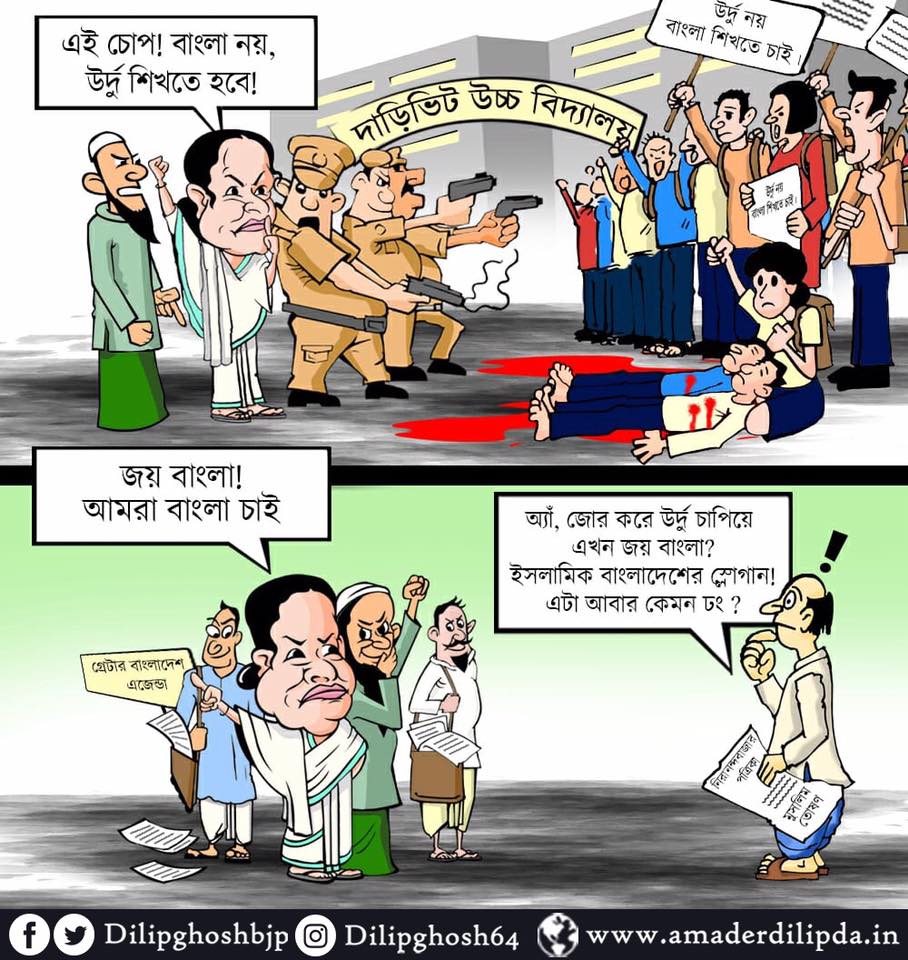
Dilip Ghosh shared this image from the Facebook page on Saturday. It apparently shows Mamata Banerjee telling students to learn Urdu.
Over the past week, there has been a social media campaign to build momentum for September 20. A series of social media posts were released from Facebook pages linked to the saffron camp, including Paschimbanger Jonyo, Bongo Brigade, Banglay Modi Jhor and Banglar Gorbo Narendra Modi, telling people things like ‘dua’ (prayer in Urdu) was better than ‘prarthona,’ ‘Nomoshkar was better than salaam’, and ‘Shrijukto was better than Janab’.
Paschimbanger Jonyo is an organisation floated in 2014 with Mohit Ray, a Hindutva ideologue who serves as the convenor of the Bengal BJP’s refugee cell. Paschimbanger Jonyo has demanded separating the Bengali spoken in India from the Bengali spoken in Bangladesh.
Hindu Samhati, another Hindutva organisation that claims to be independent of the RSS, has also called for celebrating Poschimbanga Matri Bhasha Dibas.
A senior BJP leader said that the Paschimbanga Matri Bhasha Dibos was first celebrated in 2019 but on a small scale while this year there has been a concerted effort to make the event a big one. On Saturday, Dilip Ghosh also posted from his Facebook page a graphic image showing the police opening fire at students for saying they would not allow the imposition of Urdu on Bengali.
However, the BJP’s opponents and political analysts saw in these the saffron camp’s attempt to create communal polarisation ahead of the 2021 Assembly elections.
Also read: Why Mamata Banerjee Is Backtracking From the Bengali Regionalist Stance
According to political analyst Biswanath Chakraborty, a professor of political science at Rabindra Bharati University (RBU), the BJP’s Poschimbanga Matri Bhasha Dibas had more to do with their attempt to create communal polarisation on religious lines than to do with any attempt to highlight the Bengali language.

A social media post from the page of Paschimbonger Jonyo showing a poster campaign on the occasion of Paschimbanga Matri Bhasha Dibas.
“They used the Darivit issue for communal polarisation not only in Raiganj Lok Sabha, of which Islampur is a part, but also across north Bengal. As they seemed to have reaped electoral benefits, they are clearly in no mood to let the issue die down, at least not before the 2021 Assembly elections.
Trinamool Congress spokesperson Om Prakash Mishra said the activities made the BJP’s ‘desperations loud and clear’. “The BJP is in constant lookout for issues it can issue to create fissures and division in the society. Often, it attempts to invent issues from the standpoint of widening social and cultural fault lines. However, we shall effectively meet the challenges of the BJP’s nefarious design in Bengal,” Mishra said.
“It’s a farce that the BJP is celebrating a mother tongue day for Bengali. They have never acknowledged the heritage of Bengali language. If they loved Bengali so much and if their MPs have guts, let them write to the Centre seeking Bengali’s recognition as a classical language,” said Congress Rajya Sabha MP Pradip Bhattacharya.
Bhattacharya added that the recognition that Bengali literature had gained worldwide is not due to the Bengali-speaking population spread across India and Bangladesh. “Their mother language day has less to celebrate the language and more to create communal divide. Bengali has enriched adopting words from Hindi, Urdu, English, and several other languages. They are all part of Bengali now,” he said.
Mohammad Salim, a politburo member of the Communist Party of India (Marxist) who represented Raiganj Lok Sabha between 2014 and 2019, the Darivit issue ‘is a got-up game between the TMC and the BJP’. He alleged that neither did the state police reveal if RSS men were behind the killings nor did the BJP take steps to fulfill their promise of getting an investigation by the CBI ordered to find out if the police opened fire.
“The BJP created a false narrative to create communal polarisation and that another election is approaching they are busy reviving the issue to create a communal divide,” Salim said.
Incidentally, Dilip Ghosh has been frequently accused of speaking Bengali with Hindi accent. Referring to that, Salim said, “On the one hand, they are happy to popularise a Hindi-influenced Bengali. On the other, they are telling the Rajbanshi people in north Bengal that they are not Bengalis. This is their plan to divide the Bengali speakers. If the BJP truly loved the Bengali language, why are they opposing the naming of Silchar station (in Assam) after the martyrs who died fighting for the rights of Bengali speakers?”
Eleven persons died while opposing the imposition of Assamese on the Bengali-speaking people of Silchar on May 19, 1961. That day, too, is observed in West Bengal, though at a minor scale compared to February 21.
Snigdhendu Bhattacharya is a Kolkata-based journalist and author.
This article went live on September twentieth, two thousand twenty, at zero minutes past seven in the morning.The Wire is now on WhatsApp. Follow our channel for sharp analysis and opinions on the latest developments.


